Developer Abandoned Your Project? What to Do in the First 48 Hours
When a developer vanishes mid-build, panicking or sending angry emails costs time. Follow this 48-hour recovery plan to secure credentials, retrieve databases, audit uncommitted code, and resume development safely.

Discovering that your freelance developer or outsourced agency has stopped responding mid-project is one of the most stressful experiences a founder or business operator can face. Milestone deadlines slip, customer launch commitments are jeopardized, and unanswered Slack messages or emails create immediate anxiety. The instinct for many non-technical founders is to send escalating messages demanding answers or threatening legal action. In software engineering, this reaction almost always backfires. It provokes complete communication shutdown or defensive hostility before you have secured the technical assets your business needs to survive.
Silence from a developer is an operational signal that requires clinical, structured execution. The immediate danger is rarely that the developer will delete your product out of malice; the genuine catastrophe is losing administrative control of your domain registrar, your cloud hosting accounts, or your production database while waiting for a reply. By executing a disciplined 48-hour recovery sequence, you can secure your infrastructure, establish the true state of the unfinished codebase, and transition the work to a verified replacement engineer without sacrificing your invested capital.
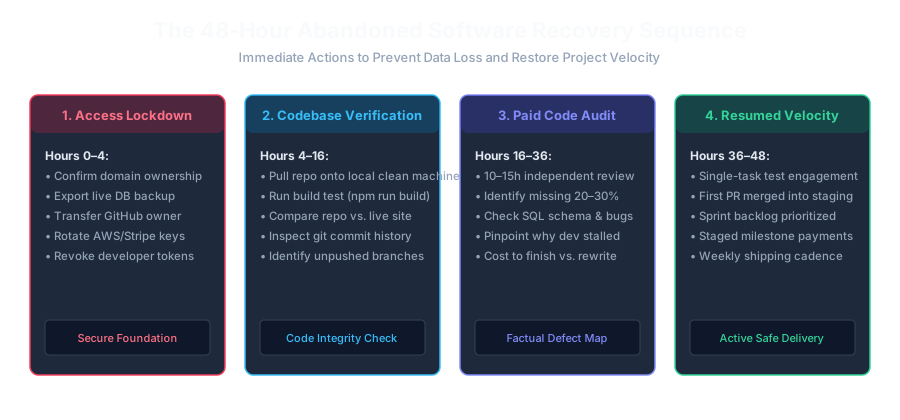
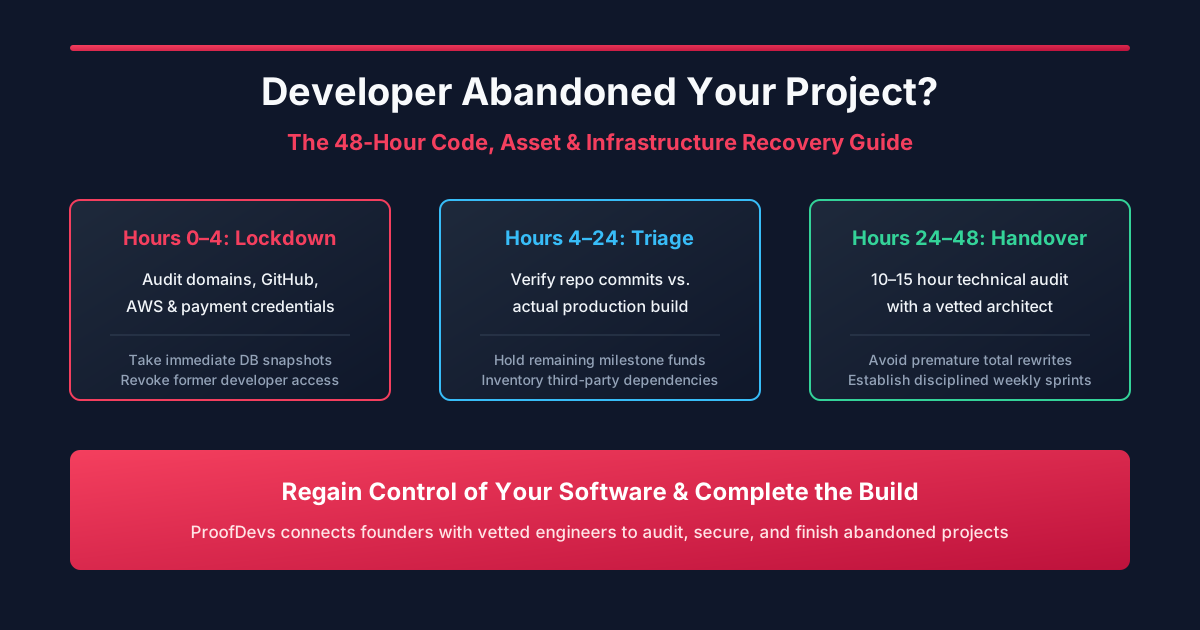
Hours 0 to 4: The Non-Hostile Access Lockdown Protocol
Before sending another follow-up message, assume that your previous contractor will not return. Your first four hours must be dedicated to securing digital ownership. Perform these steps quietly without alerting the developer. This is standard corporate hygiene, not hostile confrontation.
1. Domain Registrar and DNS Control
Your domain name is the most valuable commercial asset of your digital product. If an abandoned developer registered the domain in their personal Namecheap, GoDaddy, or Cloudflare account, recovering it after the fact can require months of trademark arbitration or ICANN disputes. Log into your registrar immediately:
- Confirm that the primary account email is an administrative inbox controlled by your company, not the contractor's personal address.
- Verify that the credit card on file for automated renewal belongs to your business.
- Enable two-factor authentication (2FA) using an authenticator app, and export backup recovery codes to an encrypted password manager.
2. Production Database Snapshots
Source code can always be rewritten or repaired; proprietary customer records, historical transactions, and uploaded files cannot. If you possess access to your database hosting provider—whether AWS RDS, Supabase, Neon, or a virtual private server—create an immediate manual database backup:
- Trigger a full database export (such as a
pg_dumpfor PostgreSQL or an automated point-in-time snapshot). - Download the backup file onto secure, company-controlled cloud storage.
- Do not rely on scheduled daily backups that reside inside an account you might lose access to tomorrow.
3. Source Code Repository Ownership
Navigate to GitHub, GitLab, or Bitbucket. Inspect the organization settings of the project repository. Many non-technical founders believe they own their code simply because they have an account on the repo, only to discover they were merely added as a "Collaborator" on the freelancer's personal profile:
- If the repository is hosted inside your company organization, immediately downgrade the former developer from "Owner" to "Read-only" or remove their collaborator seat.
- Clone the entire repository, including all remote git branches and commit histories, to a clean local development machine.
- If the code is hosted on their personal account, pull a local clone immediately before they change repository visibility to private.
4. Payment Gateways and Cloud Infrastructure API Keys
Log into your Stripe, PayPal, or payment processor account. Former developers should never maintain administrator-level credentials on payment platforms:
- Remove developer user accounts from team settings.
- Rotate API secret keys and webhook endpoints once you are prepared to redirect backend traffic.
- Check AWS, Vercel, or Google Cloud IAM policies and revoke active Personal Access Tokens (PATs) and SSH deployment keys.
| Asset Category | Critical Verification Check | Immediate Triage Action |
|---|---|---|
| Domain & DNS | Who owns the registrar account? | Update administrative email, add company card, enforce 2FA |
| Database & Data | Where do customer records live? | Execute manual point-in-time snapshot and download offsite |
| Git Repository | Is it an organization or personal account? | Clone all active branches locally; downgrade contractor access |
| Payment Gateways | Are contractor credentials still active? | Revoke team seats; inspect payout bank account details |
| Third-Party APIs | SendGrid, Twilio, OpenAI, Mapbox | Change master passwords and verify billing ownership |
For more specific scenarios involving missing contractors, review our detailed guide on what to do when a developer stopped responding.
Hours 4 to 16: Verifying the Integrity of What Was Left Behind
Once administrative ownership is secured, you must establish what actually exists. In an abandoned project, there is almost always a discrepancy between the polished live deployment you tested in your browser and the code sitting in the git repository.
The Local Build Test
A git repository that does not compile or run locally is an incomplete archive, not working software. Have an experienced full-stack engineer execute a basic compilation audit:
- Verify whether the repository contains a comprehensive environment template (such as an
.env.examplefile) documenting all necessary configuration flags. - Execute the standard packaging installation (e.g.,
npm installorpip install -r requirements.txt) to confirm third-party dependencies resolve without missing private packages. - Run the production build script (e.g.,
npm run build). If the build fails due to broken imports, missing TypeScript types, or syntax errors, the developer may have abandoned the project after a failed refactor.
The "Unpushed Code" Dilemma
It is common for freelancers to write code locally on their laptop, deploy it directly to a server via SFTP or manual command-line tooling, and forget to commit their changes to GitHub. Compare the live production application against the latest commit in your git log:
- If the live site contains features, styling, or API responses that do not appear in the repository code, there is unpushed code residing on the developer's physical machine.
- Recognizing this gap dictates your negotiation strategy: you must maintain a diplomatic posture until that uncommitted work is pushed to the central repository.
Why Developers Abandon Projects (and How It Informs Your Strategy)
Founders often assume that contractors vanish out of malicious intent or calculated fraud. In commercial reality, project abandonment is almost always caused by psychological avoidance driven by three common engineering dynamics:
1. The Underquoted Fixed-Price Trap
A freelancer quoted $4,000 for a complex feature that realistically required $12,000 of engineering effort. After spending 100 hours and exhausting the budget halfway through the build, every additional hour worked feels like working for free. Rather than renegotiating scope professionally, the contractor takes on new paying clients and puts your project at the bottom of their priority list, eventually ceasing communication out of shame.
2. The Unsolved Architectural Blocker
The developer encountered a technical wall they cannot overcome: a broken payment webhook cycle, an unsolvable database concurrency issue, or a complex third-party API integration error. Because they promised the client it was "almost done," admitting they do not know how to fix it feels impossible. Ghosting becomes their escape mechanism.
3. Scope Inflation and Burnout
The founder repeatedly introduced "small quick changes" without expanding the timeline or budget. The developer agreed verbally to maintain goodwill until the accumulated cognitive overload caused total disengagement.
Understanding these drivers gives you significant leverage. The developer usually wants to conclude the relationship just as much as you do; they simply need a clean, non-combative exit ramp.
Hours 16 to 24: The Final Settlement Offer (Converting Standoffs into Handover)
If you have outstanding milestone payments, that remaining capital is your primary bargaining chip. Sending threats of legal action against an offshore or freelance contractor rarely produces source code; it simply guarantees they block your email address and delete their working directory.
Instead, draft a concise, transactional de-escalation message that transforms an emotional conflict into an exit transaction:
"Hi [Name], we noticed communication has stalled over the past two weeks. We understand that project priorities shift and that this milestone may have encountered unexpected complexity. We have decided to transition the remaining feature backlog to a dedicated maintenance specialist. To close out our contract cleanly: please push all remaining local code to the repository branch, send over any missing environment variables, and provide a 10-minute Loom video walking through the current build. Once that repository update is verified, we will immediately release the remaining $[Amount] milestone balance and sign off on a mutual contract release."
Give an explicit deadline of 48 hours. This offers the contractor a face-saving resolution: they get paid their final balance, hand over the work without admitting defeat, and exit cleanly. In approximately 60% of cases, this single message secures the missing code.
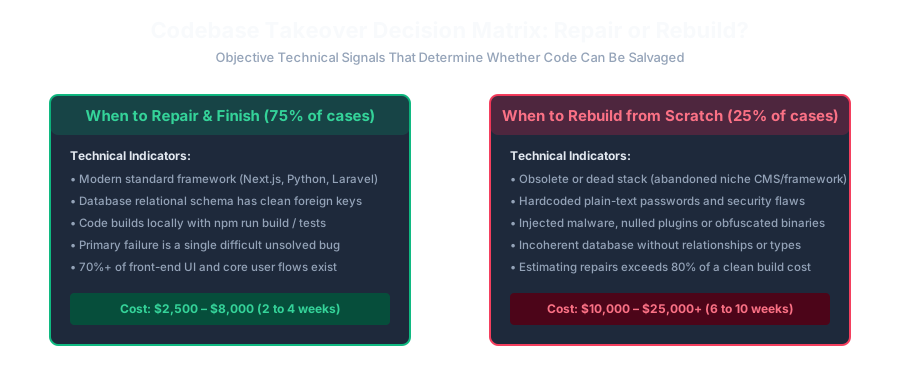
Hours 24 to 36: The 10-Hour Code Audit (Defending Against the Premature Rewrite)
The single most expensive mistake founders make when replacing an abandoned developer is immediately agreeing to rewrite the entire application from scratch. Almost every new developer who inherits an unfamiliar codebase will recommend a complete rewrite. Reading another engineer's undocumented, partially completed logic is tedious, frustrating, and mentally taxing; writing new code from a clean slate is comparatively enjoyable and billable.
Never authorize a complete rebuild before commissioning a bounded, paid technical audit from an independent senior engineer who has no financial incentive to pitch a rewrite.
Key Objectives of an Independent Code Audit
An audit typically requires 10 to 15 hours of senior engineering time and answers five concrete business questions:
- Framework Modernity: Is the application built on standard, supported technology (e.g., Next.js, Python FastAPI, PostgreSQL), or does it rely on deprecated niche libraries that cannot be maintained?
- Data Schema Health: Is the database structured with proper relational integrity, foreign keys, and indexing, or is it an unstructured mess of arbitrary tables?
- Completion Percentage: What percentage of the functional scope actually works? In most abandoned projects, 70% to 80% of the UI screens and standard CRUD operations are solid; only one or two specific features are broken.
- Security & Vulnerability Review: Are authentication tokens, database credentials, or payment secrets exposed in the frontend client bundles?
- The Repair-versus-Rebuild Cost Matrix: Will finishing the remaining 25% of the existing application cost $4,000, while a ground-up rebuild would cost $20,000 and delay launch by four months?
If your project is built around modern stacks or an MVP framework, consult our guide on building an MVP for a startup to benchmark what realistic completion timelines look like.
Hours 36 to 48: Structuring the Handover to a Replacement Engineer
When you are ready to engage a new developer, do not repeat the contractual and communication mistakes of the previous collaboration. Transitioning an abandoned codebase requires structured boundaries:
1. Begin with a Single-Task Paid Trial
Do not sign a multi-month contract on day one. Assign the replacement engineer a single, well-defined bug fix or small missing feature that can be completed within 5 to 10 hours. Observe how they interact with your repository, how clearly they document their pull requests, and whether they can explain their technical choices without engineering jargon.
2. Mandate Continuous Integration and Daily Commits
Require all development work to occur on feature branches with daily git pushes to your centralized company repository. Establish a hard rule: if code is not committed to GitHub at the end of the day, it does not exist. This eliminates the possibility of unpushed code being held hostage in the future.
3. Maintain Strict Administrative Separation
Give developers the access they need to write code, but never hand over master ownership of your cloud accounts. Use environment variable secret managers, grant restricted IAM developer roles, and keep domain registrations locked down under your executive email.
Founders seeking a smooth operational transition can explore our dedicated services for replacing a developer mid-project and codebase takeover execution.
Frequently Asked Questions
What is the very first thing I should do if my developer stops replying?
Secure your administrative credentials immediately. Log into your domain registrar, export a fresh backup of your production database, and clone your git repository locally before sending any confrontation messages.
Can I recover my project if the code is only on the developer's personal GitHub?
Yes, provided the code is deployed to a live server or staging environment. An experienced developer can connect to the hosting environment via SSH or container exports to reconstruct the production codebase and reverse-engineer the project.
Should I send the final milestone payment to get an abandoned developer to respond?
Never release funds before verifying delivery. Use the remaining balance as a formal settlement offer: promise in writing to release the payment within 24 hours of them pushing all uncommitted code and handing over missing environment variables.
How can I tell if my abandoned codebase should be repaired or completely rewritten?
Commission an independent 10-hour code audit. In approximately 75% of cases, the core application is salvageable and repairing the missing 20% is significantly cheaper than spending months rebuilding from scratch.
What legal options do I have if a freelance developer disappears with my money?
If the contractor is located internationally, cross-border litigation is usually cost-prohibitive. Your practical recourse is filing a formal dispute through the hiring platform (if applicable), requesting credit card chargebacks for unfulfilled services, or negotiating a handover settlement.
How long should I wait for a response before treating a project as abandoned?
Wait no longer than 48 to 72 hours of complete silence during an active sprint. You can perform all account security steps and database backups immediately without damaging the working relationship if they return with a valid explanation.
How much does it cost to have a new engineer audit and take over an abandoned codebase?
A professional takeover audit typically costs between $1,000 and $2,500 (10 to 20 hours of senior engineering time). Finishing the remaining scope usually ranges from $2,500 to $8,000 depending on the complexity of unresolved bugs.
Why do new developers always want to rewrite existing code?
Reading someone else's unfinished logic is mentally challenging and unglamorous, whereas building from scratch is creative and highly billable. An independent code audit protects you from this natural developer bias.
Can I take legal ownership of the code if the developer didn't sign an IP agreement?
Under most jurisdictions, the author holds default copyright unless assigned in writing. However, paid invoice records and written contract specifications establish implied commercial license rights. Consult an IP attorney for high-stakes enterprise IP.
How do I prevent my next developer from abandoning the project?
Implement daily git commit requirements, maintain centralized ownership of all hosting and third-party tools, break projects into weekly milestone payments, and test candidates with a small paid pilot task before expanding scope.
Rescue Your Software Project with Verified Senior Engineers
An abandoned development project is an operational setback, not the end of your startup. By methodically securing your digital assets, verifying the real condition of your codebase, and resisting the urge to prematurely scrap months of work, you can regain momentum and complete your product launch.
If your developer has disappeared or left your project unfinished, describe your project situation on ProofDevs. We review your codebase state and match you directly with vetted senior engineers who specialize in code audits, legacy takeovers, and completing stalled software builds.
Written by Michael Melnyk
Senior IT Technical Writer & Technology Analyst
Senior Technical Writer and IT Industry Analyst with over 7 years of experience analyzing software engineering ecosystems, tech leadership models, and developer procurement frameworks.