How to Build an MVP for a Startup: Steps, Costs, and Execution
Building a startup MVP succeeds by solving one painful problem for one customer profile on a strict 8-week timeline, avoiding agency markups and premature feature bloat.

Building a minimum viable product (MVP) is the most critical inflection point in the lifecycle of an early-stage startup. In commercial software engineering, an MVP is not a proof-of-concept, an interactive clickable prototype, or an unfinished version of an ambitious vision. An MVP is a functional software product built to test a specific commercial hypothesis: will real people change their existing habits, complete a core task, and exchange money or verifiable commitment for the solution you have assembled?
The primary reason startup MVPs fail is not technical inadequacy; it is scope inflation. Founders routinely spend six to nine months and burn tens of thousands of dollars engineering secondary settings, multi-tier user role permissions, onboarding tours, and complex edge cases before validating whether their primary value proposition solves a genuine problem. By contrasting traditional agency bloat with focused engineering execution, early-stage ventures can ship a dependable product in six to eight weeks while maintaining clean, maintainable code.
The Definition of a Production MVP
The term minimum viable product was originally coined to describe the smallest package of software required to trigger feedback from actual customers. Over the past decade, however, rising user expectations have shifted the benchmark. In 2026, software buyers will not tolerate products that suffer from database crashes, exposed security vulnerabilities, broken authentication redirects, or unresponsive interfaces, even in an initial release.
A production-ready MVP satisfies three explicit criteria:
- Singular Value Delivery: It executes one core job exceptionally well, eliminating non-essential workflows that do not directly influence the purchase or activation decision.
- Operational Integrity: It features dependable data storage, secure user authentication, reliable payment or webhook processing, and basic error alerting.
- Instrumented Feedback Loops: It collects behavioral telemetry (activation rates, workflow completion, drop-off points) rather than relying on polite verbal opinions.
When founders collaborate with vetted full-stack developers, the objective is to build clean, documented software that serves as a permanent foundation for subsequent iterations rather than disposable throwaway code.
Phase 1: Pre-Build Problem Validation and Demand Testing
Writing application code before validating customer demand is the most expensive mistake an early-stage company can make. Before drafting a technical specification or opening an IDE, founders must establish factual proof that a target demographic is actively seeking an alternative to their current tools.
Customer Discovery Interviews
Interview 15 to 20 individuals who fit your precise buyer persona. The objective of these conversations is not to pitch your solution—it is to dissect how they currently navigate the problem. Ask questions anchored in historical behavior:
- "How did you resolve this specific issue the last time it happened?"
- "How much budget, manual labor, or software cost did that process consume?"
- "What specific workarounds have you built in spreadsheets, manual workflows, or external tools to bypass existing software limitations?"
If an interviewee cannot describe a tangible financial, operational, or emotional cost associated with the problem, they will not purchase your MVP when it launches.
Smoke Testing and Pre-Orders
Customer commitment must be measured through behavior, not verbal encouragement. Before commissioning development, founders can validate intent through three low-cost mechanisms:
- The Concierge Workflow: Manually execute the underlying service behind the scenes for five to ten test clients. This exposes edge cases and data requirements that no theoretical product design can anticipate.
- The Paid Pre-Order Landing Page: Launch a concise explanation of the software with transparent pricing tiers, allowing users to join a paid early-access waitlist or place a refundable deposit via Stripe.
- Signed Letters of Intent (LOI): For B2B enterprise concepts, secure non-binding letters of intent specifying that if the product solves criteria X within timeframe Y at price Z, the company will initiate a paid pilot.
Phase 2: Scoping Discipline and the Single-Flow Principle
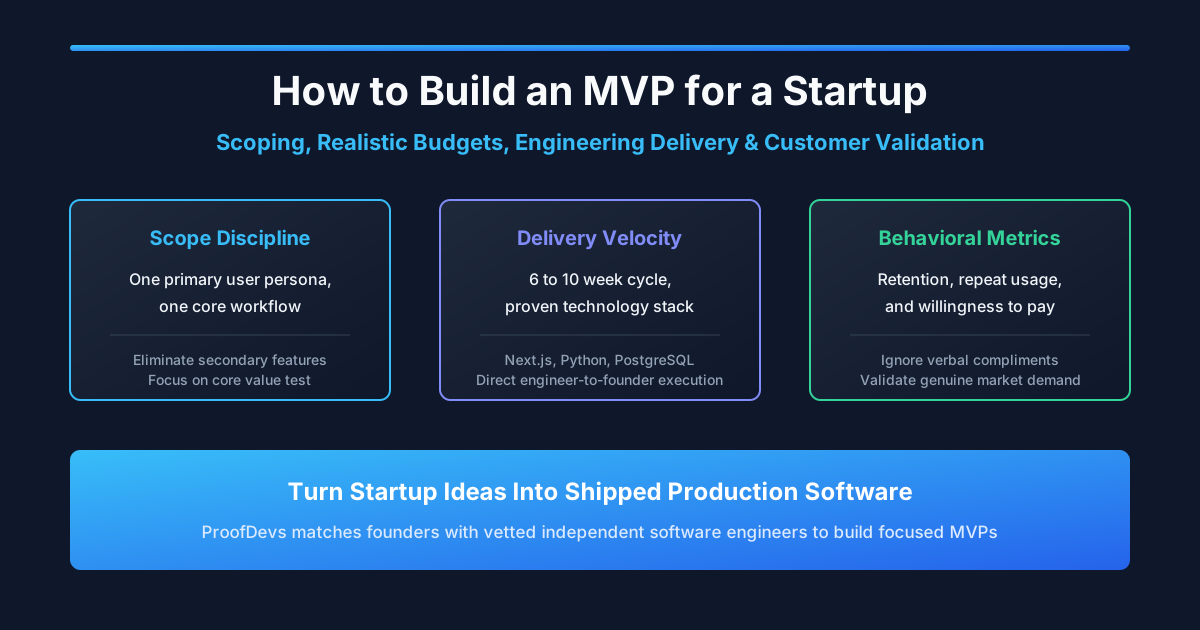
Once demand is confirmed, the greatest danger to your timeline is feature creep. The most effective scoping discipline is the Single-Flow Principle: design the product around a single persona completing a single end-to-end task.
| Product Component | Essential for Initial MVP | Defer to Phase 2 Post-Validation |
|---|---|---|
| User Authentication | Single provider (Magic links or Google OAuth) | SAML SSO, multi-factor auth, social logins |
| User Roles & Permissions | Flat model (Admin vs. Standard member) | Granular custom RBAC, department-level rules |
| Billing & Payments | Stripe Checkout pre-built hosted page | Custom in-app card forms, multi-currency invoicing |
| Notifications | Transactional emails (Resend or Postmark) | In-app notification centers, SMS, push alerts |
| Data Analytics | Event instrumentation (PostHog or Plausible) | Custom client dashboards, PDF report generation |
| Customer Support | Direct founder email or embedded chat widget | Automated ticketing systems, AI helpdesk bots |
If a proposed feature can be removed without breaking the customer's ability to achieve the primary outcome and complete payment, it belongs on the post-launch roadmap. Maintaining a ruthless cut-list protects your runway and forces your product to stand on its core value proposition.
Phase 3: Selecting a Pragmatic Technology Stack
Your MVP tech stack must optimize for developer velocity, extensive community libraries, and straightforward long-term maintainability. Choosing exotic programming languages, unproven databases, or over-engineered microservice architectures slows down delivery and makes hiring replacements prohibitively difficult.
The Modern Monolith Architecture
Early-stage startups should almost universally avoid microservices. A modular monolith hosted on a modern cloud platform provides rapid deployment, simplified automated testing, zero distributed network latency, and unified database transactions.
- Frontend & Application Framework: Next.js with React and TypeScript. It unifies server-side data fetching, API routing, and interactive frontend components within a single repository, dramatically accelerating iteration cycles.
- Backend & Compute: Node.js or Python (FastAPI). Python is particularly strategic if your product incorporates intelligent automation, machine learning APIs, or algorithmic data processing.
- Database Layer: PostgreSQL managed via Supabase or AWS RDS. PostgreSQL handles relational data, JSON documents, full-text search, and vector embeddings (via pgvector), eliminating the need to maintain separate database technologies.
- Styling & Interface: Tailwind CSS and headless component libraries (shadcn/ui or Radix). This enables rapid construction of accessible, responsive layouts without writing hundreds of custom CSS files.
- Infrastructure & CI/CD: Vercel or AWS, paired with GitHub Actions for automated linting, type-checking, and continuous staging deployments.
If your startup requires specialized capabilities such as retrieval-augmented generation (RAG) or AI agent integration, consider engaging a part-time senior AI engineer to architect the data pipeline while your core developers focus on product workflows.
Phase 4: The 8-Week Development Execution Roadmap
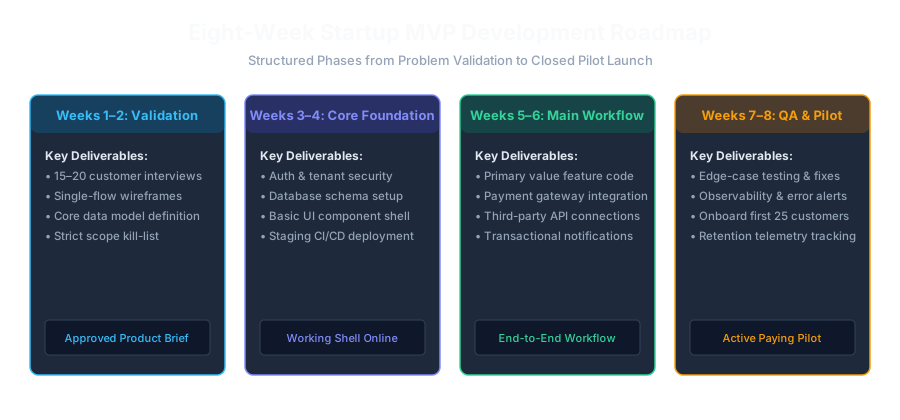
An eight-week engineering schedule provides sufficient time to build robust software while enforcing the urgency necessary to prevent scope expansion. Here is how a disciplined sprint cycle operates:
Weeks 1–2: Specification, Wireframing, and Data Architecture
The founder and lead engineer finalize the written product specification. Wireframes are constructed for the five to eight core application screens. The engineer drafts the initial PostgreSQL database schema, defining foreign key relationships, tenant indexing, and validation constraints. A non-technical founder should ensure that all third-party API keys (payment gateways, transactional email, data providers) are acquired and documented during this window.
Weeks 3–4: Core System Plumbing and Authentication
The developer configures the repository, CI/CD pipeline, and staging environment. User registration, authentication redirects, session management, and database migrations are implemented. By the end of Week 4, the founder should be able to log into the staging environment on their phone, create an account, and see a functional, styled application shell.
Weeks 5–6: Main Workflow Implementation and Integrations
This phase is dedicated entirely to the primary value driver. The developer builds the core feature logic, wires the external APIs, connects Stripe Checkout for billing, and implements transactional confirmation emails. By the end of Week 6, an end-to-end transaction must be executable in test mode: a user signs up, inputs real data, executes the primary task, and receives the expected output.
Weeks 7–8: Quality Assurance, Hardening, and Closed Pilot Launch
The application undergoes rigorous edge-case testing, cross-browser responsiveness checks, and security verification. Sentry error monitoring and PostHog analytics tracking are embedded to capture user actions and crash logs. During Week 8, the product is deployed to production, and the first 15 to 25 pre-registered beta users are onboarded personally by the founders.
Comparing Development Models and Realistic Cost Structures
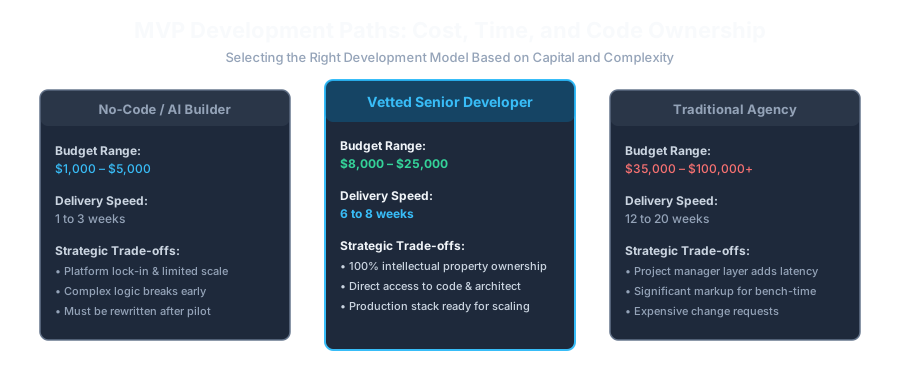
Founders frequently struggle to reconcile wildly divergent price quotes for MVP development. A project quoted at $3,000 on a generic bidding board might receive an $80,000 proposal from a traditional design agency. Understanding the trade-offs across execution models allows founders to make an informed decision.
| Development Model | Typical Budget Range | Delivery Timeline | Code Quality & Ownership | Major Risk Factor |
|---|---|---|---|---|
| No-Code Builders (Bubble, Lovable) | $1,500 – $5,000 | 2 to 4 weeks | Proprietary platform lock-in; non-exportable architecture | Scalability walls, expensive database tier upgrades |
| Vetted Independent Senior Developer | $8,000 – $25,000 | 6 to 8 weeks | 100% IP ownership; clean, modern open-source stack | Requires direct founder communication and clear priorities |
| Technical Co-Founder (Sweat Equity) | $0 cash + 20%–50% equity | 8 to 16 weeks | Internal ownership; full alignment with company mission | Lengthy search time; equity dilution before product validation |
| Traditional Software Agency | $35,000 – $100,000+ | 12 to 20 weeks | Professional delivery; variable maintainability post-handover | Heavy overhead markups for account managers and sales teams |
For early-stage startups that have raised a pre-seed round or are self-funding, partnering directly with an experienced independent engineer provides the ideal balance of velocity, financial prudence, and code ownership. If you are evaluating between hiring an executive versus a delivery contractor, read our detailed comparison on finding a technical co-founder vs hiring developers.
Phase 5: Launching to the First 25 Customers
A successful MVP launch is not a public relations spectacle on social media; it is a controlled, high-touch onboarding experience for a small cohort of targeted users. Broadcasting an unrefined MVP to thousands of indiscriminate visitors generates noisy feedback, distorts analytics, and burns early brand reputation.
The Concierge Onboarding Method
Invite your first 25 customers individually via email or scheduled video calls. Watch them navigate the software without offering verbal prompts or explanations. When they hesitate, click the wrong button, or misunderstand terminology, make immediate notes. These behavioral friction points reveal UX flaws that automated heatmaps will never explain.
Establishing a Direct Customer Feedback Channel
Embed an asynchronous feedback mechanism directly within the application, or create a private Slack or Discord channel for your initial pilot group. When users report bugs or workflow confusions, push fixes to production within 24 to 48 hours. Early adopters are remarkably forgiving of initial limitations if they observe that the engineering team listens and ships rapid improvements.
Measuring Validation: Behavioral Signals vs. Vanity Metrics
Many founders celebrate false positives: hundreds of newsletter signups, positive feedback on public forums, or congratulatory messages from acquaintances. None of these indicators represent commercial validation. True validation is measured exclusively through sacrificial commitment: time, operational reliance, and capital.
- User Retention Rate: Do customers return to use the product on Day 7, Day 14, and Day 30 without receiving marketing reminders? A product with 20 daily active users who rely on the software to perform their job is infinitely more validated than a platform with 5,000 one-time visitors.
- Workflow Completion Velocity: How quickly does a user transition from initial registration to completing the core value action? High drop-off rates during initial setup indicate that the perceived value does not outweigh the onboarding effort.
- Willingness to Transact: Do users convert to paid subscriptions, agree to invoice terms, or submit deposit payments when their trial period concludes? If users praise the product but refuse to pay when presented with a checkout screen, the MVP has not validated market viability.
If your early analytics demonstrate that retention is flat and users do not return, do not immediately write more code. Conduct exit interviews with churned users to establish whether the problem itself lacks urgency, or whether your implementation failed to deliver the promised solution.
Frequently Asked Questions
What is the minimum budget required to build a functional software MVP?
A focused, single-flow web application built by an experienced independent engineer typically costs between $8,000 and $25,000. No-code prototypes can be constructed for $1,500 to $5,000, while traditional development agencies routinely quote between $35,000 and $100,000 for equivalent scope.
How long should it take to build an MVP from scratch?
A well-scoped MVP should ship within six to ten weeks. If your development plan extends beyond three months, the feature scope is almost certainly bloated with secondary functionality that should be postponed until post-launch customer validation.
Should I build my startup MVP with no-code tools or custom code?
Use no-code tools (such as Bubble or Webflow) if your product is a simple directory, marketplace matchmaking board, or standard content portal. Choose custom code (Next.js, Python, PostgreSQL) if your product requires proprietary business logic, complex data transformations, high security, or scalable third-party API integrations.
How do I protect my intellectual property when hiring contract developers?
Ensure that all independent contractors sign a comprehensive Independent Contractor Agreement featuring explicit, immediate intellectual property assignment clauses before writing code. All source code repositories, cloud hosting accounts, and API service credentials must remain registered under your company's ownership.
What features should be excluded from an initial MVP?
Exclude custom reporting engines, granular role-based permissions, automated referral programs, dark mode toggles, native mobile apps (when a responsive web app suffices), and multi-currency payment options. Focus strictly on the primary problem-solving workflow.
Do I need a technical co-founder to build an MVP?
No. Many successful non-technical founders partner with vetted independent senior software developers or fractional technical leaders to build and validate their initial MVP before recruiting a full-time co-founder with equity.
How many features should an MVP have?
An MVP should have exactly one primary feature supported by the bare minimum administrative plumbing (authentication and billing) required to let a customer use it. Solve one problem completely before expanding scope.
When is an MVP considered successful?
An MVP is successful when a measurable cohort of target customers uses the product repeatedly to solve their problem, experiences clear retention over a 30-day period, and demonstrates verifiable willingness to pay for continued access.
What is the difference between a prototype and an MVP?
A prototype is an interactive visual model or mock-up used to visualize concept flows and demonstrate ideas to stakeholders without storing real data. An MVP is production-grade software that real users interact with to process real transactions, data, and workflows.
What should I do if our MVP fails to gain user traction?
Analyze user drop-off telemetry and conduct direct customer interviews with churned users. Determine whether the lack of traction is driven by flawed onboarding UX, poor target audience targeting, or absence of genuine market demand, and iterate or pivot before allocating capital to new features.
Build Your Startup MVP with Vetted Engineering Talent
Turning an entrepreneurial concept into validated, production-grade software requires decisive scoping, disciplined engineering, and transparent execution. By focusing on a single high-impact workflow and leveraging proven open-source technologies, founders can launch their product in weeks rather than months while conserving capital for customer acquisition.
If your startup is ready to design, build, or deploy an MVP, describe your project requirements on ProofDevs. We match founders directly with vetted independent software engineers who have proven commercial track records building and shipping scalable web applications.
Written by Michael Melnyk
Senior IT Technical Writer & Technology Analyst
Senior Technical Writer and IT Industry Analyst with over 7 years of experience analyzing software engineering ecosystems, tech leadership models, and developer procurement frameworks.