Hire a Developer to Build a Marketplace: Multi-Vendor Escrow, Concurrency & Real MVP Budgets
A commercial and engineering guide to hiring a senior full-stack developer for a two-sided marketplace. Covers Stripe Connect escrow workflows, concurrency locks to prevent overselling, and realistic milestone budgets ($45–$95/hr vs agency markups).
Building a two-sided marketplace is one of the most commercially ambitious and technically challenging undertakings in software development. Unlike a standard e-commerce store where a single business sells inventory to end consumers, a marketplace acts as an intermediary coordinating transactions between independent buyers and third-party vendors, service providers, or asset owners. Every transaction involves multi-party trust, asynchronous fulfillment, regulatory payment compliance, and split financial flows.
Founders frequently underestimate this structural leap. Treating a marketplace like a standard online store with extra user roles leads directly to architectural disaster: oversold inventory caused by race conditions, funds illegally held in unbonded accounts, brittle webhook integrations that lose track of seller payouts, and platform disintermediation where users bypass fees entirely. To succeed, founders do not simply need someone who can design a storefront; they must find an experienced developer to build a marketplace who understands multi-party fintech orchestration, database transaction isolation, and scalable trust mechanisms.
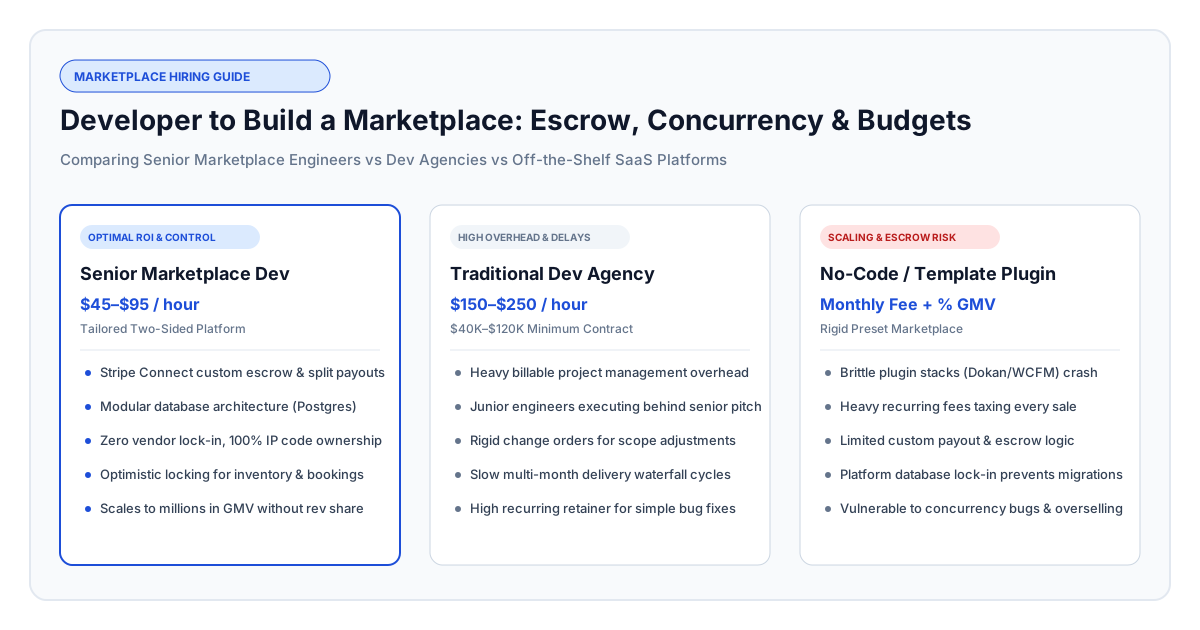
This guide provides a comprehensive executive roadmap for hiring a marketplace developer. It breaks down the four essential architectural layers of two-sided platforms, compares custom development against off-the-shelf and no-code solutions, outlines transparent hourly cost benchmarks ($45–$95/hr independent senior engineers versus $150–$250/hr traditional agencies), and provides an actionable technical vetting rubric with a practical trial task.
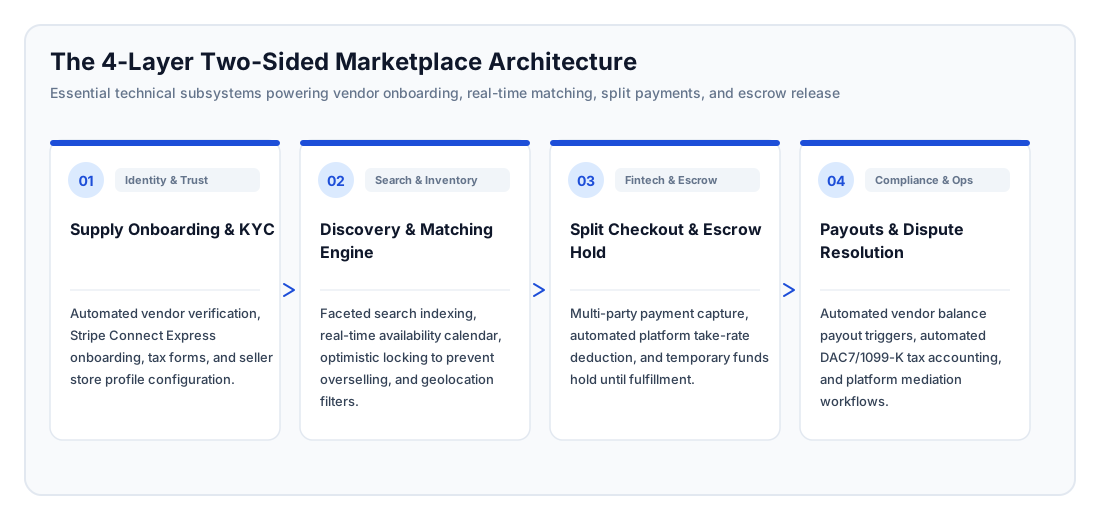
The 4-Layer Two-Sided Marketplace Architecture
A resilient marketplace relies on four distinct architectural layers functioning in total synchronization. When interviewing candidates, founders should evaluate whether the developer designs systems around these foundational requirements or merely writes surface-level user interfaces.
1. Supply Onboarding, Verification, and Identity (KYC/KYB)
In a marketplace, your supply side represents your brand reputation. If seller onboarding is friction-heavy, vendors abandon the platform; if onboarding is sloppy, fraudsters flood your catalog with counterfeit goods or phantom services. A senior marketplace developer designs automated onboarding pipelines that verify vendor identities through automated Know Your Customer (KYC) and Know Your Business (KYB) workflows via payment infrastructure partners such as Stripe Identity or Persona.
Beyond basic identity, this layer handles bank account verification, tax identification collection (such as W-9 forms in the United States or VAT numbers in Europe), automated merchant risk tiering, and granular permission systems that separate seller staff accounts from primary financial payouts.
2. Discovery, Matching Engine, and Real-Time Concurrency
Marketplace search is fundamentally multi-dimensional. Buyers rarely search for a simple SKU; they search based on geographical radius, delivery timeframes, calendar availability, seller ratings, and faceted specifications. Senior engineers implement fast, indexed search engines (using PostgreSQL full-text search, pgvector, or dedicated engines like Typesense or Algolia) capable of querying complex relational filters in under 50 milliseconds.
Critically, this layer must enforce strict database transaction isolation. When two buyers attempt to book the same rental apartment or purchase the last remaining handmade collectible simultaneously, ordinary database queries result in race conditions and double-selling. A qualified marketplace developer implements row-level locking and optimistic concurrency controls to guarantee that inventory or booking slots are reserved atomically during checkout.
3. Split Payments, Escrow Holding, and Fee Automation
The financial engine is the most legally sensitive component of any marketplace. When a customer pays $500 for an order containing items from two separate vendors, that money cannot simply land in the marketplace's corporate bank account to be manually disbursed later. Doing so classifies your platform as an unlicensed money transmitter under financial regulations (such as FinCEN rules in the US and PSD2 in the European Union), exposing the company to severe regulatory fines.
An experienced engineer architectures programmatic split payment flows using dedicated platform payment infrastructure like Stripe Connect, Adyen for Platforms, or PayPal Complete Payments. The system programmatically splits the customer's payment at the gateway level: deducting the platform's commission fee (take-rate), routing taxes to automated escrow accounts, and placing seller balances on temporary delivery holds until verification conditions are satisfied.
4. Fulfillment Verification, Automated Payouts, and Dispute Mediation
Payment capture is only half the transaction lifecycle. Funds must remain held in escrow transit until clear fulfillment criteria are met: a delivery carrier webhook reporting package delivery, an IoT door lock confirming check-in, or a buyer confirming service completion. The developer must architect reliable, idempotent background job queues that process delivery webhooks and trigger automated payout releases to seller bank accounts.
Furthermore, this layer manages edge cases: partial order cancellations, carrier damage claims, customer disputes, and chargeback allocations. If a buyer initiates a credit card chargeback, the architecture must automatically determine whether the loss is absorbed by the platform reserve or debited against the responsible vendor's connected balance.
The Build vs Buy Spectrum: Custom Code vs No-Code SaaS vs WordPress Plugins
Before hiring an engineer, founders must choose an architectural foundation. The marketplace software market spans three primary approaches: off-the-shelf WordPress multi-vendor plugins, no-code/turnkey SaaS builders, and custom full-stack web applications. Selecting the wrong foundation creates technical ceilings that cost tens of thousands of dollars to dismantle.
| Evaluation Dimension | WordPress Multi-Vendor (Dokan/WCFM) | Turnkey No-Code SaaS (Sharetribe/Bubble) | Custom Full-Stack (Next.js + Postgres) |
|---|---|---|---|
| Time to Market | 2–4 weeks | 2–6 weeks | 6–12 weeks |
| Initial Setup Cost | $1,500 – $4,000 | $2,000 – $6,000 + subscription | $7,000 – $19,500 |
| Scalability & Concurrency | Poor (database bottlenecks at ~50 concurrent carts) | Moderate (platform capacity limits and API caps) | Enterprise-grade (handles thousands of concurrent checkouts) |
| Payment & Escrow Flexibility | Rigid (restricted to plugin-supported gateways) | Constrained (preset payment workflows) | Infinite (custom multi-party splits, milestone payouts, Net-30) |
| Long-Term Operating Costs | High maintenance & constant plugin breakages | High (monthly SaaS fees + 1% to 2% GMV transaction tax) | Low (standard cloud hosting at $40–$150/mo) |
| IP & Data Ownership | Self-hosted but tied to legacy monolithic architecture | Zero database control; captive to SaaS roadmap | 100% intellectual property and database ownership |
Why WordPress Multi-Vendor Plugins Fail at Scale
Many non-technical founders begin by hiring a junior freelancer to install WordPress with WooCommerce and a multi-vendor plugin like Dokan or WCFM. While this stack provides a superficial marketplace interface in weeks for under $3,000, it inevitably collapses under real commercial load.
WordPress stores catalog data, order items, vendor attributes, and metadata inside a generic entity-attribute-value database schema (wp_posts and wp_postmeta). When dozens of vendors manage inventory while hundreds of buyers execute complex faceted searches, database queries require dozens of table joins across millions of rows. Response times degrade from milliseconds to several seconds. Worse, multi-vendor plugins lack robust transaction isolation, resulting in ghost bookings and untracked webhook drops during traffic spikes.
The Hidden Costs of Turnkey No-Code SaaS
Platforms like Sharetribe or custom Bubble templates provide an attractive starting point for non-technical validation. They allow non-programmers to assemble basic listing and booking workflows without coding. However, turnkey SaaS solutions introduce severe operational ceilings:
- Transaction Revenue Penalties: Turnkey marketplace SaaS providers frequently levy a percentage tax on your gross merchandise value (GMV)—often 1% to 2% on top of standard credit card processing fees. For a marketplace processing $150,000 monthly, this represents an unnecessary $1,500 to $3,000 monthly operational penalty.
- Workflow Rigidity: If your marketplace business model requires unique commercial mechanics—such as milestone-based contractor payouts, multi-warehouse shipping calculations, reverse bidding auctions, or custom B2B Net-30 invoicing—no-code platforms hit insurmountable feature walls.
- Platform Hostage Risk: You do not own the underlying application codebase. If the SaaS provider changes its pricing tiers, suffers regional outages, or deprecates key features, your entire business infrastructure is held hostage without an automated migration path.
The Custom Full-Stack Standard
For founders committed to building a scalable, defensible commercial asset, a custom full-stack web application is the standard model. Utilizing modern technologies—such as a Next.js or React frontend paired with a Node.js, Python, or Go backend and a relational PostgreSQL database—provides unrestricted architectural control. The platform achieves sub-second page loads, zero platform transaction rev-shares, robust relational data modeling, and complete intellectual property ownership that adds tangible valuation to startup fundraising and exit negotiations.
The Fintech Engine: Split Payments, Escrow, and Regulatory Compliance
When you operate a marketplace, you are running a fintech workflow alongside an e-commerce catalog. Founders must ensure that their hired developer is thoroughly versed in payment orchestration mechanics, legal fund segregation, and tax reporting requirements.
Stripe Connect Architecture: Standard vs Express vs Custom
The global benchmark for marketplace payments is Stripe Connect. It solves the legal hurdle of receiving buyer funds and distributing seller payouts across multiple jurisdictions. However, candidates must know which account architecture fits your commercial model:
- Connect Standard: Vendors create and manage their own standalone Stripe dashboards. The marketplace connects to them via OAuth. While easiest to implement and shifting chargeback liability entirely to sellers, the user experience is disjointed because vendors are redirected away from your platform during onboarding. Suitable for developer-centric or technical vendor ecosystems.
- Connect Express: Provides a co-branded, streamlined onboarding workflow hosted by Stripe while embedding account management and payout reporting directly within your marketplace UI. Stripe handles identity verification, localized bank account validation, and tax compliance, while your marketplace controls the brand touchpoints. This is the recommended sweet spot for 85% of modern consumer and service marketplaces.
- Connect Custom: The marketplace maintains 100% white-label control over every pixel of the seller interface. The vendor never sees Stripe branding. However, this model requires the marketplace to build custom verification UIs, assume full legal responsibility for fraudulent seller chargebacks, and manage localized compliance audits directly. Suitable only for mature enterprises with dedicated compliance teams.
Fintech Compliance Warning: Under no circumstances should a developer architect a marketplace where customer payments accumulate in the platform's primary bank account with manual weekly payouts via PayPal, Venmo, or manual wire transfers. Without formal Money Transmitter Licensing, holding unbonded third-party funds violates financial regulations, triggers immediate merchant account freezes, and subjects company directors to personal civil liability.
Marketplace Facilitator Sales Tax and Annual Reporting
In most US states and international jurisdictions, Marketplace Facilitator legislation legally mandates that the marketplace—not the individual seller—is responsible for calculating, collecting, and remitting sales taxes on third-party transactions. A senior marketplace developer integrates automated tax calculation engines (such as Stripe Tax or Avalara) directly into the checkout pipeline, ensuring accurate tax jurisdiction calculations based on seller nexus and buyer shipping coordinates.
Additionally, platforms operating in the United States must automatically generate Form 1099-K filings for sellers exceeding annual transaction thresholds, while European operators must comply with DAC7 reporting rules. An experienced engineer configures these reporting webhooks from day one, preventing hundreds of hours of manual accounting audits at year-end.
Disintermediation and Platform Leakage Prevention
Platform leakage occurs when buyers and sellers discover each other on your marketplace and subsequently conduct repeat transactions offline to avoid platform commission fees. While leakage is partially a business incentives challenge, a skilled developer implements technical safeguards to protect your take-rate:
- Masked In-App Communication: Real-time messaging systems that programmatically filter phone numbers, email addresses, external payment links, and off-platform URLs until an order deposit is confirmed.
- Escrow Value Incentives: Automated payment holding mechanisms where buyers receive protection guarantees and sellers receive automated invoice factoring or instant payout access only when transactions settle on-platform.
- Frictionless In-App Transactions: Making the on-platform payment experience so effortless—via Apple Pay, Google Pay, and saved cards—that taking transactions offline represents more inconvenience and risk than paying the marketplace fee.
Budget Planning, Hourly Rates & Real-World Cost Benchmarks
Founders planning a marketplace build face a stark commercial divide: hiring a traditional software agency or engaging a dedicated senior freelance engineer. Understanding the cost realities of each model prevents budget depletion before product launch.
| Commercial Factor | Dedicated Senior Marketplace Engineer | Traditional Digital Development Agency |
|---|---|---|
| Hourly Rate Benchmark | $45 – $95 / hour | $150 – $250 / hour |
| Team Composition | 1 Senior Full-Stack Engineer (Direct Contact) | Project Manager, Account Exec, Lead Architect, Junior Devs |
| Typical MVP Development Hours | 135 – 205 productive engineering hours | 350 – 600 total billable hours (including overhead) |
| Total Project Cost to MVP | $6,075 – $19,475 | $52,500 – $150,000 |
| Communication Latency | Direct Slack/GitHub interaction (instant alignment) | Layered through account managers and weekly status calls |
| Post-Launch Agility | Flexible hourly maintenance or fractional retainers | Rigid monthly retainers ($5,000–$15,000/mo minimums) |
Milestone-by-Milestone Development Budget Breakdown
A production-ready two-sided marketplace MVP requires approximately 135 to 205 hours of focused engineering when built by an experienced senior developer. Below is a realistic milestone-by-milestone allocation breakdown:
| Milestone Scope | Key Technical Deliverables | Estimated Hours | Budget ($45–$95/hr) |
|---|---|---|---|
| 1. Architecture & Schema Design | PostgreSQL relational schema, role-based authentication (Buyer/Seller/Admin), security policies, and environment setup. | 20 – 30 hrs | $900 – $2,850 |
| 2. Vendor Onboarding & Stripe Connect | Stripe Connect Express onboarding pipeline, seller dashboard, bank account verification webhooks, and payout status tracking. | 25 – 35 hrs | $1,125 – $3,325 |
| 3. Catalog, Search & Concurrency | Faceted listing filters, real-time availability calendar, image CDN optimization, and optimistic row-locking for checkout. | 30 – 45 hrs | $1,350 – $4,275 |
| 4. Checkout, Split Fees & Escrow | Multi-party cart checkout, platform application fee capture, automated escrow hold logic, and delivery confirmation webhooks. | 25 – 40 hrs | $1,125 – $3,800 |
| 5. Admin Dashboard & Resolution | Platform administration panel, dispute mediation tools, refund processing, seller suspension controls, and masked messaging. | 20 – 30 hrs | $900 – $2,850 |
| 6. Testing, Security & Deployment | End-to-end webhook failure reconciliation, payment idempotency tests, SSL/headers hardening, and production cloud launch. | 15 – 25 hrs | $675 – $2,375 |
| Total Project Investment | Complete, Tested Production Two-Sided Marketplace MVP | 135 – 205 hrs | $6,075 – $19,475 |
Working directly with an independent senior engineer avoids the massive non-coding billable overhead of traditional agencies. You invest 100% of your capital into working software, production database schemas, and clean, tested business logic.
Real-World Marketplace Case Studies
Reviewing how experienced engineers overcome structural marketplace challenges in the field illustrates the difference between amateur coding and senior platform architecture.
Case Study 1: B2B Heavy Machinery Rental Marketplace
The Challenge: A European commercial equipment rental platform operated on a customized WordPress multi-vendor installation. During busy morning rental windows, multiple contractors frequently submitted booking requests for the same excavator or boom lift at identical job sites. The database failed to isolate concurrent requests, resulting in double-bookings, angry contractors on active job sites, and a staggering 14% reservation dispute rate.
The Architectural Solution: A senior full-stack engineer rebuilt the platform on a Next.js and PostgreSQL foundation. The engineer implemented PostgreSQL transactional row-level locks on equipment availability dates during the checkout reservation window. When a contractor opens a checkout session, the equipment is placed in a temporary 10-minute hold state backed by Redis TTL keys. Furthermore, the payment workflow was migrated to Stripe Connect with two-step authorization holds, charging the contractor only after the rental depot confirms asset preparation.
The Business Outcome: The reservation dispute rate collapsed from 14% to 0.4%. Platform rental volume scaled by 310% over six months without a single duplicate reservation, while page load times across mobile job-site devices dropped from 4.8 seconds to 850 milliseconds.
Case Study 2: Peer-to-Peer Authenticated Collectibles Marketplace
The Challenge: An emerging marketplace for high-end vintage watches faced high customer hesitation due to counterfeit risks. Buyers refused to purchase items if payments went directly to individual sellers, while sellers refused to ship luxury goods without verified payment guarantees.
The Architectural Solution: The developer engineered a custom three-stage escrow pipeline. When a buyer checks out, payment is captured into a segregated Stripe escrow hold. The seller receives an automated prepaid shipping label directed to a verified third-party authentication laboratory. Upon physical inspection and laboratory sign-off, an inspection webhook is fired to the marketplace backend, which programmatically dispatches the authenticated item to the buyer and releases the net payout balance to the seller's connected bank account.
The Business Outcome: Buyer conversion rates increased by 44% immediately upon launch of the verified escrow guarantee. Chargeback loss rates fell to 0.02%, and average order value (AOV) increased from $320 to $1,850 as customers gained trust in the platform's automated protections.
Case Study 3: On-Demand Home Services Marketplace
The Challenge: A regional home maintenance platform suffered severe disintermediation. Homeowners and contractors frequently used the platform to discover each other, negotiated direct cash deals, and bypassed the platform's 15% booking commission. The platform was losing an estimated $18,000 monthly in commission leakage.
The Architectural Solution: A hired senior developer introduced three technical counter-measures. First, an in-app masked messaging system was built that automatically obfuscates external phone numbers, email addresses, and payment handles prior to booking deposit confirmation. Second, the developer implemented instant payouts for service providers via Stripe Instant Payouts, giving contractors immediate access to earnings upon job completion rather than waiting for bi-weekly bank settlements. Third, an automated warranty escrow was created: customers booking on-platform received automated $1,000 property damage coverage backed by the platform reserve.
The Business Outcome: Platform leakage decreased by 62% within 60 days. Service providers willingly encouraged clients to pay through the platform to receive instant fee-free bank payouts and automated liability coverage, restoring healthy unit economics.
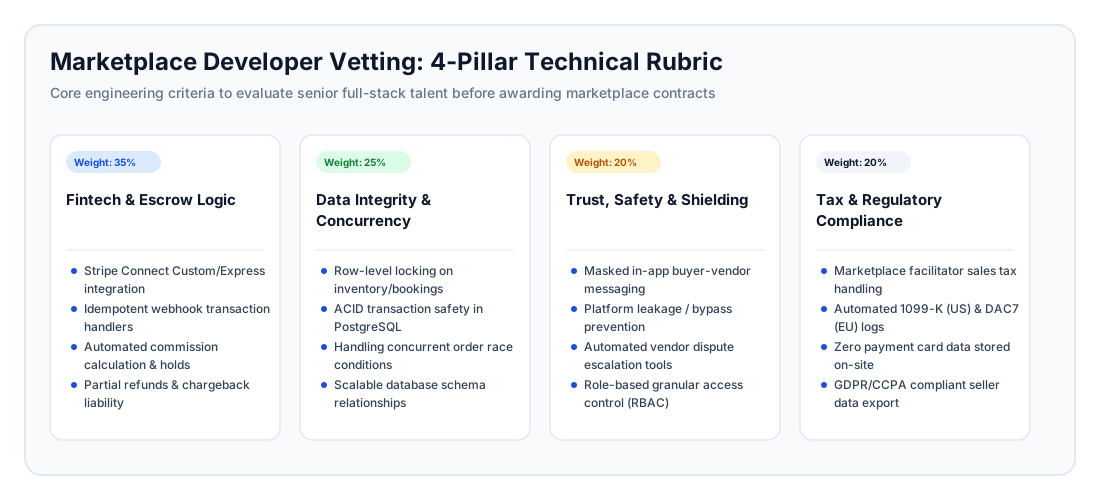
How to Screen and Vet a Senior Marketplace Developer
Interviewing marketplace developers requires assessing system architecture, transactional integrity, and edge-case handling. General web developers can easily demonstrate impressive portfolio websites, but fall apart when questioned on multi-party financial flows.
7 In-Depth Technical Screening Questions
1. How do you handle webhook failures when Stripe confirms a payment but our application database goes down?
Candidate Red Flag: "We just rely on Stripe to send the email receipt, or we re-query the payment when the user logs back in."
Senior Engineer Benchmark: "Payment webhook handlers must be strictly idempotent. Every webhook event contains an immutable event ID that we record in an event log table within a transactional database boundary. If our database is temporarily unavailable during an event delivery, Stripe automatically retries with exponential backoff over 72 hours. When our service recovers, the webhook processes once, records the event ID, and safely ignores duplicate delivery attempts. Additionally, we run a scheduled hourly reconciliation job querying Stripe's Events API to detect and heal any orphaned transactions."
2. How do you prevent two customers from booking the same calendar slot or purchasing the same single-quantity item at the same second?
Candidate Red Flag: "I write an IF statement checking if the status is 'available' before creating the order."
Senior Engineer Benchmark: "An application-level IF statement fails under concurrent load because two requests can read 'available' simultaneously before either writes the update. In PostgreSQL, we prevent this using transactional row-level locks (SELECT FOR UPDATE) or optimistic concurrency control using a version column with atomic conditional updates. During checkout initiation, we lock the row or acquire a short-lived Redis distributed lock with a 10-minute TTL, decrement availability atomically, and roll back the reservation if payment fails."
3. Which Stripe Connect account type would you recommend for our sellers, and why?
Candidate Red Flag: "Just use standard Stripe accounts for everyone; it's the simplest."
Senior Engineer Benchmark: "For almost all consumer or service marketplaces, Connect Express is the optimal choice. It gives the platform control over the seller onboarding flow while offloading KYC/KYB identity verification, international bank compliance, and tax document generation to Stripe's co-branded UI. Standard Connect redirects sellers completely away and creates separate Stripe relationships, while Custom Connect forces us to build white-label identity verification UIs from scratch and absorb 100% of the chargeback liability."
4. How should the database schema model multi-vendor orders where a single buyer checkout contains items from three different sellers?
Candidate Red Flag: "We put a seller_id column directly on the main orders table."
Senior Engineer Benchmark: "A single checkout must be modeled using a parent-child relational architecture. We have a parent `checkouts` or `payment_intents` record representing the single customer payment and aggregate transaction fee. Underneath, we create separate `vendor_orders` or `sub_orders` for each vendor, each containing its own order line items, fulfillment tracking status, shipping costs, and independent Stripe transfer ID. This ensures that if Vendor A ships immediately but Vendor B is delayed or canceled, the system manages fulfillment, partial refunds, and payout releases independently."
5. How do you handle refunds when the platform has already transferred the payout to the vendor's bank account?
Candidate Red Flag: "We just refund the customer's credit card and ask the vendor to send the money back."
Senior Engineer Benchmark: "Stripe Connect allows you to issue a refund with the `reverse_transfer` parameter set to true. If the vendor's connected account has sufficient funds, Stripe pulls the funds back from the connected account balance. If the vendor's balance is zero, the connected balance becomes negative, and Stripe debits the funds against their linked bank account or subsequent platform sales. Our platform terms must explicitly establish that chargebacks and seller refunds are debited against connected balances, and we configure rolling payout delays (e.g., 7 days post-delivery) to minimize negative balance exposure."
6. What mechanisms do you use to prevent platform leakage and keep users transacting on-platform?
Candidate Red Flag: "We can make users agree to terms of service promising not to share phone numbers."
Senior Engineer Benchmark: "Legal terms alone are insufficient. We implement technical friction and positive commercial incentives. On the technical side, in-app messaging routes through real-time regex sanitization that flags and masks phone patterns, email strings, and external payment keywords until a paid deposit is recorded. On the incentive side, we provide instant payouts to sellers upon on-platform completion, automated dispute protection, and insurance backing that applies exclusively to transactions settled through our payment pipeline."
7. How do you test marketplace payment logic without charging real credit cards?
Candidate Red Flag: "I just test it in production with $1 charges on my personal card."
Senior Engineer Benchmark: "We build a comprehensive test suite utilizing Stripe's test mode and webhooks CLI. Stripe provides test card numbers that simulate every scenario: successful 3D Secure challenges, insufficient funds, expired cards, and fraudulent declines. We use Stripe Test Clocks to advance time programmatically, simulating delayed payouts, subscription billing cycles, and dispute lifecycles. Furthermore, we test webhook handling using local tunneling with the Stripe CLI to verify that our handlers process events idempotently before deploying any code to staging."
A Practical 3–5 Hour Vetting Trial Task
Never hire a developer based on conversational interviews alone. Before committing to a full marketplace contract, assign a paid, practical 3 to 5-hour trial task that evaluates real marketplace engineering capability.
The Trial Assignment: "Build a standalone micro-service or route handler that simulates a two-vendor checkout split using Stripe Connect in test mode. The endpoint must take a mock order with two separate vendors, calculate a 12% platform application fee, generate a split payment intent with separate transfers, simulate a successful payment webhook, and handle an edge case where one vendor cancels their item, triggering a partial refund with automated transfer reversal."
Evaluation Grading Rubric
- Pass Criteria:
- Calculates platform take-rate accurately down to the cent without floating-point rounding errors (uses integer cents).
- Implements proper webhook signature verification to prevent spoofed requests.
- Demonstrates idempotent webhook processing (recording event IDs to prevent duplicate actions).
- Correctly reverses transfers for the canceled vendor without touching the fulfilled vendor's payout.
- Clean, modular, well-documented code with clear architectural rationale.
- Fail Criteria:
- Hardcodes secret API keys directly in source code rather than environment variables.
- Uses floating-point mathematics for currency calculations (e.g.,
$19.99 * 0.12yielding imprecise decimals). - Fails to verify incoming webhook signatures.
- Crashes on partial refund edge cases or leaves orphaned balances.
Frequently Asked Questions
How much does it cost to hire a developer to build a two-sided marketplace?
Hiring an independent senior full-stack developer to build a custom marketplace MVP costs between $6,000 and $19,500, based on 135 to 205 engineering hours at transparent market rates of $45 to $95 per hour. In contrast, traditional software agencies typically charge between $50,000 and $150,000 for identical deliverables due to non-coding billable overhead including project managers, account executives, and agency markups.
How long does it take a senior developer to build a marketplace MVP?
A production-ready marketplace MVP typically takes between 6 and 12 weeks of focused development. This timeframe covers database schema design, vendor identity onboarding, Stripe Connect integration, faceted catalog search, real-time availability calendar locking, split fee checkout, automated escrow release webhooks, and administrative moderation dashboards.
Should I build my marketplace with custom code or use a no-code tool like Sharetribe or Bubble?
Turnkey no-code platforms like Sharetribe or Bubble are appropriate for rapid prototype validation (first 2–4 weeks) if your business model fits strictly within their standard listing templates. However, for defensible businesses scaling past initial validation, custom code (Next.js, Node.js, PostgreSQL) is superior. Custom development eliminates the 1% to 2% GMV transaction tax levied by SaaS platforms, removes feature ceilings on custom escrow and B2B workflows, and ensures 100% intellectual property ownership of your core database and software asset.
What is the difference between Stripe Connect Standard, Express, and Custom?
Stripe Connect Standard redirects sellers to Stripe's standalone website for account creation and dashboard access, making it disjointed for consumer marketplaces. Connect Express is the industry benchmark for two-sided platforms, offering co-branded, streamlined onboarding hosted by Stripe while embedding balance management and payout metrics inside your application. Connect Custom gives you 100% white-label control over the seller UI, but forces your company to build identity verification from scratch and assume 100% liability for seller fraud and chargebacks.
Why do WordPress multi-vendor plugins (like Dokan or WCFM) fail when marketplaces grow?
WordPress multi-vendor plugins store products, vendor profiles, and orders inside generic post and postmeta database tables that require dozens of complex table joins for simple catalog searches. When multiple vendors update inventory while concurrent buyers execute faceted searches, response times degrade from milliseconds to several seconds. Furthermore, WordPress lacks native database row-level locking, frequently causing race conditions, oversold inventory, and ghost bookings during peak checkout traffic.
How do marketplaces prevent buyers and sellers from taking transactions offline (disintermediation)?
Marketplaces combat leakage using a combination of technical filters and commercial incentives. Technically, platforms implement in-app messaging filters that automatically mask phone numbers, emails, and payment handles prior to confirmed deposits. Commercially, platforms incentivize on-platform checkout by providing automated escrow dispute protection, instant payouts to sellers via Stripe Instant Payouts, and built-in property or transaction liability insurance that applies exclusively to on-platform payments.
Is my marketplace legally allowed to hold customer funds before paying sellers?
No, holding third-party customer funds directly in your corporate bank account classifies your marketplace as an unlicensed money transmitter under financial regulations (such as FinCEN in the US and PSD2 in Europe), which carries severe civil and criminal penalties. Marketplaces must use licensed payment infrastructure like Stripe Connect or Adyen for Platforms. These gateways process split payments through regulated financial escrow transit accounts, holding and disbursing funds programmatically without your business ever touching unbonded third-party capital.
What database is best for a two-sided marketplace platform?
PostgreSQL is the undisputed industry standard for two-sided marketplaces. Marketplaces rely heavily on complex relational integrity—connecting buyers, sellers, parent orders, sub-orders, inventory items, reviews, and transaction payouts. PostgreSQL provides ACID transaction compliance, robust row-level locking (SELECT FOR UPDATE) to prevent concurrency race conditions, and native support for full-text and geospatial search extensions (PostGIS) required for location-based seller discovery.
What happens if a buyer requests a refund after the vendor has already withdrawn their payout?
When issuing a refund on Stripe Connect with transfer reversal enabled, Stripe pulls the funds back from the vendor's connected account balance. If the vendor has already withdrawn the payout and their balance is zero, the connected account balance becomes negative, and Stripe automatically debits the funds against their linked bank account or subsequent platform sales. To minimize negative balance exposure, senior developers configure rolling payout delays (such as 7 days post-delivery) so that funds are released only after the standard dispute window closes.
How do marketplace facilitator sales tax laws affect custom marketplace development?
Under Marketplace Facilitator legislation across the US and Europe, the platform—rather than individual third-party vendors—is legally obligated to calculate, collect, and remit sales tax. Your developer must integrate automated sales tax APIs (such as Stripe Tax or Avalara) directly into the checkout pipeline, calculating precise state, county, and local tax rates dynamically based on the buyer's shipping address and the seller's nexus status.
How do you test marketplace payments and split payouts before going live?
Senior engineers test marketplace payment flows using Stripe's comprehensive test environment. Stripe provides specialized test card numbers that simulate successful transactions, 3D Secure identity challenges, card declines, and fraudulent disputes. Developers utilize Stripe Test Clocks to simulate the passage of time—testing payout releases, subscription renewals, and dispute windows programmatically—alongside the Stripe CLI to verify that incoming webhook handlers process events reliably and idempotently.
What code and IP ownership rights should I require when hiring a marketplace developer?
Your contract must explicitly stipulate a "Work Made for Hire" agreement with 100% intellectual property assignment upon invoice settlement. All application source code, database migration scripts, architectural documentation, and cloud infrastructure deployment configurations must reside directly within your company's private GitHub or GitLab repositories and cloud accounts (AWS, GCP, or Supabase), ensuring complete independence and zero developer lock-in.
Written by ProofDevs
Senior Technical Writer and IT Industry Analyst with over 7 years of experience analyzing software engineering ecosystems, tech leadership models, and developer procurement frameworks.