Hire a Developer to Build an LMS: Architecture, Development Costs & Vetting Guide
Off-the-shelf course SaaS tools charge high transaction taxes and restrict enterprise B2B licensing, while WordPress plugins buckle under concurrent exam loads. Here is how to hire a developer to build a custom LMS, structure your video and data architecture, and budget realistically.

Current as of October 2026. Building a custom Learning Management System (LMS) gives education businesses, corporate training departments, and edtech startups 100% intellectual property ownership, zero per-seat SaaS subscription taxes, and complete control over the learning experience. Hiring an independent senior full-stack developer to build a custom LMS costs between $45 and $95 per hour (or $7,200 to $15,200 per month on a dedicated engagement). In contrast, specialized software agencies charge $150 to $250 per hour with substantial account management markup, while off-the-shelf platforms such as Kajabi or Teachable siphon away 5% to 10% in platform fees plus ascending tier costs as your student roster grows.
A learning management system is substantially more complex than a standard content site. It combines adaptive video streaming pipelines, digital rights management, atomic student progress state machines, concurrent quiz evaluation, payment and subscription webhooks, and multi-tenant B2B corporate licensing. If you need a verified senior developer capable of architecting this infrastructure from requirement scoping to production deployment, browse our vetted full-stack developers matched directly to your technical requirements.
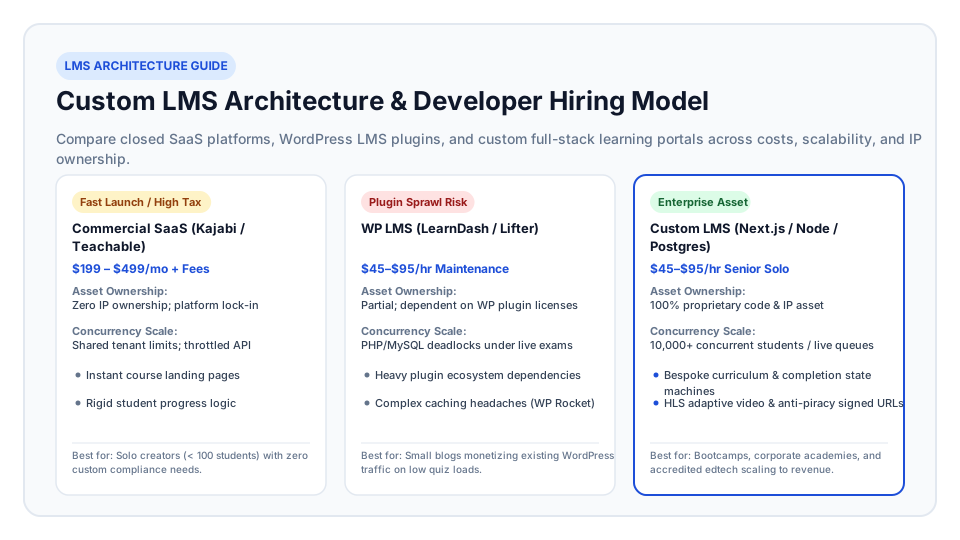
Figure 1: Evaluating build models across commercial course SaaS, WordPress LMS plugins, and custom full-stack learning platforms on ownership, scalability, and lifecycle costs.
Commercial SaaS vs. WordPress LMS Plugins vs. Custom LMS: The Architectural Decision
Before hiring an engineer, educational founders must determine whether a custom build is commercially justified. Commercial course platforms (such as Kajabi, Thinkific, or Teachable) enable fast launches for solo creators selling video tutorials to consumer audiences. However, once an educational company reaches 500 active learners or sells corporate training packages, the economics and technical limitations of hosted platforms shift dramatically:
- The SaaS Platform Tax: Hosted platforms charge steep monthly subscriptions alongside transaction surcharges on digital sales. More critically, they trap your customer data, learning analytics, and video assets inside proprietary silos, making customized business workflows impossible.
- WordPress Plugin Sprawl (LearnDash & LifterLMS): Many founders attempt to build an LMS on WordPress using plugins. While initial setup is inexpensive, WordPress relies on relational post-meta tables that degrade severely under concurrent loads. When 200 students attempt a timed exam or mark lessons complete simultaneously, PHP worker limits and MySQL row deadlocks frequently crash the entire site.
- The Custom Full-Stack LMS: A custom application built with modern frontend frameworks (React or Next.js) and a decoupled backend (Node.js or Python) backed by PostgreSQL provides sub-second page transitions, automated video encryption, zero per-user licensing fees, and bespoke B2B group-seat management.
The following comparison summarizes how each approach balances operational costs, intellectual property ownership, and technical flexibility over a multi-year horizon:
| Evaluation Dimension | Hosted Course SaaS (Kajabi / Teachable) | WordPress LMS Plugins (LearnDash) | Custom Full-Stack LMS |
|---|---|---|---|
| Ongoing Monthly Platform Cost | $199 – $499/mo + payment processing surcharges | $150 – $350/mo (managed WP hosting + premium plugin licenses) | $50 – $220/mo (cloud hosting via Supabase/Vercel/AWS + video CDN usage) |
| Intellectual Property & Code Ownership | Zero ownership; locked inside proprietary hosted cloud | Partial; dependent on third-party WordPress plugin vendors | 100% proprietary code ownership; verifiable balance sheet software asset |
| Concurrent Student Capacity | Throttled by platform rate limits and shared server resources | Low (frequent MySQL database locks during live cohort exams) | High (10,000+ concurrent students via decoupled stateless APIs and Redis caching) |
| Custom Learning Workflows | Rigid linear courses; limited conditional branching | Moderate; requires chained plugins that trigger version conflicts | Unlimited (interactive code runtimes, branching simulations, multi-role grading) |
| B2B Enterprise Portal Capabilities | Basic or unavailable; enterprise plans require custom contracts | Rudimentary group plugins with fragile permission boundaries | Native multi-tenant organizations with manager dashboards and SAML SSO |
| Video Protection & Anti-Piracy | Standard web player; susceptible to browser extension ripping | Basic Vimeo/Wistia embeds with visible direct video URLs | Encrypted HLS streaming with signed token authentication and dynamic watermarks |
The 5 Core Technical Layers of a Custom LMS Architecture
A production-ready learning management system requires clean decoupling between marketing discovery, video delivery, student progress tracking, financial transactions, and background task processing. An experienced senior engineer structures the platform across five distinct architectural layers:

Figure 2: The five decoupled architectural layers that ensure high reliability, fast video delivery, and secure student progress tracking in a custom LMS.
1. Course Catalog, Landing Pages & Edge Delivery
Marketing discovery pages and syllabus overviews demand rapid server-side rendering (SSR) for search engine indexing. Using Next.js or React with server components allows course landing pages to achieve sub-1.5 second Largest Contentful Paint (LCP) scores. Inside the authenticated student portal, client-side routing delivers instantaneous transitions between lessons without full page refreshes, keeping learners engaged.
2. Adaptive Video Streaming & Asset Protection
Video content is the primary commercial asset of most training businesses. Inexperienced developers often make the catastrophic mistake of uploading raw MP4 files directly to an Amazon S3 bucket. Raw MP4 files permit public downloading, saturate server bandwidth, and buffer constantly on mobile networks.
A senior full-stack engineer implements HTTP Live Streaming (HLS) using dedicated video infrastructure such as Mux, Cloudflare Stream, or AWS Elemental MediaConvert with CloudFront. HLS dynamically adjusts video bitrate to match the student's connection speed, while signed URL cookies and canvas-rendered dynamic watermarks (displaying the student's email and IP address) discourage screen recording and unauthorized distribution.
3. Curriculum Progress State Machine & Database Integrity
Tracking course completion is fundamentally an event-driven state machine, not a simple true/false checkbox. The platform must enforce strict prerequisites: a student cannot access Module 3 until they have passed the Quiz in Module 2 with a score exceeding 80%, nor can they claim a completion certificate while mandatory lessons remain unviewed.
In a relational PostgreSQL schema, lesson completions, quiz attempts, and cohort milestones are governed by database constraints and ACID transactions. This prevents students from manipulating client-side state in browser developer tools to artificially bypass progression rules.
4. Checkout, Team Billing & Webhook Reliability
Educational commerce involves diverse monetisation models: one-off course purchases, monthly recurring subscriptions, and multi-seat corporate packages. Senior developers integrate payment engines such as Stripe Billing using idempotent webhook listeners with automatic retry queues. When a corporate client purchases 20 employee seats, the system automatically creates an organization record, provisions administrative manager roles, and generates individual invite tokens without manual intervention.
5. Asynchronous Background Jobs & Analytics Telemetry
Resource-heavy operations—such as generating high-resolution PDF certificates, encoding user-submitted video assignments, and dispatching weekly learner activity summaries—must never block the primary HTTP request thread. A robust LMS delegates these tasks to background worker queues powered by Redis and BullMQ, guaranteeing snappy response times across the student portal.
Realistic LMS Development Timelines and Cost Estimates
When budgeting for a custom LMS, founders must distinguish between an initial Minimum Viable Product (MVP) designed to validate curriculum sales and an enterprise-grade corporate platform with multi-tenant licensing and compliance auditing. Below is a realistic breakdown of developer hours and investment requirements based on transparent senior hourly rates ($45–$95/hr) compared to agency pricing ($150–$250/hr):
| LMS Development Phase & Deliverables | Estimated Developer Hours | Independent Senior Engineer ($45–$95/hr) | Traditional Software Agency ($150–$250/hr) |
|---|---|---|---|
| Phase 1: Architecture, Data Schema & Authentication PostgreSQL database design, role-based access control (Admin, Instructor, Student), NextAuth / Supabase Auth integration, session management. |
45 – 70 hrs | $2,025 – $6,650 | $6,750 – $17,500 |
| Phase 2: Course Builder & Video Pipeline Drag-and-drop syllabus hierarchy (Course -> Module -> Lesson), Mux/Cloudflare Stream video upload with HLS transcoding, resource file attachments. |
60 – 95 hrs | $2,700 – $9,025 | $9,000 – $23,750 |
| Phase 3: Interactive Learner Experience & State Engine Responsive lesson player, state machine tracking progress and prerequisites, rich-text markdown notes, interactive quizzes with auto-grading. |
55 – 85 hrs | $2,475 – $8,075 | $8,250 – $21,250 |
| Phase 4: Checkout, Subscriptions & Webhook Handlers Stripe Checkout integration, subscription lifecycle management, coupon codes, automated invoice generation, webhook idempotency. |
35 – 55 hrs | $1,575 – $5,225 | $5,250 – $13,750 |
| Phase 5: Automated Certificates & Student Dashboard Dynamic PDF certificate generation with verification QR codes, learner progress charts, downloadable course transcripts. |
30 – 45 hrs | $1,350 – $4,275 | $4,500 – $11,250 |
| Phase 6 (Optional): Enterprise B2B Multi-Tenancy Corporate client portals, bulk seat purchasing, manager progress tracking, department-level CSV analytics exports, SAML / Okta SSO. |
50 – 80 hrs | $2,250 – $7,600 | $7,500 – $20,000 |
| Total Scope (Core Production MVP: Phases 1–5) | 225 – 350 hrs | $10,125 – $33,250 | $33,750 – $87,500 |
Working with an independent senior engineer delivers the exact same production-grade architecture as an agency for roughly 30% to 40% of the total financial outlay. Because there are no sales commissions, account managers, or junior developer onboarding cycles, 100% of your budget pays directly for architectural decisions and working code.
Real-World Case Studies: When Custom LMS Engineering Pays Off
The following case studies illustrate how real educational companies solved performance bottlenecks, reduced operating overhead, and opened enterprise revenue channels by transitioning to a custom LMS architecture.
Case Study 1: Medical Certification Academy Slashes Video Piracy and Server Costs
A European medical training academy offering high-stakes surgical exam prep hosted their curriculum on a popular WordPress LMS plugin with Vimeo embeds. Students were sharing credentials across hospital departments, and unencrypted video links were being scraped and distributed on private forums. During peak revision weeks before board exams, 400 concurrent students taking practice tests caused the WordPress database to freeze, resulting in lost student test submissions and flood of support refund requests.
The academy hired an independent senior full-stack developer to replace the setup with a custom Next.js and Node.js portal backed by PostgreSQL. The engineer migrated video hosting to Cloudflare Stream with signed playback tokens and integrated dynamic forensic watermarking displaying the logged-in doctor's medical license number across the screen. Quiz submissions were refactored into atomic database transactions with Redis session locks. Server hosting costs dropped from $680/month to $115/month, credential sharing ceased immediately, and exam submission errors fell to zero across 3,500 enrolled candidates.
Case Study 2: Cybersecurity Training Firm Unlocks Enterprise B2B Contracts
A cybersecurity training firm was selling individual course seats via a hosted SaaS platform ($399/month tier). While consumer sales were steady, the company was repeatedly rejected by enterprise banking clients who required centralized team billing, custom employee progress dashboards, and automated compliance audit reporting. The SaaS platform could not support sub-organizations or custom data export formats.
By engaging a senior full-stack developer on a part-time arrangement (20 hours per week for 10 weeks), the company built a proprietary multi-tenant B2B portal. Corporate clients could purchase bulk seat licenses, assign employees to department managers, track completion metrics in real time, and export verified compliance logs. Within six months of launching the custom platform, the firm closed four enterprise bank contracts generating over $180,000 in annual recurring revenue—business they could never have accepted on a standard consumer SaaS platform.
Vetting Framework: Candidate Signals and Practical Evaluation Rubric
Hiring for an LMS project requires screening for architectural rigor. Educational platforms present unique concurrency and streaming challenges that generalist frontend coders frequently underestimate. Use the following rubric to distinguish between inexperienced candidates and senior full-stack engineers who build reliable production systems:
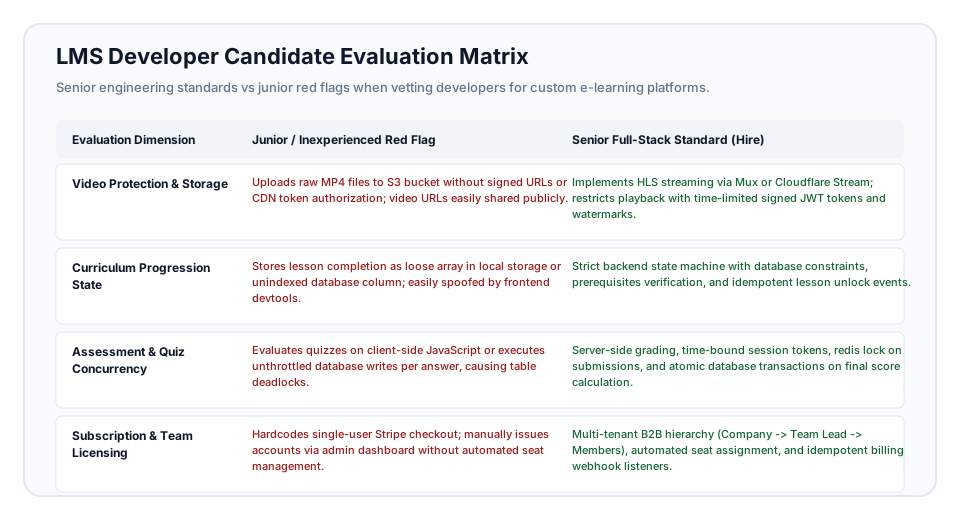
Figure 3: Practical evaluation matrix for screening LMS developer candidates across video streaming, state machines, concurrency, and team licensing.
7 Technical Interview Questions for LMS Developer Candidates
Ask these targeted technical questions during your screening interview to evaluate how candidates handle complex e-learning constraints:
- Video Pipeline Architecture: "How would you architect video delivery to prevent students from sharing direct video download URLs, while ensuring reliable playback on fluctuating mobile connections?"
Senior Answer: The candidate should explain HLS (HTTP Live Streaming) adaptive bitrate encoding using a service like Mux or Cloudflare Stream, combined with short-lived signed URL tokens or cookies generated by the backend API upon verified session authentication. - State Machine & Progression Locks: "How do you guarantee in the database that a student cannot mark lesson 5 complete or download a certificate before completing lesson 4, even if they manipulate API payloads?"
Senior Answer: The candidate should describe a server-side state machine backed by relational foreign keys and database constraints, verifying prerequisites inside an atomic transaction before writing completion timestamps. - Handling Quiz Concurrency Spikes: "If 500 students in a cohort submit a 50-question timed exam in the same 60-second window, how do you prevent database deadlocks and slow response times?"
Senior Answer: The candidate should discuss caching active test sessions in Redis, processing answer submissions through asynchronous worker queues (such as BullMQ), and writing final scores to PostgreSQL atomically rather than executing 50 unindexed SQL updates per user. - Idempotent Payment Webhooks: "What happens if Stripe sends the invoice.payment_succeeded webhook three times in two minutes due to network jitter? How do you prevent duplicate course enrollments or credits?"
Senior Answer: The candidate should explain webhook signature verification, storing processed event IDs in an idempotency table, and wrapping enrollment provisioning in a database transaction that exits early if the transaction ID already exists. - Multi-Tenant B2B Organization Hierarchy: "How would you structure the database schema to support individual students alongside corporate accounts where a company manager can invite 50 team members and track their individual progress?"
Senior Answer: The candidate should outline a clean relational hierarchy (Organization -> Team -> User Roles), utilizing role-based access control (RBAC) middleware to isolate organizational data while sharing the underlying course catalog. - Automated PDF Certificate Generation: "Generating high-resolution printable certificates can consume heavy CPU cycles. Where and how should certificates be compiled?"
Senior Answer: The candidate should advocate offloading certificate rendering (via headless Chromium or serverless Puppeteer workers) to background job queues, saving the resulting PDF to cloud storage, and storing a verifiable public verification hash in the database. - SCORM / xAPI Compatibility: "If a corporate client requires integrating existing third-party interactive training modules, how would you approach SCORM or xAPI (Experience API) support?"
Senior Answer: The candidate should describe setting up an xAPI Learning Record Store (LRS) endpoint to capture statement actors, verbs, and objects, allowing external packaged courses to communicate progress events back to the primary LMS.
The 3–5 Hour Practical Trial Task
Never rely solely on resume claims or verbal interviews. Before signing a long-term contract, commission a paid 3–5 hour practical trial that tests real-world architectural thinking. Provide the candidate with a mini-specification:
Trial Brief: "Build a lightweight course lesson progression endpoint and viewer component. The backend must enforce that Lesson B cannot be unlocked until Lesson A is marked complete. When Lesson B is completed, trigger an idempotent mock webhook that records course completion and generates a signed mock certificate token. Include automated integration tests verifying that bypassing the prerequisite API call returns an HTTP 403 Forbidden."
Pass / Fail Evaluation Criteria:
- Pass Signal: The candidate models progression rules in the backend with clean validation; writes integration tests covering both happy and forbidden paths; structures database queries with indexes; and delivers clear setup documentation within 4 hours.
- Fail Signal: The candidate validates progression only on the frontend client; leaves API endpoints open to sequence manipulation; hardcodes credentials without environment variables; or fails to deliver automated test coverage.
Frequently Asked Questions (Answer-First)
How much does it cost to hire a developer to build a custom LMS?
Building a custom production-ready LMS costs $10,125 to $33,250 when hiring an independent senior full-stack developer ($45–$95/hr across 225–350 engineering hours). Engaging a traditional software development agency for the same functional scope costs $33,750 to $87,500 ($150–$250/hr) due to project management overhead and sales margins.
How long does it take to build a custom Learning Management System from scratch?
A production-ready custom LMS MVP takes 8 to 12 weeks of development effort. Core authentication, data schemas, and video pipelines require 3 to 4 weeks; student lesson viewers, interactive quizzes, and state progression logic require 3 to 4 weeks; and payment processing, certificate generation, and production deployment take the final 2 to 4 weeks.
Why shouldn't I just build my LMS on WordPress using LearnDash?
WordPress LMS plugins rely on generic MySQL post-meta tables that cause severe database row deadlocks when more than 50 to 100 students take concurrent exams or update progress simultaneously. Furthermore, WordPress requires dozens of interconnected third-party plugins that frequently break during core updates, creating constant maintenance overhead.
What is the best technology stack for a custom LMS?
The standard modern stack for a high-performance LMS includes Next.js or React on the frontend for snappy navigation and SEO, a Node.js or Python backend API, PostgreSQL for relational data integrity, Redis for session caching and job queues, and Mux or Cloudflare Stream for adaptive bitrate HLS video delivery.
How do custom learning platforms protect course videos from being pirated?
Custom platforms protect video content by encoding video files into HTTP Live Streaming (HLS) chunks and serving them through short-lived, encrypted signed cookies or JWT tokens. They also implement dynamic visual watermarks displaying the authenticated student's email and IP address, which prevents screen recording and direct download ripping.
Can a custom LMS support B2B corporate team accounts and bulk seat licenses?
Yes, custom LMS architectures natively support multi-tenant organizational hierarchies where corporate clients purchase seat licenses in bulk. Corporate administrators receive dedicated dashboards to invite employees, assign specific curricula, track team completion rates, and export compliance reports without seeing other companies' data.
How are course certificates generated automatically upon graduation?
When a student completes the final course milestone, a background worker process (powered by Redis BullMQ) renders a high-resolution PDF certificate using serverless tools. The generated PDF is uploaded to secure cloud storage, and a unique cryptographic hash is recorded in the database, allowing employers to verify certificate authenticity via a public verification URL.
What are the ongoing monthly infrastructure costs to run a custom LMS?
Running a custom LMS for 1,000 to 5,000 active students costs approximately $50 to $220 per month in cloud infrastructure. This includes $25–$50 for managed PostgreSQL (Supabase or AWS RDS), $20–$40 for edge hosting (Vercel or AWS), and $15–$130 for video encoding and bandwidth streaming via Cloudflare Stream or Mux.
Can an independent developer migrate my existing student and course data from Teachable or Kajabi?
Yes, an experienced developer can export your existing user lists, course structures, and historical completion records via CSV or REST APIs and script a database migration into your new PostgreSQL database. Students are sent password-reset invitations to log into the new platform without losing their enrolled course access.
What is the difference between a custom LMS and an off-the-shelf SaaS platform?
An off-the-shelf SaaS platform rents access to a generic hosted system, charges monthly platform fees and transaction percentages, and restricts custom functionality. A custom LMS is an owned software asset that you control completely, allowing bespoke learning features, native enterprise billing, and zero ongoing platform revenue sharing.
Ready to build a proprietary learning management system designed specifically for your educational business? Explore our pre-vetted senior engineers at ProofDevs Full-Stack Developers or review our transparent development pricing guide to match with an engineer ready to take complete technical ownership.
Written by Michael Melnyk
Senior IT Technical Writer & Technology Analyst
Senior Technical Writer and IT Industry Analyst with over 7 years of experience analyzing software engineering ecosystems, tech leadership models, and developer procurement frameworks.