Junior vs. Senior Developer: When Can a Startup Afford an Entry-Level Hire?
Hiring a junior developer seems budget-friendly on paper, but in an early-stage startup, mentoring overhead and architectural mistakes often make entry-level hires far more expensive than a part-time senior specialist.

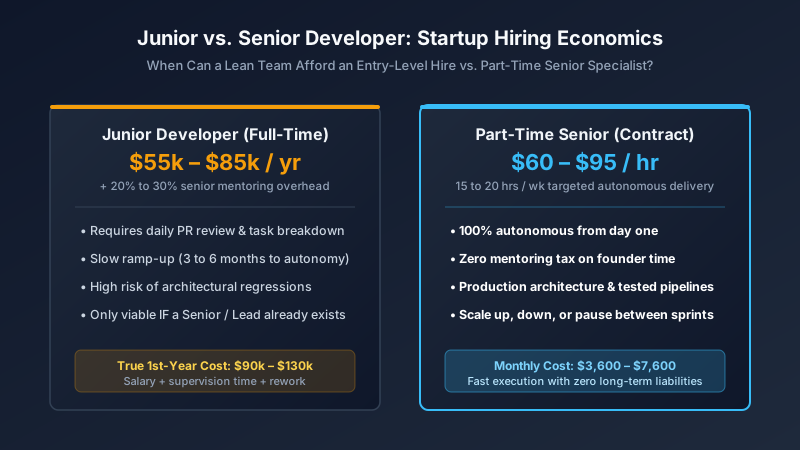
When early-stage founders and small business owners review their engineering budgets, hiring an entry-level or junior developer appears tempting. In major tech hubs, a junior developer commands an annual base salary of $60,000 to $85,000, compared to $140,000 to $180,000+ for a seasoned senior software engineer. For a company watching its seed runway or bootstrapping from customer revenue, the lower nominal salary looks like a straightforward way to stretch capital.
However, in software engineering—and especially in high-velocity startups—the nominal salary of an entry-level developer represents only a fraction of their true economic cost. Without established senior technical leadership already in place to provide continuous code reviews, architectural guardrails, and task breakdowns, hiring a junior developer is frequently the most expensive hiring mistake a young startup can make.
The Hidden "Mentoring Tax": Calculating the True Cost of an Entry-Level Hire
A junior developer is an investment in future capacity, not an autonomous producer of production software today. They do not arrive with the experience to select database indices, evaluate multitenant security models, or debug race conditions in distributed systems.
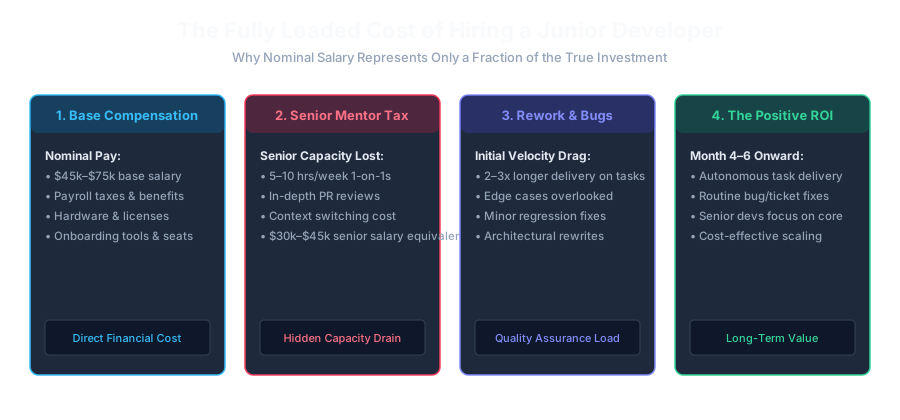
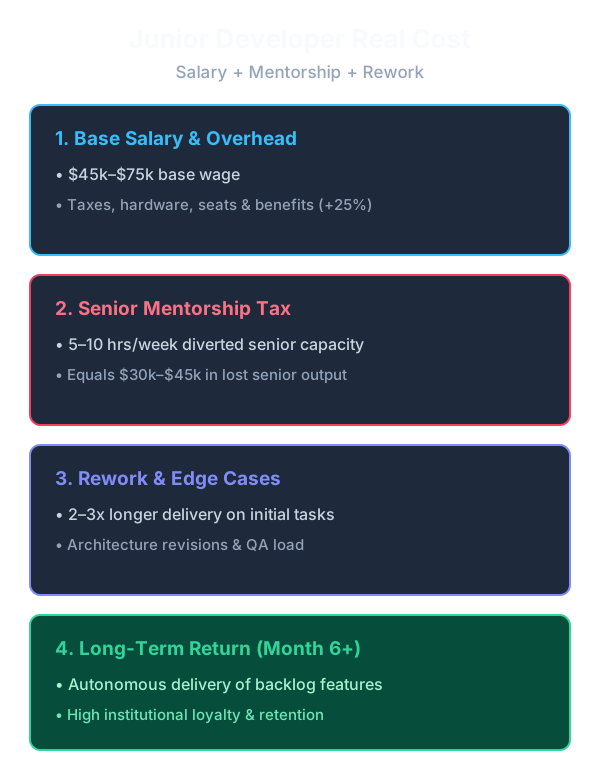
To understand why junior hiring strains early-stage teams, founders must account for the indirect costs:
1. Senior Engineering Time Drain (20% to 35% of Lead Capacity)
Every pull request submitted by an entry-level engineer requires scrutiny. A senior engineer or technical founder must spend 8 to 15 hours per week unblocking the junior hire: explaining architecture, correcting Git branch mistakes, debugging environment setups, and rewriting flawed database queries.
If your lead engineer bills at $80/hr or draws a $160,000 annual salary, dedicating 25% of their working hours to junior mentorship adds an invisible $40,000 annual overhead to the junior developer’s nominal payroll cost.
2. The Cost of Rework and Architectural Regressions
Junior developers naturally optimize for immediate ticket completion rather than long-term maintainability. Common failure modes include copy-pasting unvalidated third-party scripts, bypassing database foreign keys, exposing private API keys in client-side React bundles, and hardcoding configuration parameters.
Cleaning up technical debt after a flawed prototype launch frequently requires an external rescue or takeover project costing $5,000 to $15,000—erasing any initial payroll savings.
3. Ramp-Up Lag in Fast-Moving Product Cycles
In an early-stage company, survival depends on shipping features within days to test market demand. A junior developer typically requires 3 to 6 months of onboarding before they can independently ship non-trivial features without supervision. A startup with only 9 months of runway cannot afford a 6-month ramp-up cycle.
Financial Comparison: Full-Time Junior vs. Full-Time Senior vs. Part-Time Senior Specialist
For early-stage startups needing to ship working software, comparing full-time headcount against targeted senior contracting illustrates the financial leverage available to lean teams:
| Cost Component | Full-Time Junior Developer | Full-Time Senior Engineer | Part-Time Senior Contractor (ProofDevs) |
|---|---|---|---|
| Nominal Annual Compensation | $65,000 – $80,000 | $145,000 – $180,000 | $45,000 – $75,000 ($65–$95/hr for 15–20 hrs/wk) |
| Taxes, Benefits & Equipment (25%) | $16,000 – $20,000 | $36,000 – $45,000 | $0 (B2B vendor expense) |
| Senior Supervision / Mentoring Overhead | $25,000 – $40,000 (Lead time) | $0 (Self-directed) | $0 (Autonomous from day one) |
| Recruitment & Sourcing Fees | $8,000 – $15,000 | $20,000 – $35,000 | $0 |
| Time to First Meaningful Commit | 3 to 6 weeks | 3 to 5 business days | 24 to 48 hours |
| Autonomous Delivery Capability | Low (needs detailed specs) | High (handles ambiguous briefs) | High (architects, codes, and deploys) |
| Total First-Year Economic Investment | $114,000 – $155,000 | $201,000 – $260,000 | $45,000 – $75,000 |
When evaluated on fully loaded economic terms, engaging an experienced senior specialist on a targeted 15-to-20-hour weekly contract delivers working production software at roughly half the total cash outlay of employing a junior developer full-time.
When CAN an Early-Stage Startup Afford an Entry-Level Hire?
Hiring junior developers is not inherently flawed; it is simply situational. An entry-level hire becomes a sound business decision only when three specific organizational prerequisites are met:
1. You Already Have an Experienced Senior Lead or CTO
You cannot hire a junior as your first or sole developer. A non-technical founder cannot review pull requests, identify architectural anti-patterns, or teach automated testing practices. An entry-level developer thrives only under the daily mentorship of an experienced in-house engineer or fractional CTO.
2. You Have a Backlog of Well-Defined, Low-Risk Tasks
Junior engineers perform best when tasks have clear boundaries: building responsive landing pages from Figma mockups, writing end-to-end browser tests in Playwright, creating administrative CRUD tables, or fixing minor UI bugs. If your product is still discovering its core database architecture, you need a Founding Engineer, not an apprentice.
3. Your Runway Exceeds 18+ Months
Because an entry-level developer requires 6 months to reach positive net output, your company must possess sufficient capital runway to absorb the onboarding lag without threatening company solvency.
If your startup is evaluating initial technical hires across various stages, our guide to choosing a developer for a small business or startup provides a structured decision framework for scoping roles before allocating capital.
The Practical Alternative for Lean Startups: The Senior Sprint Model
For bootstrapped companies, pre-seed startups, and small businesses, the most capital-efficient strategy is inverted: hire senior talent for fewer hours rather than junior talent for full weeks.
Instead of paying a junior developer $6,000 per month to struggle through unfamiliar backend tasks, contracting an independent senior full-stack engineer for 15 hours per week ($4,000 – $5,500/month) yields:
- Immediate velocity: Senior engineers have already solved your authentication, billing, and database indexing challenges in prior commercial roles.
- Production-grade architecture: The application is built with clean database migrations, typed schemas, and automated CI/CD pipelines from the very first commit.
- Zero long-term liability: If product validation pauses or you need to re-evaluate roadmap priorities between funding milestones, contract engagements can be paused or scaled without severance liabilities.
Conclusion
The decision between a junior and senior developer is not a question of moral superiority—it is a question of capital allocation and supervisory bandwidth. Junior developers require dedicated mentorship, stable codebases, and predictable task backlogs. Senior developers create the architecture, establish conventions, and ship autonomous code under conditions of high uncertainty.
If your business is validating a new product or building an MVP from scratch, prioritize autonomy and velocity. Buy senior execution by the hour rather than junior availability by the month.
To connect with vetted senior full-stack specialists capable of delivering autonomous software from day one, explore our directory of verified developers or contact our technical team to discuss your roadmap requirements.
Written by Michael Melnyk
Senior IT Technical Writer & Technology Analyst
Senior Technical Writer and IT Industry Analyst with over 7 years of experience analyzing software engineering ecosystems, tech leadership models, and developer procurement frameworks.