Hire a Full-Stack Developer for Complex Web Applications: From BRD to Delivery Ownership
Most software failures on complex web apps do not start in code; they start when developers begin coding an ambiguous BRD without discovering missing edge cases, status deadlocks, or unindexed constraints. Here is how to evaluate true delivery ownership, realistic hours, and senior vetting rubrics.

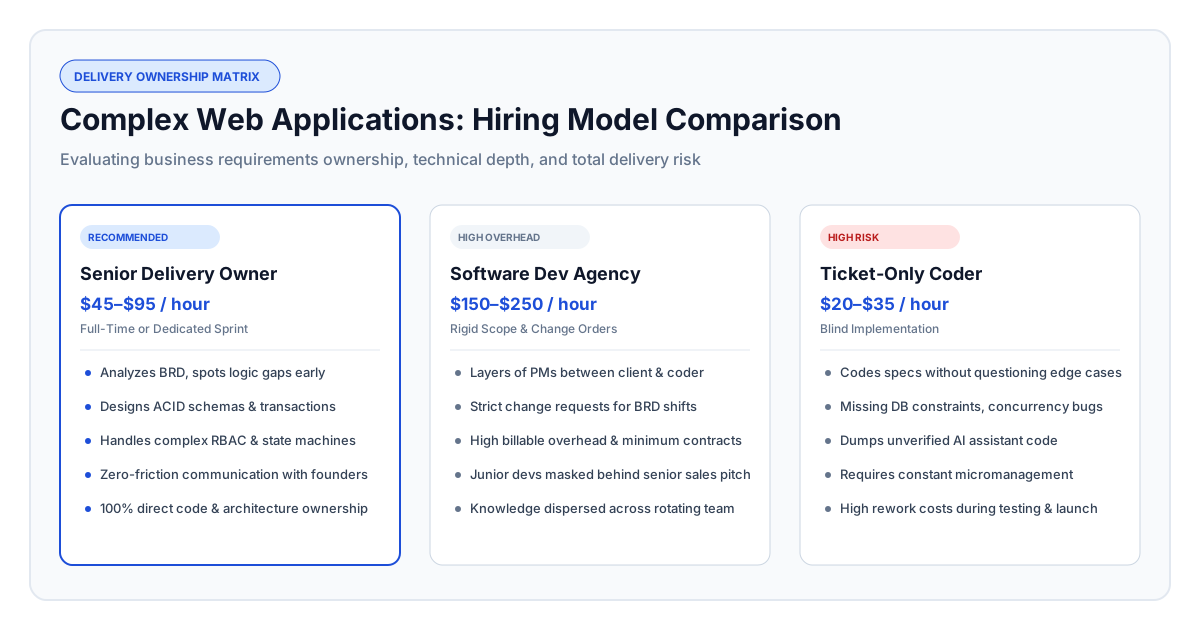
Current as of October 2026. A full-stack developer with delivery ownership translates a Business Requirements Document (BRD) into relational database constraints, ACID transactions, responsive interfaces, and automated deployments without requiring engineering micromanagement. Hiring an independent senior full-stack engineer for complex business applications costs $45–$95 per hour (or $7,200–$15,200 per month for full-time retainers). By contrast, traditional software agencies charge $150–$250 per hour with heavy management overhead, while junior ticket coders at $20–$35 per hour frequently introduce expensive technical debt by silently coding flawed assumptions.
Complex business applications—such as enterprise resource planning (ERP) platforms, customer relationship management (CRM) systems, multi-entity billing engines, and logistics portals—differ fundamentally from simple landing pages. When business software fails, the root cause is almost never syntax errors in JavaScript or Python; it fails because nobody analyzed business workflows, caught database concurrency race conditions, or verified role-based access control (RBAC) before coding. If you need a verified senior engineer who takes end-to-end accountability, explore our vetted full-stack developers matched directly to your application scope.
Figure 1: Evaluating delivery ownership, technical depth, and communication models across different hiring routes.
What BRD-to-Delivery Ownership Actually Means
A Business Requirements Document (BRD) is a formal functional specification detailing operational goals, business workflows, actor personas, business rules, and acceptance criteria. Translating a BRD into working software requires an engineer who acts simultaneously as a solution architect, database designer, backend engineer, frontend developer, and release manager.
The difference between a feature coder and a delivery owner is how they handle requirement ambiguity. An inexperienced coder treats a BRD as an unquestioned order: if an edge case is missing, they either stop and wait for instructions or make an unverified guess, leaving the resulting bug for user acceptance testing (UAT). A delivery owner reads the BRD as an interconnected system, discovers logical contradictions before writing code, designs the data architecture, builds the features, and verifies the deployment against agreed acceptance criteria.
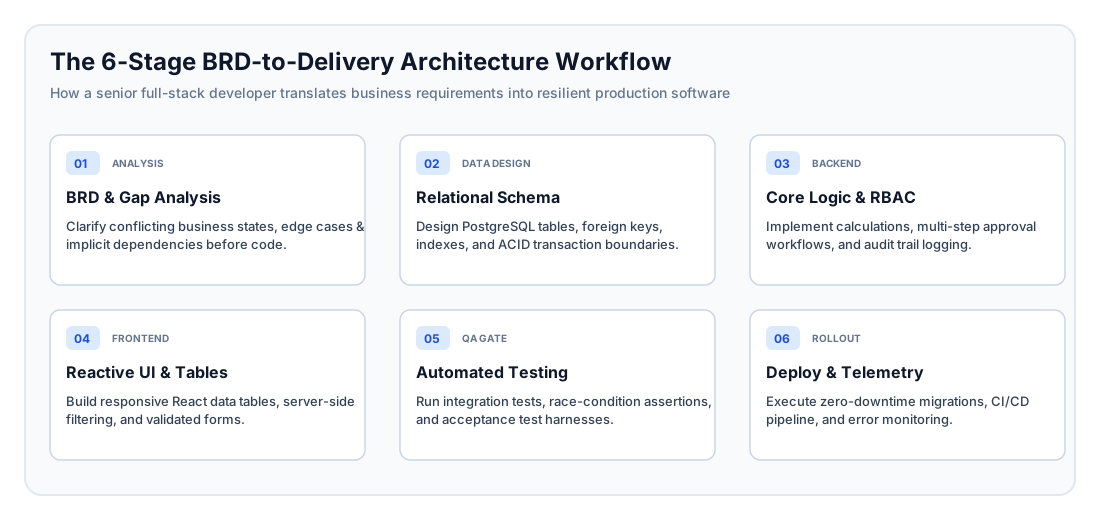
Figure 2: The 6-stage lifecycle that transforms raw business requirements into stable production software.
True end-to-end delivery ownership encompasses six core disciplines:
- Requirements Validation: Reviewing functional specifications, workflows, and acceptance criteria to identify missing edge cases, conflicting rules, and technical dependencies prior to coding.
- Architectural & Schema Design: Mapping business entities into normalized relational schemas (PostgreSQL or MySQL) with strict integrity constraints, foreign keys, indexes, and concurrency locks.
- Backend Business Logic Implementation: Constructing clean, modular API services in Python (Django / DRF) or PHP (Laravel) that enforce complex calculations, multi-step approval state machines, and fine-grained RBAC.
- Frontend Interface Engineering: Building intuitive React.js interfaces with responsive layouts, dynamic forms, server-side data tables, multi-column filters, and real-time dashboard metrics.
- Automated Quality Assurance: Writing unit, integration, and functional test suites that verify business calculations, permission boundaries, and acceptance criteria.
- Cloud Deployment & Telemetry: Configuring Docker containers, CI/CD pipelines, database migration runners, and monitoring alerts on AWS, GCP, or cloud environments.
Phase 1: BRD Gap Analysis and Requirement Clarification
BRD gap analysis is the systematic review of a functional specification to uncover missing state transitions, unhandled error conditions, ambiguous acceptance criteria, and conflicting permissions prior to development. Resolving a requirement defect during the initial document review takes minutes; discovering that same defect during production testing costs roughly 10× to 30× more in developer hours due to cascading database schema alterations and API refactoring.
When an experienced full-stack engineer analyzes a BRD, they do not just read the happy path. They interrogate the boundaries of every business entity:
- Workflow Deadlocks: What occurs if an invoice is rejected at approval Step 3 of a 4-step chain? Does it return to the creator, reset to Step 1, or transition to a specialized disputed status?
- Temporal Inconsistencies: If a customer changes their billing tier mid-month, are partial usage records calculated pro-rata at invoice creation, or does the system generate immediate credit notes?
- Concurrency & Race Conditions: What happens when two warehouse dispatchers approve the same inventory allotment simultaneously? Does the database prevent negative inventory counts, or does the frontend rely on client-side state?
- Role Collisions: Can an account manager approve their own purchase requests if they also hold a department lead role? How are separation-of-duties rules enforced?
- Data Deletion Policies: When an organization or user entity is archived, how do existing financial transactions, historical audit logs, and scheduled background tasks behave?
A candidate who claims they can start coding immediately upon receiving a BRD is a major operational risk. A true senior engineer schedules a structured clarification session within the first 48 hours, delivering an annotated list of edge cases and workflow adjustments that protect your timeline from scope creep.
Phase 2: Database Schema Architecture and Data Integrity
Relational database architecture is the structural foundation of complex business software; an application with an unnormalized, poorly indexed schema will degrade under real-world load regardless of how clean the frontend interface looks. Senior full-stack engineers prioritize data modeling in PostgreSQL or MySQL as the primary source of truth, enforcing data integrity at the database engine level rather than relying solely on application code.
Complex business software requires four fundamental data engineering practices:
- Relational Integrity and Strict Constraints: Every relationship between organizations, users, accounts, orders, and line items must be governed by explicit foreign keys with defined
ON DELETE RESTRICTorCASCADEbehaviors. Status fields must utilize native database enums or lookup tables withCHECKconstraints rather than arbitrary strings. - ACID Transactions and Concurrency Locking: Operations that modify financial ledgers, inventory counts, or approval records must execute within atomic database transactions. When concurrent processes compete for the same row, senior developers employ pessimistic row-level locking (such as PostgreSQL's
SELECT FOR UPDATE) or optimistic concurrency control using version timestamps. Without transactional locking, concurrent user actions produce phantom reads and silent data corruption. - Query Optimization and Composite Indexing: Data-intensive applications frequently query millions of records for reporting dashboards. Senior developers construct composite indexes tailored to exact query patterns (such as combining
tenant_id,status, andcreated_at) and analyze query execution plans usingEXPLAIN ANALYZEto eliminate costly sequential scans. - Immutable Audit Trails and Event Logging: In business-critical systems, updating a record in place destroys historical context. A seasoned full-stack engineer designs append-only audit tables or change-data-capture triggers that record who changed what, the exact timestamp, the previous values, and the IP or user agent responsible, satisfying compliance mandates.
Phase 3: Backend Business Logic, Workflows, and RBAC
Backend business logic encompasses the domain rules, mathematical calculations, validation routines, and access permissions that govern how an organization operates. While frontends and styling change frequently, backend business logic represents the intellectual property and core operating engine of your company.
Two primary tech stacks dominate modern business-critical web applications: Python with Django / Django REST Framework and PHP with Laravel. Both frameworks provide enterprise-grade ORM layers, robust migration engines, built-in security protections against CSRF and SQL injection, and mature ecosystems for background task processing.
| Evaluation Metric | Python (Django / DRF) | PHP (Laravel) | Node.js (NestJS / Express) |
|---|---|---|---|
| Core Strength | Exceptional ORM, built-in admin panel, strong math, AI & data processing integration. | Expressive syntax, built-in queue workers, rapid business workflow tooling (Eloquent, Nova). | High I/O concurrency, shared TypeScript models across frontend and backend. |
| Complex Business Logic | Superior for heavy calculations, reporting algorithms, and enterprise data models. | Superior for domain-driven design, events, jobs, and rapid CRUD scaffolding. | Requires extensive boilerplate to achieve enterprise-grade transaction & ORM maturity. |
| Database Migrations | Automated schema diffing with strict rollback support. | Expressive migration classes with explicit up/down rollbacks. | Depends on third-party libraries (Prisma, TypeORM) which vary in edge-case stability. |
| Background Tasks | Celery / Redis / Django-Q for asynchronous pipelines and scheduled tasks. | Laravel Queues (Horizon) with built-in retry backoff and rate limiting. | BullMQ / Redis for asynchronous job processing. |
| Independent Rate | $50–$95 / hr | $45–$90 / hr | $50–$95 / hr |
Beyond framework syntax, a senior full-stack engineer implements two architectural pillars essential for complex business applications:
- Finite State Machines (FSM): Approval workflows (Draft → Submitted → Department Review → Finance Approval → Dispatched) should not be managed with arbitrary
if/elsestatements scattered across controllers. Delivery owners use dedicated state machine libraries that enforce valid transition paths, preventing illegal transitions such as moving directly from "Draft" to "Dispatched". - Granular Role-Based Access Control (RBAC): Rather than assigning crude "Admin" or "User" flags, enterprise applications require permission-based architecture where roles represent collections of granular capabilities (e.g.,
invoices.create,invoices.approve_tier_1,reports.export_csv). This allows company administrators to customize permissions per department without requesting code changes.
Phase 4: Responsive Frontend Architecture for Data-Heavy Interfaces
Frontend development for complex business applications is not about creating flashy landing page animations; it is about building responsive, high-performance dashboards, data tables, and dynamic form workflows that business operators can use eight hours a day without encountering interface lag or input loss. In the vast majority of enterprise applications, this interface is built using React.js with TypeScript.
Business interfaces present specific engineering challenges that simple web developers struggle to resolve:
- Complex Dynamic Forms: Long forms involving conditional validation rules, dependent dropdowns (e.g., selecting a country updates valid tax categories), and auto-saving drafts require state managers such as React Hook Form paired with Zod schemas. This ensures inputs are validated on the client side for instant user feedback and re-validated identically on the server.
- High-Volume Data Tables: Enterprise users regularly view data tables containing thousands of rows. An inexperienced developer renders all rows into the DOM, causing browser freezes. A senior engineer implements server-side pagination, debounced multi-column search, dynamic sorting, and virtualized scrolling (via TanStack Table or react-window) to keep DOM nodes lightweight.
- Optimistic Updates with Safe Rollback: When an operator updates an item status or reorders a workflow task, the interface should reflect the change immediately while firing the API request in the background. If the server request fails, the application must gracefully rollback the UI state and display an actionable toast notification explaining why the action was rejected.
- Exporting and Reporting: Generating large CSV or PDF exports directly in the browser can crash the tab. Senior engineers initiate an asynchronous background export job via the backend, notify the user with a progress indicator, and deliver a secure download link upon completion.
AI Coding Assistants in Production: The Engineering Boundary
The widespread adoption of AI coding assistants such as Cursor, GitHub Copilot, and Claude Code has changed modern software development. Senior developers utilize AI tools to accelerate boilerplate generation, write comprehensive unit test cases, generate mock data, and scaffold repetitive CRUD routes. However, in complex business applications, uncritical reliance on AI code creates catastrophic vulnerabilities.
AI assistants generate code based on statistical pattern matching, not domain understanding. In business-critical software, this leads to subtle, high-severity defects:
- Missing Transaction Boundaries: AI models frequently generate code that executes multiple database writes sequentially without wrapping them in an atomic database transaction. If the second write fails, the database remains in a corrupt, partial state.
- Incomplete Permission Checks: AI tools often write controller logic that fetches records by ID (e.g.,
Order.objects.get(id=order_id)) without verifying that the requesting user'stenant_idmatches the record's ownership, opening severe multi-tenant data leak vulnerabilities (IDOR). - Hallucinated Edge-Case Handling: When asked to calculate financial compounding or prorated subscription refunds, AI assistants frequently produce convincing code that produces rounding errors on edge conditions or fails to respect leap years and timezone boundaries.
A senior full-stack developer with delivery ownership understands, reviews, and tests 100% of the code that enters your repository. During the interview process, you should specifically probe candidates on how they use AI: the ideal candidate uses AI as an efficiency multiplier for drafting and testing, but insists on manual verification of business rules, security boundaries, and database locks.
Budget Planning, Realistic Timelines, and Agency Cost Comparison
Understanding developer rates and milestone durations allows business founders and product managers to forecast development expenditures accurately. Independent senior full-stack developers charge $45–$95 per hour depending on technical specialization, years of domain experience, and geographic location. For ongoing product development, full-time monthly retainers typically range between $7,200 and $15,200 per month (based on 160 billable hours).
In contrast, software development agencies bill at $150–$250 per hour. On a typical 400-hour module, an agency costs between $60,000 and $100,000, whereas an independent senior engineer delivers the exact same scope for $18,000 to $38,000—a saving of over 60%—while offering direct, unmediated communication with the person writing your software.
| Project Phase | Typical Scope & Deliverables | Estimated Hours | Independent Cost ($45–$95/hr) | Agency Cost ($150–$250/hr) |
|---|---|---|---|---|
| 1. BRD Analysis & Architecture | Requirements review, edge-case audit, database ERD, API specification, and technical milestone roadmap. | 15–30 hrs | $675 – $2,850 | $2,250 – $7,500 |
| 2. Database Modeling & Migrations | PostgreSQL/MySQL schema design, foreign keys, indexes, ACID transaction configurations, seed data. | 20–40 hrs | $900 – $3,800 | $3,000 – $10,000 |
| 3. Backend APIs & Business Logic | Django/Laravel domain services, calculation engines, approval FSM workflows, background tasks, RBAC. | 60–120 hrs | $2,700 – $11,400 | $9,000 – $30,000 |
| 4. Frontend UI & Reactive Tables | React responsive components, dynamic forms, validation schemas, server-side data tables, dashboard charts. | 50–100 hrs | $2,250 – $9,500 | $7,500 – $25,000 |
| 5. Integrations & Authentication | Third-party REST APIs (Stripe, QuickBooks, Salesforce), OAuth/SAML single sign-on, email notifications. | 25–50 hrs | $1,125 – $4,750 | $3,750 – $12,500 |
| 6. Testing, CI/CD & Deployment | Automated unit/integration tests, Dockerized environments, AWS ECS/RDS provisioning, monitoring setup. | 20–40 hrs | $900 – $3,800 | $3,000 – $10,000 |
| Total Module / MVP | Complete business-critical web application module | 190–380 hrs | $8,550 – $36,100 | $28,500 – $95,000 |
To review quotes you have already received from other vendors, explore our second opinion software review to ensure your scope and timeline estimates are mathematically sound.
Real-World Case Studies: BRD-to-Delivery in Practice
The true value of delivery ownership is best demonstrated through real-world scenarios where complex business rules and technical architecture intersect.
Case Study 1: Multi-Entity Financial Billing Engine
Initial Situation: A B2B SaaS platform operating across North America and Europe needed to automate monthly recurring billing, usage-based consumption calculations, and multi-currency tax reconciliations based on a 45-page BRD.
What Was Blocking the Project: Their previous development team implemented basic billing endpoints without database concurrency controls. When billing jobs ran on the 1st of the month, concurrent webhook retries from payment processors caused duplicate invoices and ledger discrepancies totaling over $35,000 in billing errors.
The Solution: A senior full-stack engineer analyzed the billing BRD and restructured the entire database architecture: implemented a double-entry general ledger schema in PostgreSQL with strict immutability constraints, wrapped invoice generation in atomic transactions utilizing pessimistic row locks (SELECT FOR UPDATE) on customer balances to eliminate race conditions, built an idempotent webhook consumer in Python with Celery that verified incoming Stripe signatures, and delivered a React reconciliation dashboard allowing finance managers to inspect mismatched ledger lines with one-click audit histories.
The Business Outcome: Billing run processing times decreased from 4 hours to 18 minutes, duplicate invoices dropped to zero, and the company eliminated manual reconciliation work, saving an estimated $42,000 annually in accounting contractor fees.
Case Study 2: Multi-Tier Procurement & Approval Portal
Initial Situation: A logistics company required an internal procurement portal to manage purchase requests ranging from $500 to $250,000, involving varying approval thresholds across departmental managers, safety officers, and executive directors.
What Was Blocking the Project: The original specification contained subtle logic contradictions: if an item exceeded $50,000 but belonged to an emergency maintenance category, two conflicting approval routes were triggered simultaneously, causing purchase orders to freeze in a permanent pending state.
The Solution: Rather than blindly coding the conflicting rules, the full-stack developer surfaced the deadlock during the initial BRD review: designed an explicit finite state machine in PHP (Laravel) using state transitions that resolved priority hierarchies cleanly, created a dynamic RBAC system enabling administrators to adjust threshold values and delegate approval authority during vacation leaves, engineered an audit trail logging all approval decisions with cryptographic timestamps, and delivered a responsive React interface featuring server-side paginated tables, instant approval modals, and email notification deep-links.
The Business Outcome: Procurement turnaround time dropped from 9 days to 28 hours, and zero purchase orders stalled in workflow deadlocks during the first 12 months of operation.
Case Study 3: High-Volume Analytics & Reporting Dashboard
Initial Situation: A medical supplies distributor needed a real-time inventory and fulfillment analytics dashboard consolidating data from three legacy warehouse databases.
What Was Blocking the Project: The client's initial prototype attempted to render 15,000 unpaginated order rows directly into a browser table, causing frequent tab crashes and taking up to 45 seconds to load data over slow network connections.
The Solution: The full-stack delivery owner re-engineered the data pipeline from database to browser: created automated ETL cron tasks that pre-aggregated hourly inventory metrics into dedicated PostgreSQL reporting tables with compound indexes, refactored backend endpoints in Django REST Framework to implement keyset pagination and selective column querying, rebuilt the React frontend using TanStack Virtual and TanStack Table (rendering only the 30 rows visible in the viewport), and added asynchronous CSV export processing that generated files via background workers and sent download alerts via WebSockets.
The Business Outcome: Dashboard load times decreased from 45 seconds to 180 milliseconds, browser crashes were eliminated completely, and warehouse teams improved daily picking throughput by 22%.
Pre-Hire Vetting: 7 Technical Questions to Separate Owners from Coders
When interviewing full-stack developers for complex business web applications, avoid generic algorithmic puzzles. Instead, ask situational questions that test how the candidate handles requirement ambiguities, database concurrency, and business state machines.
- "How do you handle a BRD that has conflicting acceptance criteria or missing edge cases?"
Strong signal: The candidate describes a structured clarification process. They identify discrepancies during requirement review, document assumptions in writing, present trade-offs to business stakeholders, and refuse to write code until the business rule is clear.
Red flag: "I just code what the client asked for and fix it later if they don't like it." - "In an e-commerce or inventory system, how do you prevent two concurrent users from purchasing the last available item?"
Strong signal: Mentions database-level ACID transactions, pessimistic locking (SELECT FOR UPDATE) on the inventory row, or optimistic locking with a version field. Mentions that frontend checks or unindexed updates are completely insufficient to prevent race conditions.
Red flag: Suggests checking the quantity in anifcondition in Python/PHP before running a separateUPDATEquery without a transaction lock. - "How do you design a multi-tier approval workflow (Draft → Review → Approved → Rejected) in your backend?"
Strong signal: Explains state machines (FSM), defining valid transitions explicitly, storing transition logs, and emitting events to trigger notifications.
Red flag: Manages states with arbitrary string updates and nestedif/elsestatements directly inside controller actions. - "When building data-heavy tables with thousands of rows in React, how do you ensure the interface stays performant?"
Strong signal: Discusses server-side pagination, server-side filtering and sorting, debounced input handlers, and DOM virtualization (e.g., TanStack Virtual).
Red flag: Fetches all records via a single API call and relies entirely on client-side array filtering in JavaScript. - "How do you implement Role-Based Access Control (RBAC) so that permissions remain maintainable as new roles are added?"
Strong signal: Recommends decoupling roles from permissions. Users belong to roles, roles map to discrete capabilities (e.g.,can_refund_payment), and authorization guards check capabilities rather than hardcoded role names.
Red flag: Hardcodes checks likeif user.role == 'admin'throughout frontend components and backend endpoints. - "How do you incorporate AI coding assistants like Cursor or Copilot into your daily workflow without compromising security or code quality?"
Strong signal: Uses AI for boilerplate generation, writing test suites, and drafting repetitive schema migrations, but conducts 100% manual review of transaction logic, permission guards, and edge cases.
Red flag: Relies on AI to generate entire architectural modules without validating database constraints or understanding the underlying code. - "What is your strategy for running database migrations in production without causing application downtime?"
Strong signal: Describes the expand/contract pattern: add columns as nullable first, deploy backend code that writes to both columns, backfill existing data via background scripts, and drop obsolete columns in a subsequent release.
Red flag: Runs destructiveALTER TABLEcommands directly on production databases during peak business hours.
The 3–5 Hour Practical Trial Task & Pass/Fail Rubric
Never hire a full-stack developer for a business-critical application based on an interview conversation alone. Always conduct a paid, 3–5 hour practical trial task that mirrors real-world business requirements. Compensate candidates at their standard hourly rate ($45–$95/hr) to ensure senior candidates take the assessment seriously.
The most effective trial task provides the candidate with a mini-BRD (1–2 pages) for a realistic business feature—such as a Tiered Discount & Order Approval Engine—containing two intentional specification gaps. For example, specify that orders over $10,000 require manager approval and orders over $25,000 require director approval, but intentionally omit what happens if the manager rejects the order or if the discount reduces the total below the approval threshold.
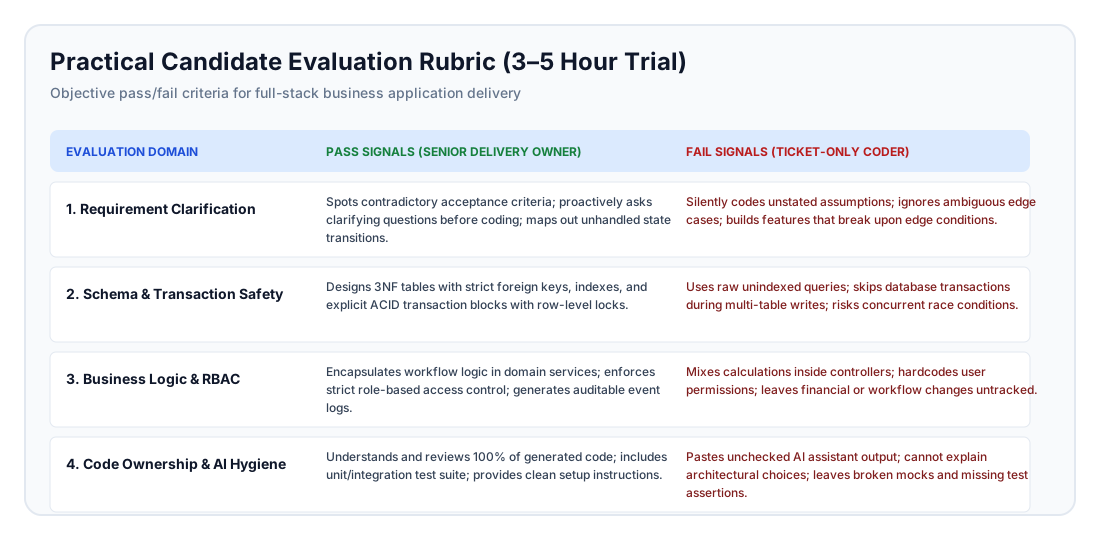
Figure 3: Practical evaluation matrix across requirement clarification, schema safety, business logic, and code hygiene.
Grading Rubric for Trial Evaluation
| Assessment Criteria | Pass Signal (Senior Delivery Owner) | Fail Signal (Ticket Coder) |
|---|---|---|
| Requirement Clarification | Identifies the intentional specification gaps; asks clarifying questions via message or email before implementing code; documents assumptions in the pull request description. | Silently implements an unstated assumption; fails to notice contradictory logic; delivers code that crashes on omitted edge conditions. |
| Database Schema & Transactions | Creates normalized relational tables with foreign keys; defines explicit indexes on filtered columns; wraps order creation and balance updates in atomic ACID transactions. | Writes unindexed queries; executes multi-table updates sequentially without transaction wrappers; leaves the database open to concurrency race conditions. |
| Business Logic Architecture | Encapsulates calculation rules and approval transitions in dedicated domain services or state machines; enforces granular permissions; records change events. | Packs business calculations directly into controller methods; hardcodes user roles; leaves zero audit trails for status changes. |
| Frontend Quality & Data Tables | Builds responsive, clean form components with schema validation (Zod/Yup); implements loading and error states; manages form feedback gracefully. | Builds brittle forms without input validation; lacks loading spinners; displays unformatted raw JSON error responses to the user. |
| Testing & Verification | Includes automated unit tests verifying calculations and integration tests asserting transaction rollbacks on failure; provides clean README setup instructions. | Provides zero automated tests; README setup instructions are incomplete or broken; code fails to run locally without manual debugging. |
Common Pitfalls When Hiring for Complex Web Applications
Founders and non-technical managers frequently stumble over common misconceptions when recruiting full-stack developers for complex software projects:
- Confusing Prototyping Speed with Delivery Ownership: A developer who builds a visual prototype in three days using templates may look fast, but if their database lacks transaction boundaries, foreign keys, and role-based permissions, the application will collapse once paying customers start triggering concurrent operations.
- Treating the BRD as an Infallible Blueprint: Expecting developers to follow a BRD without question is a mistake. Business analysts and founders routinely miss technical edge cases. You need an engineer who challenges assumptions and refines requirements before coding.
- Hiring Frontend Specialists to Solve Data Architecture Problems: Frontend engineers often view systems through UI state. When building data-intensive applications, you need an engineer who designs the relational data model first and derives the frontend forms from database truth.
- Ignoring Concurrency Until Production Launch: Concurrency bugs rarely appear in staging environments with a single tester. A senior engineer designs for concurrent user behavior from day one, employing row locks and atomic database transactions.
- Accepting Unreviewed AI-Generated Code: Inexperienced candidates frequently dump raw AI-generated output into codebases. If a candidate cannot explain the trade-offs of their schema or why they chose a specific database index, they cannot maintain your software when unexpected production issues occur.
Expert Advice for Business Founders and Product Managers
If you are managing the development of a complex web application, structure your developer relationship to maximize accountability and minimize delivery risk:
- Phase Development into Milestone-Driven Sprints: Break large applications into 2-week to 4-week functional milestones (e.g., Milestone 1: Authentication, RBAC, and Schema; Milestone 2: Order Calculation Engine and State Machine; Milestone 3: Reporting Dashboard and Exports). Tie milestone sign-offs to functional demonstration in a staging environment.
- Establish a Non-Negotiable Staging Environment: Never permit developers to test features directly on production. Maintain an automated staging environment deployed on AWS or your cloud provider that mirrors production database schemas and configurations.
- Require Automated Tests as a Condition of Delivery: Mandate that every pull request includes unit tests covering core business calculations and integration tests verifying database transaction rollbacks.
- Maintain Full Ownership of Repositories and Infrastructure: Ensure all source code repositories (GitHub/GitLab) and cloud accounts (AWS/GCP/Supabase) are created under your organization's corporate accounts, granting the developer contributor access rather than delegating ownership to third-party accounts.
Frequently Asked Questions
What is the typical hourly rate for a senior full-stack developer with delivery ownership?
An independent senior full-stack developer with end-to-end delivery ownership costs between $45 and $95 per hour in 2026. This translates to $7,200 to $15,200 per month for dedicated full-time engagements (160 hours/month). By contrast, development agencies charge $150 to $250 per hour for equivalent capabilities.
What is the difference between a full-stack coder and a full-stack delivery owner?
A full-stack coder writes code strictly against given tickets and assumes the specification is correct. A delivery owner studies the BRD, identifies missing edge cases, designs the relational database schema, implements transactional business logic, conducts automated testing, configures CI/CD deployments, and takes full accountability for meeting business acceptance criteria.
Why is PostgreSQL preferred over NoSQL databases for complex business applications?
PostgreSQL provides strict ACID transaction guarantees, relational foreign keys, row-level concurrency locking (SELECT FOR UPDATE), and robust schema validation. These features are non-negotiable for accounting, ERP, inventory, and billing applications where inconsistent or orphaned data results in financial loss. NoSQL databases lack cross-document transactional guarantees and shift relational integrity enforcement into brittle application code.
Should I choose Python (Django) or PHP (Laravel) for my business application backend?
Both are enterprise-grade options. Choose Python with Django if your web application involves complex mathematical calculations, data science pipelines, reporting analytics, or AI integrations. Choose PHP with Laravel if your application requires rapid workflow automation, queue-heavy event architectures, and complex administrative CRUD interfaces.
How long does it take to turn a 30-page BRD into a working web application module?
A comprehensive business application module typically requires 190 to 380 developer hours, which spans 5 to 10 weeks of full-time development. This includes 2 to 3 weeks for requirement analysis and database architecture, 3 to 4 weeks for core backend APIs and business logic, 2 to 3 weeks for React frontend forms and tables, and 1 to 2 weeks for integration testing and staging deployment.
How do senior developers prevent race conditions in financial or inventory workflows?
Senior developers use database-level ACID transactions paired with pessimistic locking (such as SELECT FOR UPDATE in PostgreSQL) or optimistic concurrency control using version numbers. This ensures that when two users or background tasks attempt to update the same record simultaneously, the second transaction waits until the first commits, preventing double-spending and inventory overselling.
What is Role-Based Access Control (RBAC) and why does it matter in business software?
RBAC is an authorization model that grants permissions based on user roles within an organization. In complex business software, RBAC must be permission-driven rather than role-driven: users are assigned roles, and roles contain granular capabilities (such as invoice.approve or report.export). This enables custom company permission hierarchies without requiring code modifications.
How should a full-stack developer handle AI coding assistants like Cursor?
Senior engineers use AI assistants to accelerate boilerplate code, write test fixtures, and draft initial migrations, but they manually review and verify 100% of the code. They never allow AI tools to design transaction boundaries, authorization checks, or complex financial logic without rigorous manual testing and verification.
What should be included in a paid trial task before hiring?
A paid trial task should take 3 to 5 hours, be compensated at the developer's normal rate, and involve building a small, focused feature (such as a multi-tier approval service or discounted billing calculator) based on a 1-page mini-BRD. Crucially, the brief should contain 1–2 intentional specification gaps to test whether the candidate asks clarifying questions before coding.
What are the biggest red flags during the interview process?
Major red flags include: claiming a BRD needs zero clarification, suggesting that database transactions or row locks are unnecessary, lacking automated testing practices, hardcoding user permissions inside controllers, and displaying inability to explain architectural decisions in previously written code.
Can an independent developer replace a software agency for complex projects?
Yes. A senior independent full-stack developer delivers the technical capabilities of an agency development pod (architect, backend dev, frontend dev, and DevOps) at a 50% to 65% cost reduction. Working with an independent developer eliminates project manager overhead, avoids change order bureaucracy, and ensures direct collaboration with the person authoring your code.
How do I protect my intellectual property (IP) and source code ownership?
Ensure your contract explicitly states that all code, documentation, and database schemas are "work made for hire" with 100% intellectual property ownership assigned to your company upon payment. Always maintain repositories (GitHub/GitLab) and cloud accounts (AWS/PostgreSQL) under your direct corporate ownership, issuing access credentials to the developer rather than letting them host code on personal accounts.
Take the Next Step in Building Your Application
Building a complex web application requires technical precision, architectural foresight, and genuine delivery ownership. Attempting to build business-critical software with low-cost ticket coders inevitably leads to costly rewrites, data corruption, and missed deadlines.
If you have an existing BRD, functional specification, or complex software roadmap, connect with our network of pre-vetted senior engineers. Hire a verified full-stack developer matched to your specific technology stack, or explore our flexible hourly arrangements to kick off your project with a low-risk architectural audit.
Written by Michael Melnyk
Senior IT Technical Writer & Technology Analyst
Senior Technical Writer and IT Industry Analyst with over 7 years of experience analyzing software engineering ecosystems, tech leadership models, and developer procurement frameworks.