Legacy Software Modernization: Cost, Timelines, and When It Is Worth Doing
A rewrite quote that omits the legacy stack's remaining support runway is the most expensive document a buyer can sign. Four migration paths, honest hour ranges, and the questions that expose a padded estimate before you commit budget.

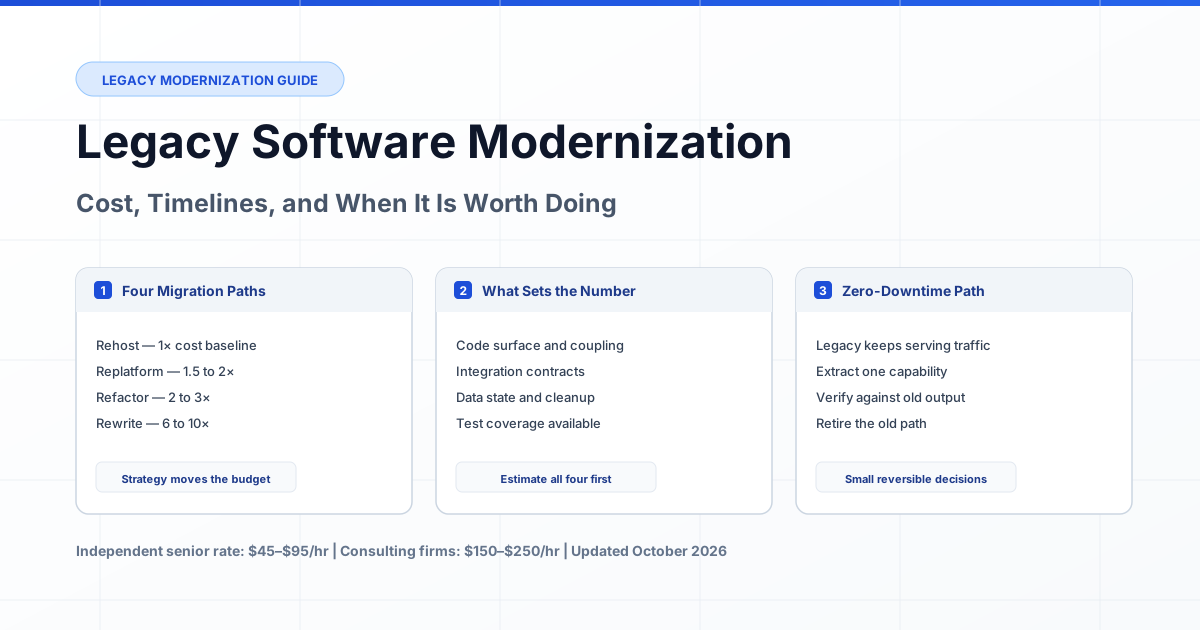
Current as of October 2026. Legacy software modernization means moving an existing system off unsupported runtimes, unsupported databases, or unmaintainable code without breaking the business that depends on it. Buyers typically face four paths: rehost (move the app as-is to new infrastructure), replatform (swap one blocking layer such as the runtime or database engine), refactor (restructure the code in place, module by module), or rewrite (build a replacement from scratch). Published 2026 vendor benchmarks put a rewrite at 6–10× the cost of a rehost and a refactor at 2–3×, so the strategy a vendor proposes moves the number far more than the vendor's hourly rate does.
Hiring an independent senior engineer for legacy modernization work runs $45–$95 per hour. Consulting firms quote $150–$250 per hour and typically require a six-figure minimum engagement. The hourly gap is real, but it is the second-order variable: a 10× strategy error costs more than any rate difference. This guide gives you the four paths, the honest hour ranges, the hidden costs that appear after the contract is signed, and the questions that separate a real estimate from a padded one. If you want a specialist matched to your stack instead, you can hire a verified legacy code specialist matched within hours.
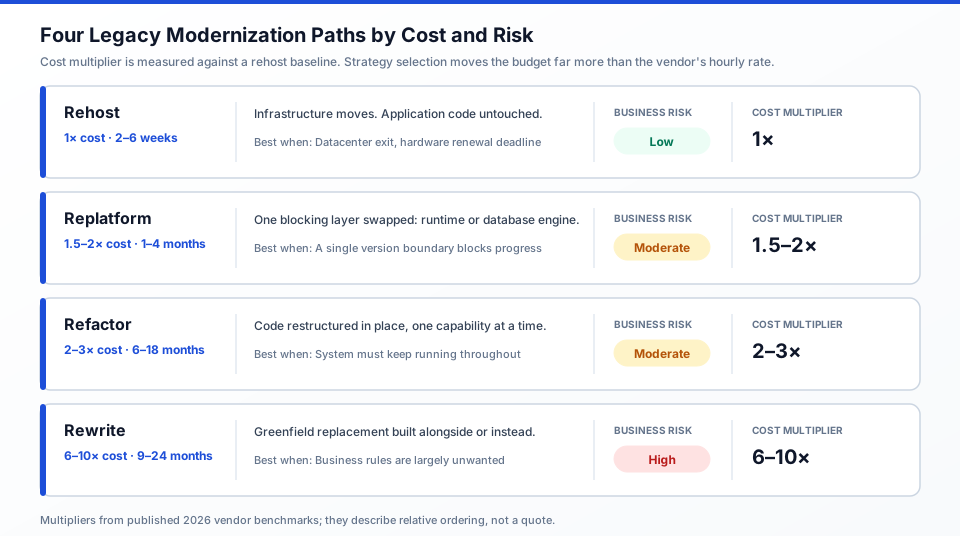
Figure 1: The four modernization paths ordered by cost multiplier against a rehost baseline. Strategy selection moves the budget far more than the vendor's hourly rate.
What Counts as Legacy Software in 2026
Legacy software is any system still running on a runtime, database engine, or framework version that its vendor no longer patches for security fixes. The age of the code matters far less than the support status of the platform underneath it, because an unpatched runtime turns every new vulnerability into your problem regardless of how clean the application code is.
PHP is the clearest example. The PHP Group supports each release branch for two years of active work plus two years of security fixes only — a four-year runway that was extended from three years in March 2024. As of October 2026, PHP 8.0 and 8.1 are fully end-of-life with no security patches at all; PHP 8.2 loses security support on 31 December 2026; 8.3 on 31 December 2027; 8.4 on 31 December 2028; and 8.5 on 31 December 2029. A business running PHP 7.4 in 2026 is past its runway entirely. Check your actual versions against the official PHP support table and the endoflife.date PHP timeline rather than trusting an internal wiki from 2021.
The same arithmetic applies elsewhere. Databases that reached end of life, unsupported .NET Framework and Windows Server versions, mainframes running COBOL, and self-hosted WordPress or Magento installs on end-of-life PHP all sit in the same category. IBM's own mainframe material notes that an estimated 250 billion lines of COBOL remain in production use, with banking and government as the heaviest concentrations — an estimated figure IBM published in November 2025, not a measured count.
The Four Cost Drivers Behind Every Modernization Quote
Quotes differ mainly because vendors estimate four variables differently: the surface area of code that must change, the number of integrations that must keep working, the state of your data, and the amount of test coverage that exists to prove nothing broke. Get answers on all four before comparing prices.
- Code surface. Lines of code matter less than coupling. A 400,000-line system with clear module boundaries is cheaper to modernize than a 60,000-line one where a single stored procedure touches every table.
- Integration count. Each external system — payment gateway, accounting package, ERP, government reporting API — is a contract that must be reproduced exactly. Industry guidance commonly budgets 15–25% of total modernization effort on integration work alone.
- Data state. Migrating a database without cleaning it moves your inconsistencies to a faster engine. Legacy schemas typically carry duplicate records, orphaned foreign keys, and encoding damage accumulated over a decade of incremental patches.
- Test coverage. With no automated tests, modernization means paying for verification by hand. On a codebase with under 10% coverage, budget an additional 20–30% of the estimated hours just to build the safety net before you touch behaviour.
The 2025 State of Legacy Software Modernization report surveyed teams about what their legacy systems cost them. The most reported problems were security vulnerabilities, incompatibility with current tooling, high maintenance cost, lack of vendor support, and business disruption risk — with poor performance and difficulty training new staff trailing. Those five complaints are the real specification for your project, and a credible proposal addresses each one in measurable terms.
Rehost, Replatform, Refactor, or Rewrite
The single most expensive mistake in legacy modernization is agreeing to a strategy before you know what your system actually needs. Rehosting is the cheapest path and the one that preserves the most risk; a rewrite is the most expensive and the one most likely to miss its deadline. Choose deliberately.
| Path | What Changes | Cost vs Rehost | Typical Timeline | Main Risk |
|---|---|---|---|---|
| Rehost (lift and shift) | Infrastructure only — server, OS, and hosting move; application code untouched. | 1× baseline | 2–6 weeks | Old code problems travel with it. Cloud bills creep if nobody optimizes. |
| Replatform | One blocking layer replaced: PHP 7.4 → 8.3, SQL Server → PostgreSQL, .NET Framework → current .NET. | 1.5–2× | 1–4 months | Scope creep while engineers are already inside the codebase. |
| Refactor (incremental) | Code restructured in place, one bounded capability at a time, production stays live. | 2–3× | 6–18 months | Drifts indefinitely without a sunset date for the old path. |
| Rewrite | Greenfield replacement built alongside or instead of the existing system. | 6–10× | 9–24 months | Business disruption. IBM's COBOL guidance and most enterprise retrospectives agree the underlying business rules are usually undocumented, so the replacement rebuilds behaviour nobody wanted. |
The multipliers above are vendor-published 2026 benchmarks and describe relative ordering, not your invoice. Treat them as a sanity check: if a proposal for a runtime upgrade costs the same as a full rewrite, ask why.
What Legacy Modernization Actually Costs
Legacy modernization costs for a mid-size business application typically fall between $25,000 and $300,000 in 2026, with enterprise portfolios and mainframe programs running into the millions. Below are realistic hour ranges priced at the independent senior rate of $45–$95 per hour, plus what a consulting firm at $150–$250 per hour would charge for the same scope.
| Scope | Hours (Independent Senior) | Budget at $45–$95/hr | Equivalent at $150–$250/hr |
|---|---|---|---|
| Read-only code and infrastructure audit with a written modernization plan | 20–40 | $900 – $3,800 | $3,000 – $10,000 |
| Runtime and dependency upgrade on a single service (e.g. PHP 7.4 → 8.3) | 40–90 | $1,800 – $8,550 | $6,000 – $22,500 |
| Database migration with schema cleanup (e.g. MySQL → PostgreSQL) | 80–180 | $3,600 – $17,100 | $12,000 – $45,000 |
| One module extracted behind an API facade, running in production alongside the old path | 120–260 | $5,400 – $24,700 | $18,000 – $65,000 |
| Full refactor of a mid-size CRUD application, incremental, no downtime | 500–1,200 | $22,500 – $114,000 | $75,000 – $300,000 |
| Ground-up rewrite of a mid-size application | 1,500–4,000 | $67,500 – $380,000 | $225,000 – $1,000,000 |
These ranges are planning estimates for teams with existing repository access and functional requirements documentation. Both assumptions fail more often than buyers expect, which is why the audit line item above is worth paying for before signing anything larger. Without documentation, expect to add 25–40% for requirements discovery.
Three Realistic Modernization Scenarios
Case 1: PHP 5.6 point-of-sale system approaching end of support
Situation: A regional retailer ran 14 stores on a custom PHP 5.6 point-of-sale and inventory application built in 2014, integrating with a barcode scanner fleet and an accounting package.
Blocker: PHP 5.6 had been unsupported for years, so every scanner firmware update required a bespoke patch. Two outages in six months traced to unpatched library code.
Approach: Replatform first — PHP 5.6 to 8.3, MySQL schema cleaned and moved to PostgreSQL, scanner integration rewritten against a documented API. No rewrite of business logic.
Result: 190 hours at $70/hr average, roughly $13,300, delivered over five weeks with two short cutover windows outside trading hours. Outage risk removed and the accounting integration moved off a package the vendor had retired.
Case 2: .NET Framework monolith needing multi-tenant billing
Situation: A B2B software company had a .NET Framework 4.6 application with 11 years of accumulated feature work. They needed per-tenant data isolation to sign larger customers, and the framework version blocked the deployment tooling they required.
Blocker: The team estimated a rewrite but could not produce a number they could take to a board. The stored procedure layer touched every table, so no module could be extracted cleanly.
Approach: A four-week audit identified three bounded seams. Billing was extracted first behind a facade with row-level security in PostgreSQL, while the remaining modules stayed on the old path. No big-bang cutover.
Result: Audit at 35 hours ($3,150) produced the roadmap the board approved. Tenant isolation shipped in the first quarter; the rest of the migration continued incrementally against a fixed budget rather than an open-ended rewrite.
Case 3: COBOL batch processing with a shrinking specialist pool
Situation: An insurance firm processed claims nightly through COBOL batch jobs on a mainframe. Two of the five engineers who understood the code had retired.
Blocker: The knowledge was undocumented and the batch window was fixed — a failure meant missing the next morning's claims run.
Approach: Encapsulation rather than translation. COBOL programs were exposed as services through the platform's integration layer, then one claims rule at a time was reimplemented off the mainframe and verified against the batch output. IBM lists this route, alongside migration and refactoring, among the standard COBOL modernization paths.
Result: Rules migrated one at a time instead of in one risky rewrite, and the dependency on retiring staff dropped as the code became documented services.
The Costs Buyers Consistently Miss
Modernization overruns rarely come from the coding. They come from four budget lines that proposals frequently omit, each of which industry analysis puts at 20–40% above the initial estimate.
- The double-pay trap. For a 12–18 month refactor you pay for the legacy stack and its replacement simultaneously — servers, licences, and salaries. Published estimates put this inflation at 37–75% of total programme cost before the new system delivers anything. An incremental strangler approach reduces it because value arrives while you are still paying both bills.
- Knowledge transfer. The engineer who understood the weird workaround leaves and nobody documented why it existed. Budget explicit documentation time rather than treating it as overhead.
- Data reconciliation. Migration is not complete when rows are copied. Someone must reconcile totals between old and new systems over a full business cycle, including month-end close and annual billing.
- Retraining and change management. Staff who worked around the old system's quirks need to learn the new workflow. Skipped training converts a modernization project into a support burden.
Large legacy programmes have historically carried a 50–75% failure rate on $1M–$3M spend over 12–18 months, which is why AI-assisted analysis and automated dependency mapping now draw serious vendor investment: the expensive part is reading and mapping decades of undocumented code, not writing new code.
Strangler Fig: Modernize Without a Cutover Disaster
The Strangler Fig pattern, described by Martin Fowler and updated in 2024, replaces a system incrementally: build new capability alongside the old, route traffic to it for one bounded piece, verify the results match, then retire the old path for that piece only. Fowler's original write-up and his 2024 revision make the central argument plainly — a cut-over rewrite is easy to specify badly and hard to finish, because the existing behaviour is mostly undocumented and often unwanted.
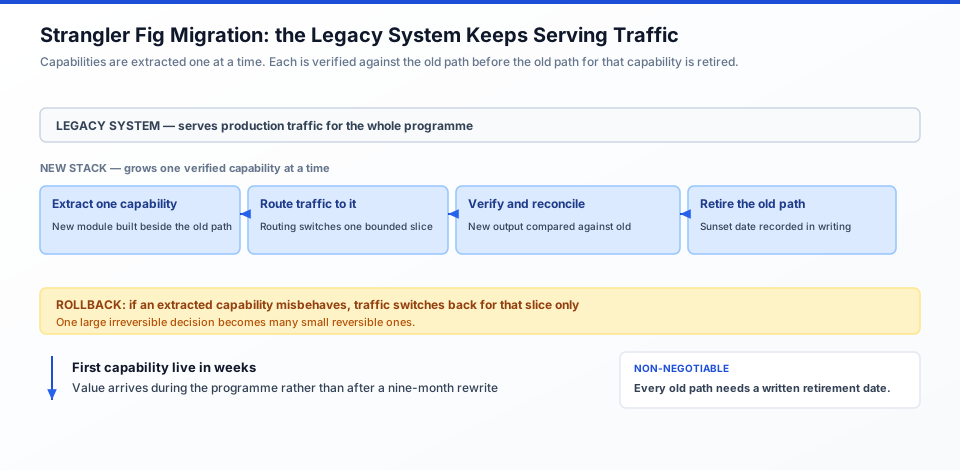
Figure 2: Under a strangler fig migration the legacy system keeps serving traffic for the whole programme. Each extracted capability is verified against the old path before the old path for that capability is retired.
For buyers this converts an open-ended risk into a series of reversible decisions. If extracted module three does not match the old behaviour, you revert module three — not the entire system. You also get value earlier: the first capability is live in weeks, not after a nine-month rewrite. Fowler's caveat matters just as much: without an explicit sunset date for each old path, the two systems live side by side for years and your costs go up, not down.
If you want the pattern explained visually before you commit, this short walkthrough shows the routing layer and facade in action: [Choking the Monolith — The Strangler (Fig) Pattern Applied](https://www.youtube.com/watch?v=bS1Q8a7SOKg). IBM Technology also published a focused treatment of the COBOL variant, where the "host" is a compiler your team cannot easily replace: [Technical Debt and Modernizing COBOL](https://www.youtube.com/watch?v=-CI8hb-077E).
When You Should Not Modernize At All
Modernization is not automatically the right answer, and a vendor who cannot describe what happens if you decline has told you something. Do not modernize when the system is stable and cheap to run, when the supporting platform has real remaining runway, or when the business problem is a missing feature rather than a structural one. A working system on supported software that costs $400 a month to host is not an emergency.
Run the build vs buy analysis honestly. Replacing a working internal tool with an off-the-shelf SaaS product is frequently cheaper than any migration path, and it transfers maintenance to a vendor with a support team. The honest answer for a great many "legacy" systems is: keep it running, upgrade the runtime, add tests, and revisit in two years.
How to Hire a Developer for Modernization Work
Modernization hires fall into three engagement shapes, and the right one depends on how much of the scope is already understood.
| Engagement | Best When | Cost Shape | Risk |
|---|---|---|---|
| Fixed-scope audit and plan | Nobody can scope the work yet. This is the normal first step. | 20–40 hours, fixed fee | Low. Deliverable is a written plan you own. |
| Part-time ongoing (10–20 hrs/week) | Incremental extraction across several months with a business owner coordinating. | $45–$95/hr with a weekly cap | Low to moderate. Needs a named decision-maker on your side. |
| Project with milestones | Scope is genuinely fixed — a runtime upgrade, a database migration. | Milestone-based, 20–30% held back until acceptance | Moderate. Only safe with written acceptance criteria. |
Whatever the shape, insist on three things: repository access on your infrastructure from day one, a written statement that all code and credentials transfer to your company, and a handover document. The codebase takeover process used for inherited projects applies here — you should never be left unable to maintain what a contractor built.
Seven Questions to Ask Before Signing a Modernization Quote
These questions are designed to separate an engineer who has done this before from one who is pricing your system optimistically. Ask them in a call, then compare the answers against each other — the quality of the answers matters more than the presence of answers.
- "What is the exact support status of every runtime and dependency in this project?" A senior engineer names versions and end-of-life dates without checking. If they say "we'll handle it", you have learned nothing.
- "Which module would you extract first, and why that one?" There is no generic answer. They should pick based on coupling and business value, not alphabetical order.
- "How do you prove the new path returns identical results to the old one?" Expect a concrete answer about parallel running, reconciliation, or differential testing — not "unit tests".
- "What is your rollback plan if this module behaves incorrectly in production?" Any answer other than a routing switch back to the old path is a red flag.
- "What will you refuse to do in this project?" This separates engineers from sellers. Nobody should agree to rewrite everything in the first milestone.
- "What happens to my infrastructure credentials and cloud accounts at handover?" They should describe transferring ownership to you, never to their account.
- "Which security guidance do you apply to a system with known unpatched dependencies?" Expect a reference to a specific framework such as NIST SP 800-218 and awareness that unpatched internet-facing components appear in CISA's Known Exploited Vulnerabilities catalog.
The 3–5 Hour Paid Modernization Assessment
Before committing to a multi-week engagement, ask a candidate to run a paid assessment on your actual repository. Four to five hours is enough to reveal whether they can read unfamiliar code, judge coupling, and give an honest answer.
Assignment: Given read-only access to one service, produce (1) a dependency inventory with support status per package, (2) one function under test that covers the riskiest branch, (3) a written recommendation of replatform versus incremental extraction with an hour estimate, and (4) a 20-minute walkthrough. Read-only access only — this is an assessment, not a delivery.
| Signal | Pass | Fail |
|---|---|---|
| Support status accuracy | Correct versions and end-of-life dates for every dependency. | Guesses, or "all these libraries are fine". |
| Coupling judgement | Identifies the specific module with the tightest coupling and explains why. | Suggests starting with the easiest file because it is smallest. |
| Honest scoping | Estimate includes a named discovery phase and states what is unknown. | Confident fixed number with no unknowns listed. |
| Risk framing | Names the top three risks and how each would be detected in production. | Lists risks generically without a detection method. |
| Boundaries | Stayed inside the four hours, documented open questions. | Kept working past scope or started writing production code unprompted. |
Pay the candidate their standard rate. An engineer who declines a four-hour paid assessment is telling you something too.
Typical Mistakes
- Starting with a rewrite because the code is old. Age is not the criterion; support status and coupling are. Most "rewrite everything" proposals are replatforming problems described in dramatic language.
- Comparing quotes that price different scopes. One proposal includes data migration and testing, the next excludes both. Normalise scope before comparing numbers.
- No sunset date for the old system. Two systems running indefinitely cost more than the original problem. Set a written retirement date per extracted capability.
- Skipping the test safety net to save money. Testing looks like overhead until the first regression reaches a customer. It is the cheapest insurance in the project.
- Accepting a fixed price before discovery. A firm price on an undocumented codebase is either a guess or an incentive to cut scope mid-project.
- Modernizing during a growth crunch. Migration and feature pressure in the same quarter means both slip. Sequence them.
- Letting the vendor own the infrastructure. If your application runs on their cloud account, you have a dependency, not a handover.
- Ignoring the people who use the system. Process quirks that look like bugs are often load-bearing. Users identify them in an hour that code review takes a week to find.
- Assuming AI will compress the timeline. Automated analysis compresses the reading and mapping phase. Architectural decisions and business-rule verification remain human work.
Expert Advice
Modernize the thing that is about to cost you money, not the thing that annoys your engineers. Sort your systems by two axes — remaining support runway on one, business impact of failure on the other — and fund the high-impact, short-runway system first.
Pay for the audit before you pay for the migration, and treat the deliverable as an asset you own. Without it, every vendor rediscovers your architecture and bills you again for the same discovery.
Budget for a second system. Programmes that assume a single application finish their budget on the first one and stall on everything discovered afterwards. An explicit reserve for systems you have not yet examined is what separates a programme that completes from one that quietly overruns.
Frequently Asked Questions
How much does legacy software modernization cost?
For a mid-size business application, expect $25,000–$300,000 in 2026. Enterprise portfolios and mainframe programmes run into millions. Independent senior engineers charge $45–$95 per hour; consulting firms charge $150–$250 per hour. Strategy moves the total far more than rate: a rewrite is 6–10× a rehost, and a refactor is 2–3×.
Is it cheaper to refactor legacy code or rewrite it?
Refactoring is cheaper in the large majority of cases — 2–3× the cost of a rehost versus 6–10× for a rewrite — and it keeps the system in production throughout. Rewrite only when the underlying business rules are largely unwanted and you want to shed them, or when the platform genuinely cannot run on supported software at all.
How do we know our software is actually legacy?
Check the support status of the runtime and every dependency, not the age of the code. An application running PHP 8.2 in October 2026 has until 31 December 2026 for security fixes; PHP 7.4 and earlier have none. Do the same audit for your database engine, OS, and framework against their published support tables.
Can we modernize a legacy system without downtime?
Yes, using incremental extraction. Under a strangler fig approach the legacy system serves production traffic for the whole programme while capabilities move to the new stack one at a time. Each move is verified and reversible, so a failure affects one capability rather than the entire system.
What is the Strangler Fig pattern and why does it matter for buyers?
It is an incremental migration approach where new capability is built alongside the legacy system and traffic is routed to it for one bounded piece at a time. For buyers it converts one enormous irreversible decision into many small reversible ones, and delivers value in weeks rather than after the full programme. Its requirement is discipline: each old path needs an explicit retirement date.
Should we modernize COBOL systems on a mainframe?
Usually incrementally, not by translation. IBM describes encapsulation, migration, and code refactoring as the standard routes, and encapsulation — exposing COBOL programs as services, then reimplementing rules one at a time and verifying against the old output — avoids the risk of a wholesale rewrite where undocumented behaviour gets rebuilt incorrectly.
How long does a legacy modernization project take?
A replatform takes 1–4 months. An incremental refactor of a mid-size application runs 6–18 months. A ground-up rewrite runs 9–24 months. Published enterprise programme benchmarks commonly show 12–18 month timelines for multi-million dollar efforts, with a historically high failure rate on that class of spend.
Who should do the work — in-house, an agency, or an independent engineer?
In-house if someone already owns the system and has protected time; the constraint is rarely skill, it is competing priorities. Agencies suit regulated enterprises needing procurement paperwork and multi-region delivery. Independent senior engineers suit mid-size scope where you want direct ownership of the code and no agency overhead. For unclear scope, start with a fixed-fee audit regardless of who performs the migration.
How do we avoid a failed cut-over rewrite?
Do not plan a cut-over. Extract one bounded capability, run it in production alongside the old path, reconcile the outputs, then retire the old path for that capability only. Set a written sunset date for each legacy component, because without it both systems run indefinitely and the cost exceeds what you were trying to save.
Can AI reduce the cost or timeline of modernization?
It compresses the analysis phase — mapping dependencies, reading undocumented code, explaining unfamiliar logic. IBM describes this as one of the main reasons it invests in AI-assisted mainframe tooling. It does not compress architecture decisions, business-rule verification, or data reconciliation, which is where modernization projects actually fail.
How do we keep ownership of the code and infrastructure?
Require repository access on your own infrastructure from the first day, cloud accounts registered to your company, and a written statement that all code and credentials transfer to your business on payment. Hold 20–30% of any milestone payment until handover documentation is delivered and verified.
What if we cannot find anyone who knows the old technology?
That is a knowledge-transfer problem before it is a hiring problem, and it raises the price of every other option. Start with a documentation and analysis engagement: modern tooling can read and map the code faster than a new hire can learn it. Budget explicitly for capturing what the departing engineer knows while they are still available.
Ready to scope your own system? Compare developer rates and hire a verified engineer matched to your stack — starting with a fixed-scope audit so the next quote you receive is built on facts, not assumptions.
Written by Michael Melnyk
Senior IT Technical Writer & Technology Analyst
Senior Technical Writer and IT Industry Analyst with over 7 years of experience analyzing software engineering ecosystems, tech leadership models, and developer procurement frameworks.