What Is a Forward Deployed Engineer? Role, Rates, and When Startups Need One
A Forward Deployed Engineer (FDE) embeds with clients to deploy software, build custom integrations, and solve production blockers on the frontline. Here is what the role covers, when your startup needs one, and how to hire.

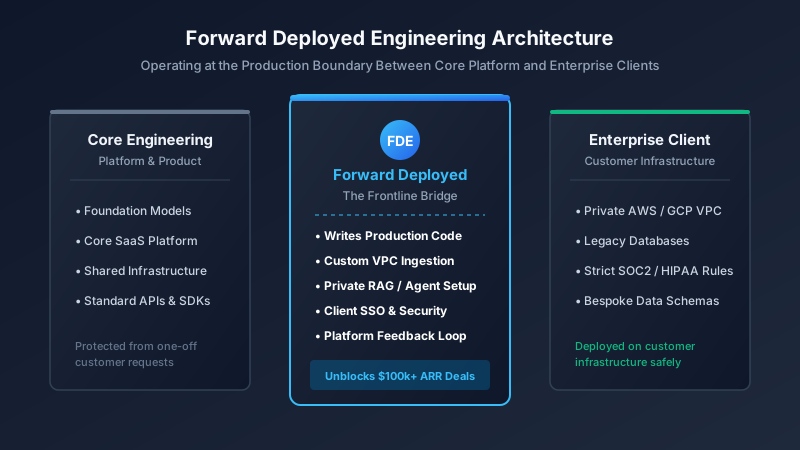
A Forward Deployed Engineer (FDE) is a senior software engineer stationed at the frontline between a company's core product and its enterprise customers. Rather than building platform features in isolation or delivering abstract architectural slide decks, an FDE writes tested production code directly inside or against client environments. They deploy complex software platforms, build custom data connectors, configure network isolation layers, and adapt application logic to fit enterprise workflows.
Originally popularized by Palantir Technologies, the FDE model has become an industry standard across high-growth AI and infrastructure leaders—including OpenAI, Scale AI, Databricks, Stripe, and Vercel. In an era where commercial deals hinge on deploying generative AI models, private vector databases, and multi-tenant integrations into strict client perimeters, the Forward Deployed Engineer serves as the technical engine that converts high-stakes pilot agreements into permanent revenue.
What Does a Forward Deployed Engineer Actually Do?
Many technical founders struggle to classify the FDE role because it combines the technical depth of a senior backend engineer with the business empathy of a solutions consultant. An FDE owns the end-to-end technical onboarding of key accounts across four critical areas:
1. Hands-On Client Deployment and Infrastructure Engineering
Enterprise customers rarely run software directly off standard public cloud multi-tenant setups. They demand deployments within private AWS Virtual Private Clouds (VPCs), Azure GovCloud, or on-premise Kubernetes clusters adhering to strict SOC2 Type II, HIPAA, or ISO 27001 constraints.
An FDE designs and executes the deployment automation: configuring AWS PrivateLink, setting up mutual TLS (mTLS) authentication handshakes, containerizing services via Docker, and applying Terraform scripts that allow software to operate within tightly restricted client perimeters.
2. Custom Integration Engineering and Data Ingestion
Every enterprise client possesses legacy systems, undocumented REST or SOAP endpoints, internal SQL warehouses, and proprietary data schemas. When a client cannot format their data to meet your API standards, the deal stalls.
An FDE builds defensive data ingestion pipelines in Python, TypeScript, or Go. They implement schema validation using libraries like Pydantic or Zod, establish message queues (such as Kafka, RabbitMQ, or AWS SQS) to handle client-side rate limits, and build bidirectional webhooks that sync records between client databases and your platform.
3. Deploying Production AI and RAG Workflows
For artificial intelligence and SaaS platforms, an FDE configures domain-specific retrieval-augmented generation (RAG) pipelines directly over client documents. This involves setting up vector databases (e.g., PostgreSQL with pgvector, Qdrant, or Pinecone), tuning chunking algorithms, implementing semantic caching to control API costs, and verifying that client-specific retrieval strictly enforces role-based access control (RBAC).
4. The Upstream Product Feedback Loop
A critical distinction between an FDE and an outsourced contractor is the upstream feedback loop. When an FDE encounters friction in customer deployments, they do not simply hack together a quick one-off patch. They document recurring integration pain points and work directly with Core Engineering to abstract those client-specific workarounds into native platform features, APIs, and SDK capabilities.
Role Comparison: FDE vs. Solutions Architect vs. Core SWE vs. Systems Integrator
Choosing the right engineering role depends on whether your bottleneck is product development, pre-sales advisory, or frontline implementation. The table below outlines how these roles differ:
| Role | Primary Mandate | Production Code Output | Client Interaction | Deployment Environment |
|---|---|---|---|---|
| Forward Deployed Engineer (FDE) | Deploy, customize, and integrate solutions in client environments | High (writes connectors, pipelines, infra code) | Daily collaboration with client engineers & PMs | Client VPC, on-premise, or hybrid cloud |
| Solutions Architect | Pre-sales technical discovery and high-level system design | Low to None (diagrams, slide decks, non-prod PoCs) | Frequent meetings with client executives & sales | Cloud reference architecture diagrams |
| Core Software Engineer (SWE) | Build and scale central product features and platform services | High (commits to central codebase & services) | Minimal or zero direct client interaction | Internal staging and production cloud |
| Enterprise Systems Integrator | Multi-client outsourcing and large-scale ERP customization | Moderate (often junior devs overseen by managers) | Filtered through account managers and analysts | Client enterprise legacy environments |
When Does Your Startup or Scale-Up Need an FDE?
Not every technology company needs an FDE on day one. During initial product validation, founders and generalist developers handle both code and early customer feedback. If you are assessing your initial technical hires, our comprehensive guide to choosing a developer for a small business or startup provides a clear framework for defining scope and matching roles at earlier stages.
However, once a software company moves into mid-market and enterprise sales, the dynamics change rapidly. You should consider bringing in a Forward Deployed Engineer when:
1. High-Value Enterprise Deals ($50k–$250k+ ARR) Are Stalled in Technical Onboarding
Enterprise sales cycles often stall after contract signing. The customer's security team demands private VPC routing, their database team requires custom ETL adapters, and their compliance team insists on SAML single-sign-on integration. If your platform lacks an engineer to resolve these issues hands-on, pilot agreements expire before moving into production licensing. An FDE enters the account, resolves technical blockers within 2 to 4 weeks, and unblocks revenue recognition.
2. Core Engineering Is Drowning in One-Off Customer Requests
When core platform engineers spend 40% of their sprints writing custom webhook handlers or modifying database schemas for single enterprise accounts, the central product roadmap freezes. Hiring a dedicated FDE creates a protective buffer: the FDE absorbs client-specific customization tasks, leaving your core engineering team focused on platform scalability and universal product features.
3. Deploying Generative AI Models into Client Data Perimeters
Enterprises in healthcare, financial services, and legal sectors will not send sensitive customer data to shared third-party endpoints. Deploying software into these environments requires deploying localized models (such as Llama 3 via vLLM), configuring private VPC endpoints, and setting up isolated evaluation test harnesses. Experienced engineers from our AI native developer network and FDE specialists possess the commercial background to deploy AI agents safely within strict enterprise boundaries.
Commercial Economics: How Much Does a Forward Deployed Engineer Cost?
Engaging a Forward Deployed Engineer can be structured through traditional IT consultancies or by working directly with independent senior specialists.
| Metric / Consideration | Traditional Systems Integrator (Accenture, Deloitte) | ProofDevs Independent FDE |
|---|---|---|
| Hourly Rate Range | $200 – $350 / hr | $65 – $130 / hr |
| Minimum Contract Commitment | $80,000 – $150,000 (6-month minimum retainer) | Flexible sprint or milestone model (20–40 hrs/wk) |
| Communication Layer | Account managers, project leads, offshore juniors | Direct collaboration with senior hands-on engineer |
| Time to Start Work | 4 to 8 weeks of formal scoping and staffing | 2 to 5 business days |
| Code & IP Ownership | Proprietary delivery modules & vendor lock-in | 100% client-owned code delivered to your repo |
Typical Engagement Models
- Pilot Deployment Sprint (30–60 engineering hours): $2,500 – $7,500. Ideal for deploying your software into a single enterprise client's VPC, establishing automated data ingestion, and passing security audits.
- Embedded Part-Time FDE (15–25 hours/week): $4,500 – $12,000 / month. Provides ongoing technical onboarding bandwidth across multiple enterprise accounts without adding a permanent six-figure payroll overhead.
- Integration Rescue & Modernization (15–35 hours): $1,200 – $4,500. Rapid diagnostic audit and stabilization of a broken customer integration, webhook failure, or unstable legacy connector.
How to Vet and Hire a Forward Deployed Engineer
Because an FDE operates directly in front of your most valuable clients, vetting requires evaluating both engineering discipline and communication maturity:
- Test for defensive coding and dirty data handling: Ask the candidate how they handle third-party endpoints that intermittently fail, drop network connections, or return malformed JSON payloads. Senior FDEs immediately describe idempotency keys, exponential backoff retries, dead-letter queues, and schema validation boundaries. Juniors assume third-party APIs will always behave predictably.
- Evaluate architectural abstraction instincts: Inquire how they decide whether a customer's requested feature belongs in the core platform or in a client-specific microservice adapter. A competent FDE explains how to maintain clean separation using configuration flags, webhook triggers, or plugins, preventing core codebase contamination.
- Inspect client-facing clarity: Have the candidate explain a complex technical tradeoff (such as why a synchronous database call must be converted into an asynchronous message queue) in plain business language that a non-technical project manager can understand.
- Run a paid 3-to-5-hour trial task: Provide sanitized sample data from a real enterprise client integration. Task the candidate with building an automated ingestion script with structured validation, error logging, and deployment documentation.
Conclusion and Next Steps
The Forward Deployed Engineer represents the most effective bridge between high-level technology strategy and practical enterprise deployment. Whether you are rolling out private AI models, integrating complex payment pipelines, or onboarding Fortune 500 accounts, deploying a dedicated FDE accelerates time-to-value while keeping your core engineering team focused on the central roadmap.
To connect with vetted specialists who have shipped frontline solutions at leading technology organizations, explore the ProofDevs Forward Deployed Engineer directory or contact our technical team to discuss your deployment requirements.
Written by Michael Melnyk
Senior IT Technical Writer & Technology Analyst
Senior Technical Writer and IT Industry Analyst with over 7 years of experience analyzing software engineering ecosystems, tech leadership models, and developer procurement frameworks.