Developer for Small Business and Startups: How to Hire the Right Fit
A small business usually needs a developer who can turn one costly manual task into a reliable workflow. This guide helps you choose the right scope, compare website and app specialists, and hire without buying a full team too early.

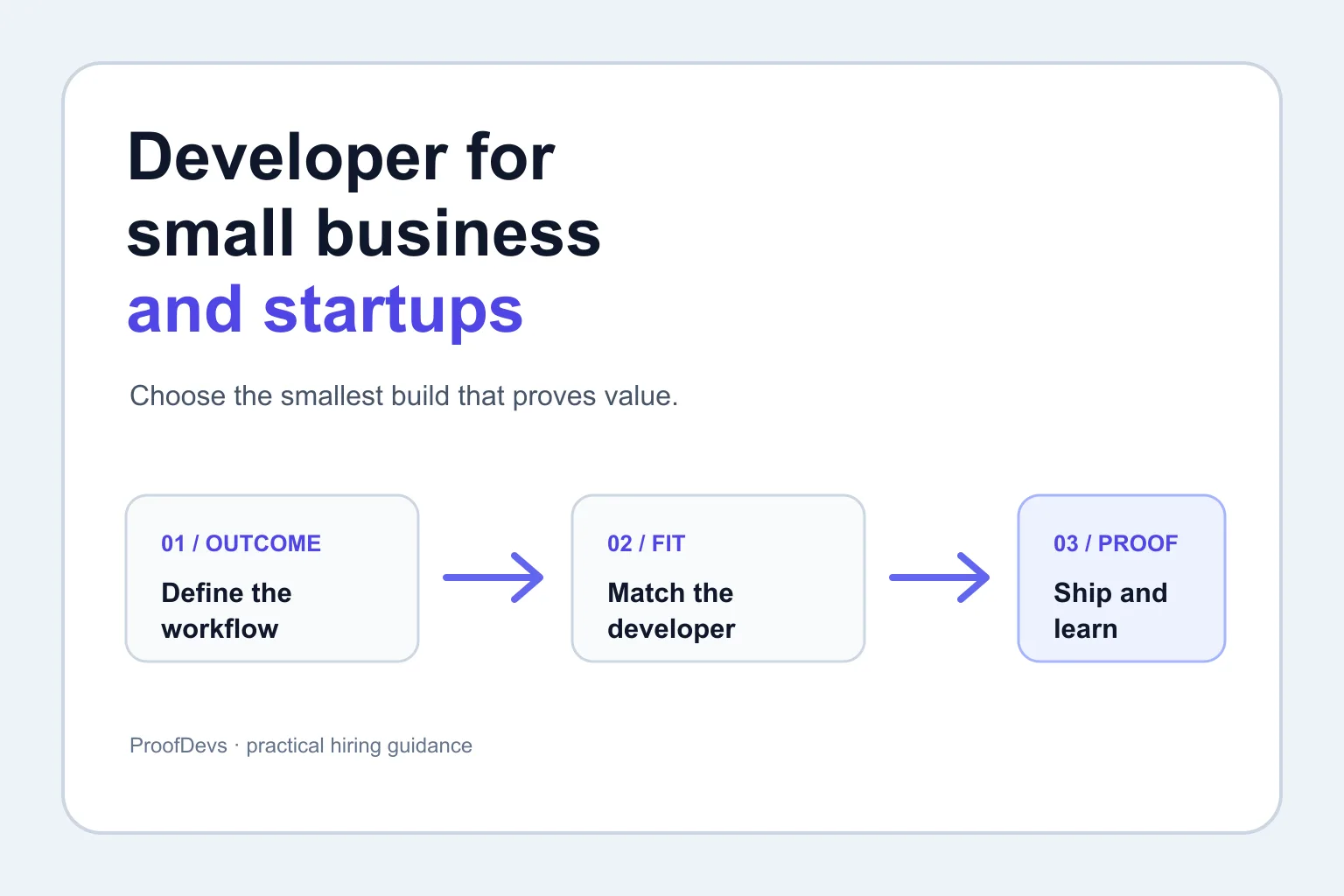
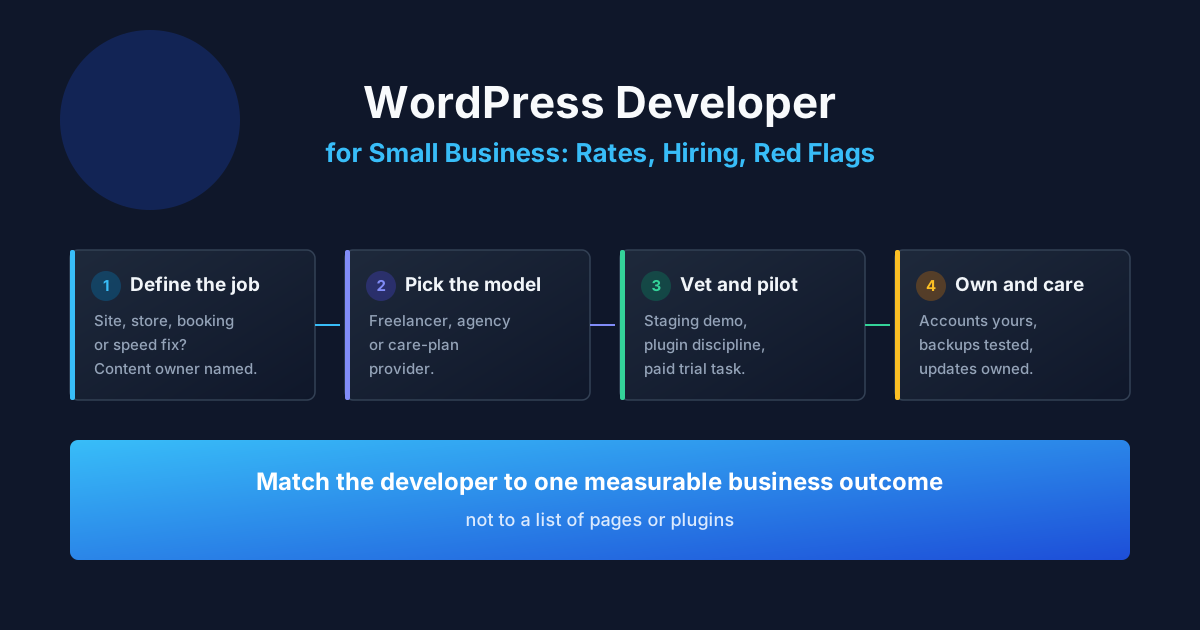
A developer for a small business should be hired around a measurable business outcome, not a long list of technologies. That outcome might be a website that turns local searches into enquiries, an ordering workflow that removes spreadsheet work, or a small app that lets customers complete one important task without calling your team.
Startups have a similar need but a different risk: the product may still be changing. The best developer for a startup can make progress while assumptions are being tested, explain tradeoffs in plain language, and leave the business with software another person can maintain. Reviewed September 2026. Budget figures below are illustrative planning examples, not market averages or ProofDevs quotes.
What does a developer for a small business actually do?
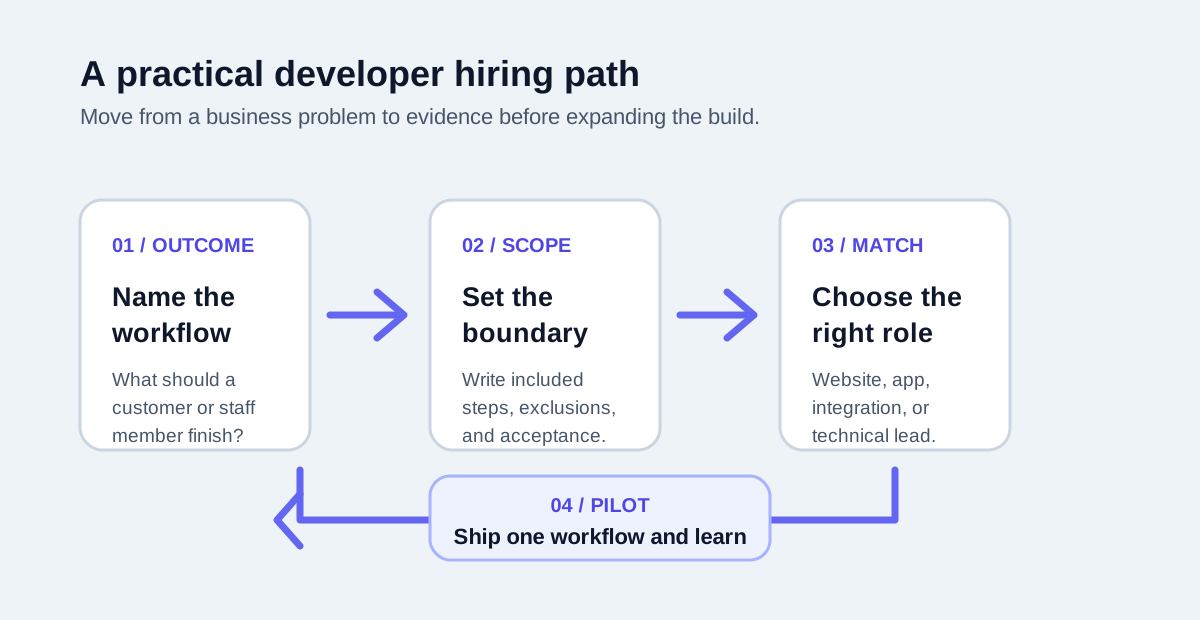
A small-business developer turns a defined business workflow into a working website, web application, mobile app, integration, or automation. The deliverable should include the operational details around the code: a usable interface, error handling, analytics where needed, deployment, access to accounts, and a handover that lets the business keep operating.
The role is broader than “someone who can code a page.” A useful brief names the customer or staff task, the business rule, the data involved, and the evidence that the result works. A developer can then recommend whether you need a custom build, a configured platform, or a smaller experiment.
| Business need | Likely first deliverable | Proof that it worked |
|---|---|---|
| More qualified enquiries | Fast service pages, forms, tracking, and a clear follow-up path | Correct enquiries reach the right person and can be attributed |
| Less manual administration | Internal dashboard, automation, or an integration with existing tools | A real staff task takes fewer steps with fewer duplicate records |
| Online selling or booking | Catalog, checkout, scheduling, or a focused customer portal | A customer can complete the intended flow without staff intervention |
| New product idea | Small MVP or paid pilot around one user workflow | Target users complete the workflow and give evidence for the next decision |
Small-business developer or startup developer?
The same person may serve both audiences, but the buying decision is different. A small business often needs dependable execution around an established process. An early startup needs someone comfortable with uncertainty, short feedback loops, and deliberate learning before scale.
| Question | Small business | Early startup |
|---|---|---|
| What is already known? | The business process and customer are usually visible | The customer, pricing, or workflow may still be an assumption |
| Best first scope | One workflow that saves time or creates revenue | One experiment that tests a high-risk product assumption |
| Most valuable trait | Reliability, clarity, and practical integration experience | Product judgment, adaptability, and fast evidence gathering |
| Main hiring risk | Paying for a custom system where a configured tool would work | Building too much before users confirm the problem |
If you are a non-technical founder, you do not need to become an engineer before hiring. You do need a person who can own product decisions and an independent technical review for security, data access, and maintainability. Our guide to hiring a developer as a non-technical founder explains how to run a paid pilot without pretending to judge every line of code.
Choose the smallest engagement that can prove value
The right engagement is the smallest one that can produce evidence for your next business decision. Do not hire a full-time team when a two-week discovery or a limited website release can answer the main question.
| Engagement | Good fit | Watch for |
|---|---|---|
| Fixed-scope website | Service pages, lead capture, content, local search, or a small store | Unclear copy, design, or approval ownership can turn a short build into an open-ended project |
| Paid discovery or prototype | You need to test a workflow, integration, or technical assumption first | A prototype is evidence, not automatically production software |
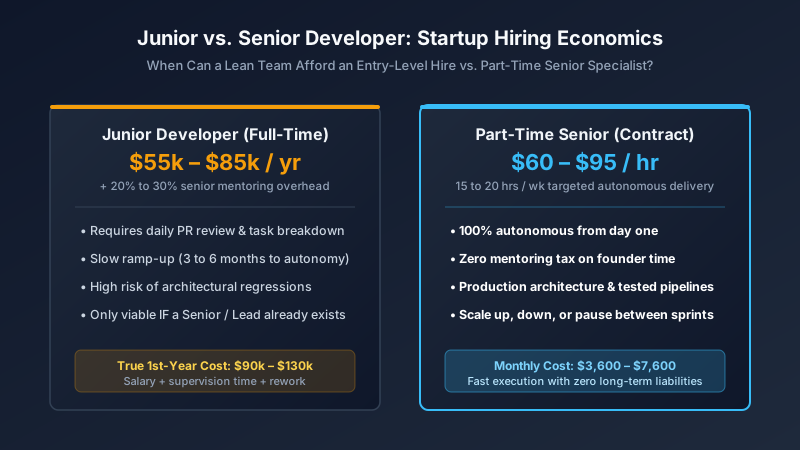
| Part-time developer | You have a continuing backlog but not enough work for a full-time hire | Someone on your side must prioritize and review the work each week |
| Short-term app build | A mobile or web app has one validated user journey to deliver | App-store operations, analytics, support, and privacy work need explicit owners |
| Full-time employee | Engineering work will remain sustained and you can provide technical leadership | One employee cannot cover product, design, QA, security, and operations indefinitely |
A fractional CTO or technical consultant may be the missing role when nobody can set technical priorities or assess a proposal. That adviser should be contracted to make the decisions you need; do not assume that “CTO” includes hands-on development. See what a fractional CTO does before combining the roles.
When should a small business hire a website developer?
Hire a website developer when the site must do more than display information: it needs to generate measurable enquiries, sell products, accept bookings, connect systems, or present a customer-specific workflow. For a simple brochure site, a builder or a well-configured CMS may be cheaper and easier to maintain.
A website developer for small business should clarify who supplies copy, photography, branding, accessibility decisions, analytics accounts, domain access, and post-launch updates. A quote that only lists “five pages” leaves the most expensive questions unanswered.
- Marketing site: define the conversion event, service areas, content owner, and analytics event.
- Online store: define products, inventory rules, taxes, shipping, payment failures, refunds, and order notifications.
- Booking site: define availability, rescheduling, cancellations, reminders, and what happens when two people request the same slot.
- Customer portal: define account recovery, permissions, data retention, and the support process when a user cannot sign in.
For a broader decision about custom software versus an existing platform, compare the tradeoffs in our build-versus-buy assessment.
When does an app developer make sense for a small business?
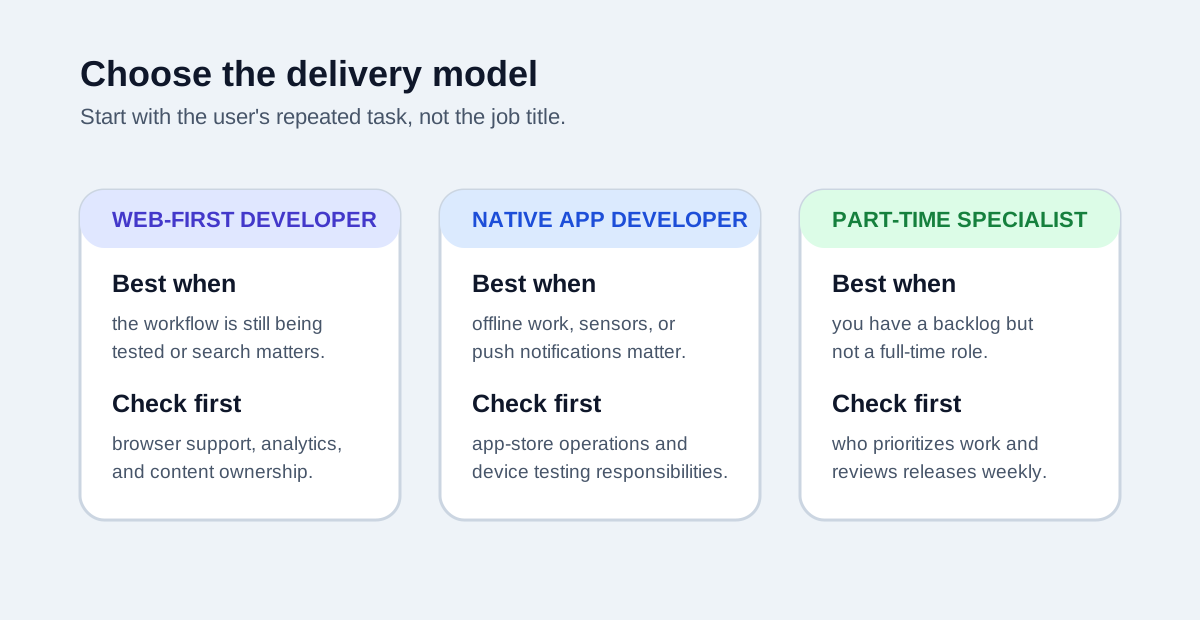
An app developer for small business is justified when a mobile experience creates a repeated advantage that a responsive website or existing tool cannot provide. That advantage could be offline work, device capabilities, push notifications, field workflows, or frequent customer use.
Ask for a web-first comparison before commissioning iOS and Android apps. A responsive web app can test the workflow and reduce installation friction. If the pilot proves frequent use or a device-specific need, the next release can add native capabilities with better evidence.
| Choose a web app first when… | Choose native mobile work sooner when… |
|---|---|
| Users can complete the task in a browser | Offline access is essential to the job |
| You are still testing the workflow or pricing | Camera, Bluetooth, GPS, or background notifications are central |
| Search traffic and shareable links matter | Frequent repeat use makes installation worthwhile |
| You need one codebase and a quick pilot | App-store distribution and device integration are part of the business model |
Five common hiring situations
Use the situation, not the job title, to decide what to buy first.
- A local service business receives enquiries by phone. Hire a web developer for a focused site, service-area pages, a short form, call tracking, and a follow-up workflow. The first result is correctly routed enquiries, not a decorative redesign.
- A distributor re-enters orders from email and spreadsheets. Hire a developer experienced with integrations and internal tools. Start with one product group and one export path; measure time saved and duplicate-order reduction before expanding.
- A founder has validated a problem but not the product. Find a developer for your startup who can build a narrow paid pilot and instrument the user journey. Keep payments, roles, and edge cases limited to what the test requires.
- A retailer needs repeat mobile ordering. Begin with a responsive ordering flow unless offline access or device features are essential. Add a native app after repeat use justifies another distribution channel.
- A previous contractor left an unfinished build. Hire a rescue developer for an assessment and handover before promising new features. Inventory the repository, hosting, domains, credentials, data, and deployment path first.
How to find developers for startups and small businesses
Find candidates where they can show relevant shipped work: trusted founder referrals, specialist directories, local technology communities, and profiles with a clear individual contribution. “Full-stack” or “startup developer” is only a starting label; the evidence must match your workflow.
When looking for developers for startups, ask each candidate to explain one product they shipped under changing requirements. When looking for a small-business developer, ask how they handle content ownership, third-party accounts, analytics, backups, and a staff member who is not technical. These questions reveal fit faster than a long list of frameworks.
You can browse independent developer profiles on ProofDevs or use the directory as a comparison point while collecting referrals. Availability, scope, and pricing still need to be confirmed directly.
How to vet a developer without becoming technical
Evaluate the developer's reasoning and delivery evidence rather than trying to perform a coding interview. A short paid task is often more informative than an unpaid take-home assignment or a polished portfolio.
- Ask for a relevant example. What did the product do, what did this person own, and what changed after launch?
- Request a written plan. It should state assumptions, exclusions, dependencies, milestones, and how acceptance will be checked.
- Run a small paid pilot. Use one workflow that can be demonstrated to a real user or staff member.
- Check communication under uncertainty. Ask what they would do if an integration, estimate, or requirement turned out to be wrong.
- Use a technical reviewer for high-risk areas. Payments, authentication, personal data, permissions, and production deployment deserve an independent check.
Useful warning signs include a confident fixed quote before questions are answered, a portfolio with no explanation of the candidate's contribution, requests to put domains or production accounts in the developer's name, and resistance to a staged handover.
Write a brief that a developer can estimate
A good brief describes a user, a task, a constraint, and an observable result. It does not need to prescribe the framework.
Example: “Independent cleaning companies need to send a quote after a site visit. The pilot must let a staff member enter room counts, choose standard add-ons, generate a branded quote, and email it to the customer. The owner will test it with five staff members. Online payments, route planning, and a native app are outside this release. A quote is accepted when the same job produces the same total, the customer receives the correct PDF, and the owner can change a price without editing code.”
Add the information a developer cannot infer:
- who approves decisions and how quickly they can respond;
- existing domains, designs, content, code, accounts, and data exports;
- the budget ceiling, currency, desired date, and what can move;
- privacy, payment, accessibility, and retention requirements;
- what you will measure after launch and who will support users.
How much does a developer for a small business cost?
The cost depends on the workflow, risk, specialist mix, and how much product definition already exists. A short website release can be priced very differently from an app with accounts, payments, notifications, and ongoing support. Treat any number as a planning scenario until a developer has reviewed the scope.
Illustrative planning example: 60 hours of development at $60 per hour is $3,600. Add 12 hours of client review and content coordination valued at $75 per hour ($900), plus a $500 allowance for tools and launch work. The planning envelope is $5,000 before tax and any ongoing support. The arithmetic is an example for comparing scope, not a market rate.
Ask for an itemized quote that separates discovery, design, development, testing, deployment, third-party costs, and maintenance. Compare the assumptions behind two proposals instead of comparing only their totals. Our freelance developer hiring guide covers rates, contracts, and ownership questions in more detail.
Protect ownership and continuity before work starts
The business should control the domain, hosting account, source repository, analytics, payment account, email provider, and production credentials. Invite the developer to those systems with the minimum access needed, and document the access before the first release.
Your agreement should define intellectual-property transfer, open-source obligations, data processing, security expectations, warranty or bug-fix terms, support response times, and what happens if the developer becomes unavailable. Require a deployable branch, environment notes, backups, and a handover before the final payment.
For authentication, payments, or personal data, ask for a security review and a plain-language explanation of the threat model. The OWASP Application Security Verification Standard is a useful reference for turning vague “secure enough” promises into review questions.
When should you not hire a custom developer?
Do not commission custom software when the business problem is still undefined, an established product already covers the workflow, or nobody can make weekly decisions. Configure an existing platform, run a manual service, or test demand with a landing page first.
Custom development becomes easier to justify when the manual workaround is expensive, the workflow differentiates your offer, the required integration does not exist, or the customer experience itself is the product. If the decision is unclear, buy a short assessment rather than a large build.
FAQ: developer for small business and startup hiring
What kind of developer does a small business need first?
Start with the workflow. A web developer fits a customer-facing site or portal; a full-stack developer can suit a small web product; an integration specialist fits data flowing between existing tools. Choose a narrower specialist when the risk is clearly payments, analytics, automation, or a specific platform.
Should a small business hire a freelance developer or an agency?
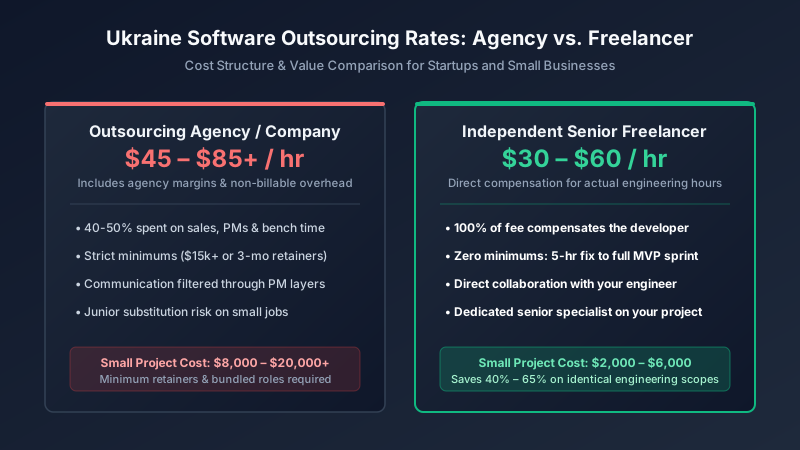
Hire a freelancer when one person can deliver a bounded outcome and someone on your side can make decisions. Choose an agency when you need several disciplines, a delivery manager, or broader coverage. Compare who will actually do the work and who owns the handover. For a wider comparison of outsourcing, in-house hiring, and independent developers, see our development engagement model guide.
Is a website developer enough for a small business app?
Sometimes. A developer who builds responsive web applications may be enough for a browser-based pilot. Native iOS or Android work requires additional knowledge of device behavior, app-store release processes, notifications, and mobile testing.
How do I find a developer for my startup idea?
Describe the user, the risky assumption, and the smallest test before searching. Then use referrals, specialist directories, and relevant communities to find developers who can explain similar shipped work. Begin with a paid discovery or pilot when the product is not yet fully defined.
Should a startup hire a full-stack developer first?
A strong full-stack developer can be a practical first builder for a narrow web MVP, but the title does not prove product judgment, security knowledge, or design ability. Hire around the next release and add specialist review where the risk requires it.
How much does a small-business website developer charge?
There is no useful single price without scope. Ask for a quote that states pages, workflows, integrations, content responsibility, testing, deployment, and post-launch support. Use an itemized proposal to compare assumptions rather than relying on an hourly number alone.
How much does an app developer for small business cost?
An app with accounts, payments, notifications, device features, and two app stores costs more to build and support than a simple responsive web app. Start with the smallest validated platform and ask the developer to identify the mobile-specific work before estimating.
Can a non-technical owner manage a developer?
Yes, if the owner can describe the customer problem, make product decisions, review demonstrations, and keep feedback timely. Use a technical reviewer or fractional CTO for architecture, security, and maintainability questions that the owner cannot assess.
What should be in a developer contract?
Include scope, milestones, acceptance criteria, payment terms, ownership of code and accounts, confidentiality, data handling, third-party licenses, support, warranty, change control, and termination or handover terms. Have local counsel review employment, tax, and data-processing obligations where relevant.
How do I know whether a developer's portfolio is relevant?
Ask what the developer personally delivered, what constraints existed, which decisions changed, and how the system was maintained after launch. A visually similar screenshot is weaker evidence than a clear explanation of a comparable workflow.
Should I hire a developer before validating a startup idea?
Usually validate the riskiest customer and business assumptions first with conversations, a landing page, a manual service, or a clickable prototype. Hire for working software when a developer can test a specific workflow that those earlier steps cannot test.
What if the developer disappears halfway through?
Keep the repository, domain, hosting, and third-party accounts under your control. Use milestones, regular demonstrations, written deployment notes, and a backup or handover clause. If the project is already stuck, buy an assessment before agreeing to new features; our developer-disappeared checklist covers the first checks.
Is a no-code tool better than hiring a developer?
A no-code tool is often better when it already supports the workflow and your team can operate it. Hire a developer when the tool blocks a necessary integration, customer experience, data rule, or scale requirement. A short comparison can prevent an expensive custom build.
What should happen after the first release?
Review actual usage, support questions, errors, conversion, and operational time saved. Keep, change, or stop the next scope based on that evidence. A developer should leave you with enough documentation and access to make that decision without being locked into an unexplained system.
Have a concrete business workflow but are unsure whether you need a website developer, app developer, specialist, or technical adviser? Send the brief to ProofDevs and ask for a scope conversation before committing to a larger engagement.
Written by Michael Melnyk
Senior IT Technical Writer & Technology Analyst
Senior Technical Writer and IT Industry Analyst with over 7 years of experience analyzing software engineering ecosystems, tech leadership models, and developer procurement frameworks.