Build vs Hire vs Outsource Software Development: A Decision Guide
The cheapest quote can create the most expensive dependency. Use this decision guide to separate core product work, repeatable capacity, and bounded delivery before choosing an in-house developer or an external partner.

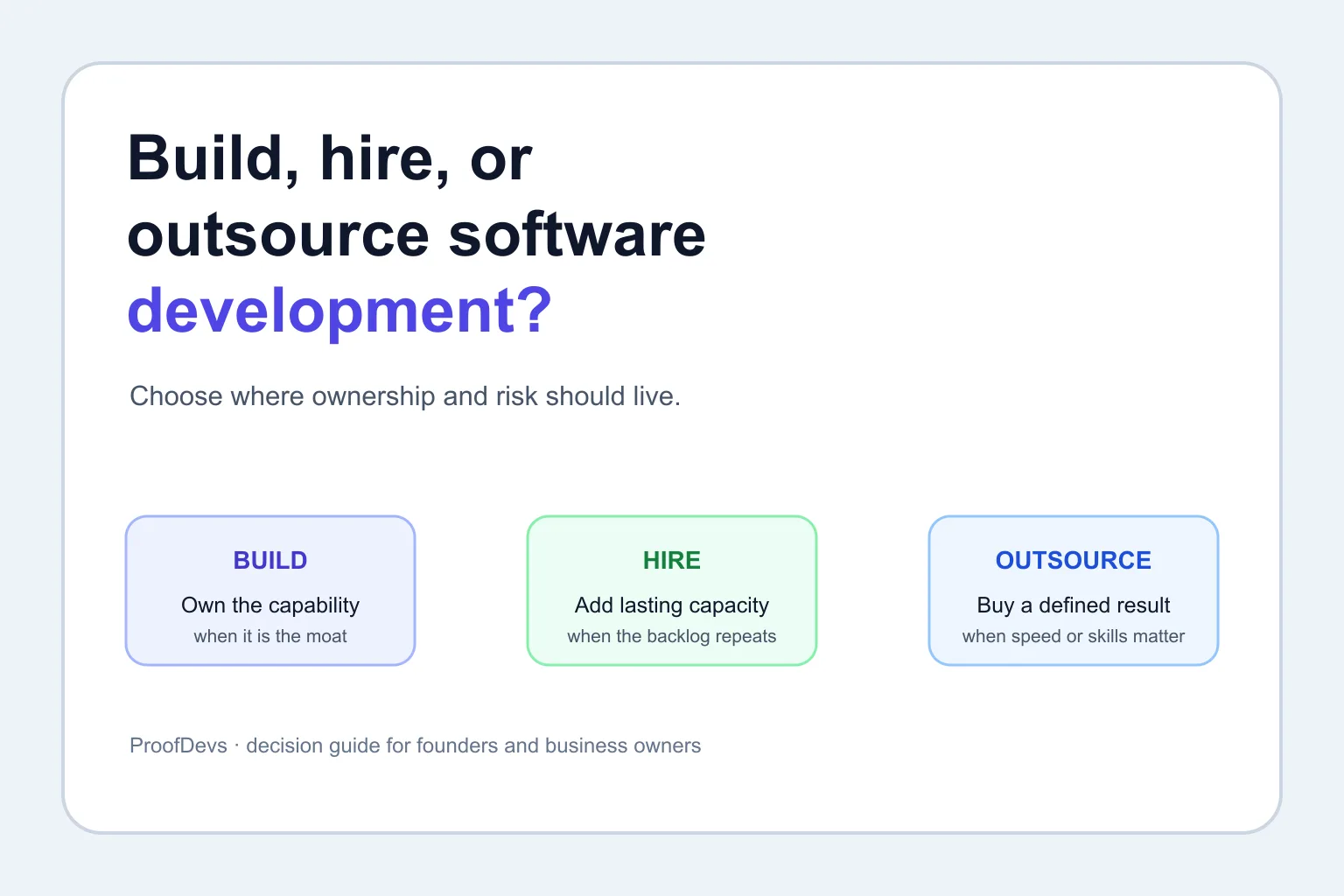
Build software in-house when the technology is part of your competitive advantage, hire directly when you have a durable engineering backlog, and outsource when you need a bounded result or a specialist capability faster than you can create it internally. The best decision is often a split: keep product-defining knowledge close to the company and buy temporary capacity for work that does not need to become a permanent department.
The phrase “build vs hire vs outsource software development” combines two different choices. Build usually means building internal engineering capability; hire means adding a developer as an employee or direct contractor; and outsource means contracting an external agency, studio, or independent developer to deliver agreed work. First check whether an existing product can be configured instead of building anything custom. Cost examples below are illustrative planning calculations, not market averages or ProofDevs quotes.
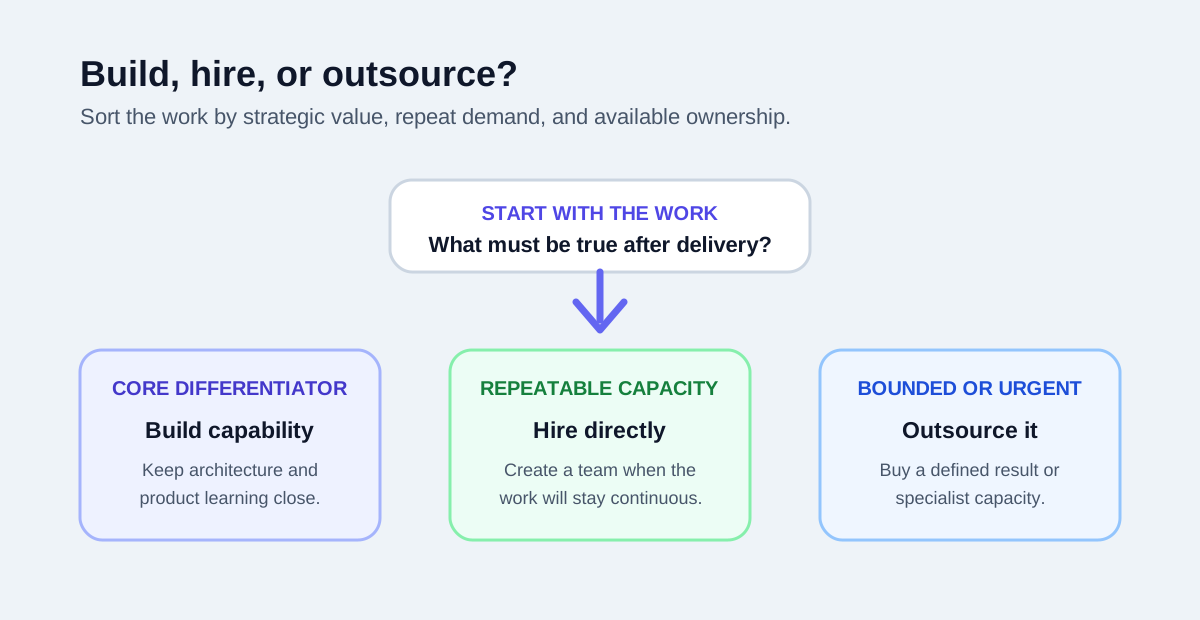
The short answer: decide where the risk should live
Choose the model that puts the hardest risk next to the person who can manage it. If the risk is product learning and architecture, keep a technical owner close to the business. If the risk is sustained capacity, hire or grow an internal team. If the risk is a temporary skills gap or a deadline, outsource a clearly defined result with an explicit handover.
- Build internal capability: best for core intellectual property, continuous product learning, and work that will remain central for years.
- Hire a developer directly: best for a recurring backlog where one person will become part of the operating team.
- Outsource software development: best for a bounded project, an unusual specialist skill, a rescue engagement, or a deadline that your current team cannot meet.
- Use a hybrid: best when your team must own decisions and architecture while an outside developer supplies delivery capacity.
The model is a business decision, not a verdict on whether external developers are good enough. A strong outsourced team can be more effective than an unprepared internal hire, while an employee can be the wrong choice when nobody has time to manage them.
What build, hire, and outsource mean in practice
Build in-house means the company creates the capability to design, code, test, deploy, and maintain software with people it manages directly. That may begin with one employee and a specialist adviser; it does not require a large engineering department on day one.
Hire a developer means adding a person to the company’s recurring operating system. The person may be a full-time employee or a direct contract developer, but the company owns priorities, feedback, access, and the long-term relationship.
Outsource software development means buying delivery from an outside party. “Outsource” can describe a development agency, a dedicated development team, or a senior independent developer. The contract should state whether the supplier owns only implementation or also discovery, design, QA, infrastructure, support, and delivery management. For an in-depth breakdown of dedicated engineering capacity versus turnkey agency contracts, read our guide on outstaffing vs outsourcing in Ukraine.
These labels are not enough to compare proposals. Ask who makes technical decisions, who can change priorities, where the repository lives, who responds to production incidents, and what happens when the named developer leaves.
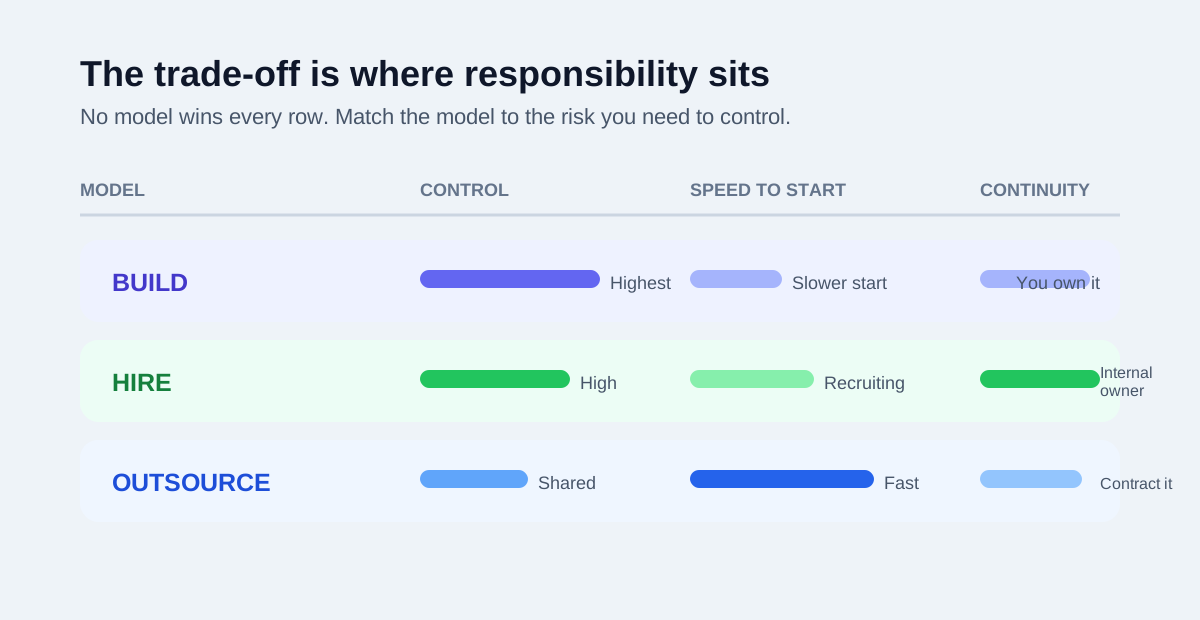
Compare the three models on the decisions that matter
Price is only one row in the decision. A lower invoice can still cost more if it creates rework, delays learning, or leaves the company unable to operate the system.
| Decision factor | Build internal capability | Hire directly | Outsource software development |
|---|---|---|---|
| Control over priorities | Highest, if leadership is ready | High, through the team lead | Depends on the contract and delivery model |
| Speed to start | Slowest while the capability is created | Limited by sourcing, interviews, and notice | Often fastest for a well-scoped task |
| Product learning | Stays close to the product team | Accumulates with the employee | Must be deliberately transferred and documented |
| Specialist access | Requires internal training or new hires | Requires finding and retaining the skill | Can be purchased for the period it is needed |
| Continuity risk | Company carries team and succession risk | One employee can become a bottleneck | Supplier dependency and handover risk must be managed |
| Best first scope | Core product or repeated platform work | Recurring backlog with one clear owner | Bounded feature, assessment, migration, or rescue |
Build software in-house when the technology is the moat
Build internal capability when the software itself creates the advantage customers pay for or competitors cannot easily copy. The work may include a proprietary workflow, a data model that improves with use, a regulated process, or infrastructure that determines the product’s performance.
Internal capability is also valuable when the product changes through constant customer learning. A team that speaks directly with users can shorten the loop between a support question, a product decision, and a safe release. That benefit disappears if every change must be translated through a supplier who does not share the context.
- Good fit: the product’s core workflow is the company’s differentiator.
- Good fit: the same architecture and domain decisions will be revisited every week.
- Good fit: data, compliance, or security requirements need an internal owner.
- Poor fit: the work is a one-time migration, a short website project, or a temporary integration.
- Poor fit: nobody inside the company can lead engineering or review the work.
“Build in-house” should not be used as a reflex. A small team can keep its core product internal while using a specialist for a payment migration, accessibility review, mobile release, or infrastructure assessment.
Hire a developer directly when the backlog will keep returning
Hire directly when you can describe the work that will still exist after the first release. A direct developer becomes valuable when they own context, improve the codebase over time, and collaborate with product, operations, and customers instead of delivering a single isolated milestone.
Before opening a role, answer three questions: who will manage the developer, what technical decisions can they make, and how will you cover design, QA, security, and operations outside their strengths? A “full-stack developer” title does not automatically cover every function a growing product needs.
| Hire directly when… | Prepare before hiring |
|---|---|
| The backlog is continuous for at least the next planning cycle | A product owner and technical reviewer are available |
| The developer must retain deep domain context | Repository, accounts, environments, and decision records are organized |
| You need daily collaboration with internal staff | You can explain the role’s boundaries and first 90-day outcome |
| You can support employment or direct contract obligations | Local counsel or an HR adviser has checked the arrangement |
For a short-term need, a contract developer can be a better fit than a permanent hire. Treat it as a direct relationship with a fixed purpose, clear access, and a handover date, rather than an indefinite substitute for technical leadership.
Outsource software development when the result is bounded
Outsource when you can write down what will be delivered, how acceptance will be checked, and who will own the result afterward. External development works well for a fixed workflow, a migration, a new platform integration, an independent technical assessment, or a rescue project with a defined first milestone.
Outsourcing also makes sense when the skill is important but not permanent. An experienced developer can solve a difficult performance issue or prepare a mobile release without becoming a full-time cost centre. The contract must still protect repository access, documentation, credentials, data, and intellectual property.
- Choose an agency when you need several disciplines, project management, and one delivery agreement.
- Choose an independent developer when the scope is narrow and you want a direct technical relationship.
- Choose a dedicated team when you need several people for a sustained release programme but do not want to recruit every role immediately.
Do not outsource the decision about what success means. Your business should own the outcome, priorities, acceptance criteria, and access to the live system even when another party writes the code.
The hybrid model is often the deliberate answer
Many sensible teams keep product ownership and architecture internal while outsourcing defined delivery. A product lead may own the roadmap, a fractional CTO may review technical decisions, and an independent developer may ship a customer portal. This arrangement can be faster than hiring a complete team and safer than handing every decision to a supplier.
Write the boundary in the brief. State which decisions the outside developer can make, which changes need approval, how pull requests are reviewed, and who responds when an integration fails. Hybrid work fails when everyone assumes somebody else owns the gap.
Model the full cost instead of comparing hourly rates
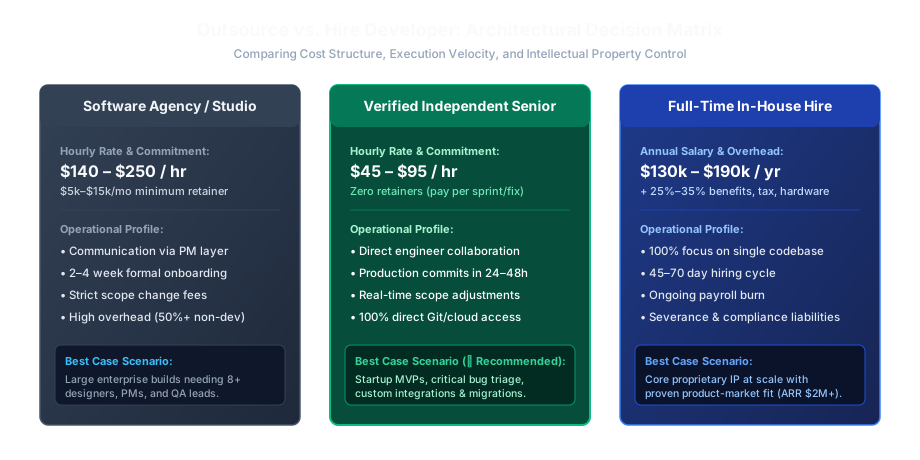
Compare the cost of the engagement, not only the rate shown on a proposal. Include recruiting time, management time, onboarding, equipment, software licenses, taxes or benefits, supplier overhead, technical review, rework, support, and the cost of a delayed launch.
Illustrative scenario: an internal hire paid $8,000 per month may require a recruiting budget, a manager’s time, equipment, and several weeks before productive delivery. An outsourced project quoted at $18,000 may start sooner but require an internal reviewer and a maintenance plan. A direct senior contractor at $65 per hour for 80 hours is $5,200 for a focused month, but the company still owns prioritization and review. These are planning examples; they are not comparable offers until scope and responsibilities match.
Use a decision sheet with four totals:
- cash paid to the developer, employee, or supplier;
- internal time required to manage and review the work;
- one-time setup, migration, security, and handover work;
- ongoing support and the cost of replacing the model later.
Our outsource versus hire comparison covers cost, control, repository access, and operating friction in more detail.
Protect IP, access, and continuity in every model
The safest delivery model still fails if the company cannot access its own software. Keep the domain, cloud account, source repository, analytics, payment account, email provider, and production credentials under business control. Grant people the access they need instead of putting critical accounts in a supplier’s personal name.
Your agreement should cover:
- ownership and assignment of code, designs, documentation, and data;
- open-source and third-party license obligations;
- security, privacy, backups, and incident response;
- acceptance criteria, change control, and payment milestones;
- support, warranty, response times, and termination;
- handover notes, deployment instructions, credentials, and a replacement path.
Ask a technical reviewer to inspect authentication, permissions, payments, personal data, backups, and deployment before the final milestone. A finished interface is not evidence that the business can safely operate the system.
Choose by company stage and work type
| Situation | Starting model | Reason |
|---|---|---|
| Unvalidated startup idea | Short discovery, prototype, or manual test | Reduce product uncertainty before creating a permanent team |
| Early MVP with a clear workflow | Independent developer plus technical review | Ship evidence without committing to a large organisation |
| Growing product with a stable backlog | Direct hire or internal core plus external capacity | Retain context while scaling delivery |
| Small business with a one-time system change | Bounded outsourced project | Buy the result without creating a permanent engineering function |
| Regulated or highly proprietary product | Internal technical ownership with selected specialists | Keep critical decisions, data, and learning close to the company |
Five examples of the decision in practice
- A logistics startup is testing route optimisation. Keep the data model and product decisions internal, then outsource a narrow algorithm assessment. Hire only after the experiment proves that this capability will remain central.
- A professional services firm needs a client portal. Outsource a defined first release with repository ownership, acceptance checks, and a maintenance handover. A full-time engineer is unnecessary until portal work becomes a recurring backlog.
- An ecommerce company has a permanent stream of checkout work. Hire directly or build an internal core because payment decisions and customer context will repeat every week. Use specialists for security reviews or a platform migration.
- A founder needs a mobile pilot in six weeks. Start with an independent app developer or a small external team, limit the pilot to one user journey, and decide later whether mobile engineering belongs inside the company.
- A SaaS company is preparing for a security review. Keep product ownership internal and outsource an independent assessment. Do not ask the same team that wrote the system to be the only evidence that it is safe.
Run a decision workshop before signing a contract
Bring the product owner, budget owner, and technical reviewer into one short session. Write the answers down before comparing vendors or candidates.
- What customer or staff workflow must improve?
- Which part of the software is strategically differentiating?
- Will the same type of work exist after the first release?
- Who can make technical and product decisions each week?
- What must be delivered by a fixed date, and what can move?
- What access, data, security, and compliance constraints apply?
- What evidence will make you continue, change the model, or stop?
Then ask candidates or suppliers to list assumptions, exclusions, dependencies, and the first milestone. A proposal that cannot explain its boundary is not comparable to one that can.
Questions to ask a developer, agency, or hiring candidate
- What similar workflow have you shipped, and what did you personally own?
- Which assumptions could change the estimate?
- Where will the repository, hosting, analytics, and production accounts live?
- How will a non-technical owner accept each milestone?
- What happens if the named developer becomes unavailable?
- What will you document so another developer can take over?
- Which parts should we configure or buy instead of building?
- What would make you recommend a different delivery model?
FAQ: build vs hire vs outsource software development
Is it cheaper to build software in-house or outsource it?
There is no universal cheaper option. Outsourcing can reduce initial recruiting and speed up a bounded project, while internal development can reduce repeated supplier context costs over a long product life. Compare the full cash, management, rework, support, and replacement costs.
Should a startup hire developers or outsource the MVP?
Outsource or use an independent developer when the MVP is a narrow test and the team can define acceptance. Hire directly when the product already has a validated, recurring backlog and the developer will retain valuable domain context after launch.
When should a company build software in-house?
Build in-house when software is the product’s differentiator, the architecture changes continuously with customer learning, or data and compliance require an internal owner. Keep a technical lead accountable even when specialists are external.
When should a company outsource software development?
Outsource when the work has a clear boundary, a temporary specialist need, a migration, a rescue milestone, or a deadline that the current team cannot meet. Keep decisions, access, acceptance, and handover under business control.
What is the difference between hiring a developer and outsourcing?
Hiring gives the company a direct person to manage and retain. Outsourcing buys delivery from an external party whose responsibilities are defined by the contract. A contract developer can sit between the models, so clarify who manages the work and who owns the result.
Is a development agency better than an in-house team?
An agency is better when you need several disciplines or managed delivery for a bounded scope. An in-house team is better when product context and continuous technical ownership are central. Neither model removes the need for a clear business owner.
Should I hire a freelance software engineer or an agency?
Choose an independent developer for a narrow scope and direct collaboration. Choose an agency when you need design, QA, project management, infrastructure, or broader delivery coverage. Compare the actual people assigned, not only the company profile.
What does a dedicated development team mean?
A dedicated team is an external group allocated to one client for an ongoing period. It may include delivery management and several roles, or it may simply be a staffing arrangement. Ask who directs priorities, who reviews work, and how the team is replaced.
How do I protect intellectual property when I outsource?
Put ownership and assignment terms in the contract, keep the repository and critical accounts under the company’s control, record third-party licenses, and require a documented handover. Have local counsel check the agreement for the relevant countries.
Can I outsource development and still own the code?
Yes, if the agreement assigns the deliverables and the company controls the repository, accounts, and data. Ownership language alone is weak if a supplier can withhold the code or production credentials.
How long does it take to hire an in-house developer?
Timing depends on the market, seniority, location, interview process, and notice period. Treat the hiring timeline as a planning variable rather than promising a fixed number. A short external assessment can keep a critical decision moving while you recruit.
What if the outsourced developer disappears?
Keep accounts and the repository in the company’s name, use milestones, require regular demonstrations, and document deployment and handover steps. If a project is already stuck, buy a technical assessment before commissioning more features.
Should a small business build custom software or buy a SaaS tool?
Buy or configure an existing tool when it covers the workflow and the business can accept its constraints. Build custom software when the workflow, integration, or customer experience creates enough value to justify ownership and maintenance.
What is the best model for a non-technical founder?
Start with a clearly bounded pilot and an independent technical reviewer. The founder should own the customer problem, scope, priorities, and acceptance; the reviewer can assess architecture, security, and maintainability.
Can a hybrid build-and-outsource model work?
Yes. Keep product direction and critical architecture internal, then outsource defined features, specialist reviews, or temporary capacity. Write the boundary so that decisions and handover do not fall between the teams.
If you have a project but are unsure whether to build an internal team, hire a developer, or outsource the first release, send ProofDevs a short brief. A scope conversation can identify the smallest safe next step before you commit to a delivery model.
Written by Michael Melnyk
Senior IT Technical Writer & Technology Analyst
Senior Technical Writer and IT Industry Analyst with over 7 years of experience analyzing software engineering ecosystems, tech leadership models, and developer procurement frameworks.