Outsource vs. Hire Developer: Complete Cost, Speed, and Control Guide
Choosing between outsourcing to an agency, hiring in-house, or engaging a vetted independent developer determines your capital burn and technical velocity. Here is how the three models compare on real costs, repository access, and project failure rates.

Choosing between outsourcing your software project to an agency, hiring an in-house software engineer, or contracting an independent developer is the single largest factor determining development velocity, monthly capital burn, and intellectual property ownership.
For most growing businesses and early-stage founders, the question is framed as a binary dilemma: pay $150 to $250 per hour for a digital agency, or take on an annual $160,000 payroll liability for a full-time hire. In reality, a third commercial model—contracting a verified independent senior engineer—delivers the velocity and direct code access of an internal hire at a fraction of traditional agency overhead. If you are preparing to build or scale your product, you can find verified independent developers with commercial track records across modern tech stacks.
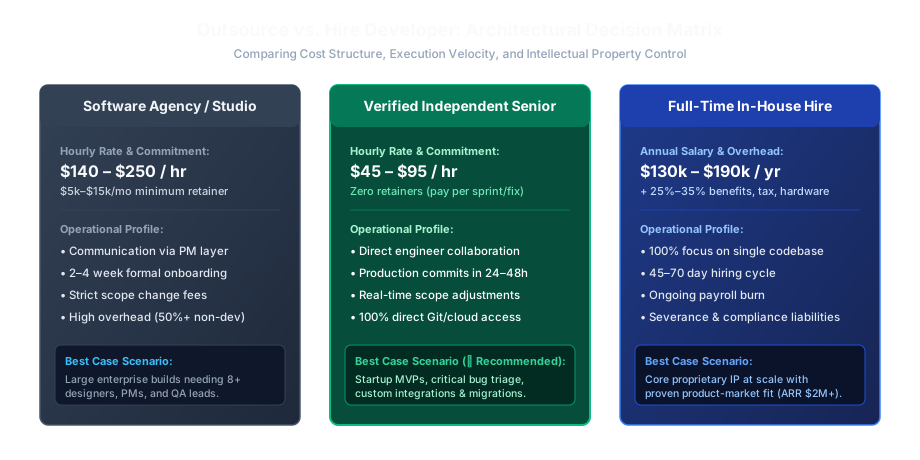
Figure 1: Architectural Decision Matrix comparing traditional agencies, verified independent seniors, and in-house engineering across hourly rates, commitments, and team structures.
What Is the Difference Between Outsourcing and Hiring a Developer?
Software outsourcing is the practice of delegating software design, coding, testing, and infrastructure management to an external organization (such as an IT agency, dev shop, or offshore firm) under a milestone or time-and-materials contract. Hiring a developer means bringing an individual software engineer directly into your organization—either as a permanent salaried employee or as an independent contractor who commits directly to your private code repository.
The difference between these approaches is not merely where the developer sits; it is a fundamental difference in communication layers, cost distribution, and operational accountability:
- In an agency outsourcing model: You buy a managed outcome. Your technical requirements are filtered through account managers and non-technical coordinators, meaning 50% to 65% of your hourly billing rate funds non-billable overhead rather than actual code production.
- In an in-house hiring model: You buy 100% of an engineer's time and organizational loyalty. However, you take on significant overhead: recruitment agency commissions (15%–25% of first-year salary), health benefits, payroll taxes, hardware provision, and 45 to 70 days of hiring lag.
- In a verified independent developer model: You engage a vetted solo senior engineer directly. You talk to the person writing the code, inspect pull requests directly in GitHub or GitLab, and pay strictly for productive sprint hours without ongoing retainers.
If you are exploring offshore or dedicated staffing alternatives, see our detailed guide comparing outstaffing vs outsourcing in Ukraine to evaluate cost structures and code control.
Comprehensive Comparison: Agency Outsourcing vs. In-House vs. Solo Senior
To evaluate which approach matches your technical scope, the table below compares the three primary models across commercial criteria, legal protections, and operational friction:
| Evaluation Factor | Traditional IT Agency / Dev Shop | Full-Time In-House Hire | ProofDevs Independent Senior |
|---|---|---|---|
| Effective Hourly Cost | $140 – $250 / hr | $85 – $145 / hr (salary + overhead) | $45 – $95 / hr |
| Minimum Commitment | $5,000 – $15,000 / mo retainer | 12+ months employment agreement | None (pay per sprint or fixed task) |
| Time-to-First-Commit | 2 – 4 weeks (discovery & scoping) | 45 – 70 days (recruiting & notice) | 24 – 48 hours after requirement review |
| Communication Path | Client → Account Rep → PM → Dev | Direct Slack / standup access | Direct technical Slack / video access |
| Code & Repository Access | Often held in agency Git until final bill | 100% internal Git from day one | 100% merchant/client Git repository |
| Scope Flexibility | Rigid change requests & renegotiation | High (reprioritize sprint backlog) | High (direct developer adjustments) |
| Best Suited Project Stage | Large multi-role builds ($100k+) | Core IP at scale (ARR $2M+) | MVPs, custom features, audits, bug fixes |
The Real Cost Breakdown: Where Does Your Software Dollar Go?
Comparing headline hourly rates is deceptive because agencies, recruitment firms, and independent contractors package internal overhead differently. Understanding the internal cost structure reveals why outsourcing quotes often feel disproportionate to the delivered features.
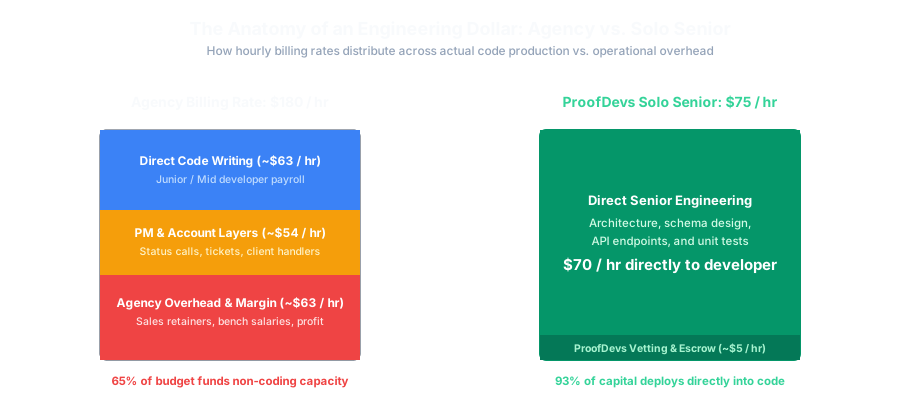
Figure 2: Distribution of billing capital between direct code production and administrative overhead.
1. Anatomy of an Agency Invoice ($180 / hr)
When an agency bills $180 per hour for a full-stack developer, that invoice must sustain the entire company infrastructure:
- Direct Engineering Payroll ($55 – $65 / hr): The actual salary of the developer assigned to your project (often a mid-level or junior engineer supervised by a senior lead).
- Project Management & QA Coordination ($45 – $55 / hr): Billing hours allocated to Scrum masters, client success handlers, and QA coordinators who translate client emails into Jira tickets.
- Agency Overhead & Sales Bench ($50 – $65 / hr): Non-billable bench time between client contracts, executive salaries, corporate office leases, legal retainers, and sales commissions.
2. Anatomy of an In-House Salary ($140,000 Base)
Hiring a full-time senior software engineer at a $140,000 annual base salary incurs significant hidden employer burdens according to US Department of Labor employer cost metrics:
- Recruiting Agency Fee: $21,000 – $28,000 (standard 15%–20% one-time placement fee).
- Payroll Taxes & Social Insurance: $11,000 – $14,000 annually.
- Healthcare, 401(k), & Benefits: $15,000 – $24,000 annually.
- Workstation, SaaS Tooling, & Cloud Sandboxes: $4,000 – $7,000 per seat.
- Total First-Year Outlay: $191,000 – $213,000 regardless of whether your product roadmap requires 40 hours of work per week.
3. Anatomy of a Verified Independent Senior ($65 / hr)
Working directly with an independent senior engineer eliminates corporate intermediary markups. Over 90% of your capital goes directly into feature development, architectural reviews, and automated test coverage. A 3-week feature sprint costing 60 engineering hours totals $3,900 on ProofDevs, compared to $12,000 to $18,000 under agency minimum billing caps.
When Should You Outsource to an Agency?
Outsourcing to a traditional software agency is justifiable under specific enterprise operating conditions where specialized cross-disciplinary teams are required simultaneously.
- Multi-disciplinary projects requiring 6+ simultaneous specialists: If your project requires brand strategy, high-fidelity 3D WebGL animation, native iOS Swift development, backend Go microservices, and dedicated manual regression testers, an agency can assemble this multidisciplinary squad without separate vendor contracts.
- Zero internal technical leadership: If your organization lacks anyone capable of evaluating code quality, writing technical specifications, or reviewing Git pull requests, an agency provides its own project management structure.
- Fixed enterprise budgets with enterprise indemnification: Large public corporations with rigid procurement guidelines often mandate vendor liability insurance ($5M+ umbrella policies) and formal corporate warranties that solo contractors cannot provide.
When Should You Hire a Full-Time In-House Developer?
Hiring an internal employee makes commercial sense when your company has achieved predictable product-market fit and code generation represents your primary enterprise asset.
- Proven business model with $2M+ Annual Recurring Revenue (ARR): When recurring revenue easily covers consistent monthly payroll, an internal engineer accumulates institutional domain knowledge that compounds over multiple years.
- Daily product experimentation: When your core product requires daily A/B testing, rapid continuous deployment, and immediate real-time pivots based on user session replays.
- Highly proprietary core IP: If your technological competitive advantage relies on proprietary machine learning algorithms or patent-pending data processing logic, venture capital investors strongly prefer internal equity-holding engineers over external agencies.
When Should You Hire a Verified Independent Senior Developer?
Engaging an independent senior software engineer is the optimal strategy for the vast majority of commercial software tasks where speed, budget efficiency, and technical precision are critical.
- Early-stage MVP build (Pre-seed to Seed): You have validated customer demand and need to ship a working web application in 4 to 8 weeks without burning your entire funding runway on agency discovery phases.
- Specific platform integrations & deep migrations: Adding a custom Stripe subscription billing flow, upgrading an ecommerce store with Shopify Checkout UI Extensions, or migrating a relational schema from MySQL to PostgreSQL.
- Codebase rescue & performance tuning: Resolving database locking deadlocks, eliminating Next.js hydration errors, or refactoring unmaintainable spaghetti code left behind by an offshore agency.
- Temporary capacity bursts: Your existing team is falling behind sprint deadlines and needs an experienced engineer who can clone the repository, pass local test suites, and deploy PRs within 48 hours without weeks of hand-holding.
3 Realistic Case Studies from Production Software Projects
The following real-world scenarios illustrate the operational outcomes of selecting different staffing paths.
Case Study 1: The E-Commerce Custom Subscription & Bundling Engine
Initial Situation
A direct-to-consumer wellness brand generating $3.5M in annual sales wanted to replace five third-party Shopify apps ($650/month in recurring fees) with a custom bundle-pricing app and Checkout UI extension to reduce mobile page load latency.
What Was Blocking Them
An e-commerce digital agency quoted $48,000 with a 14-week timeline, requiring a mandatory $6,000 monthly maintenance retainer and complete control over the private app repository.
The Solution
The merchant hired an independent senior Shopify and React engineer through ProofDevs at $85 per hour. Working directly with the merchant's technical founder, the engineer built a native Liquid section set, implemented Shopify Functions on WebAssembly for tier discounts, and deployed an idempotent webhook handler using Redis.
The Outcome
The build completed in 68 billable hours over 3 weeks, totaling $5,780 (an 88% reduction compared to the agency quote). Mobile Core Web Vitals improved from a 42 to 91 score on Google Lighthouse, and the store eliminated $7,800 in annual third-party app subscriptions.
Case Study 2: The SaaS MVP Launch Under Runway Pressure
Initial Situation
A B2B logistics startup closed a $250,000 pre-seed round and needed to launch a functional freight-tracking portal with authentication, role-based access control, and PostgreSQL database queries for ten pilot customers.
What Was Blocking Them
A recruiting firm proposed a 60-day search for two full-time in-house developers ($150,000 salary each plus a $50,000 upfront recruiting fee), which would have consumed over 60% of the startup's total capital before shipping a single feature.
The Solution
The founder engaged an independent senior Full Stack Next.js & PostgreSQL developer. The developer implemented a type-safe architecture using Next.js App Router, Supabase Auth with strict Row-Level Security, and automated Playwright integration tests.
The Outcome
The MVP was delivered in 7 weeks for a total investment of $14,200. The founder closed 8 paid pilot contracts, providing real revenue traction that unlocked a subsequent $1.2M seed round without early equity dilution.
Case Study 3: The Offshore Agency Codebase Rescue
Initial Situation
A legal tech firm outsourced the development of their document management platform to a low-cost offshore dev agency billing $35/hr. After six months and $45,000 spent, the application suffered from frequent database deadlocks, broken PDF generation queues, and lacked automated tests.
What Was Blocking Them
The offshore agency claimed the issues were caused by client hosting limits and demanded a $15,000 change order to refactor the database. Meanwhile, paying legal clients threatened contract cancellation.
The Solution
The firm engaged an independent senior Node.js and PostgreSQL performance engineer. The engineer conducted an emergency 10-hour query audit, identified unindexed foreign keys in PostgreSQL, migrated PDF processing to an asynchronous BullMQ queue with Redis, and eliminated connection pool exhaustion.
The Outcome
Production server response latency dropped from 4,200ms to 180ms within 5 days. Total triage investment was $2,400, permanently stabilizing the application and preventing the loss of $120,000 in annual recurring enterprise contracts.
7 Costly Mistakes Companies Make When Choosing a Development Model
- Equating High Agency Hourly Rates with Senior Technical Quality: Assuming a $200/hr agency fee guarantees senior engineering. In practice, agencies routinely assign junior or mid-level engineers to client accounts while senior architects only appear during pre-sales pitches.
- Relinquishing Code Repository Ownership: Allowing an agency or freelancer to host your source code on their personal GitHub or GitLab accounts. You must retain 100% administrative ownership of all repositories and cloud environments from day one.
- Hiring Full-Time Employees for Temporary Technical Problems: Adding a permanent $150,000 annual salary to resolve a 3-month integration backlog, resulting in painful layoffs or redundant payroll once the initial build stabilizes.
- Hiring Unvetted Freelancers on Open Job Boards: Posting on uncurated marketplaces and sifting through 150 generic AI-generated proposals, only to hire a contractor whose code fails basic security and sanitization checks.
- Neglecting Webhook Idempotency & Rate Limits: Contracting developers who build API integrations without persistent idempotency checks (such as missing Redis caches for Stripe webhooks), leading to duplicate charges and inventory race conditions.
- Failing to Define Clear Acceptance Criteria: Agreeing to vague "build our app" statements of work rather than measurable sprint milestones with automated unit test passes.
- Paying 100% Upfront Retainers: Transferring multi-month retainers before verifying that staging deployments meet agreed performance and architectural standards.
Expert Advice: The 4-Question Framework for Decision-Makers
When deciding between an agency, an in-house hire, or an independent senior engineer, run your project through this four-step decision framework:
1. Does this project define your permanent core IP? If yes, and you have sustained cash flow (ARR $2M+), hire an in-house lead engineer. If no, or if you are pre-seed, contract an independent specialist.
2. Does the task require an army or a surgeon? A broken payment webhook, slow database query, or Next.js App Router migration does not need an agency account team; it needs one senior engineer with three free days.
3. Who will talk to the engineer? If you have a technical founder or product manager, hiring an independent developer directly eliminates the 50% agency management markup.
4. What is the cost of delay? In-house hiring requires 60+ days; agencies require multi-week discovery phases. A verified independent senior can review requirements, clone your repository, and begin shipping within 24 to 48 hours.
Frequently Asked Questions
Is it cheaper to outsource or hire an in-house developer?
Outsourcing to independent developers is significantly cheaper for project-based work, MVPs, and specific feature builds, saving 60% to 75% compared to permanent full-time payroll, benefits, and recruiting fees. In-house hiring becomes cost-effective only when an engineer is fully utilized on core proprietary product development for more than 18 to 24 consecutive months.
Why are digital agencies so much more expensive than independent developers?
Agency rates ($140–$250/hr) include non-technical operational overhead: account managers, sales commissions, non-billable bench time, office leases, and executive profit margins. Independent senior developers bill directly ($45–$95/hr) for actual engineering hours without intermediary markups.
How fast can I onboard an independent developer compared to an in-house hire?
An independent developer on ProofDevs can be matched and onboarded into your private Git repository within 24 to 48 hours. In contrast, recruiting a full-time employee in the US or Europe averages 45 to 70 days between job posting, screening, interviews, and employee notice periods.
What are the primary risks of outsourcing to a software agency?
The primary risks include communication latency through account managers, junior developers assigned after contracts are signed, rigid scope change fees, and proprietary vendor lock-in if code repositories are not hosted in client-owned accounts.
Who owns the intellectual property and code when outsourcing?
Under professional contracts on ProofDevs, the client retains 100% intellectual property ownership of all source code, database migrations, credentials, and assets upon milestone approval. You should never sign an agreement that reserves code licensing rights to the vendor.
Can I hire an independent developer for a small 4-hour bug fix?
Yes. Unlike traditional agencies that require minimum retainers of $5,000 to $10,000, independent engineers on ProofDevs can be engaged for focused emergency fixes, database query optimization, or small feature sprints.
How do I know if an independent developer has the necessary senior experience?
ProofDevs vets every engineer by verifying commercial production track records, inspecting real Git commits, and confirming their ability to explain complex architectural trade-offs without non-technical obfuscation.
What tech stacks are best suited for independent developer staffing?
Independent seniors excel across modern web stacks including Next.js, React, Node.js, Python, TypeScript, PostgreSQL, AWS infrastructure, Shopify Liquid/Functions, and WordPress core PHP development.
Should early-stage startups use agencies or hire independent developers?
Early-stage startups should almost always hire independent senior developers. Engaging solo seniors allows founders to conserve capital runway, build MVPs in weeks rather than quarters, and iterate rapidly without agency bureaucracy.
Can an independent developer collaborate with our existing in-house team?
Yes. Independent contractors regularly integrate into internal engineering teams as specialized sprint contributors, attending daily standups, reviewing pull requests, and pairing with existing developers.
What is the typical hourly rate for an independent senior developer?
Independent senior developers on ProofDevs set transparent hourly rates between $45 and $95 per hour based on specific architectural depth, framework mastery, and backend experience.
What should be in our contract before starting work with an external developer?
Your contract must include explicit intellectual property assignment upon payment, non-disclosure confidentiality, defined milestone acceptance criteria, repository access terms, and hourly rate caps.
Make the Right Staffing Choice for Your Software Product
Every software project has a natural operational rhythm. When you need a massive multidisciplinary team and have six-figure enterprise budgets, agencies serve a purpose. When you have established multi-million dollar recurring revenue, permanent internal hiring builds compounding value.
However, when your goal is to build an MVP, integrate complex third-party APIs, optimize database latency, or ship critical features without paying for agency sales layers, a verified independent senior engineer delivers the highest return on engineering capital. Explore our catalog to hire vetted independent developers who have already built and shipped the solution your business needs today.
Written by Michael Melnyk
Senior IT Technical Writer & Technology Analyst
Senior Technical Writer and IT Industry Analyst with over 7 years of experience analyzing software engineering ecosystems, tech leadership models, and developer procurement frameworks.