Fractional CTO Rates: Hourly Costs, Retainers, and Pricing Guide
Explore fractional CTO rates in 2026: compare hourly pricing ($150–$350/hr), monthly retainers ($3k–$15k/mo), equity compensation, and how startups calculate ROI against full-time executive salaries.

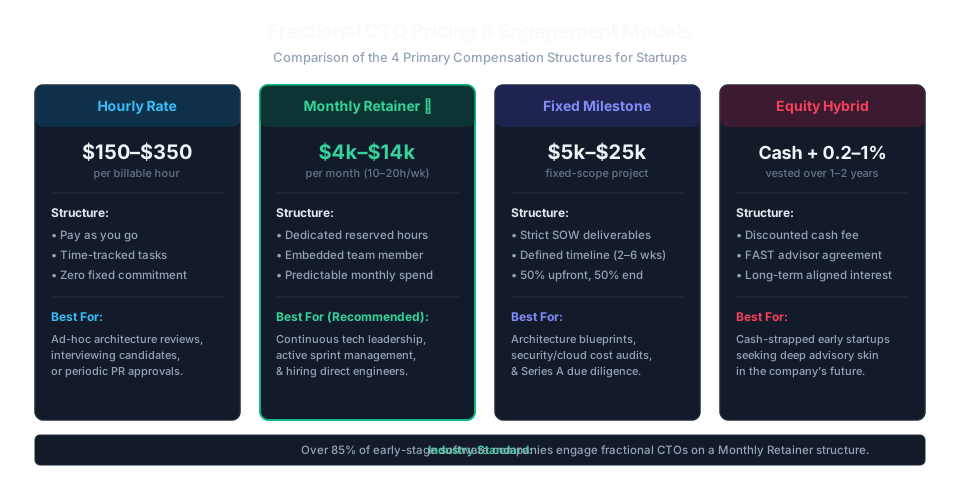
Fractional CTO rates range from $150 to $350 per hour, with monthly retainers typically spanning $4,000 to $14,000 per month for 10 to 20 hours of weekly strategic oversight. While a permanent in-house Chief Technology Officer commands a total compensation package exceeding $350,000 to $550,000 per year (including base salary, executive search fees, bonuses, and 1% to 5% equity dilution), a fractional technical leader delivers targeted architectural leadership at a 65% to 80% reduction in annual cash expenditure.
For early-stage startups navigating initial product builds, bootstrapped companies scaling revenue, and non-technical founders managing remote development teams, understanding fractional CTO pricing structures is essential to optimizing capital runway. Engaging an experienced fractional CTO allows founders to secure enterprise-grade systems architecture, developer vetting rigor, and cloud cost control without burning early equity or taking on executive payroll liabilities.
2026 Fractional CTO Pricing Benchmark: At a Glance
The table below outlines current market benchmarks for fractional technology executives based on engagement models, commitment levels, and typical monthly investments:
| Engagement Model | Typical Hours / Commitment | Rate / Price Range | Billing Frequency | Best Suited Business Stage |
|---|---|---|---|---|
| Advisory & Governance | 5 – 8 hours / week | $3,000 – $6,000 / month | Monthly Retainer | Pre-seed startups, MVP planning, weekly PR approvals |
| Active Strategic Retainer | 10 – 20 hours / week | $7,000 – $14,000 / month | Monthly Retainer | Seed to Series A startups, multi-dev sprint management |
| Ad-Hoc Hourly Advisory | Flexible / on-demand | $175 – $350 / hour | Weekly / Bi-weekly | Technical due diligence, architecture audits, interviews |
| Fixed Milestone / Audit | 2 – 6 week project sprint | $5,000 – $25,000 / project | 50% upfront, 50% delivery | Cloud security audits, database refactoring blueprints |
| Equity Hybrid Structure | 10 – 15 hours / week | $3,500/mo + 0.2%–1.0% equity | Monthly + FAST Agreement | Bootstrapped ventures seeking long-term skin-in-the-game |
4 Primary Fractional CTO Pricing Models Explained
Choosing the right compensation structure depends on your current development stage, budgetary constraints, and whether your engineering team requires ongoing oversight or a one-time architectural intervention.
1. Monthly Retainer Model (Most Common)
Under a monthly retainer, the fractional CTO reserves a dedicated weekly allocation of hours (commonly 10, 15, or 20 hours per week). Retainers are billed at the beginning of each 30-day billing cycle.
- Typical Cost: $4,000 to $14,000 / month.
- Why Founders Prefer It: Retainers offer predictable monthly cash budgeting and ensure the fractional CTO participates in recurring sprint ceremonies, executive syncs, and unexpected architectural escalations.
- Key Contract Clause: Transparent rollover policies (whether unused weekly hours roll over into the following week within the same month) and defined communication SLAs (e.g., response within 4 hours during business days).
2. Hourly Billing Model
Hourly contracts bill purely for logged time spent on specific tasks, such as reviewing repository pull requests, attending board meetings, or interviewing engineering candidates.
- Typical Cost: $150 to $350 / hour.
- When to Use: Best for limited, irregular engagements where total monthly demand is under 15 hours, such as periodic tech stack reviews or ad-hoc technical interview support when you need to hire developer contractors.
- Trade-off: Hourly billing lacks guaranteed calendar reservation; during critical production incidents, an hourly consultant may not be immediately available.
3. Fixed-Price Milestone & Audit Model
For well-defined technical deliverables with strict boundaries, a fixed-price statement of work (SOW) eliminates financial ambiguity.
- Typical Cost: $5,000 to $25,000 per project.
- Typical Deliverables:
- Comprehensive Codebase & Architecture Security Audit.
- AWS / Supabase / GCP Cloud Cost Optimization Blueprint.
- Investor Technical Data Room Preparation for Series A Due Diligence.
- Microservices Decoupling and Database Schema Refactoring Plan.
4. Hybrid Retainer + Equity Advisory Model
Early-stage founders with limited cash reserves often negotiate a reduced monthly retainer supplemented with advisory equity using standard Founder Advisor Standard Template (FAST) agreements.
- Typical Cost: $3,000 – $5,000 / month in cash + 0.25% to 1.0% equity (vested over 12 to 24 months with a 3-month cliff).
- When It Works: Seed-stage startups where the executive actively assists with investor fundraising pitches and high-stakes technical strategy.
Fractional CTO Rates by Experience Level and Geography
Fractional executive rates reflect commercial track records, past startup exits, and regional market economics.
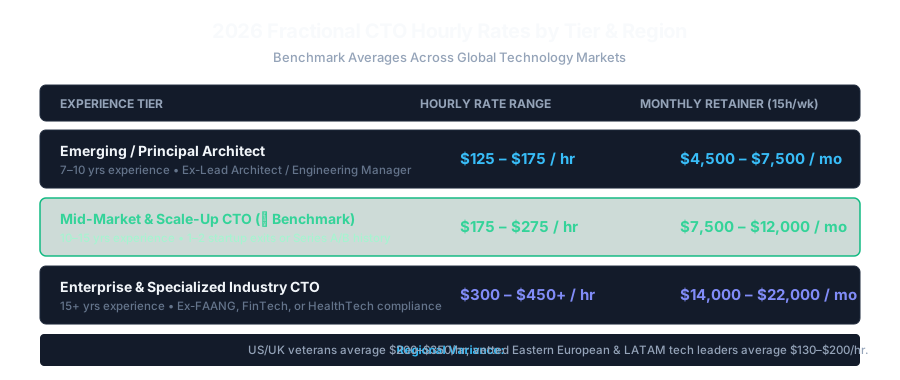
Rate Breakdown by Experience Tier
Emerging Fractional CTO / Principal Architect ($125 – $175 / hour):
- Background: 7–10 years of software engineering experience; former Lead Architect or Engineering Manager transitioning into fractional advisory.
- Strengths: Hands-on code reviews, CI/CD pipeline setup, modern full-stack frameworks (Next.js, Node.js, PostgreSQL).
- Best Fit: Early MVPs, small contract developer oversight, and technical proof-of-concepts.
Seasoned Mid-Market & Scale-Up CTO ($175 – $275 / hour — Industry Benchmark):
- Background: 10–15+ years of engineering leadership; past VP of Engineering or CTO with 1–2 commercial exits or successful Series A/B scaling rounds.
- Strengths: Multi-team engineering governance, high-concurrency database tuning, hiring frameworks, vendor contract negotiations, SOC2 compliance.
- Best Fit: High-growth startups ($1M–$10M ARR) and companies replacing underperforming agencies.
Enterprise & FAANG Regulatory Veteran ($300 – $450+ / hour):
- Background: 15–20+ years of enterprise experience in highly regulated sectors (FinTech, HealthTech, Defense, Enterprise Cybersecurity).
- Strengths: Institutional due diligence, complex compliance audits (HIPAA, PCI-DSS, FedRAMP), board-level governance.
- Best Fit: Series B+ funded ventures, enterprise turnaround situations, and high-liability acquisitions.
Full-Time CTO vs. Fractional CTO: Complete Total Cost of Ownership (TCO)
Evaluating executive compensation requires calculating the Total Cost of Ownership (TCO), which includes recruiting fees, payroll taxes, healthcare benefits, retention bonuses, and equity dilution.
Comprehensive First-Year Financial Comparison
| Expense Category | Full-Time Executive CTO (In-House) | Fractional CTO (15 hrs/wk Retainer) | Net Annual Cash Savings |
|---|---|---|---|
| Annual Base Salary | $250,000 – $380,000 / yr | $84,000 – $120,000 / yr ($7k–$10k/mo) | +$166,000 – $260,000 |
| Employer Payroll Taxes (FICA, State) | $20,000 – $32,000 / yr | $0 (B2B Consulting Expense) | +$20,000 – $32,000 |
| Health, Dental, 401(k) Benefits | $24,000 – $40,000 / yr | $0 | +$24,000 – $40,000 |
| Executive Search / Recruiter Fee (25%) | $62,500 – $95,000 (One-time) | $0 | +$62,500 – $95,000 |
| Annual Performance Bonus | $35,000 – $75,000 / yr | $0 | +$35,000 – $75,000 |
| Equity Grant Dilution Value | 1.5% – 5.0% ($150k–$500k+ enterprise value) | 0% (or minimal 0.25% advisory) | Conserves 1.5% – 5.0% Equity |
| Severance & Contract Termination Risk | 3 to 6 months salary liability | 30-day written cancellation notice | Low legal/financial liability |
| TOTAL FIRST-YEAR CASH OUTLAY | $391,500 – $622,000+ | $84,000 – $120,000 | 💰 $307,500 – $502,000 / year |
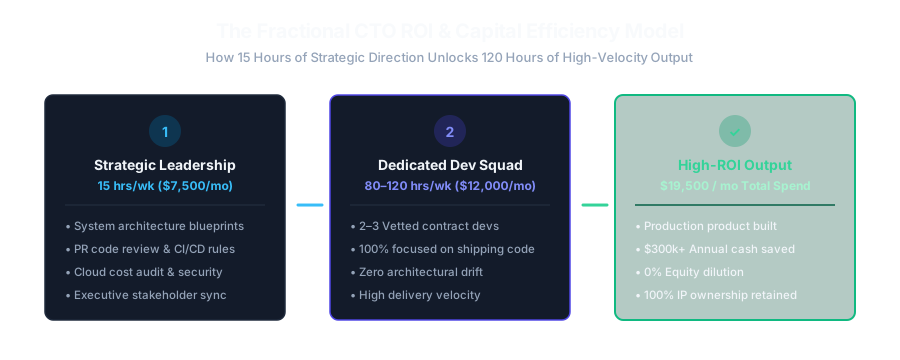
The Fractional CTO ROI Framework: Capital Efficiency in Practice
A common misconception among first-time founders is viewing a fractional CTO solely as an expense. In reality, strategic technical leadership functions as a high-leverage cost reducer.
1. Eliminating Agency Markup Waste
Software development agencies routinely mark up junior developer hours by 200% to 300% and propose convoluted microservice architectures to expand project scope. A fractional CTO acts as your buyer's representative, structuring lean requirements and managing vetted independent engineers to cut software build costs by 50% or more.
2. Preventing Premature Architectural Rewrites
Rebuilding an application because an offshore team chose an unmaintainable database schema or proprietary closed framework typically costs $100,000 to $250,000 in direct developer payroll, plus 6 to 9 months of lost market momentum. Investing $15,000 in upfront architectural design with a seasoned fractional CTO avoids this pitfall entirely.
3. Slashing Cloud Hosting & Database Overspending
Unindexed PostgreSQL database queries, oversized AWS EC2 instances, and redundant third-party SaaS subscriptions quietly inflate cloud bills. Fractional CTOs regularly audit cloud environments, reducing monthly infrastructure burn by 30% to 50% within the first 60 days.
4 Real-World Case Studies: Financial Impact and ROI
The following real-world case studies illustrate how startups across various growth stages leveraged fractional CTO engagements to optimize capital allocation.
Case Study 1: FinTech Startup Cuts Initial Build Costs by $185,000
Initial Situation
A seed-stage payments platform needed to build an automated reconciliation dashboard connecting multiple banking APIs. A boutique development agency submitted a fixed proposal of $260,000 with a 7-month timeline.
What Was in the Way
The agency's proposal included unnecessary custom encryption microservices and a complex Kubernetes cluster for an MVP that expected fewer than 50 enterprise customers in its first year.
Solution
The founders engaged a fractional CTO on a 15-hour/week retainer ($7,500/month for 4 months = $30,000 total):
- Redesigned the architecture into a secure, modular monolithic Next.js and PostgreSQL backend hosted on Supabase and AWS.
- Directly vetted and hired two dedicated senior full-stack engineers via ProofDevs ($45,000 total development payroll over 3 months).
- Supervised weekly sprint deliveries and enforced banking-grade automated test coverage.
Financial Outcome
- Total Project Spend: $75,000 (Fractional CTO + Engineers) vs. $260,000 agency quote.
- Net Cash Savings: $185,000 (71% savings).
- Time to Market: Shipped production MVP in 12 weeks instead of 28 weeks.
Case Study 2: B2B SaaS Scale-Up Slashes Cloud Infrastructure Spend by $3,800/Month
Initial Situation
A B2B analytics platform with $3.5M in annual recurring revenue saw its monthly AWS and cloud database hosting bill surge from $2,400 to $8,900/month over a 6-month period, outpacing active user growth.
What Was in the Way
The company had no dedicated DevOps lead. Junior developers were spinning up unreserved high-memory instances and running un-cached database queries on millions of analytics records during peak business hours.
Solution
The company engaged a fractional CTO for a fixed 30-day infrastructure audit ($9,000 fixed fee):
- Identified 14 missing database indices on high-volume reporting tables, dropping database CPU utilization from 85% to 14%.
- Migrated static asset delivery to Cloudflare Edge CDN caching and consolidated redundant container instances.
- Purchased 1-year AWS Savings Plans for baseline compute workloads.
Financial Outcome
- Monthly Cloud Bill: Reduced from $8,900/month to $5,100/month ($3,800/month recurring savings).
- First-Year Net ROI: $45,600 annual savings on a one-time $9,000 audit fee (506% first-year ROI).
Case Study 3: HealthTech Startup Secures $5M Series A Funding
Initial Situation
A digital health platform operating on a legacy Node/MySQL backend received a term sheet for a $5M Series A investment round, subject to passing rigorous institutional technical due diligence.
What Was in the Way
The lead VC firm appointed an external auditing firm to inspect codebase security, HIPAA data encryption at rest, backup recovery SLAs, and historical contractor IP assignment agreements.
Solution
The founders brought in a healthcare-specialized fractional CTO on a 20-hour/week sprint for 8 weeks ($22,000 total retainer):
- Created a formalized Technical Data Room containing system diagrams, disaster recovery procedures, and dependency vulnerability scans.
- Standardized environment variables, rotated exposed API keys, and enforced multi-factor authentication (MFA) across all staging servers.
- Executed proper IP assignment documentation for all historical freelance developers.
Financial Outcome
- Diligence Audit Passed with Zero Deficiencies.
- $5M Series A Round Closed on schedule without valuation renegotiations.
- Clean architectural foundation established for permanent engineering scale.
Case Study 4: E-Commerce Brand Replaces Stalled Dev Shop with High-Velocity Squad
Initial Situation
A direct-to-consumer brand ($5M annual turnover) was stuck with a development shop that had missed three consecutive deadlines to launch a subscription checkout portal.
What Was in the Way
The agency charged $12,000/month on an open-ended time-and-materials contract with zero commit transparency or code review documentation.
Solution
The CEO terminated the agency contract and engaged a fractional CTO for 10 hours per week ($5,500/month):
- Audited the Git repository and extracted all proprietary source code to a secure internal GitHub organization.
- Structured job specifications and vetted two senior TypeScript developers to hire developer contractors directly at transparent market rates ($45/hr).
- Established automated CI/CD pipelines and bi-weekly sprint delivery goals.
Financial Outcome
- Monthly Engineering Spend: Dropped from $12,000/month to $9,500/month (Fractional CTO + 2 Direct Developers).
- Delivery Velocity: Launched subscription checkout in 6 weeks, unlocking $42,000 in new monthly recurring subscription revenue.
5 Hidden Costs to Watch for in Fractional CTO Contracts
When evaluating fractional CTO proposals, founders should scrutinize contract terms to prevent unexpected cost inflation:
- Vague Scope & Uncapped Hourly Overages: If on a retainer model, ensure the contract specifies how additional hours are approved. Extra hours should require written confirmation rather than automatic billing.
- Equity Cliff Terms in Advisory Agreements: If offering equity, use a standard 12-to-24-month vesting schedule with a 3-month trial cliff. Never grant upfront unvested shares.
- Intellectual Property (IP) Assignment Loopholes: Ensure the agreement explicitly states that 100% of all architectural designs, code snippets, documentation, and infrastructure configurations belong exclusively to your company.
- Non-Exclusive Time Conflicts: Clarify that the fractional CTO does not advise direct commercial competitors within your exact niche.
- Notice Period Flexibility: Standard fractional leadership contracts operate on a 30-day written cancellation notice. Avoid multi-quarter lock-in agreements.
Frequently Asked Questions
What is the average hourly rate for a fractional CTO in 2026?
The market average hourly rate for a verified fractional CTO is between $175 and $300 per hour in the US and Western Europe. Specialized industry veterans (such as FinTech or AI architects) range from $300 to $450+ per hour, while vetted international engineering leaders average $130 to $190 per hour.
How many hours per week does a startup need a fractional CTO?
Most early-stage and seed startups require between 10 and 15 hours per week. Early MVP planning and advisory may need only 5 to 8 hours weekly, while companies executing heavy platform migrations or preparing for investor due diligence typically engage 15 to 20 hours weekly.
What is the difference between a Fractional CTO and a freelance Senior Developer?
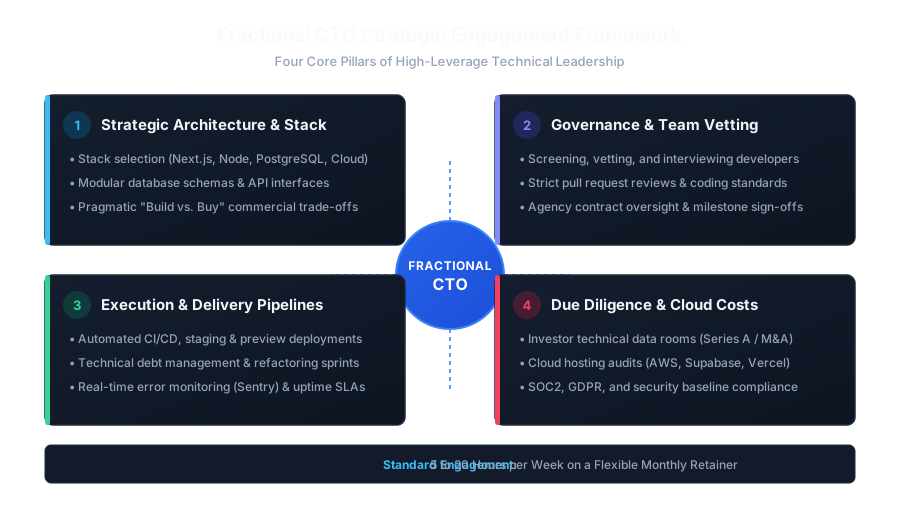
A freelance senior developer writes code to complete specific backlog tickets. A fractional CTO is an executive leader who decides what technologies to use, how systems should scale, evaluates code quality standards, audits cloud infrastructure budgets, and vets new technical hires.
How much equity does a fractional CTO typically receive?
When equity is part of the compensation package, fractional CTOs typically receive between 0.25% and 1.0% equity, vested over 1 to 2 years under a standard FAST (Founder Advisor Standard Template) agreement, usually paired with a reduced cash monthly retainer.
Can a fractional CTO help us hire and vet full-time developers?
Yes. One of the highest-value responsibilities of a fractional CTO is designing technical job descriptions, screening developer resumes, conducting architectural interviews, and setting up coding standards to prevent bad engineering hires.
How does fractional CTO pricing compare to an outsourced software agency?
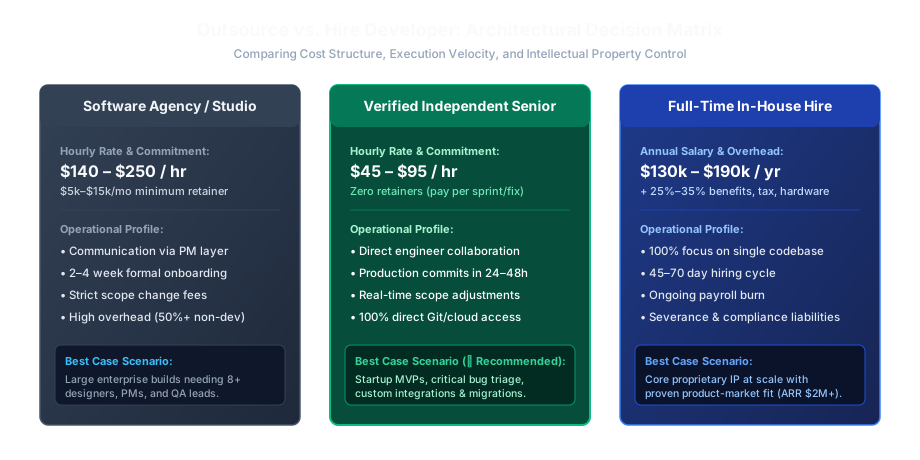
A software development agency typically charges $50,000 to $250,000+ per milestone with high hidden margins. A fractional CTO works as your internal executive for $5k–$10k/month, helping you hire and direct engineers directly to achieve better code quality at 50% lower total cost.
Optimize Your Technical Leadership and Runway
Engaging high-level technical leadership no longer requires risking hundreds of thousands of dollars in permanent executive compensation and equity dilution.
With a structured fractional CTO retainer, early-stage and growing companies gain the architectural governance, hiring rigor, and strategic direction needed to build scalable software while keeping capital focused on growth.
Written by Michael Melnyk
Senior IT Technical Writer & Technology Analyst
Senior Technical Writer and IT Industry Analyst with over 7 years of experience analyzing software engineering ecosystems, tech leadership models, and developer procurement frameworks.