Outstaffing in Ukraine: Costs and How to Hire
A monthly developer invoice buys capacity. Who turns that capacity into a release? That responsibility should be clear before you choose an outstaffing partner in Ukraine.

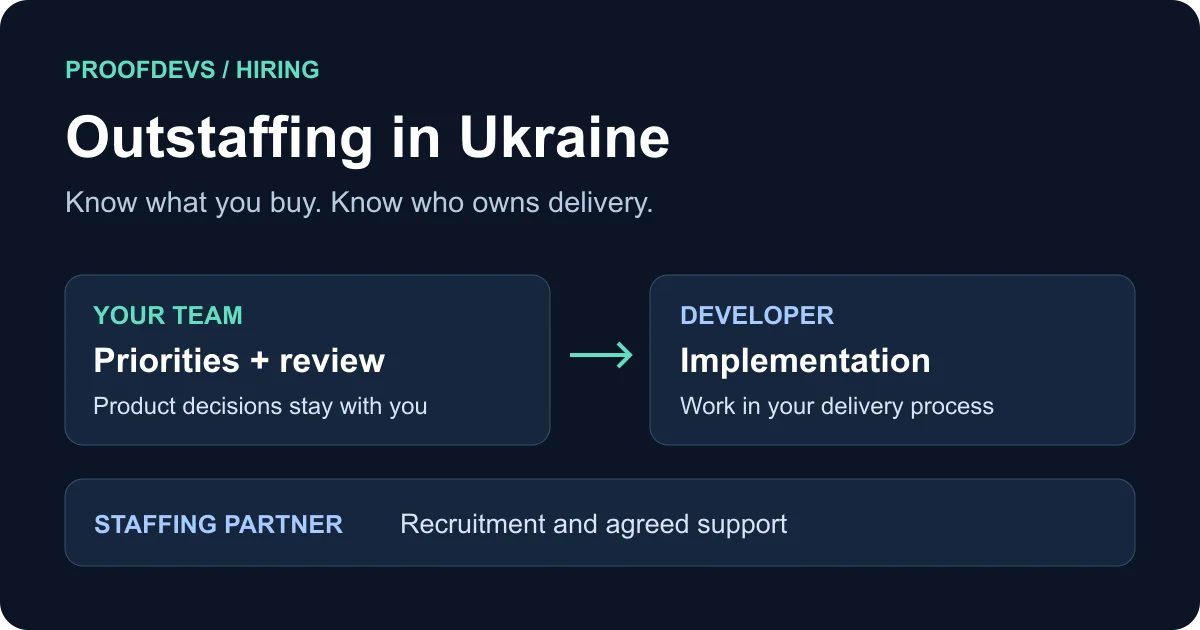
Outstaffing in Ukraine is a way to add Ukrainian software specialists to a team you manage, usually through a provider that handles recruitment and agreed administrative services. It can suit a business with an existing product, a clear backlog, and someone responsible for technical decisions. It does not automatically include product management, quality assurance, or responsibility for delivering a finished application.
For a buyer in the US, UK, or Europe, the important questions are who directs the work, what the invoice includes, where the developer actually works, and how delivery continues when someone becomes unavailable. Budget figures below are illustrative calculations, not Ukrainian market averages or ProofDevs quotes.
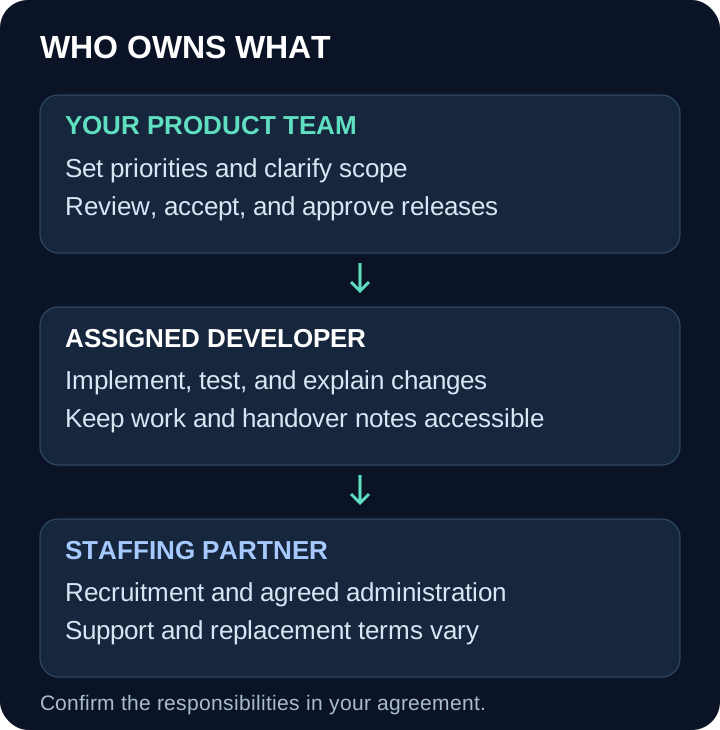
What an outstaffing arrangement actually includes
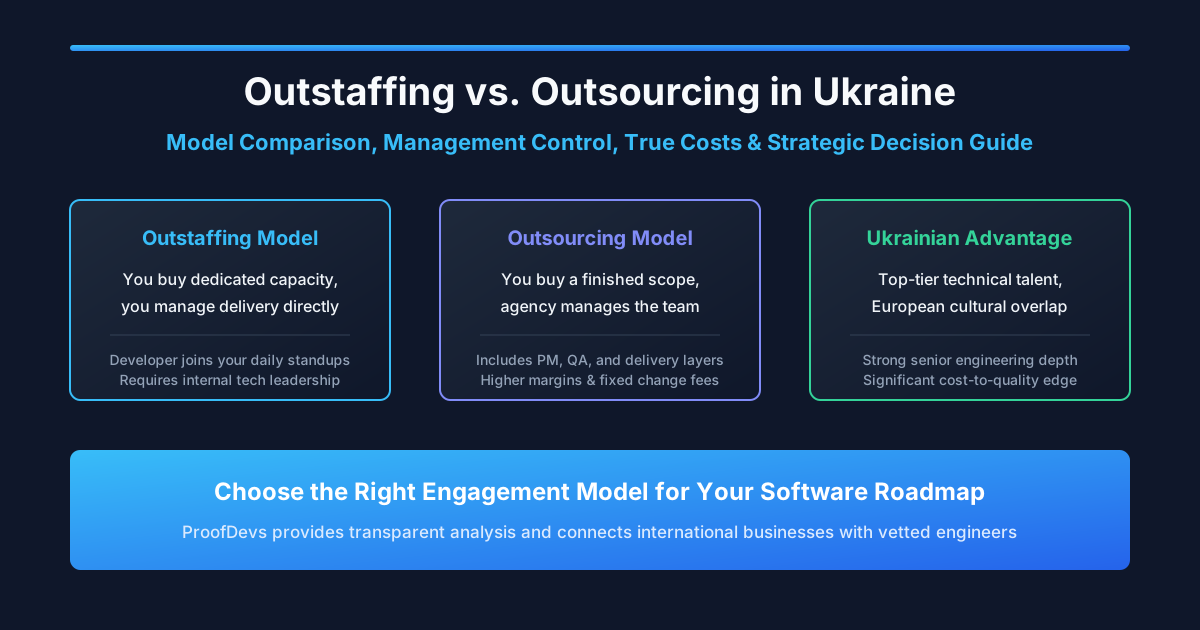
In a staff augmentation arrangement, your business directs an external developer's day-to-day work. The provider supplies the person and the support specified in your agreement; your team usually retains responsibility for priorities, technical review, and release decisions.
Vendors use “outstaffing,” “dedicated developers,” and “team extension” inconsistently. A dedicated development team might include delivery management, or it might simply mean people allocated to your account. The contract and working process matter more than the label.
| Arrangement | Who directs the work? | What to clarify |
|---|---|---|
| Staff augmentation / outstaffing | Your product and engineering leads | Capacity, provider support, replacement terms |
| Managed software outsourcing | A supplier delivery lead, within agreed scope | Deliverables, acceptance, changes, maintenance |
| Independent developer | You and the developer agree the workflow | Scope, availability, review, handover |
| Direct employment | Your internal management | Employment setup and ongoing obligations |
Outstaffing also differs from an employer of record, whose service concerns employing workers on a client's behalf. Do not assume a software staffing vendor provides that legal arrangement. Ask who contracts with the developer and which entity invoices you. For a comprehensive comparison of dedicated capacity versus agency delivery, see our detailed guide on outstaffing vs outsourcing in Ukraine. To compare hourly pricing models across independent contractors and agencies, see our guide on Ukraine outsourcing rates. For a broader model comparison, see outsourcing versus hiring a developer.
When staff augmentation fits your project
Choose staff augmentation when your team can direct the work but lacks delivery capacity or a particular skill. If nobody can assess estimates, review changes, or make product decisions, appoint that owner before adding more developers.
For example, an engineering lead may need a React developer to complete an account dashboard while internal engineers maintain the backend. Another business may need a Python specialist for a defined data integration. In both cases, someone already understands the product and can resolve questions.
- Good fit: an established team needs an additional developer for a continuing backlog.
- Possible fit: a founder has a senior technical reviewer and a small, clearly scoped release.
- Consider another model: you want a supplier to discover, design, build, and manage the entire product.
- Probably unnecessary: a one-off website repair can be completed by an independent specialist.
A non-technical founder can still work with Ukrainian programmers. The missing ingredient may be technical leadership rather than a large team. Read about the fractional CTO role if you need someone to assess architecture and supervise delivery.
Evaluate the developer's location, not just the country label
A Ukrainian developer, a developer currently in Ukraine, and a provider incorporated in Ukraine are different descriptions. Confirm the person's current work location, working hours, and contracting entity before judging fit.
Someone listed as Ukrainian may work from another European country. A supplier with an overseas office may still have its delivery team in Ukraine. Those differences affect communication planning, continuity arrangements, and the questions your legal or procurement team needs answered.
Use location alongside relevant work evidence. Ask a frontend candidate to discuss accessibility and error states in a product they built. Ask a backend engineer how a failed integration is detected and recovered. Assess English communication through a real planning discussion, rather than assuming proficiency from nationality.
On ProofDevs, examples of published profiles include Olga Savitska for React frontend development and Roma Vandolyak for backend and AI engineering. These are starting points for evaluating individual experience, not a promise of availability or a staffed team.
Calculate outstaffing costs from the whole engagement
The usable budget is the developer charge plus any separately billed support, your management time, tools, and contingency. Comparing Ukrainian outsourcing rates with salaries or unbundled freelance rates can produce a misleading saving.
Request an itemized quote. An hourly provider rate may already include recruitment, equipment, and administration. A cost-plus arrangement may show compensation and a separate service fee. Avoid adding a fee twice, and ask what happens when compensation or exchange rates change.
| Illustrative monthly budget | Assumption | Amount |
|---|---|---|
| Developer capacity | 160 billed hours × $45, including provider fee | $7,200 |
| Your technical lead's time | 16 hours × $75 internal planning cost | $1,200 |
| Separate tools and environments | Example allowance | $200 |
| Contingency reserve | 10% of the $8,600 subtotal | $860 |
| Total planning envelope | Provider charge, internal cost, tools, reserve | $9,460 |
This example assumes all 160 hours are billable; actual monthly capacity varies with your agreement and calendar. The reserve is money set aside, not automatically spent. The technical lead's time is an economic cost, not necessarily another supplier invoice. Onboarding, additional QA, taxes, and bank charges may require separate lines.
For a simple sensitivity check, changing the illustrative developer rate from $45 to $55 increases the developer line by $1,600. Keeping the other assumptions and the 10% reserve gives a $11,220 planning envelope. This calculation helps you compare quotes; it does not establish a national price range.
Ask about paid leave, public holidays, overtime approval, minimum commitments, unused hours, replacement onboarding, and notice periods. A lower rate can become a higher project cost when work repeatedly waits for clarification or review.
Shortlist providers through evidence you can inspect
A useful shortlist contains named candidates, relevant work examples, an understandable quote, and clear operating responsibilities. A logo wall or an anonymous pool of CVs does not establish who will join your project.
- Write the role around a task. “Build a reliable supplier import with failure reporting” is more useful than a long technology wishlist.
- Meet the proposed developer. Discuss an actual tradeoff from your backlog and ask for a written recap.
- Check comparable work. Request a walkthrough that explains the candidate's own contribution without exposing another client's confidential information.
- Compare commercial assumptions. Use the same hours, responsibilities, and support requirements across quotes.
- Agree a paid initial assignment. Define the spending cap, review process, and continuation decision before work begins.
Ask a reference about a missed deadline or a difficult handover, with the client's permission. The response can reveal more about communication and accountability than a broad recommendation.
For specialist roles, evaluate the skill itself: database migration, test automation, React Native releases, or AI evaluation. “Senior developer” is a description to investigate, not a substitute for role-specific evidence.
Resolve contracts, ownership, and data access before onboarding
Your agreement should identify the parties, purchased capacity, payment rules, ownership terms, confidentiality, and exit process. Have appropriate counsel review the employment, intellectual-property, tax, and data obligations for the actual entities and jurisdictions involved.
An NDA addresses confidentiality; it does not settle every ownership question. Ask how rights flow from the person doing the work through the supplier to your business, what pre-existing materials are excluded, and which open-source obligations remain. Do not assume payment alone resolves ownership.
For EU personal-data transfers, the European Commission provides standard contractual clauses as one possible safeguard. Applicability and any additional measures depend on the transfer. For UK restricted transfers, the ICO explains the IDTA and UK Addendum; EU clauses alone are not sufficient for that purpose. Get the actual arrangement reviewed before granting personal-data access.
Keep company repositories and hosting accounts under company control. Give each collaborator an individual account with permissions appropriate to the task. GitHub's repository roles allow different access levels, so contributing code need not mean owning the repository. Use synthetic test data where possible.
Ask for a workable business continuity plan
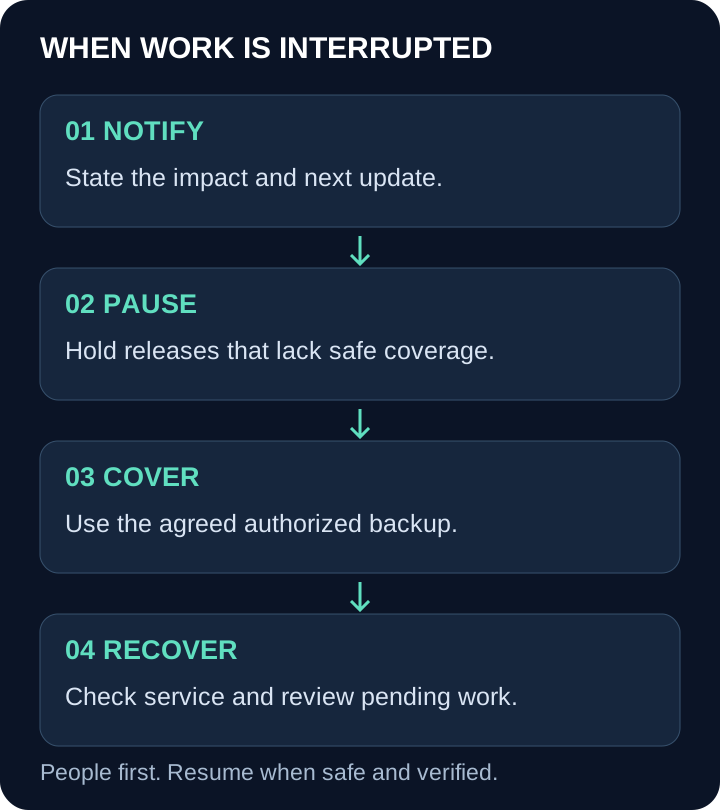
The operational question is how the engagement handles interruption, not whether a supplier promises that nothing will happen. Russia's war against Ukraine creates real disruption risks; the UK government's current Ukraine advice notes that attacks on the energy network can cause unexpected power cuts.
That warning is context, not a delivery rating for every Ukrainian developer. Assess the arrangements of the people actually assigned to your account. Ask about backup power, an alternative internet connection, a safe alternative workspace, and how an interruption is communicated.
- Communication: who informs you when a planned meeting or delivery cannot happen?
- Recovery: what work can resume remotely, and what depends on a particular machine?
- Coverage: who can support the system if the main developer is unavailable?
- Handover: are current code, deployment instructions, and decisions accessible to your team?
- Commercial treatment: how are interruptions, credits, replacement, and termination handled?
Do not ask people to continue working during an immediate safety emergency. Agree a fallback that protects both people and the service, such as pausing a release while another authorized person handles urgent support. Review the plan when staffing or work location changes.
Agree working overlap instead of relying on timezone claims
Useful overlap is the time both sides agree to be available for decisions. Put actual calendar slots in the working agreement rather than assuming a Ukrainian developer follows your office hours.
As a planning example, reserve a two-hour shared window for questions, review, and occasional pairing. Verify the conversion in both calendars and revisit it around daylight-saving changes. A US West Coast buyer may need a different schedule from a London buyer, and some candidates will not want shifted hours.
Outside that window, use a short written update: completed work, evidence, the next task, and any decision needed. For a blocked integration, the update should say which credential or business rule is missing and who needs to provide it.
Keep routine development hours separate from incident response. If you need overnight support or weekend coverage, define the response arrangement and price explicitly. A full-time allocation does not imply continuous availability.
Make the first month a delivery check
The first month should demonstrate whether the developer can deliver a useful change within your team's process. Review working output, communication, and maintainability before increasing the commitment.
The following is an illustrative onboarding sequence, not a promised timetable. Adjust it for access approvals, system complexity, and the agreed workload.
| Stage | Work | Evidence to review |
|---|---|---|
| Week 1 | Access setup and a small existing issue | Working environment and a reviewed change |
| Week 2 | A contained feature or integration | Demonstration against written acceptance checks |
| Week 3 | Failure handling and delivery notes | Tests, recovery steps, review feedback addressed |
| Week 4 | Joint continuation review | Accepted work, remaining risks, next scope |
For a supplier import, acceptance might mean valid rows appear correctly, invalid rows are reported, rerunning the file avoids duplicates, and an authorized teammate can operate it. These checks connect engineering work to a business outcome. Commit counts and online status cannot answer the same question.
Three situations that lead to different hiring decisions
The right arrangement depends on the gap you need to fill. These illustrative scenarios are decision examples, not reported ProofDevs client results.
A subscription business needs frontend capacity
Starting situation: a SaaS team has an engineering lead and backend support, but customers are waiting for a self-service account area. Obstacle: existing frontend developers are committed to another release.
Approach: add a React developer through staff augmentation. The internal lead owns API decisions and review; the candidate implements account settings in the existing codebase. Target result: a usable account workflow accepted by the product owner, with maintenance remaining inside the existing team. A separate redesign or new framework is outside the assignment.
A distributor wants to stop re-entering supplier data
Starting situation: an operations team manually copies product updates from supplier files. Obstacle: nobody has specified duplicate handling or which price should win when files disagree.
Approach: commission a discovery assignment before reserving an ongoing developer. An operations owner defines the rules; a backend specialist demonstrates an import with a reviewable error report. Target result: an agreed process and tested implementation scope. A long monthly staffing commitment becomes a later decision, supported by the amount of continuing work.
A founder needs continuous service but has no engineering lead
Starting situation: a founder runs a booking application and wants one external developer to handle features and every incident. Obstacle: support depends on a single person, and nobody independently reviews production changes.
Approach: appoint technical oversight, document recovery, and arrange backup support before expanding feature capacity. Compare a managed maintenance service with an individual developer plus explicit coverage. Target result: named responsibility for support and release approval. Hiring another programmer alone would leave the original management gap unresolved.
Common mistakes when buying Ukrainian development capacity
The most expensive mistakes leave a responsibility unassigned or make a headline rate look cheaper than the complete engagement. Check these issues before approving a proposal.
- Buying hours without a decision-maker. Assign someone who can clarify priorities and accept completed work.
- Comparing different packages. Normalize management, QA, equipment, and support before comparing rates.
- Interviewing one person and receiving another. Record candidate approval and substitution terms.
- Assuming “dedicated” means exclusive. Confirm allocation, other commitments, and availability.
- Accepting a generic continuity statement. Check the arrangements for the assigned team.
- Leaving access until the last day. Maintain company ownership and current handover notes throughout the engagement.
- Ignoring the exit cost. Understand notice, outstanding invoices, replacement work, and knowledge transfer.
Expert advice: make the proposal name the missing owner
Ask a provider to explain who owns each step between a request and a supported release. Any unnamed step is work your business may need to supply or purchase separately.
Take an ordinary task from your backlog and walk through clarification, implementation, review, testing, release, and support. Ask who approves extra hours, who decides a feature is finished, and who handles a defect after release. A useful answer names roles and evidence rather than promising “seamless delivery.”
Repeat the exercise for an exit: another developer should be able to find the current code, understand the pending work, and follow the deployment instructions. This makes handover a normal part of the service instead of an emergency negotiation.
Questions buyers ask about outstaffing in Ukraine
Is outstaffing the same as staff augmentation?
In software procurement, the terms often describe adding external people to a client-managed team. Confirm responsibilities because vendors use the labels differently.
How does outstaffing differ from outsourcing?
Outstaffing usually supplies capacity you direct. Managed outsourcing usually assigns more delivery responsibility to the supplier. Neither label replaces a clear scope and acceptance process.
How much does a Ukrainian outstaffed developer cost?
Request a current quote for the role, allocation, and included services. The $45 hourly figure above is a calculation input, not a market benchmark or an advertised offer.
Is hiring in Ukraine always cheaper?
No. Compare the whole engagement, including oversight, onboarding, rework, support, and exit costs. A lower hourly quote does not guarantee a lower cost per accepted release.
Can I hire one developer instead of a team?
Yes, if the provider offers individual allocations or you contract directly with a specialist. Make sure one person is not implicitly responsible for every technical and support function.
Can a non-technical founder use outstaffing?
Yes, with suitable technical oversight and a product decision-maker. Without those roles, compare managed delivery or a discovery assignment before buying ongoing development capacity.
Can Ukrainian developers work with US clients?
They can work remotely across borders, subject to the actual contractual and regulatory arrangement. Agree overlapping hours and support expectations with each candidate.
Does Ukrainian nationality tell me where someone works?
No. Ask for the current work country and timezone. Do not infer location, availability, or working conditions from nationality or a supplier's office address.
What should I check about wartime disruption?
Check the assigned team's communication, backup power and connectivity, safe working options, coverage, and recovery process. No vendor can responsibly guarantee the absence of disruption.
Who owns code written by an outstaffed developer?
Ownership depends on the agreements and applicable law. Review assignment terms and the chain of rights from the developer to your business; keep repository access under company control.
What happens if the developer leaves?
Your agreement should explain notice, replacement, any overlap cost, and knowledge transfer. Maintain current documentation so recovery does not depend entirely on recruiting a substitute.
Does ProofDevs provide an employer-of-record service?
This article does not offer payroll or employer-of-record services. Use ProofDevs to explore developer profiles and describe your project; confirm the engagement and contracting terms before proceeding.
Describe the work you need a Ukrainian developer to own
A useful introduction includes your product, current stack, first deliverable, budget range, required overlap, and who will review the work. Mention Ukraine as a location preference and explain whether you need an individual contributor or managed delivery.
If you have already chosen direct hiring rather than a staffing provider, compare published profiles on the hire developers in Ukraine page, including each developer's stated skills, availability, and hourly range.
Tell ProofDevs about your project, or browse developer profiles to compare relevant experience before discussing availability and terms.
Written by Michael Melnyk
Senior IT Technical Writer & Technology Analyst
Senior Technical Writer and IT Industry Analyst with over 7 years of experience analyzing software engineering ecosystems, tech leadership models, and developer procurement frameworks.