How to Hire a Freelance Web Developer: Rates, Vetting, and Contracts
A founder paid $4,000 for a website that never launched because the brief listed pages instead of business outcomes. This guide shows how to scope, price, vet, and contract a freelance web developer so the site ships on time.

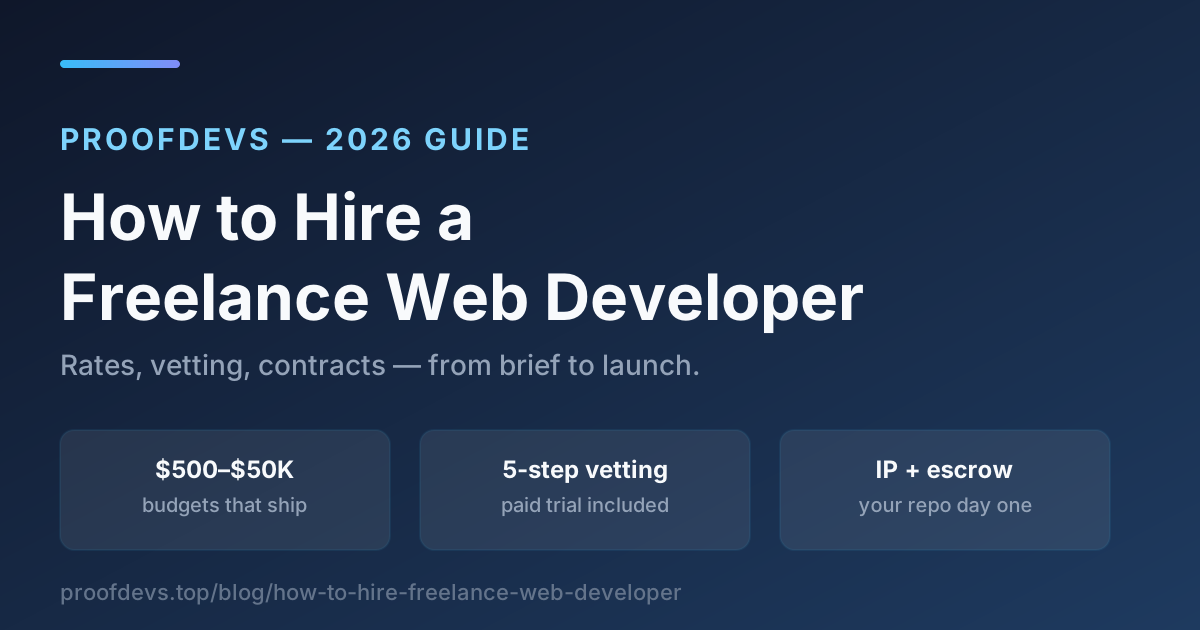
Updated September 2026. To hire a freelance web developer who actually ships, define one measurable outcome, match the developer type to that outcome, and verify past work before discussing price. Most failed engagements trace back to a vague brief — "need a modern website" — rather than to the developer's skill.
A freelance web developer is an independent engineer you contract directly to design, build, or fix a website or web application, without agency overhead or employment obligations. You pay for productive hours or a fixed deliverable, communicate with the person writing the code, and keep full ownership of the repository and domain. If you want to skip marketplaces and talk to a pre-screened engineer, you can find a verified independent web developer with a commercial track record.

Figure 1: Five hiring stages from scoping to launch, with kill signals and green signals at each control point.
What Does a Freelance Web Developer Actually Do?
A freelance web developer delivers a working website you own: layout, code, content integration, hosting setup, and handover. The scope usually covers responsive pages, contact or checkout flows, CMS integration so you can edit text yourself, basic SEO setup (titles, meta, sitemap), analytics, and deployment to your hosting account.
What is typically not included unless agreed: logo and brand design, copywriting, product photography, ongoing content updates, and server administration after launch. Clarify this boundary in the brief — example: "Developer delivers a 7-page Next.js site on my Vercel account with Sanity CMS; copy and logo provided by me; 30 days of bug fixes included." Clients who hire a website developer with this split in writing report far fewer "I thought this was included" disputes.
Related titles you will meet: freelance programmer and freelance coder usually mean the same role in buyer phrasing; webmaster skews toward maintenance of an existing site; software engineer skews toward larger applications. For a marketing site or store, search "web developer" — for a custom portal or SaaS MVP, search "full-stack developer" or "software engineer".
When Should You Hire a Freelance Web Developer — and When Not?
Hire a freelancer when the work is bounded, the outcome is clear, and you need speed without headcount. A contract developer fits landing pages, business sites, stores, and MVPs — engagements of 2 weeks to 4 months. It also fits rescue work: your previous developer disappeared and someone must take over the repository.
Do not hire a solo freelancer when you need 40+ hours per week for 6+ months across several specialties (design, backend, DevOps, QA) — that is a team, and one person becomes the bottleneck. Do not hire when nobody on your side can approve staging demos weekly; without feedback, even a strong developer builds the wrong thing. In those cases an agency with a project manager, or an in-house hire, is the honest answer.
- Good fit: developer for a small project — landing page, 5–10 page site, Shopify setup, WordPress rebuild, booking integration.
- Good fit: developer for my website — a business owner who needs one person to own design implementation through launch.
- Good fit: short-term contract developer — 1–3 month build with a defined handover.
- Poor fit: permanent on-call coverage with 15-minute SLA — that is a retainer team or employee, not a solo freelancer.
- Poor fit: "build me the next Amazon, budget $2,000" — the scope-to-budget gap guarantees failure regardless of who you hire.
Which Type of Web Developer Do You Need?
Match the hire to the layer you are changing. If the site looks dated but the business logic works, you need a frontend developer. If checkout fails, logins break, or the database is slow, you need a backend developer. If nothing exists yet, hire a full-stack developer or a small team.
| Type | Owns | Typical tasks | Hire when |
|---|---|---|---|
| Frontend | What visitors see | Responsive layout, HTML/CSS/JavaScript, React or Next.js, Core Web Vitals, accessibility | Redesign, slow pages, mobile breakage |
| Backend | What runs the site | APIs, databases (PostgreSQL, MySQL), auth, payments via Stripe, admin panels | Integrations, accounts, dashboards, performance |
| Full-stack | Both ends | End-to-end build: database to deployed UI, CMS wiring | New site, MVP, or takeover with no docs |
| Platform specialist | Ecosystem | WordPress, Shopify, Webflow, Wix setup and customization | Store or content site on a fixed platform |
Stack shorthand for non-technical founders: WordPress developer for content sites you edit yourself; Shopify developer for stores with real checkout and inventory; Webflow developer for design-led marketing sites; React / Next.js developer for custom fast sites and web apps. Name the platform in your job post — "need a Shopify developer to migrate 80 SKUs and connect Stripe" attracts relevant candidates, while "need a coder" attracts everyone.
How Much Does It Cost to Hire a Freelance Web Developer in 2026?
Cost depends on seniority, region, and pricing model — not on the word "freelance". As an orienting example based on 2026 marketplace data (Arc.dev 2026 rate database, Upwork cost pages, ZipRecruiter salary survey): North American mid-level developers charge roughly $70–$100/hr, seniors $100–$160/hr; Western Europe runs 15–25% lower; Eastern Europe and Latin America $35–$70/hr for comparable seniority; South and Southeast Asia $20–$50/hr. Platform medians (Upwork, Fiverr) skew lower — $15–$50/hr — because they include high volumes of junior offshore supply.
| Project type | Typical budget (example) | Timeline | Best pricing model |
|---|---|---|---|
| Landing page, single | $500–$2,000 | 1–3 weeks | Fixed price |
| Business site, 5–10 pages + CMS | $2,000–$8,000 | 2–6 weeks | Fixed price with milestones |
| Custom site with CMS + integrations | $8,000–$25,000 | 4–10 weeks | Milestone-based |
| E-commerce (Shopify / WooCommerce) | $5,000–$35,000 | 6–12 weeks | Milestone-based |
| Web app MVP | $15,000–$50,000 | 8–16 weeks | Hourly with weekly cap |
| Ongoing care plan | $300–$1,500/mo | Retainer | Monthly retainer |
Request a developer quote in comparable form: ask every candidate to break the same scope into milestones with hours each. A quote of "$3,000 total" tells you nothing; "discovery 4h, homepage + 6 templates 30h, CMS 10h, QA and deploy 8h, at $60/hr" lets you compare. Treat any fixed bid 50% below the cluster median as a risk flag — it usually means misunderstood scope, not efficiency. And add 10–15% platform fees (Upwork charges clients ~5% plus freelancer-side fees) when budgeting marketplace hires; direct contracts avoid this layer.
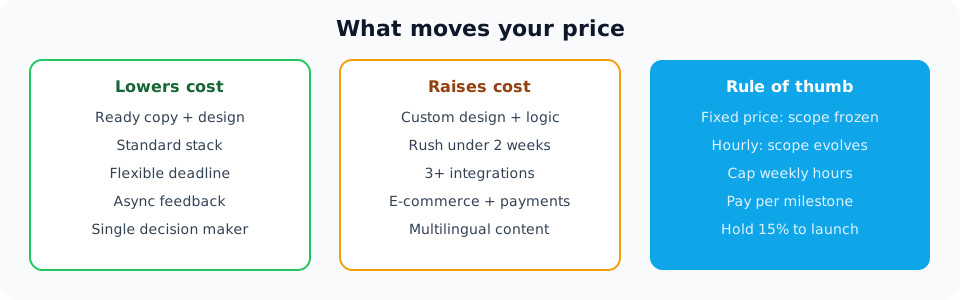
Figure 2: What moves your price — cost-lowering factors, cost-raising factors, and pricing rules of thumb.
Where to Find a Freelance Web Developer
The right channel depends on budget and how much vetting you want done for you. Marketplaces give volume; vetted networks and direct directories give signal.
| Channel | Strengths | Weaknesses | Best for |
|---|---|---|---|
| Upwork / Freelancer | Huge supply, escrow, reviews | Noisy; reviews are gameable; 5–15% fees | Small fixed-scope tasks with clear specs |
| Toptal / Lemon.io / Arc | Pre-screened seniors | Higher rates ($80–$200/hr); slower start | MVPs and critical rebuilds |
| Direct / ProofDevs | Talk to the coder, no middleman markup, repo access | You run the vetting (use this guide) | Founders who want one accountable senior |
| Referrals / LinkedIn | Trust via mutual contact | Slow, small pool | Regulated niches (medical, legal, finance) |
| Platform communities | Certified Shopify / Webflow / WordPress experts | Locked to one ecosystem | Store or CMS builds on that platform |
Practical tip: post the same brief in two channels and compare. One founder looking to find a web developer for a booking site posted on Upwork (47 proposals in 48 hours, mostly templated) and through a vetted directory (4 candidates, all with live booking sites). The directory hire cost 30% more per hour and finished two weeks early — total cost lower. Volume is not choice; comparable shortlists are.
How to Vet Candidates in 5 Steps
Vetting is a funnel: filter fast on evidence, spend time only on the top three. The whole process should take 5–8 days, not a month.
- Portfolio triage (15 min per candidate). Open two live links, not screenshots. Check mobile layout, page speed feel, and whether contact or checkout flows actually work. Reject anyone whose "portfolio" is mockups only or dead links.
- Async screen (written). Ask: stack used on the last similar project, hardest bug faced, how handover was handled. Written answers reveal communication quality — the top predictor of remote success.
- Paid trial (2–4 hours). A small real task from your project — e.g., "build this hero section from Figma with responsive behavior." Pay the candidate's hourly rate. This filters out 70% of mismatches for under $300.
- Code and process check. Ask where the code lives (must be your repository), how staging previews work, and what "done" means. Request one code sample or pull request link and check readability, not cleverness.
- Reference + availability. One past client call (10 minutes): did they ship on time, respond within 24 hours, document handover? Confirm weekly capacity in writing — "20 hrs/week for 6 weeks starting September 15."
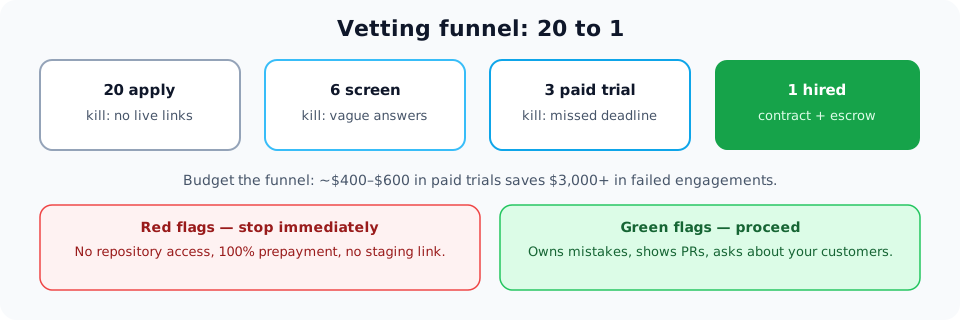
Figure 3: Vetting funnel — from twenty applicants to one hire through portfolio, screen, and paid trial filters.
Interview Questions That Reveal the Truth
Ask questions tied to your project, not riddles. A strong hourly developer or fixed-price contractor answers with specifics — file names, tools, timelines — while a weak one answers with adjectives.
- "Walk me through the last site like mine you shipped. What stack, how long, what broke at launch?" — listens for concrete detail and honesty about problems.
- "How do you handle a change request mid-project?" — good answer: written scope update with time and cost impact before coding.
- "Where will my code live, and what do I get on the last day?" — expect: your GitHub/GitLab repo, admin credentials you own, deployment docs, short handover video.
- "How do you make pages fast?" — expect mention of image optimization (WebP), caching, and Core Web Vitals; verify with PageSpeed on their past sites.
- "What happens if you get sick or disappear for a week?" — expect a backup contact, pushed code, and docs sufficient for takeover.
- "Show me how you secure forms and logins." — expect validation, HTTPS, and reference to OWASP basics, not "my code is secure, trust me."
Score answers 1–3 on evidence, not charm. The candidate who says "checkout failed because Stripe webhooks retried during deploy; I added idempotency keys and it held through 400 orders on Friday" beats the one who says "I'm passionate about quality code."
Contracts, Payment, and IP: the Non-Negotiables
A one-page agreement beats a handshake and beats a 20-page template nobody reads. Cover six points: scope with acceptance criteria, milestones tied to payments, IP assignment on payment, credentials ownership, support window, and termination.
- Milestones, not vibes: 20% kickoff, 40% staging demo approved, 25% launch, 15% retained 14–30 days for bug fixes. Never 100% upfront; never "pay when you feel happy."
- IP assignment: "All code, designs, and content produced under this agreement become the client's property upon payment." Without this sentence, ownership defaults vary by jurisdiction — get it in writing.
- Your accounts from day one: domain, hosting, repository, analytics, and admin logins registered to your email. The developer gets collaborator access, never sole ownership.
- Acceptance criteria per milestone: "Homepage loads under 2.5s LCP on mobile, contact form delivers to info@company.com, client can add a blog post via CMS unassisted." Testable beats "looks good."
- Termination clause: either party exits with 7 days' notice; you pay for approved work delivered with code pushed to your repo. This single paragraph prevents most hostage situations.
For cross-border hires, add governing law, invoice requirements, and who absorbs transfer fees. Templates from your local small-business association plus these six clauses cover 95% of freelance web builds — involve a lawyer only above ~$25,000 or when user data and compliance are involved.
Common Mistakes When Hiring a Freelance Web Developer
These seven errors account for most failed engagements we see in rescue work:
- Briefing pages instead of outcomes. "5 pages" is not a spec. Write: "visitors book a call — current conversion 0.4%, target 1.5%; form must reach our CRM." Developers estimate accurately only against outcomes.
- Choosing the cheapest developer quote. A $900 bid against a $3,000–$5,000 cluster means the bidder missed scope. The rebuild later costs 2–3x the "savings."
- Skipping the paid trial. Interviews predict likability; a 3-hour paid task predicts delivery. The $200 trial is the cheapest insurance in the project.
- Letting the developer own the accounts. Domain and hosting registered to the freelancer's email means you rent your own website. Create accounts first, invite second.
- Approving design from screenshots only. Demand a staging URL you can click on your phone. Half of usability defects hide in real interaction.
- Adding features mid-build without repricing. "Just one small shop section" resets testing and CMS work. Every addition gets a written time-and-cost delta first.
- No support window. Every launch has bugs. Contract 14–30 days of fixes now, or pay emergency rates later — typically 1.5–2x standard developer rates.
Real Hiring Scenarios: 4 Cases
Case 1 — Restaurant chain landing + online booking, $1,800, 3 weeks
Start: 4 locations, no online reservations, Instagram-only presence. Blocker: owner feared a "big IT project" and had no copy ready. Fix: contract developer built a single Next.js landing with an embedded booking widget (Fonestorm-class tool), WebP food photography, click-to-call. Copy drafted from the menu in two async rounds. Result: launched in 19 days; 34 table bookings in the first month attributed to the site form (example outcome, tracked via UTM + widget reports).
Case 2 — B2B services site rebuild on WordPress, $5,500, 6 weeks
Start: 10-year-old site, 6s mobile load, zero leads from organic. Blocker: 120 blog posts that could not lose rankings. Fix: freelance WordPress developer rebuilt on a lightweight theme, kept URL slugs, added redirects for 18 changed URLs, wired contact forms to HubSpot, documented "how to publish a post" in a 12-minute video. Result: mobile LCP 5.8s → 2.1s (PageSpeed, May 2026 retest example); contact submissions 3 → 11 per month in the quarter after launch.
Case 3 — Shopify store rescue, $7,200, 5 weeks
Start: half-built store, previous freelance coder vanished, theme heavily hacked. Blocker: no repo, admin owned by the missing contractor. Fix: store access recovered via Shopify owner verification; new Shopify developer froze features, rebuilt checkout on a clean theme copy, migrated 80 SKUs, connected Stripe + Nova Poshta delivery, wrote handover with app list and credential map. Result: store live in 5 weeks; first 60 orders fulfilled without checkout errors; owner holds all admin rights.
Case 4 — SaaS marketing site + docs portal, $14,000, 10 weeks
Start: startup with a React product but a Webflow landing that marketing could not update safely. Blocker: docs lived in Notion, unindexed and unstyled. Fix: full-stack contract developer built a Next.js site + MDX docs on the company's repo, preview deploys per pull request, Sanity CMS for marketing pages. Milestone pay with 15% held for the support window. Result: marketing ships pages without engineering; docs indexed (120 pages in Search Console within 2 months, example); staging-to-prod flow survives the original developer's departure.
Expert Advice
Write the acceptance test before you post the job. One paragraph per milestone, each testable by a non-technical person: "I open the staging link on my phone, tap Call, the number dials; I submit the form, the email arrives within a minute; I add a news post myself without calling the developer." Send this text to all candidates and ask for milestone hours against it. The developer who replies with clarifying questions about your customers in the first message is almost always the one who ships. And keep the repository rule absolute: no code in your repo by Friday of week one, no second payment — every rescue project we inherit violated exactly this rule.
Frequently Asked Questions
How much does it cost to hire a freelance web developer?
As an orienting example for 2026: simple landing pages $500–$2,000, business sites $2,000–$8,000, custom CMS builds $8,000–$25,000, e-commerce $5,000–$35,000, web app MVPs $15,000–$50,000. Hourly, expect roughly $70–$100/hr mid-level and $100–$160/hr senior in North America, lower in other regions. Always compare milestone-broken quotes, not single totals.
Should I pay hourly or fixed price?
Fixed price when scope is frozen (landing, defined site); hourly with a weekly cap when scope will evolve (MVP, integrations). Hybrid works well: fixed price to staging demo, hourly for refinement within a cap.
Where can I hire a freelance web developer near me?
Search "hire web developer near me" on Google Maps, LinkedIn, and local business communities for on-site needs; for remote, use Upwork, vetted networks (Toptal, Lemon.io, Arc), or direct directories like ProofDevs developers. Near-me matters only if in-person workshops or same-timezone support are required.
Freelancer vs. agency vs. in-house — what is cheaper?
For bounded builds, a freelancer is usually cheapest total cost: no account-manager overhead (agencies bill $140–$250/hr with 50%+ overhead) and no payroll liability (in-house $130,000–$160,000/year loaded cost in the US). Agencies win on managed multi-specialty programs; in-house wins on permanent 40hr/week product work.
How long does it take to build a small business website?
Typical example: landing 1–3 weeks, 5–10 page site 2–6 weeks, store 6–12 weeks. Add 1–2 weeks if copy, logo, or product data are not ready — content delays cause more slippage than coding.
How do I check a developer's skills before hiring?
Open two live sites they built, run them through PageSpeed, test on your phone, then assign a 2–4 hour paid trial from your real scope. Verify code lives in your repository from day one.
What should a freelance web developer contract include?
Scope with acceptance criteria, milestone payments, IP assignment on payment, your ownership of all accounts, a 14–30 day bug-fix window, and a 7-day termination clause with code handover.
Who owns the code and the website?
You should, upon payment — stated explicitly in the contract. Register domain, hosting, and repo under your email and grant the developer collaborator access.
Can I hire a developer for a small project or one-time fix?
Yes — this is the core freelance market. Frame it as "one-time contract developer, 5–15 hours, staging proof required" and expect to pay a slightly higher hourly rate than for long engagements; minimum engagements of 3–5 hours are normal.
WordPress, Shopify, or custom code — which should I choose?
WordPress for content you edit often; Shopify for selling physical goods with real checkout; Webflow for design-led marketing pages; custom code (Next.js/React) when you need speed, custom logic, or a product portal. Name your choice in the job post to attract the right specialist.
What are red flags when hiring a freelance programmer?
No live portfolio links, 100% prepayment demands, refusal to work in your repository, no staging previews, vague answers about past launches, and pressure to decide "today." Any single one justifies walking away.
Do I need to prepare anything before contacting developers?
Yes: one outcome sentence, 5–10 reference sites you like, your logo and copy (or a note that copywriting is in scope), logins for domain/hosting, and your budget band. This one-page brief cuts quoting time from weeks to days.
Ready to move from browsing to shipping? Write your one-page brief using the acceptance-test format above and talk directly to a verified freelance web developer — fixed milestones, your repository from day one, and a support window in every contract. For broader context on engagement models, see our comparison of outsourcing vs. hiring a developer.
Written by Michael Melnyk
Senior IT Technical Writer & Technology Analyst
Senior Technical Writer and IT Industry Analyst with over 7 years of experience analyzing software engineering ecosystems, tech leadership models, and developer procurement frameworks.