Hire a Developer as a Non-Technical Founder
Your product idea is clear, but you cannot judge the code. Use a paid pilot and observable acceptance checks to choose your first developer.

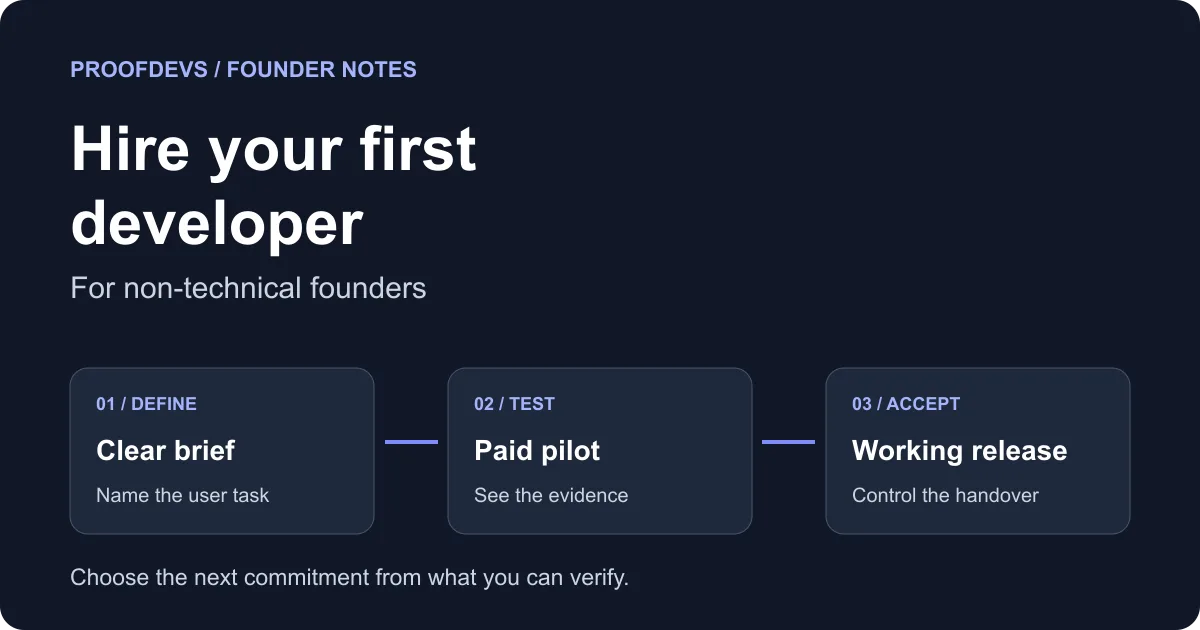
To hire a developer as a non-technical founder, define a customer task, choose the right engagement, and evaluate a small paid delivery before committing to the full product. You can assess communication, usability, and delivery without reading code. Use an independent technical reviewer for the parts you cannot verify yourself, especially data access, payments, and whether another developer can maintain the work.
A non-technical founder leads a business without being its software engineering expert. Your responsibility is to explain the customer problem and decide what is worth building. The developer should translate that decision into working software, explain tradeoffs, and make progress visible.
Reviewed September 2026. Budget figures below are illustrative planning calculations, not market averages or ProofDevs quotes.
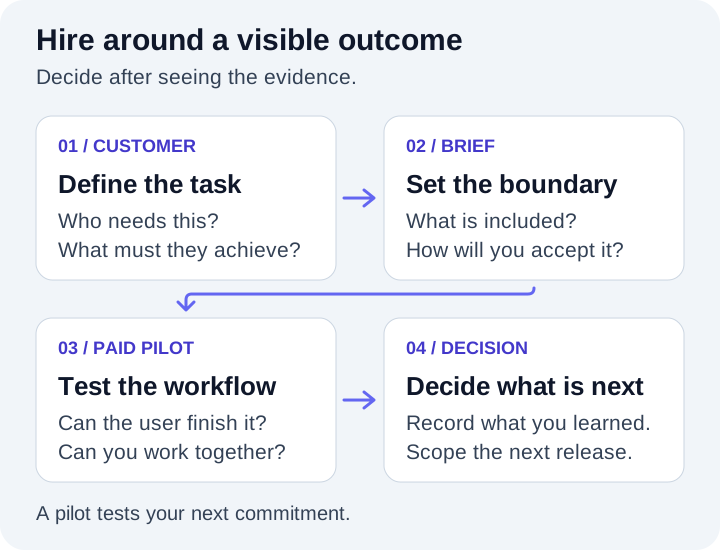
When is your startup ready to hire a developer?
Hire when you can describe a specific workflow that software needs to deliver and identify people willing to try it. If the uncertain part is whether anyone wants the service, test that assumption before commissioning a full application.
A minimum viable product, or MVP, is the smallest usable version that lets you test a product assumption with intended customers. A clickable mockup can test whether someone understands a booking flow; a working pilot can test whether they actually complete bookings. Those are different purchases.
- Only an idea: start with customer conversations, a landing page, or a manually delivered service.
- A clear workflow: a freelance MVP developer may be enough to deliver a limited first release.
- An existing prototype: commission an assessment of what can be reused before requesting a rebuild.
- A difficult technical dependency: test that dependency first. For example, confirm that a supplier permits the data access your product requires.
For a standard shop, booking service, or contact website, compare existing software with custom development. A developer can configure an established product instead of recreating it. Our build-versus-buy assessment covers that decision.
For an explanation of how to keep the first release focused, watch How to Build An MVP with Michael Seibel on Y Combinator's Startup School channel.
Choose a developer, agency, fractional CTO, or technical co-founder
Choose a developer for delivery, an agency for coordinated delivery across disciplines, and a technical co-founder for shared responsibility for the company. A fractional CTO can provide part-time technical leadership, but the engagement must explicitly include coding if you expect them to build the product.
| Option | Useful when | What you still need to check |
|---|---|---|
| Independent developer | The first release has a limited scope and a clear decision-maker. | Who handles design, testing, launch, and absences? |
| Development agency | You need several disciplines with one delivery agreement. | Who will do the work, and which responsibilities are included? |
| Fractional CTO plus developer | You need independent hiring, architecture, or delivery oversight. | How do the adviser and builder divide decisions and fees? |
| Technical co-founder | You want a long-term partner shaping the company and product. | Are commitment, responsibilities, and working expectations aligned? |
| Employee | You have sustained engineering work and resources to support a permanent role. | Who provides technical direction and coverage beyond that person's skills? |
If the choice is still unclear, use this comparison of development engagement models before committing to a hiring path.
A full-stack developer works across the customer-facing interface and the server-side application. That can suit an early web product, but the title alone does not establish design, security, or infrastructure expertise. Ask for evidence relevant to your project.
If you need oversight, read what a fractional CTO actually does. Hiring a contractor should not be treated as a substitute for finding a business partner.
Write a brief a startup developer can estimate
A useful development brief names the user, the task, the limits, and the observable result. It gives candidates enough context to ask informed questions and makes their proposals easier to compare.
Example brief for a supplier-ordering pilot:
Independent cafe managers need to submit a weekly order to their existing supplier. Today they send spreadsheets by email. The pilot must let a manager sign in, select products, submit an order, and see its status. A supplier needs to view and export orders. We will test it with invited cafes using a browser on their phones. Online payments, stock forecasting, and delivery routing are outside this release.
Add the following before sending it:
- Available designs, sample records, existing code, and third-party accounts.
- Your budget ceiling, currency, and desired pilot date, distinguishing a real external deadline from a preference.
- The person who approves decisions and their availability for feedback.
- Acceptance criteria: the observable conditions that make a delivery acceptable.
- Data sensitivity, expected pilot usage, support needs, and required integrations.
For example: “After submission, the supplier sees the correct products and quantities; submitting twice does not create two orders.” That is more useful than “build a reliable dashboard.” Ask candidates to list assumptions, exclusions, and questions before estimating.
Where to find a developer for your startup
Find candidates through relevant founder referrals, specialist directories, or communities where developers show completed work. Compare evidence against your brief regardless of where an introduction comes from.
A referral is most useful when the previous customer bought something similar. Ask what was delivered, who maintained it after launch, and how the developer handled a disagreement or missed estimate. An attractive portfolio alone does not answer those questions.
- Founder referrals: seek introductions from people with a comparable product and delivery stage.
- Developer profiles: look for relevant shipped applications, a clear individual contribution, and availability. You can browse developers on ProofDevs as a starting point.
- Specialist communities: useful when an existing platform or integration determines the required expertise.
- Co-founder networks: appropriate when you want a company-building partner. Y Combinator Co-Founder Matching is one option for meeting potential partners.
For remote hiring across the US, UK, and Europe, agree on overlapping working hours, written updates, invoice currency, and who responds to an incident. Location is useful context; a live working session gives better evidence of communication fit.
Evaluate a developer without testing their coding knowledge
Evaluate what you can observe yourself: relevant delivery, clear explanations, thoughtful questions, and a working demonstration. Ask an independent engineer to assess implementation quality where it matters to the decision.
Use the same questions for shortlisted candidates:
| Ask the candidate | Look for |
|---|---|
| “Show me a comparable product and your contribution.” | A clear account of their responsibilities, constraints, and delivered work. |
| “What would you remove from my first release?” | A smaller scope that still tests your main business assumption. |
| “Which uncertainty could change the estimate?” | Specific dependencies and a way to investigate them. |
| “How will I check the first delivery?” | A demonstration and written acceptance conditions you can follow. |
| “What happens if you stop working on it?” | Accessible code, operating accounts, documentation, and a handover process. |
Request a reviewer’s short written assessment of whether the application can be run from its repository, whether users can access only their own records, and whether important workflows have repeatable checks. A repository is the shared home of the source code and its change history.
Give the reviewer an explicit scope and appropriate access. “Looks good” is not a useful review outcome; findings should explain their business effect and whether they block the pilot. Confidential client work may not be shareable, so accept a permitted demonstration or relevant paid sample instead of demanding private repositories.
Make a paid pilot your first commitment
A paid pilot is a small delivery that tests both a product risk and your ability to work together. Set its fee, boundaries, deadline, and acceptance conditions before it starts.
For the cafe-ordering example, a pilot might cover one complete journey: submit an order and view it as the supplier. It should expose a meaningful uncertainty, such as permissions or a supplier integration, while keeping unrelated features outside the agreement.
- Agree on the deliverable and who supplies the required inputs.
- Keep the work in a repository accessible to the company.
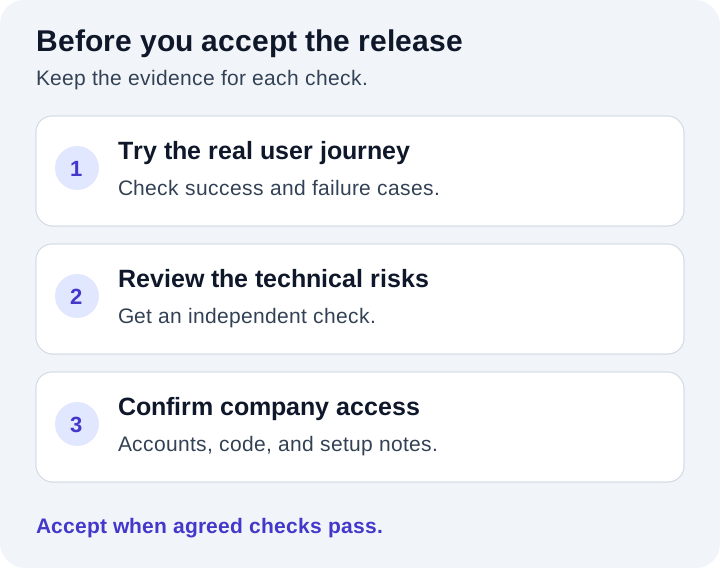
- Review the working flow together and try agreed failure cases.
- Record what passed, what failed, and what the next phase would cost.
Stop or revise the plan if the key assumption fails. An integration that cannot support the intended workflow is valuable information even when you decide against a full build. Pay for the agreed work; a pilot should not be an unpaid request to build your product.
Budget for a usable release and its ongoing costs
The cost of hiring a developer depends on the scope, required expertise, delivery responsibilities, and uncertainty. Compare proposals for the same accepted outcome, including testing and launch, rather than comparing hourly rates in isolation.
Illustrative planning calculation, September 2026: assume a quoted rate of $75 per hour for a small web pilot. These invented inputs demonstrate the calculation; they are not a recommended rate or an estimate for your product.
| Work item | Example allowance | Calculation |
|---|---|---|
| Brief and workflow clarification | 8 hours | $600 |
| Implementation | 48 hours | $3,600 |
| Testing, fixes, and launch | 16 hours | $1,200 |
| Development subtotal | 72 hours | $5,400 |
| Independent review | Example separate quote | $600 |
| Change reserve | 20% of development subtotal | $1,080 |
| Example planning total | Before excluded costs | $7,080 |
This example excludes taxes, hosting, external software, payment fees, and ongoing maintenance. Replace every allowance with actual quotes. Ask which recurring subscriptions you will pay directly and what support costs after the agreed delivery period.
Fixed-price work suits a defined result. Hourly work with a spending cap can suit investigation or changing requirements. In either case, require an estimate for the next delivery and written approval before extra work. Use our proposal comparison checklist if the quotes cover different things.
Stay in control of progress, access, and acceptance
Manage delivery through working demonstrations, written decisions, and company-controlled accounts. Set up access before the build begins so that launching or changing developers does not depend on a last-minute transfer.
- Progress: agree on a regular demonstration of the actual application, with completed work, blockers, spending, and next decisions recorded.
- Access: the company should control the domain, source repository, hosting, database, and billing accounts; invite the developer with suitable permissions.
- Acceptance: test complete user journeys, including denied access, invalid input, and interrupted operations.
- Handover: request setup instructions, a list of services and charges, known limitations, and a named support arrangement.
Account access and legal ownership are different questions. Put deliverables, code rights, third-party licences, confidentiality, payment conditions, and termination arrangements into a written agreement, with terms checked for the applicable jurisdiction.
Where there is another trusted person in the company, avoid relying on one GitHub owner: GitHub recommends at least two organization owners to reduce the risk of losing access when one is unavailable. This is not a reason to give every contractor unrestricted administration.
Three founder scenarios and the first work to commission
The best first engagement depends on what is uncertain: customer demand, product reliability, or delivery continuity. The following scenarios are illustrative, not reported ProofDevs client results.
Scenario 1: A founder matching venues with caterers
Starting situation: a founder wants a marketplace connecting event venues and caterers. Obstacle: it is unclear whether venues will submit usable requests or whether caterers will respond.
Approach: commission a simple request form and operator dashboard; use email and a spreadsheet to arrange matches manually. Keep automated bidding and payouts outside the pilot.
Expected result: the founder can observe requests and responses before funding a matching engine. Track completed introductions and reasons for rejection. The initial developer purchase supports that experiment; it does not assume the marketplace already works.
Scenario 2: A founder with an AI-built subscription prototype
Starting situation: a founder has assembled a Lovable prototype for client reports. Obstacle: the screens work, but subscription access and separation between customers have not been verified.
Approach: hire a developer to assess the existing code, then test sign-in, access permissions, and billing in a test environment. A payment success screen alone is insufficient: Stripe explains why fulfillment needs server-side payment notifications, including when a customer never reaches the return page.
Expected result: the founder gets a list of launch blockers and a tested path from payment to access before inviting paying customers. The Lovable project assessment is relevant when the prototype needs this kind of work.
Scenario 3: A founder taking over a stalled supplier portal
Starting situation: a previous contractor has left an unfinished ordering portal. Obstacle: the founder has screenshots but cannot confirm whether the code can be deployed.
Approach: commission a takeover assessment covering repository access, a reproducible deployment, available data, and a comparison of working features against the brief.
Expected result: the replacement developer can estimate the remaining work from inspected evidence. The founder can choose between completing the existing application and replacing specific parts. Use a project takeover brief before paying for new features.
Common mistakes when hiring your first developer
The most avoidable hiring mistakes leave the founder unable to judge progress or change direction. Use these checks before agreeing to the full project.
- Buying the whole roadmap: identify the smallest release that answers your current business question.
- Choosing from technology names alone: ask why the proposed tools fit your workflow and maintenance needs.
- Accepting screenshots as delivery: test the application using the agreed acceptance conditions.
- Leaving exclusions unstated: clarify design, data migration, testing, launch, and support.
- Approving changes informally: record their effect on scope, cost, and timing.
- Relying on a single private account: establish company access and a handover process early.
- Assuming AI-generated code is finished: verify operation, data permissions, and maintainability before launch.
Expert advice: ask what would change the recommendation
Ask each candidate, “What would you need to learn before recommending this approach?” The answer helps you distinguish an informed recommendation from a confident sales pitch.
A useful response names an uncertainty and a cheap way to resolve it: check an integration’s permissions, watch a customer attempt the workflow, or run the existing application. Ask for a short written decision note recording the recommended next step, alternatives, and what would justify changing course. This gives you something concrete to discuss with a second reviewer.
Questions non-technical founders ask before hiring
You can make the first engagement manageable without becoming an engineer. These answers address the decisions that commonly sit between an idea and a developer brief.
Can I start a software company if I cannot code?
Yes. You still need a way to make technical decisions and evaluate delivery, whether through a technical partner, an experienced builder, or independent review. Customer understanding and product decisions remain your responsibility.
Do I need a technical co-founder before hiring a developer?
Not for every project. You can contract a defined delivery while exploring a partnership separately. If ongoing technical discovery is central to the company, consider who will carry that responsibility over time.
How do I find a software developer for a startup?
Prepare a short brief, seek relevant referrals or specialist profiles, and compare comparable work. Discuss the brief directly with the person who will build it before committing to a paid pilot.
Should I hire an MVP developer or a full development team?
A developer may cover a narrow web pilot. A team becomes useful when delivery needs parallel work across several disciplines. Ask who is responsible for each task before comparing prices.
Can I hire a part-time developer for my startup?
Yes, if their availability fits the delivery and support needs. Agree on working capacity, response expectations, and coverage for absences. Part-time availability needs to appear in the schedule.
How can I check code quality without programming experience?
Use an independent technical reviewer with a defined brief. You can test the user experience yourself; ask the reviewer to examine access controls, maintainability, critical checks, and the ability to deploy the application.
What should I prepare before talking to developers?
Bring a user workflow, example inputs and outputs, known constraints, available assets, and a budget ceiling. List unanswered questions openly. You do not need to prescribe the architecture to start the conversation.
How much should a non-technical founder budget for development?
Request a scoped estimate and separate build costs from review, subscriptions, launch, and maintenance. The calculation above shows how to assemble a budget; it cannot price an unspecified application.
Should I pay a fixed price or an hourly rate?
Use a fixed price for a well-defined delivery with clear exclusions. For discovery or uncertain existing code, consider a capped hourly engagement followed by a revised estimate once the unknowns are investigated.
How long should building an MVP take?
There is no useful universal deadline. Ask for a schedule tied to named deliveries, dependencies, and your feedback availability. If the schedule misses your business window, reduce the scope or revisit the experiment.
Can I use no-code or AI tools instead of hiring?
They may be enough for a mockup or a workflow supported by the platform. Check data handling, integrations, and operating limits. Hire targeted help when an important requirement exceeds what you can verify.
Should I offer equity instead of payment?
Discuss a founder partnership if you want shared long-term responsibility. An equity-only proposal is not equivalent to buying a defined development service. Clarify expectations and obtain appropriate advice before agreeing on ownership terms.
Who should control the code and hosting accounts?
The company should have the access needed to operate and maintain the product. Document code rights separately in the agreement. Verify repository, domain, hosting, and database access before final acceptance.
What if the first developer stops responding?
Check the contract, document outstanding work, and confirm which accounts and code you can access. Arrange a takeover assessment before authorizing a replacement to rebuild anything. Avoid sharing production credentials indiscriminately.
What should happen after the MVP launches?
Observe intended users, record failures and support requests, and decide what the next release needs. Agree who monitors the application, handles urgent problems, maintains dependencies, and estimates changes.
Bring a specific first task to your developer search
Write down the customer, the workflow, and the decision the first delivery should help you make. Include what already exists and what you can spend. That gives a developer a useful starting point and gives you a way to compare their response.
Describe your project to ProofDevs to find relevant developers for the first build, an independent assessment, or the next stage of an existing product.
Written by Michael Melnyk
Senior IT Technical Writer & Technology Analyst
Senior Technical Writer and IT Industry Analyst with over 7 years of experience analyzing software engineering ecosystems, tech leadership models, and developer procurement frameworks.