Hiring a Developer to Clone a Website: Recreating Architecture Rather Than Scraping HTML
Non-technical founders often assume copying a website means grabbing its HTML. This guide covers how to hire a developer who reverse-engineers the 85% hidden backend iceberg — database schemas, payment flows, and business logic — without legal or architectural traps.

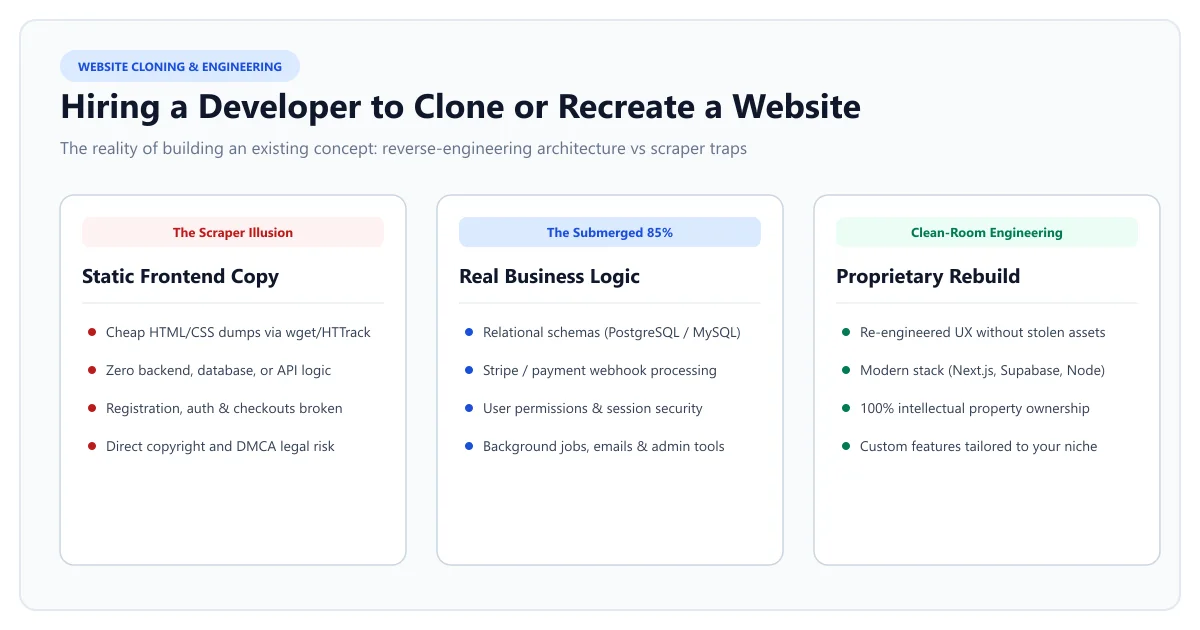
To clone or recreate an existing website successfully, hire a software engineer who reverse-engineers the underlying business logic, database relationships, and API workflows rather than a contractor who merely scrapes frontend HTML. When non-technical founders say they want to "copy a website," they typically want to replicate the user experience, transaction mechanisms, and commercial model of a proven competitor while adapting it to their own brand, niche, or geographic market. Reviewed October 2026. Figures, timelines, and legal frameworks below represent current engineering benchmarks for production software builds.
The marketplace for website cloning is filled with dangerous shortcuts. Freelance job boards are crowded with low-cost bids offering to "clone any website in forty-eight hours for one hundred dollars." What clients receive from such engagements is almost universally a static rip of compiled HTML, minified stylesheets, and broken JavaScript scripts executed via scraping tools. The resulting files display a visual facade in a browser, but interactive features — user registration, database lookups, payment processing, transactional emails, and administrative dashboards — do not function. If you are assessing quotes from development agencies or freelancers, consult our quote evaluation guide; to understand pricing fundamentals across bespoke builds, explore our custom website cost analysis.
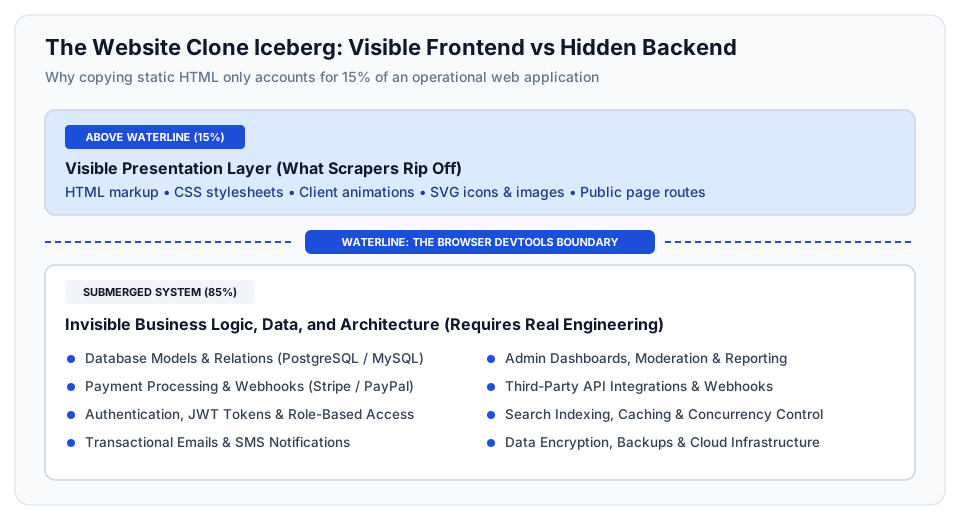
The Website Clone Iceberg: Why You Cannot Simply "Copy" a Web Application
The visible presentation of a website represents only fifteen percent of its total technical complexity; the remaining eighty-five percent consists of server-side data models, asynchronous webhooks, authentication state machines, and business rules that are invisible to web browsers. When an internet user loads a modern web application, the browser receives only the compiled client-side representation — HTML tags, CSS styling, and client-side UI bundles — while the underlying engine remains secured inside private server environments.
A website clone is an iceberg:
- The Tip (Above the Waterline — 15%): Visual layout, typography, responsive grid behavior, navigation headers, client-side animation curves, and public informational copy. This is everything an automated crawler or browser scraper can read.
- The Submerged Base (Below the Waterline — 85%): Relational database schemas, foreign key constraints, payment gateway integrations, webhook listeners, user identity verification, permission hierarchies, search indexing pipelines, background job queues, transactional messaging services, and administrative reporting dashboards. None of this code can be downloaded from a browser.
When an inexperienced contractor promises to copy a complex platform like Airbnb, Thumbtack, or a specialized SaaS tool by downloading its pages, they are attempting to build an automobile by photographing its exterior paint. A functional recreation requires an engineer to deduce the business rules governing user interactions, design an appropriate relational database from scratch, construct secure backend API endpoints, and bind original frontend components to that custom architecture.
Legal and Intellectual Property Realities of Website Cloning
Directly copying a competitor's proprietary source code, copyrighted text, graphic illustrations, brand assets, or trademarked logos is illegal and exposes business owners to DMCA takedown notices, payment processor bans, and copyright infringement lawsuits. Conversely, reverse-engineering the functional concepts, business workflows, and user interface paradigms of an existing product using clean-room engineering is entirely legal and represents the standard path of software innovation.
To navigate intellectual property laws safely, founders and engineering contractors must distinguish between three distinct categories of intellectual assets:
- Protected by Law (Never Copy): Trademarked brand names, logos, distinctive trade dress, proprietary brand color schemes, original marketing copy, custom illustrations, registered product imagery, and literal backend source code. Extracting an existing site's HTML markup and asset files verbatim constitutes copyright theft under international intellectual property treaties.
- Freely Reusable (Industry Standard Patterns): Functional workflows (such as a three-step checkout, multi-vendor escrow release, calendar date-picking, or faceted search filters), architectural layouts (such as two-column product grids or sticky navigation headers), and standard database relationships. Copyright law protects specific creative expressions, not functional mechanisms or commercial concepts.
- Clean-Room Reverse-Engineering: The formal engineering practice of observing how an external software system behaves from the outside (its user journeys, public API response payloads, and inputs/outputs) and writing entirely original software code to reproduce that utility without inspecting or copying the competitor's internal codebase.
A reputable software developer protects their client by conducting a clean-room build. They write fresh semantic markup, implement distinct typography, construct tailored UI design components, and establish a proprietary database schema. This guarantees that your business owns one hundred percent of the resulting intellectual property and can safely raise venture capital, secure merchant accounts, or pursue an acquisition.
Four Approaches to Recreating an Existing Website
Recreating an existing web platform can be accomplished through four distinct technical approaches: static HTML scraping, turnkey clone scripts, no-code application builders, and bespoke clean-room engineering. Each approach carries distinct trade-offs in development velocity, capital expenditure, architectural stability, and long-term asset ownership.
| Approach | Typical Cost | Delivery Timeline | Core Advantages | Fatal Flaws & Operational Risks |
|---|---|---|---|---|
| Static HTML Scraping (Rip Tools) | $50 – $300 | 1–3 days | Immediate visual mock-up; near-zero upfront cash outlay | Completely non-functional: No database, no auth, broken forms; massive legal and DMCA infringement liability |
| Turnkey Commercial Clone Scripts | $1,500 – $4,500 | 2–4 weeks | Pre-packaged core features (e.g. marketplace or directory templates) | Bloated legacy PHP code; obsolete dependencies; security vulnerabilities; difficult to customize beyond default settings |
| No-Code Builders (Bubble, Webflow) | $2,500 – $7,000 | 3–6 weeks | Rapid visual iteration; drag-and-drop workflow configuration | Severe platform lock-in; monthly subscription scaling taxes; hard database performance limits under concurrency |
| Bespoke Clean-Room Engineering | $4,000 – $15,000+ | 6–12 weeks | 100% code and IP ownership; tailored database schema; enterprise security; infinite scalability | Requires experienced senior engineering talent and a structured sprint-based development investment |
Turnkey clone scripts represent a particularly deceptive trap. Online marketplaces sell pre-made "Airbnb clone scripts" or "Upwork clone scripts" for a few hundred dollars. These software packages are frequently built on decade-old programming frameworks, contain hardcoded database credentials, and lack basic input sanitization, leaving platforms vulnerable to SQL injection and payment skimming attacks. When a business outgrows the rigid parameters of a turnkey script, modifying the monolithic codebase often costs more than building a clean application from the ground up.
The 5-Phase Clean-Room Reverse-Engineering Lifecycle
Professional software engineers execute website recreations through a five-phase engineering lifecycle that moves methodically from feature decomposition to production deployment. This methodology ensures that business logic is thoroughly documented and implemented without relying on guesswork or pirated code.
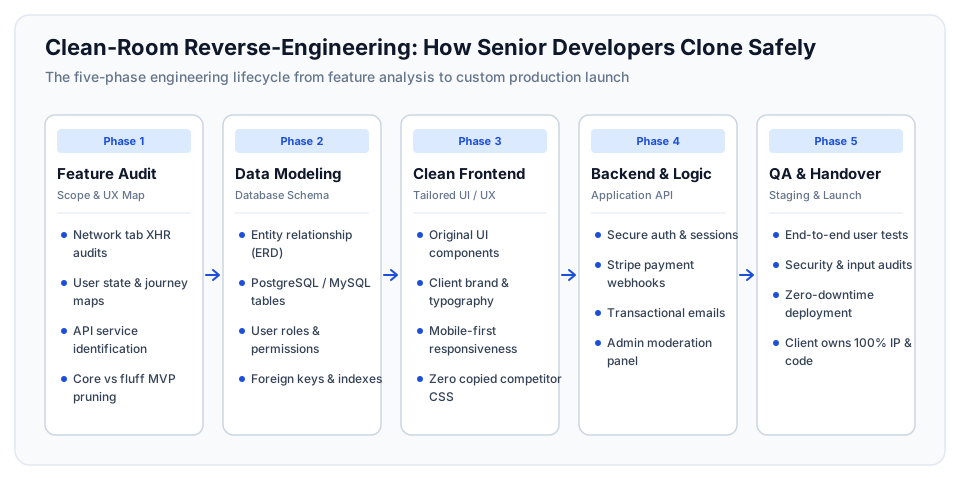
Phase 1: Feature Decomposition and Network Auditing: The developer analyzes the target reference website as a functional specification document. Using browser developer inspection consoles, the engineer maps every user journey (unauthenticated browsing, registration, customer onboarding, checkout, messaging, and account management). They monitor network requests to observe asynchronous API payloads, determine data structures, and identify third-party microservices (such as Stripe for payments, Algolia for search, or Twilio for SMS verification).
Phase 2: Database Schema and Data Modeling (ERD): Before writing visual code, the engineer designs the relational database schema. They define database tables, primary keys, foreign key relationships, enum states, and indexing strategies. For a rental marketplace, this entails modeling users, property listings, booking reservations, availability blocks, review entities, and transaction ledger rows. A well-designed Entity Relationship Diagram (ERD) ensures the application can scale to hundreds of thousands of records without structural database rewrites.
Phase 3: Clean-Room Frontend Component Development: The contractor develops an original frontend application utilizing modern component-driven libraries such as React or Vue inside frameworks like Next.js. They recreate the responsive UX patterns, modal interactions, and form flows of the reference site using clean, maintainable utility CSS (such as Tailwind CSS). Crucially, the styling adopts the client's distinct branding, color system, and accessible typography, avoiding any direct duplication of the competitor's visual assets.
Phase 4: Backend Business Logic and API Integration: The developer writes the application server handlers, database migration scripts, authentication mechanisms, and external API webhooks. They construct backend logic to handle sensitive operations: cryptographic password hashing, role-based session authorization, idempotent payment processing, automatic tax calculations, and transactional email triggers. Every endpoint is built with strict server-side validation to prevent malformed or malicious data submissions.
Phase 5: Quality Assurance, Security Audit, and Staging Handover: The application undergoes end-to-end integration testing on an isolated staging environment. The developer verifies user registration, simulates successful and failed card transactions, tests edge-case error boundaries, and conducts automated vulnerability scans. The client receives full administrative ownership of git repositories, cloud hosting accounts, and database credentials.
Cost Bands and Timeline Benchmarks: What Does It Cost to Recreate a Website?
The cost to recreate an existing website ranges from $1,200 for a static marketing replica to over $15,000 for a complex multi-sided transactional platform, with senior freelance engineers billing between $45 and $95 per hour. Project budgets correlate directly with the complexity of the underlying database schema and the number of external API integrations rather than the count of visual pages.
| Project Tier & Complexity | Estimated Hours | Typical Cost Band | What Is Included in the Scope | Target Architecture & Stack |
|---|---|---|---|---|
| Marketing / Corporate Site Replica | 20–40 hours | $1,200 – $3,200 | Clean visual frontend, custom responsive layout, contact forms, blog CMS integration, SEO optimization | Next.js / Astro static generation, headless CMS (Sanity/Strapi), Formspree API |
| Single-Workflow Web Application | 50–85 hours | $3,000 – $6,500 | User auth, customer profile dashboard, single payment checkout, automated transactional emails, admin review portal | React / Next.js, PostgreSQL / Supabase, Stripe Checkout, Resend email API |
| Two-Sided Marketplace / Booking Engine | 90–160 hours | $5,500 – $13,000 | Dual user roles (buyer/seller), search & filtering, booking calendars, escrow payouts, reviews, dispute flows | Next.js, Node.js / Python backend, PostgreSQL, Stripe Connect, Redis cache |
| Complex SaaS Platform / Custom Portal | 160–250+ hours | $10,000 – $22,000+ | Subscription billing, team tenant isolation, complex data processing, real-time analytics, automated onboarding | Modern full-stack microservices, cloud queue workers, high-availability database cluster |
Understanding these price bands protects founders from unrealistic promises. If an agency quotes $500 to build an "exact clone of Fiverr," they will either deliver an unmaintained clone script or abandon the project when they encounter the technical complexity of multi-vendor payout webhooks. For focused development sprints or single-feature additions, explore our one-time task developer arrangement; for continuous product builds, consult our hourly developer model.
Vetting Guide: How to Spot Scraper Contractors vs True Software Engineers
To vet a developer for a website recreation project, test their architectural deduction skills, database design methodology, and API integration experience rather than reviewing static screenshots of past work. A true engineer talks about database normalization, edge cases, and transaction atomicity; an unqualified scraper talks exclusively about visual themes and HTML scraping software.
- Ask how they plan to extract the competitor's functionality: If the candidate mentions tools like HTTrack, wget, website copiers, or theme scrapers, disqualify them immediately. A professional developer will explain how they inspect network calls in Chrome DevTools, document data schemas, and write original application code to mirror the feature set.
- Ask them to sketch the data model: Provide a link to one core feature on your target reference site (such as an order booking form or a supplier profile) and ask the candidate to outline the required database tables and relational keys. A qualified engineer can produce a coherent entity relationship schema in fifteen minutes.
- Ask how they handle payment processing and webhooks: Inquire how the application confirms a customer payment before granting access to a digital service. An amateur developer relies on client-side frontend redirect pages (which can be easily bypassed by savvy users); a senior engineer implements cryptographically verified server-side webhook endpoints that mutate database state only upon direct confirmation from the payment processor.
- Inquire about administrative capabilities: Ask the developer how you, as the non-technical platform owner, will manage users, ban fraudulent accounts, refund payments, and update content. A competent build always includes an administrative management panel or integrates a headless dashboard.
- Conduct a 3–5 hour paid trial task: Before committing to a multi-thousand-dollar contract, pay the candidate for a brief discovery spike. Task them with writing a Functional Requirements Document (FRD) and an Entity Relationship Diagram (ERD) for the reference site's primary user workflow. If their architectural breakdown is thorough and logically sound, approve the full implementation sprint.
Real-World Implementation Case Studies
The following case studies demonstrate the commercial and technical realities of recreating existing web platforms across diverse industries.
Case 1: B2B Job Board Founder Rescued from a Compromised Turnkey Clone Script
Initial situation: An industry consultant wanted to launch a specialized job portal replicating the functionality of an established executive recruitment board. To save capital, the founder purchased a $299 commercial "job board clone script" from an online script marketplace and hired a low-cost freelancer to install it on shared hosting.
What blocked progress: Within three weeks of launching, user registration forms began throwing database connection errors during traffic spikes. More critically, an automated security vulnerability scanner revealed that the clone script ran on an unpatched PHP 7.1 runtime containing known remote code execution exploits. Customer credit card information was passed directly through unsecured form inputs without proper PCI-compliant tokenization, and the vendor refused to provide source code documentation or database migration utilities.
Solution: The founder abandoned the compromised script and engaged a senior full-stack developer through an hourly contract. The engineer audited the competitor's core user flows and built a clean-room application using Next.js and Supabase (PostgreSQL). The specialist constructed a normalized database model for job postings, employer organizations, and applicant resumes, integrated Stripe Checkout for employer listing fees, and deployed the frontend to a serverless edge network with strict Content Security Policies.
Result: The custom platform launched within five weeks. Page load latency plummeted from 3.2 seconds to 420 milliseconds, and candidate application conversion rates increased by 44%. Because the business owned 100% of its custom codebase, the founder successfully integrated automated LinkedIn profile enrichment two months later without vendor restrictions. Total development investment: 68 hours at $75 per hour ($5,100).
Case 2: Custom Heavy Equipment Rental Platform Recreated from Consumer Marketplace Models
Initial situation: A regional logistics entrepreneur recognized that existing peer-to-peer equipment rental platforms catered exclusively to residential consumers, leaving a massive commercial gap for industrial heavy equipment leasing. The founder wanted a platform operating on the exact booking and calendar mechanics of Airbnb, tailored to industrial contractors.
What blocked progress: Standard no-code marketplace templates could not support the complex commercial requirements of heavy equipment leasing: multi-day rental pricing with security deposit holds, certificate of insurance (COI) upload verification, customized operator add-on fees, and freight delivery dispatch coordination. Attempting to force these features into pre-built plugins created severe UI lag and conflicting state calculations.
Solution: A senior full-stack engineer was hired to reverse-engineer the listing, search, and reservation workflows of leading consumer rental engines into a bespoke system. The developer architected an optimistic database reservation lock in PostgreSQL to prevent double-booking collisions, integrated Stripe Connect for automated split-payouts with deferred security deposit holds, and constructed an administrative verification queue for equipment liability insurance documents.
Result: The bespoke platform facilitated over $380,000 in rental equipment volume during its first six months of operations with zero booking conflicts or payment reconciliation discrepancies. The proprietary software architecture served as the foundational IP that enabled the startup to close an $850,000 seed investment round. Total project budget: 135 hours at $90 per hour ($12,150).
Case 3: High-Converting E-Commerce Funnel Recreated Without DMCA or Brand Infringement
Initial situation: A direct-to-consumer skincare company identified an international competitor whose multi-step quiz funnel generated exceptional conversion rates. The brand wanted an identical diagnostic quiz and checkout sequence for their own product formulations.
What blocked progress: The initial freelance marketer hired by the company used browser scraping tools to duplicate the competitor's HTML, CSS, and imagery directly. Within forty-eight hours of launching ad campaigns to the copied page, the competitor's legal counsel issued a formal DMCA cease-and-desist letter to their hosting provider and Shopify, threatening an immediate domain shutdown and trademark lawsuit.
Solution: The company immediately took down the scraped assets and hired a professional frontend engineer to conduct a legitimate clean-room recreation. The developer abstracted the competitor's diagnostic questionnaire into a dynamic JSON logic tree, built custom React interactive components styled with the client's proprietary brand guidelines, and integrated the questionnaire directly with Shopify's Storefront API. Original medical diagrams and copywriting were produced to replace all borrowed competitor content.
Result: The custom diagnostic quiz launched completely insulated from legal liability. The clean, unbloated code delivered a 98% Google PageSpeed score, and the personalized bundle recommendation engine achieved a 6.2% checkout conversion rate — outperforming the original competitor's estimated benchmarks. Total engineering cost: 35 hours at $80 per hour ($2,800).
Common Mistakes When Hiring a Developer to Copy a Website
The most costly mistake non-technical founders make is paying a contractor before verifying that backend database schemas and server-side APIs have been custom-engineered rather than scraped. Falling into developer traps leads to abandoned projects, wasted capital, and severe security liabilities.
- Believing frontend scraping equals a functional site: Assuming that because a developer delivered HTML files that look identical to the competitor in a local browser, the website is "almost finished." Static HTML without a database, backend server, and API integrations represents less than a fifth of the necessary work.
- Purchasing nulled or pirated marketplace scripts: Many low-cost developers simply download pirated ("nulled") versions of commercial WordPress plugins or clone scripts. These files frequently contain malicious backdoors, cryptocurrency miners, and hidden administrative access accounts that compromise your customer data.
- Ignoring mobile responsive edge cases: Competitor platforms often hide complex mobile responsive logic behind server-side user-agent sniffing. If your developer only copies the desktop layout, the mobile interface will fail, alienating the sixty percent of web traffic that browses on smartphones.
- Failing to secure production account ownership: Allowing the contractor to host your database, source code repositories, and third-party API accounts on their personal cloud infrastructure. If a billing dispute arises, the contractor can hold your entire digital business hostage.
- Overlooking transaction concurrency and race conditions: In booking and marketplace sites, two users may attempt to reserve the same inventory item or appointment slot at the identical second. Amateur developers fail to implement database concurrency locks, leading to embarrassing and expensive double-booking failures.
Expert Advice on Reverse-Engineering Competitor Websites Safely
Approach website recreation as a product specification exercise rather than a copying task. Use the competitor's live website as an interactive wireframe that saves you thousands of dollars in user experience research, but build the underlying engine to your exact business standards.
Draft a functional feature matrix before hiring: Walk through the reference website and document every explicit feature in a spreadsheet: user login, email notifications, search filters, payment types, admin moderation, and user profiles. Rank every feature as "Must-Have for MVP," "Nice-to-Have for Phase 2," or "Unnecessary Fluff." Stripping out secondary features can reduce your initial engineering bill by forty percent.
Establish clean-room IP separation: Explicitly stipulate in your developer agreement that all delivered code must be original, clean-room software created specifically for your organization. Require the contractor to certify that no proprietary code, stylesheets, or assets were scraped from the reference website, ensuring your company holds unencumbered intellectual property rights.
Mandate standard Git version control and milestones: Require the contractor to push daily code commits to a private GitHub or GitLab repository owned by your company. Tie contract milestone disbursements to functional deployments on an isolated staging server where you can test live user registrations and dummy payment transactions with your own hands.
Retain your own infrastructure accounts: Set up your own hosting accounts (such as Vercel, Supabase, AWS, or DigitalOcean) and payment gateway keys (Stripe). Provide the developer with restricted team collaborator credentials; never allow critical operational infrastructure to be owned by third-party freelancers.
Frequently Asked Questions
Can a developer legally copy a competitor's website?
A developer cannot legally copy a competitor's source code, text copy, graphic assets, or trademarked branding, as this constitutes copyright and trademark infringement. However, a developer can legally reverse-engineer the functional concepts, layout paradigms, and business workflows of an existing website by writing completely original, clean-room code from scratch.
How much does it cost to hire a developer to clone a website?
Recreating an existing website typically costs between $1,200 and $3,500 for a static marketing site with a CMS, $3,500 to $7,000 for a functional web application with user authentication and payments, and $6,000 to $16,000+ for a complex multi-sided marketplace or SaaS platform. Senior freelance software engineers generally charge between $45 and $95 per hour for custom architecture.
Why is copying HTML and CSS files not enough to make a functional website?
HTML and CSS files only govern the visual presentation rendered inside a visitor's browser. They contain none of the hidden backend infrastructure — relational databases, server-side business logic, authentication token handlers, payment gateway listeners, and administrative portals — required to process user accounts, store data, or execute commercial transactions.
What is a clean-room software recreation?
A clean-room software recreation is an engineering practice where a developer analyzes the external behaviors, workflows, and API responses of an existing application and writes entirely original code to achieve similar utility. This ensures that the new platform infringes on no third-party copyrights and gives the business complete, legally defensible ownership of its software intellectual property.
Are pre-made website clone scripts worth buying?
Pre-made commercial clone scripts are rarely worth the investment for serious businesses because they are frequently built on obsolete codebases, carry severe security vulnerabilities, and resist customization. Modifying and securing a legacy clone script often costs more in engineering hours than developing a clean MVP on modern frameworks like Next.js and PostgreSQL.
How long does it take for a developer to recreate a website?
A senior developer can recreate a standard marketing website in two to three weeks, a functional single-workflow MVP in four to six weeks, and an advanced two-sided marketplace or SaaS application in eight to twelve weeks. Timelines depend primarily on database schema depth and the number of third-party API integrations.
Can I copy the business model and user flow of a successful website?
Yes. Business models, user journeys, navigational conventions, and functional concepts cannot be copyrighted under international law. You are entirely free to build a platform that operates on the same commercial mechanics as an established competitor, provided you use your own brand identity, original copywriting, and proprietary codebase.
How do I verify that my developer wrote original code rather than stealing assets?
Require your developer to submit code through a private Git repository where you can inspect commit history. You can run automated code plagiarism scans and verify that the application uses an original component architecture (such as Tailwind CSS) rather than minified, scraped stylesheet bundles containing the competitor's internal class names.
What technologies should a modern website recreation use?
Modern functional web applications are typically built using component-driven frameworks like Next.js (React) or Nuxt (Vue) paired with a robust relational database such as PostgreSQL (managed via Supabase or AWS RDS). For payment processing, industry-standard APIs like Stripe or Braintree provide secure, PCI-compliant infrastructure.
What features should I exclude from an initial website clone MVP?
When launching an initial MVP, exclude secondary features such as social media logins, multi-language localization, complex automated recommendation engines, and native mobile apps. Focus exclusively on the primary commercial transaction: listing discovery, user booking or purchase, payment processing, and administrative fulfillment.
Why do cheap freelancers promise to clone websites in two days?
Cheap freelancers promise two-day turnarounds because they use automated website scrapers (such as HTTrack or browser extensions) to rip static frontend files, or they install pirated, unmaintained script templates. They deliver non-functional visual shells that lack functional databases, backend logic, and security safeguards.
Who should own the code, hosting, and domain during the build?
You, the platform owner, must always maintain direct ownership of all source code repositories (GitHub/GitLab), cloud hosting infrastructure (AWS, Vercel, Supabase), domain registrar accounts, and payment gateways. Grant developers collaborator access, and ensure your contract explicitly transfers all intellectual property rights to your company upon milestone payment.
Written by Michael Melnyk
Senior IT Technical Writer & Technology Analyst
Senior Technical Writer and IT Industry Analyst with over 7 years of experience analyzing software engineering ecosystems, tech leadership models, and developer procurement frameworks.