What Is a Founding Engineer? Role, Equity, Rates, and When Startups Need One
A Founding Engineer takes your startup from 0 to 1, building the core MVP and setting up technical architecture. Here is what the role covers, equity vs rate benchmarks, and how to hire.

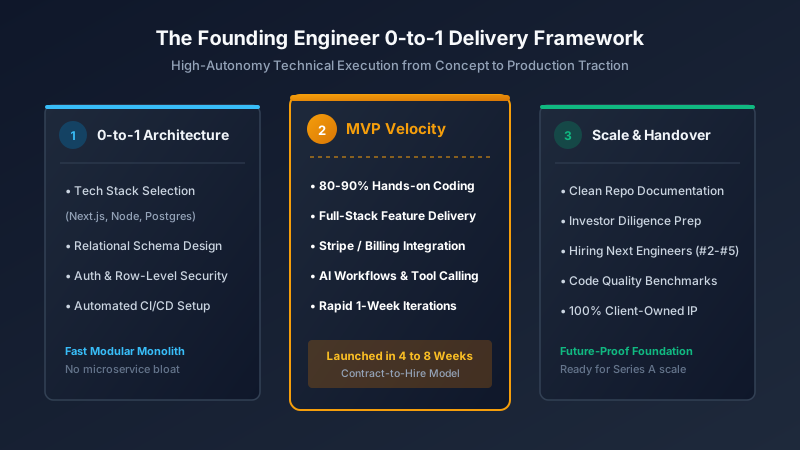
A Founding Engineer (FE) is the first senior technical hire at an early-stage startup—typically employee #1 through #3. Rather than specializing in a narrow domain or executing pre-written product specifications, a Founding Engineer owns the zero-to-one (0-to-1) journey: translating founder vision into tested production code, designing the database schema, selecting infrastructure, and launching the Minimum Viable Product (MVP).
For non-technical founders, solo entrepreneurs with pre-seed or seed capital, and commercial leaders launching new software ventures, the Founding Engineer represents the operational core of the startup. They combine the broad capability of a senior full-stack engineer with the urgency and product empathy of a founder.
What Does a Founding Engineer Actually Do?
In an early-stage startup, there are no dedicated product managers, DevOps teams, or QA testers. A Founding Engineer operates autonomously across the entire software delivery lifecycle:
1. 0-to-1 Architecture & Tech Stack Selection
The initial technology choices determine whether a startup can iterate weekly or gets bogged down in infrastructure maintenance. A Founding Engineer selects proven, typed technologies (such as TypeScript, Next.js, Node.js, Python, and PostgreSQL) that enable rapid feature shipping while remaining easy for future engineers to maintain. They deploy on managed platforms (like Supabase, AWS, or Vercel) to keep monthly operational costs low until traffic demands dedicated infrastructure.
2. Full-Stack Hands-On Feature Delivery (80–90% Coding)
Unlike executive technical leaders who focus on hiring, board meetings, and strategy, a Founding Engineer spends the vast majority of their working hours writing production code. They implement user authentication, configure database relational models, integrate billing pipelines (such as Stripe Checkout and webhooks), assemble responsive web interfaces, and connect AI model APIs.
3. Product Discovery and Rapid Prototyping
A Founding Engineer works directly with founders and early beta customers. When user feedback reveals that an assumed workflow is confusing, the engineer iterates on the interface within hours. They possess the product judgment to suggest pragmatic technical alternatives that cut development time in half without sacrificing user value.
4. Setting the Engineering Baseline and Culture
As the company gains traction and prepares for seed or Series A financing, the Founding Engineer establishes the codebase conventions, automated CI/CD deployment pipelines, code review standards, and repository documentation. When the startup begins hiring engineers #2 through #6, the Founding Engineer leads technical interviews and manages onboarding.
Role Comparison: Founding Engineer vs. Co-Founder vs. Fractional CTO vs. Senior SWE
Founders frequently struggle to decide which technical role best fits their current runway and company maturity:
| Metric | Technical Co-Founder | Founding Engineer | Fractional CTO | Senior Software Engineer |
|---|---|---|---|---|
| Primary Focus | Company strategy, vision, fundraising, tech | Hands-on 0-to-1 code, MVP, architecture | High-level governance, hiring, tech due diligence | Ticket execution in established systems |
| Typical Equity | 20% – 50% | 0.5% – 2.5% (optional future pool) | 0% – 0.5% (advisory) | 0.05% – 0.2% |
| Cash Cost Model | $0 to minimal stipend initially | $65 – $120 / hr (contract) or market salary | $4,000 – $12,000 / month retainer | $140,000 – $190,000 / year salary |
| Time to Onboard | Months of networking & co-founder dating | 2 to 5 business days (contract-to-hire) | 1 to 2 weeks | 4 to 8 weeks (recruiter cycles) |
| Code Commitment | 50% – 70% of time | 85% – 95% of time | 10% – 20% (reviews & specs) | 80% (PR-driven) |
For founders balancing these early decisions, our guide on technical co-founder equity agreements details how vesting schedules and cliff periods protect early cap tables. Similarly, if your primary need is part-time executive governance rather than full-time coding, reviewing what a fractional CTO covers clarifies the distinction.
When Does a Startup Need a Founding Engineer?
Hiring a Founding Engineer is the right move when you have validated your core business hypothesis and secured initial capital, but lack the technical execution capacity to ship software:
1. You Have Pre-Seed or Seed Capital and Need to Ship an MVP
If you have raised $100,000 to $1,000,000 from angels or pre-seed funds, speed to market is your single most important metric. Surrendering months to find an elusive technical co-founder burns runway. Engaging a vetted Founding Engineer allows you to begin software construction within days, shipping a functional commercial product within 6 to 10 weeks.
2. You Want to Test Technical Alignment Before Granting Permanent Equity
Splitting 30% or 40% of your company with an unvetted technical partner before writing a single line of code is one of the leading causes of early startup collapse. Utilizing a contract-to-hire model with a Founding Engineer allows both parties to work together in production for 8 to 16 weeks at an hourly rate ($65–$120/hr). If technical velocity, communication, and mutual respect are proven, the founder can extend a permanent offer with stock options from a position of confidence.
3. Transitioning from Early Experiments to Scalable Software
If you have built an early no-code prototype or worked with initial contractors, you may reach a stage where customer demand outgrows the initial build. As outlined in our guide on hiring developers for small businesses and startups, transitioning from basic workflows to proprietary web applications requires architectural discipline that only an experienced 0-to-1 software builder can provide.
Commercial Economics: Rates, MVP Budgets, and Equity Structures
The cost of engaging a Founding Engineer varies based on whether the arrangement is contract-to-hire, hourly, or salaried with equity.
1. Contract-to-Hire / Hourly Sprint Model
On ProofDevs, independent Founding Engineers bill between $65 and $120 per hour depending on specialized domain experience (such as AI workflows, fintech compliance, or real-time event streaming):
- Initial MVP Delivery (120–220 engineering hours): $10,000 – $22,000 total cash outlay over 4 to 8 weeks.
- Monthly Sprint Retainer (25–35 hours/week): $6,500 – $14,000 per month.
- Cap Table Impact: 0% dilution during the initial build phase. All code is delivered directly to your private repository under work-for-hire terms.
2. Full-Time Salaried Model with Equity Grant
When transitioning a Founding Engineer into a permanent in-house employee:
- Annual Salary: $130,000 – $180,000 (US/Remote benchmark, adjusted for funding stage).
- Equity Compensation: 0.5% to 2.5% of company common stock, subject to standard 4-year vesting with a 1-year cliff.
- Title Evolution: Founding Engineers typically progress into Head of Engineering, VP of Engineering, or Chief Technology Officer (CTO) as subsequent engineering cohorts are hired.
How to Vet and Select a Founding Engineer
Founding Engineers require a fundamentally different skillset than developers who excel in mature enterprise environments. Use the following framework during evaluation:
- Evaluate 0-to-1 track record: Confirm that the candidate has previously built and shipped software products from scratch that acquired real paying users. Probe how they handled initial hosting, database migrations, and early customer bugs.
- Test for pragmatic architecture instincts: Ask how they decide between building a custom feature and integrating a third-party SaaS tool (such as Auth0, Supabase, or Stripe). Senior Founding Engineers default to proven managed services to maximize launch speed; junior candidates often propose building custom infrastructure from scratch.
- Inspect communication clarity and product empathy: Describe a high-level customer requirement without providing technical details. A senior engineer asks about user workflows, business constraints, and success metrics before discussing technical frameworks.
- Run a paid 3-to-5-hour trial task: Commission a paid mini-project on a sanitized problem (e.g., scaffolding an authenticated API endpoint with schema validation, database migrations, and an automated deployment pipeline). Evaluate code cleanliness, testing discipline, and speed of delivery.
Conclusion and Next Steps
The Founding Engineer provides the fastest, most capital-efficient pathway to translate early business vision into launched commercial software. By combining full-stack execution, architectural discipline, and founder empathy, a Founding Engineer allows early-stage companies to reach product-market fit without early equity compromise or agency overhead.
To connect with vetted senior 0-to-1 builders who are available for contract-to-hire and MVP builds, explore the ProofDevs Founding Engineer directory or contact our matching team to discuss your project roadmap.
Written by Michael Melnyk
Senior IT Technical Writer & Technology Analyst
Senior Technical Writer and IT Industry Analyst with over 7 years of experience analyzing software engineering ecosystems, tech leadership models, and developer procurement frameworks.