Building AI-First Products with AI-Native Developers
Explore the modern engineering lifecycle for AI-first products. Learn how AI-native developers transition from rapid prototypes to hardened architectures, automated evals, and scalable LLMOps.

The conventional playbook for building software products has permanently changed. Traditionally, launching a web or mobile application required a multi-month development cycle: weeks of wireframing, followed by tedious frontend scaffolding, manual API endpoint coding, and rigorous database schema migrations. In an AI-first product—where foundation models power core customer workflows rather than serving as minor supplementary features—speed of iteration and structural resilience are the primary drivers of commercial success.
Today, founders and forward-thinking engineering teams partner with vetted AI-native developers to compress the timeline from initial concept to live market testing into days. However, building fast cannot come at the expense of engineering discipline. Without proper architectural boundaries, AI-generated applications quickly degenerate into unmaintainable spaghetti code, critical security leaks, and uncontrollable token expenditures.
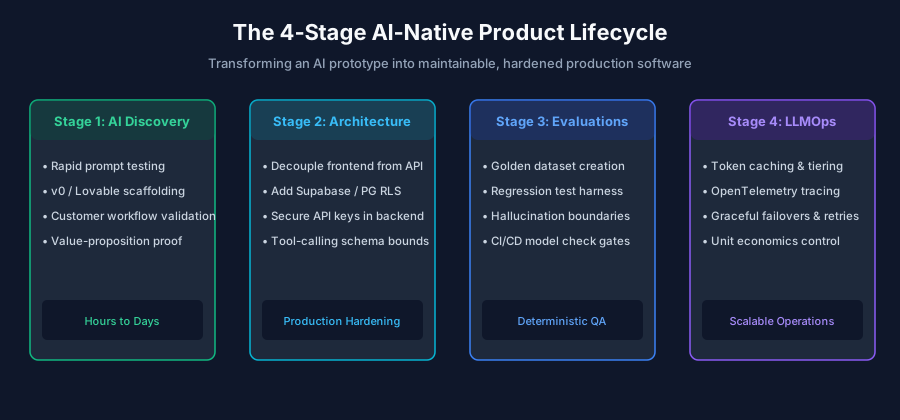
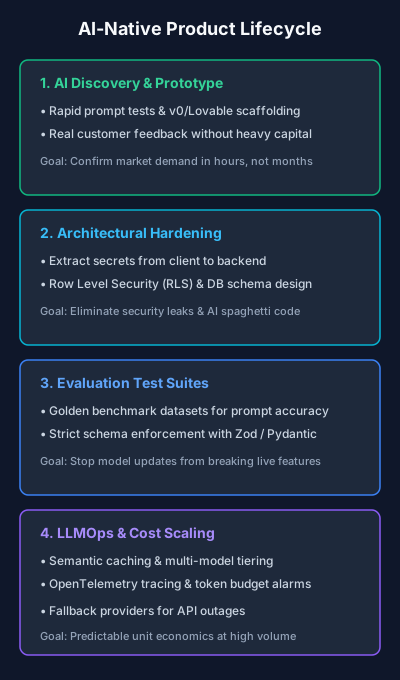
The 4-Stage Lifecycle of an AI-First Software Product
Successfully transitioning an AI-powered idea into an enterprise-ready production platform requires progressing through four structured development stages:
Stage 1: AI Discovery & Rapid Prototyping
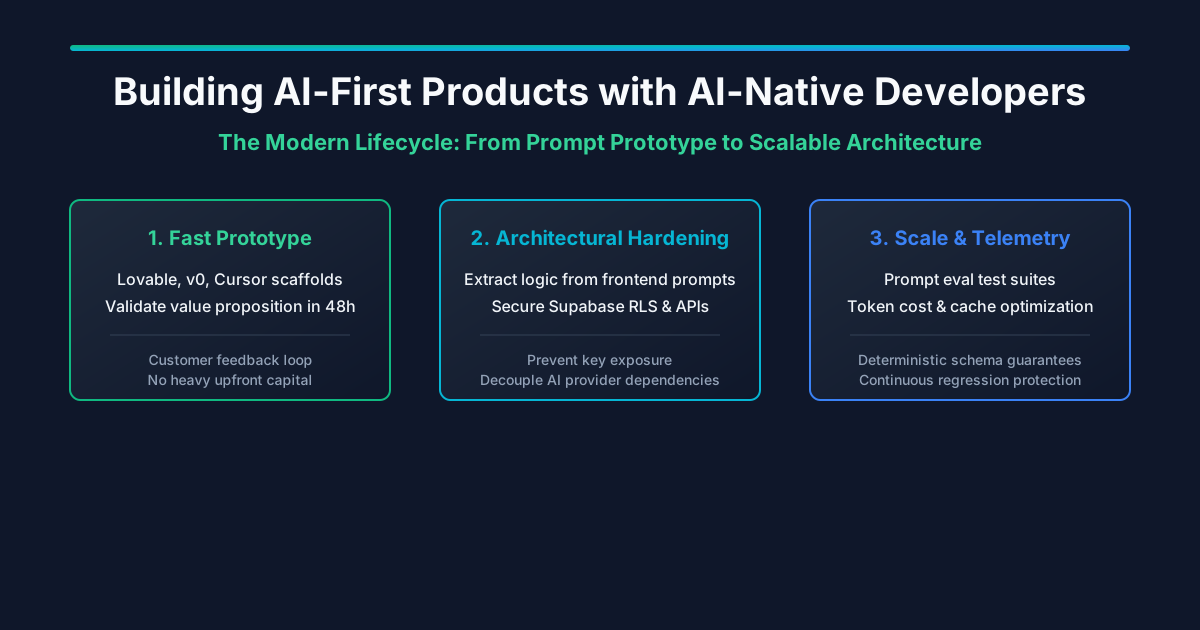
The objective of the first stage is ruthless validation of the core value proposition. Instead of spending weeks building extensive user management settings, an AI-native developer leverages rapid scaffolding tools like Lovable, v0, or modern full-repo coding assistants to stand up a functional interactive prototype within 48 to 72 hours. The goal is to put the AI feature in front of real prospective customers immediately to answer fundamental business questions: Does the model's output actually solve their problem? Are users willing to pay for this workflow? What edge cases emerge in real-world usage?
Stage 2: Architectural Hardening & Security Isolation
Once customer demand is confirmed, the prototype must be decoupled from naive frontend implementations. Prototype generators frequently embed sensitive provider API keys directly in client bundles or rely on client-side state without database authorization checks. In this stage, the AI-native developer:
- Migrates all LLM interactions behind secure server-side API endpoints or serverless edge functions.
- Establishes strict PostgreSQL Row Level Security (RLS) policies to prevent cross-tenant data leaks.
- Extracts business logic out of prompt text and encapsulates it in deterministic TypeScript or Python services.
- Implements structured tool-calling contracts that validate model arguments with Zod or Pydantic before any database mutation occurs.
For founders navigating the transition from early concepts to stable releases, our guide on building an MVP for a startup covers essential technical trade-offs and scoping strategies.
Stage 3: Automated Evaluation Test Suites (Evals)
In traditional development, automated unit and integration tests guarantee that software behaves as expected. In AI-first products, traditional tests alone are insufficient because model providers periodically update weights, causing subtle regressions in prompt performance. To safeguard against quality degradation, the engineer builds a dedicated evaluation pipeline:
- Golden Benchmark Datasets: A curated suite of 50 to 200 real-world customer prompts paired with annotated ideal outputs, boundary cases, and adversarial injection attempts.
- LLM-as-a-Judge & Heuristic Scoring: Automated test runners that grade model responses on factual groundedness, tone consistency, semantic completeness, and absence of hallucinations.
- CI/CD Gateways: Automated checks that run on every pull request, preventing prompt modifications or model version upgrades from being deployed if evaluation pass rates drop below predefined thresholds.
Stage 4: LLMOps, Cost Telemetry, and Scaling
As user volume expands, AI infrastructure costs can scale exponentially if not managed proactively. The final stage establishes operational maturity through modern LLMOps practices:
- Semantic Caching: Storing vector representations of frequent queries in Redis or pgvector to return instant cached responses for semantically identical questions, cutting token costs and latency by up to 40%.
- Model Tiering & Routing: Directing straightforward classification and formatting tasks to fast, lightweight models (such as GPT-4o-mini or Claude 3.5 Haiku) while reserving frontier reasoning models only for complex multi-step analysis.
- Observability & Tracing: Instrumenting OpenTelemetry pipelines (via tools like Langfuse, Arize Phoenix, or Helicone) to monitor token burn per user, p95 latency, prompt iteration history, and error spikes in real time.
- Graceful Fallbacks: Implementing automated failover routing across multiple AI providers (e.g., Anthropic, OpenAI, AWS Bedrock) to maintain uptime during upstream service disruptions.
Avoiding the "AI Spaghetti Code" Trap
One of the greatest hazards in modern AI software development is allowing inexperienced builders to blindly commit raw AI-generated code. Without senior oversight, codebases accumulate duplicated logic, orphaned dependencies, and silent failure modes. An experienced AI-native developer acts as an architectural gatekeeper: they maintain clean separation of concerns, enforce comprehensive automated testing, and treat AI as an execution engine governed by rigorous engineering discipline.
Start Building Your AI-First Product with ProofDevs
Building an AI-first product requires more than generic programming knowledge; it demands deep familiarity with model capabilities, vector retrieval architectures, structured outputs, and production LLMOps. Whether you are bootstrapping a new venture or modernizing an existing enterprise platform, engaging vetted talent ensures your software ships rapidly without sacrificing long-term scalability.
Ready to bring your AI application to market? Submit your project scope on ProofDevs to connect with senior, verified engineers, or explore our directory of AI-native developers today.
Written by Michael Melnyk
Senior IT Technical Writer & Technology Analyst
Senior Technical Writer and IT Industry Analyst with over 7 years of experience analyzing software engineering ecosystems, tech leadership models, and developer procurement frameworks.