Hiring a Technical SEO Specialist: Server Redirects, Canonical Traps, and SPA Indexability
Most SEO audits end up as 50-page PDF reports that developers ignore. This guide covers how to hire a technical SEO specialist who diagnoses crawler traps, writes server-level redirects, fixes SPA rendering, and proves every fix in Search Console.

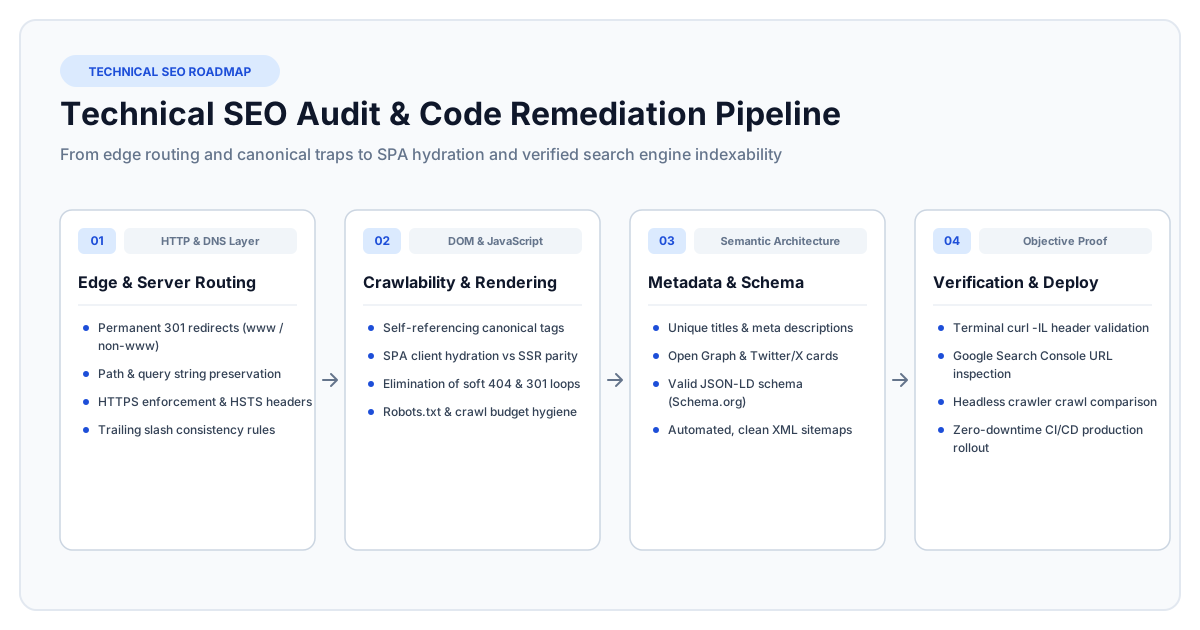
To fix technical SEO issues permanently, hire a technical SEO specialist who writes and deploys production code rather than an agency that merely delivers a PDF audit. Most technical search penalties, dropped rankings, and indexing blind spots stem from infrastructure flaws — broken server redirect rules, duplicate canonical parameters, trailing slash mismatches, hydration delays in modern JavaScript frameworks, and invalid structured data markup. Reviewed October 2026. Figures and timelines below represent standard market benchmarks for senior technical SEO engineering engagements.
Founders and engineering leaders routinely face a frustrating divide: an SEO agency delivers an eighty-page automated crawler report listing hundreds of "critical warnings," but their core web developers dismiss the findings as theoretical noise or refuse to touch routing rules for fear of breaking user sessions. Conversely, hiring a generic front-end freelancer often introduces fatal indexing regressions, such as client-side redirects returning HTTP 200 OK or empty HTML shells that search bots abandon during crawl budget exhaustion. If your platform has suffered sudden traffic decay following an infrastructure change, review our website enhancement guide; for evaluating ongoing emergency site support, explore our maintenance support options.
The Gap Between Traditional SEO Audits and Code-Level Remediation
A technical SEO specialist is a software engineer specialized in crawler mechanics, server routing, and search engine rendering, whereas traditional SEO consultants focus primarily on keyword research, content briefs, and backlink acquisition. When an organization hires a conventional marketing agency for an audit, the client receives a diagnostic export from commercial crawlers that identifies symptoms without addressing underlying root causes in the codebase.
The fundamental failure of standard SEO audits lies in the implementation gap. A standard agency report flags that "four thousand URLs have non-canonical status or redirect chains," but provides zero actionable instructions on whether the resolution requires edge middleware, reverse proxy rewrites, web server virtual host updates, or dynamic framework routing adjustments. When that ticket lands in an internal software sprint, full-stack engineers prioritize user-facing product features over deciphering marketing jargon. A dedicated technical SEO developer bridges this divide by diagnosing the exact failure point in the architecture, writing the necessary server and template logic, testing the changes on staging, and delivering verifiable proof of recovery.
What a Technical SEO Specialist Actually Fixes
Technical SEO remediation covers seven core architectural pillars: domain canonicalization and permanent redirects, self-referencing canonical integrity, dynamic metadata generation, crawler directive architecture, structured data engineering, internal crawl budget hygiene, and JavaScript rendering parity. Each pillar requires precise code execution; a failure in any single layer can invalidate the search performance of an entire web property.
Domain canonicalization and permanent redirects: Every public website must resolve to a single, unambiguous canonical host. If a domain responds simultaneously on both the www and non-www subdomains, or serves identical content over plain HTTP and encrypted HTTPS, search engines treat the variants as competing duplicate websites. A technical SEO specialist configures edge CDN rules or server virtual hosts to execute single-hop permanent HTTP 301 redirects from secondary hosts to the primary domain. Crucially, these redirection rules must preserve full URI paths and URL query parameters rather than truncating incoming visitors and bots to the homepage, which destroys inbound link equity and conversion tracking.
Self-referencing canonical tags: The canonical link element instructs search engines which URL represents the authoritative version of a document. When multiple URLs serve near-identical content due to tracking parameters, sorting filters, or session identifiers, every indexable page must output a clean, absolute, self-referencing canonical tag pointing to its definitive production URL. A technical SEO engineer implements server-side logic that strips ephemeral tracking parameters from the canonical declaration while maintaining the user's active page state.
Head metadata and social graph integrity: Search crawlers and social platforms rely on structured meta tags to understand document relevance and generate preview cards. The specialist ensures that page titles, meta descriptions, Open Graph attributes, and Twitter/X card metadata are uniquely generated from backend database models or headless CMS endpoints, preventing duplicate snippet penalties across paginated or parameterized routes.
Crawler access directives and dynamic sitemaps: The robots.txt file establishes boundary conditions for search crawlers, while XML sitemaps provide an authoritative inventory of discoverable pages. The specialist configures dynamic sitemap endpoints that automatically publish only HTTP 200 indexable URLs, excluding redirected routes, password-protected administrative paths, and canonicalized parameter variations. Furthermore, they audit robots.txt to ensure critical CSS and JavaScript bundles remain accessible to headless rendering bots.
Structured data engineering: Search engines utilize schema markup to construct rich snippets, knowledge graph entities, and AI search summaries. Rather than relying on generic plugins that inject conflicting schema blocks, a technical SEO developer embeds semantic JSON-LD graph structures adhering to Schema.org standards. They map organization entities, breadcrumb hierarchies, review collections, and software application schemas with complete property parity.
Internal link graph hygiene and redirect elimination: Over years of development, internal site links accumulate redirects, trailing slash inconsistencies, and broken 404 destinations. These micro-inefficiencies waste crawler budget and dilute PageRank distribution. The contractor crawls the codebase and database records to update obsolete links to their direct final destinations, eliminating multi-hop redirect chains and orphan nodes.
Single-Page Application (SPA) rendering and hydration parity: Client-rendered JavaScript applications present the highest technical risk in modern web search. When search crawlers encounter an empty HTML container that relies on client-side JavaScript execution to fetch data and render content, indexation slows down or fails entirely. The specialist configures server-side rendering (SSR), static site generation (SSG), or edge hydration so that crawlers receive fully formed DOM trees on the initial HTTP response.
The SPA Indexability Dilemma: Why Modern Web Apps Break in Search Engines
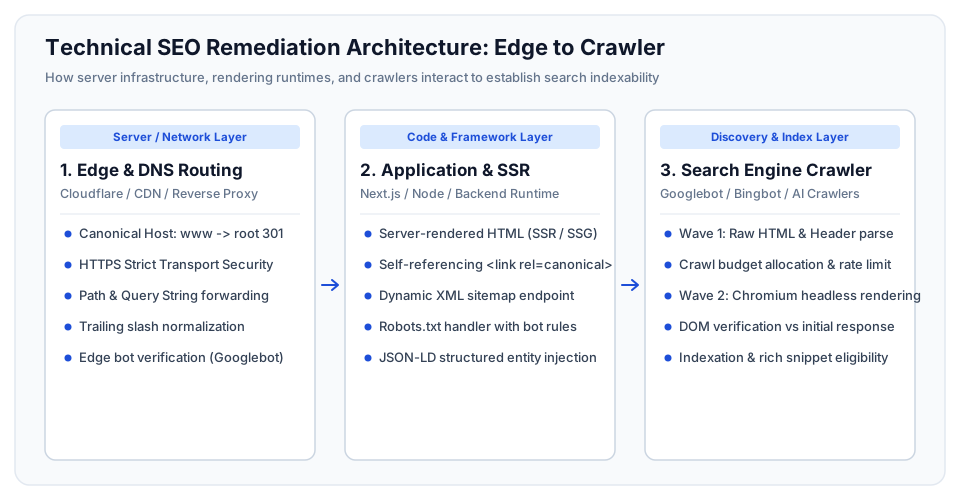
Search engine crawlers process modern web applications through a two-wave indexing system, which causes significant indexing delays and ranking drops for purely client-rendered Single-Page Applications (SPAs). In the first wave, crawler bots fetch the immediate server HTTP response, parse the raw HTML document, extract metadata, and evaluate canonical tags. If the application returns an empty root element with external JavaScript bundles, the page enters a secondary rendering queue that waits for available headless browser processing power.
This secondary rendering queue can lag behind the initial crawl by hours, days, or weeks depending on site authority and crawler resource allocation. If an application relies on client-side routing libraries to inject page titles, canonical tags, and Open Graph metadata after asynchronous API fetches complete, search bots frequently index the pre-rendered fallback shell instead of the true page content. Furthermore, if client-side hydration fails due to browser runtime errors, API rate limits, or heavy script payloads, the crawler records a blank page and drops the URL from indexation.
A senior technical SEO engineer resolves the SPA dilemma by moving critical document rendering to the server runtime. In modern frameworks like Next.js, this entails configuring Server-Side Rendering (SSR) or Incremental Static Regeneration (ISR) so that the raw HTML payload delivered over the wire contains complete heading structures, body copy, and head metadata. When architectural constraints prevent full framework migration, the specialist implements edge pre-rendering via Cloudflare Workers or server-level caching that serves static HTML snapshots specifically to verified search engine bot user-agents.
Architectural Comparison: Where Technical SEO Logic Should Live
Technical SEO rules must be deployed at the highest feasible layer of the infrastructure stack to maximize crawl efficiency and minimize server compute latency. Routing and canonical decisions handled at the edge or web server level execute in single-digit milliseconds without waking backend application containers or querying primary databases.
| Infrastructure Layer | Appropriate Responsibilities | Execution Speed | Primary Advantage | Main Architectural Risk |
|---|---|---|---|---|
| Edge / CDN (Cloudflare Workers, Fastly) | Host canonicalization (www/non-www), HTTP-to-HTTPS enforcement, geo-routing, global 301 redirects, bot verification | 1–5 ms | Zero origin server load; instantaneous crawler response | Routing rule drift if edge configuration is disconnected from Git CI/CD |
| Web Server / Reverse Proxy (Nginx, Apache) | URL rewrites, trailing slash normalization, HTTP security headers, compression (Brotli/Gzip), static asset caching | 5–15 ms | Deterministic routing before application runtime invocation | Server configuration complexity; potential regex collision errors |
| Application Framework (Next.js, Laravel) | Dynamic canonical tags, JSON-LD schema generation, metadata rendering, dynamic XML sitemaps, SSR hydration | 40–200 ms | Direct access to database models and dynamic business logic | Compute overhead; hydration mismatch risks if client DOM mutates server state |
| Client-Side DOM (React Helmet, Vue Meta) | Interactive UI state, client viewport adjustments, logged-in user preferences | 500–2500 ms | Decoupled frontend development without backend changes | Fatal for SEO: Crawlers may miss metadata; two-wave indexing queue latency |
Deploying redirection logic inside client-side components is one of the most destructive architectural practices in modern web development. When a React router performs a client-side navigation redirect via window location updates, the web server initially responds with HTTP 200 OK. Search crawlers interpret this 200 status as a permanent, indexable document containing no real content, resulting in soft 404 classifications and complete loss of ranking equity. A technical SEO specialist migrates all redirection logic to edge middleware or web server configuration blocks that emit strict HTTP 301 Permanent Redirect headers.
How Much Does It Cost to Hire a Technical SEO Specialist?
Hiring a freelance senior technical SEO specialist typically costs between $55 and $120 per hour, with scoped audit-and-remediation projects ranging from $1,500 for small business triage to $8,000+ for enterprise headless migrations. In contrast to marketing agencies that charge recurring monthly retainers of $3,000 to $7,000 to produce repetitive PDF monitoring reports, a technical contractor operates on defined engineering milestones with concrete code deliverables.
| Engagement Scope | Typical Duration | Standard Cost Range | Core Deliverables | Best Suited For |
|---|---|---|---|---|
| Targeted Technical Triage | 15–25 hours | $1,000 – $2,500 | Fix www/non-www redirects, trailing slashes, robots.txt, broken canonicals, and XML sitemap bugs | Small business sites or startups with immediate indexing warnings following a redesign |
| Comprehensive Audit & Code Remediation | 35–60 hours | $2,500 – $5,500 | Full repository audit, server routing overhaul, structured data JSON-LD, internal link graph repair, CI/CD linting | Growing B2B platforms, SaaS products, and established e-commerce catalogs losing organic visibility |
| Headless SPA & Platform Migration | 70–120+ hours | $5,000 – $12,000+ | SSR/SSG architecture implementation, edge pre-rendering pipelines, multi-domain canonical maps, zero-downtime cutover | Complex web applications migrating from legacy monoliths to decoupled Next.js or React frontends |
When budgeting for technical SEO, evaluating the return on investment requires examining commercial opportunity cost. A SaaS company spending $15,000 per month on Google Ads to compensate for unindexed product pages achieves rapid payback by investing $4,000 in a technical remediation sprint that restores organic indexation. For projects requiring immediate, focused assistance on a single blocking infrastructure issue, explore our one-time task developer arrangement; for ongoing technical oversight, consult our hourly developer model.
Vetting Guide: How to Distinguish Real Technical SEO Engineers from Tool Operators
To vet a technical SEO specialist effectively, test their understanding of HTTP protocol headers, server routing mechanics, and DOM compilation rather than asking generic questions about keyword density or backlinks. A qualified contractor should be entirely comfortable discussing reverse proxy configurations, terminal command-line diagnostics, and JavaScript execution contexts.
- Ask how they diagnose redirect chains: A tool operator will say they run a crawl in third-party SaaS software. A technical SEO engineer will explain how to use terminal network tools like curl with follow-redirect flags to inspect every intermediate HTTP response header, verifying whether hops pass through intermediate HTTP 302 temporary redirects or drop URL query parameters.
- Ask how they handle trailing slashes: The candidate must articulate why a URL with a trailing slash and its counter-part without a slash represent two distinct resources under RFC specifications. They should describe the server rewrite rule necessary to enforce a single standard without causing infinite redirect loops on root directories.
- Ask how they audit client-side rendering: A competent specialist compares the raw server response HTML (view-source) against the fully rendered browser DOM. They will explain how to disable JavaScript in developer tools to determine which navigation links and semantic headings fail to render for basic crawlers.
- Ask about canonical header implementation: Beyond standard HTML meta tags, an experienced engineer knows how to emit canonical declarations via HTTP response headers (
Link: <https://example.com/file.pdf>; rel="canonical"), which is the only reliable method to canonicalize non-HTML assets such as downloadable PDFs, spreadsheets, and headless API endpoints. - Evaluate their Git and deployment workflow: An engineer submits pull requests through standard branch workflows, provides staging environments with password authentication rather than crawler-blocking meta tags, and includes automated regression tests in CI/CD pipelines to prevent future template commits from stripping canonical attributes.
Verification Protocol: How Contractors Must Prove Their Work
Never release final milestone payment for technical SEO work based on verbal assurances or promises that "rankings will appear in three months"; insist on verifiable, objective server evidence. Real technical SEO deliverables produce immediate, testable proof at the network, DOM, and search engine inspection layers.
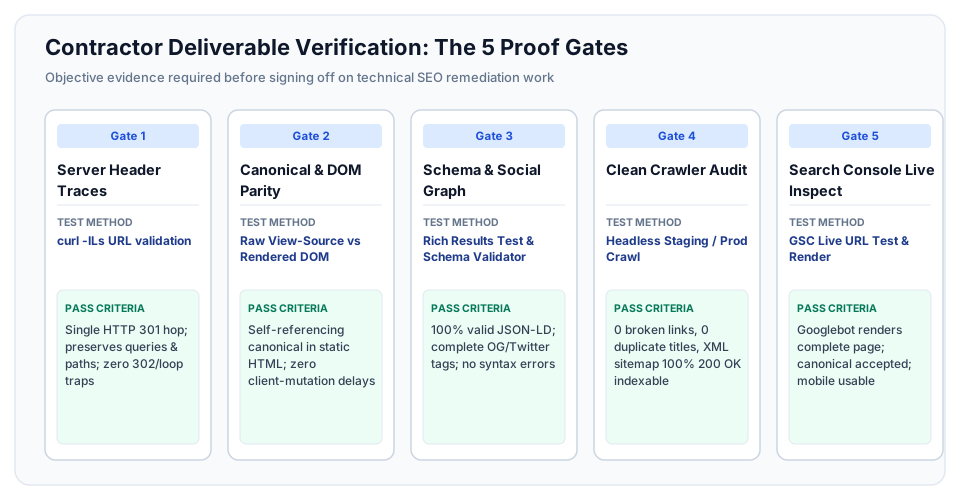
A rigorous verification protocol incorporates five distinct sign-off gates:
- Server Header Traces: The contractor must provide terminal header output demonstrating that non-canonical hosts (such as http://example.com, http://www.example.com, and https://www.example.com) resolve to the single canonical production domain via a single HTTP 301 or 308 redirect hop. The output must confirm that path structures and incoming UTM or query parameters remain completely intact without truncation or double-slash formatting.
- Static HTML DOM Parity: The specialist demonstrates that the raw server response contains a valid, self-referencing canonical link tag matching the exact requested URL. The canonical URL must use the secure https protocol, lowercase path characters, and correct trailing slash conventions without relying on client-side script execution.
- Structured Data Validation: All JSON-LD scripts embedded in the page templates must pass Google's Rich Results Test and Schema.org Validator with zero syntax errors, unescaped characters, or missing mandatory entity properties.
- Clean Headless Crawl Diff: The contractor runs a comprehensive crawl of the staging or updated production environment using headless browser mode. The resulting audit diff must prove zero broken internal links (HTTP 404), zero redirect chains (more than one hop), zero duplicate title tags, and confirm that 100% of URLs listed in the XML sitemap return HTTP 200 OK.
- Search Console Live URL Inspection: Using the Google Search Console URL Inspection API or interface, the contractor runs a live test on primary template samples. The rendered screenshot and DOM tree must confirm that Googlebot successfully fetches all stylesheets, executes critical JavaScript bundles, identifies the self-referencing canonical, and reports the URL as eligible for indexation.
Real-World Implementation Case Studies
The following case studies illustrate how senior technical SEO specialists resolve complex infrastructure bottlenecks across diverse business environments.
Case 1: B2B SaaS React Application Recovering from Client-Side Hydration Penalties
Initial situation: A high-growth project management SaaS rebuilt its marketing site as a Single-Page Application using React and client-side routing. Within six weeks of deployment, organic search traffic dropped by 64%, and hundreds of key landing pages disappeared from Google's primary index.
What blocked progress: The company's in-house frontend team utilized a popular client-side document head library to dynamically set page titles, meta descriptions, and canonical links inside React component lifecycle hooks. When search engine bots crawled the URLs, the initial server response delivered a generic index.html containing only an empty root division and vendor bundle scripts. Because the backend API required authorization tokens that crawlers could not supply, the asynchronous rendering step timed out in Googlebot's Chromium headless queue, leading the crawler to classify every URL as an identical soft 404.
Solution: The company hired a senior technical SEO engineer on a 40-hour contract. Rather than undertaking an expensive months-long framework rewrite, the specialist implemented an edge prerendering layer on Cloudflare Workers. When incoming HTTP requests originated from verified search crawler IP ranges, the worker routed the traffic through a headless rendering cache that served pre-warmed, fully rendered HTML documents containing complete semantic headings and static JSON-LD schema. Concurrently, the engineer configured server-side middleware in their Node.js backend to output permanent HTTP 301 redirects for legacy routes.
Result: Within 18 days of deployment, Google Search Console confirmed the re-indexing of 412 previously dropped landing pages. Organic impressions rebounded by 82% over the subsequent quarter, and the edge prerendering cache reduced origin server compute load by 35%. Total project investment: 42 contractor hours at $85 per hour ($3,570).
Case 2: Multi-Regional E-Commerce Store Resolving Faceted Parameter Explosions
Initial situation: An apparel brand operating a custom e-commerce storefront noticed that newly added product collections took upwards of two months to appear in search results, while existing category rankings steadily deteriorated.
What blocked progress: The catalog utilized a multi-attribute faceted navigation filter (size, color, material, price range) where every user click generated dynamic URL query parameters. Because the frontend templates lacked canonical parameter rules, search engine crawlers discovered and attempted to crawl over 450,000 algorithmic parameter combinations. This crawl trap exhausted the site's search engine crawl budget, causing crawlers to abandon valuable top-level collection pages while indexing millions of thin, near-duplicate parameter pages.
Solution: A technical SEO specialist audited the URL architecture and deployed a three-tier remediation strategy. First, they updated the backend routing controller to inject a strict self-referencing canonical tag pointing exclusively to the clean base category URL, stripping all non-essential sorting and filtering parameters from the indexation directive. Second, they implemented server-level Nginx rewrite rules to return HTTP 410 Gone for historical dead filter combinations that held no search equity. Third, they restructured the dynamic robots.txt file to disallow crawler access to infinite sorting combinations while preserving accessibility for essential collection pathways.
Result: Googlebot's daily crawl requests shifted from 92% parameter clutter to 98% high-value product and category pages within three weeks. Over the following two months, indexation velocity for new inventory increased from eight weeks to under 48 hours, and organic revenue expanded by 27%. Total project cost: 30 hours at $95 per hour ($2,850).
Case 3: Media Publishing Hub Eliminating 4-Hop Redirect Chains After CMS Migration
Initial situation: A high-volume digital publication with over 50,000 articles migrated from a legacy WordPress monolith to a headless content architecture. Post-launch, page load speeds degraded, Core Web Vitals failed across all templates, and organic referral sessions plummeted by 38%.
What blocked progress: During the migration, multiple overlapping redirection plugins and server configuration files were merged without rationalization. When external visitors or search bots requested historical URLs, the network executed a four-hop redirect sequence: from plain HTTP non-www, to plain HTTP www, to secure HTTPS www, and finally to the new headless slug structure without trailing slashes. Each intermediate hop introduced 150 to 300 milliseconds of latency, dissipating crawl budget and causing mobile crawlers to abandon requests before reaching the destination page.
Solution: The publishers engaged a freelance technical SEO developer for a comprehensive routing cleanup. The contractor extracted all historical redirection rules into an automated normalization script, consolidated 14,000 legacy records into a single direct lookup table, and deployed the routing logic inside an Nginx reverse proxy configuration. Every incoming request was evaluated against the consolidated map and redirected directly to its final destination in a single HTTP 301 hop, fully preserving original query strings and URL anchors.
Result: Server response latency dropped from an average of 920 ms to 45 ms across all redirected pathways. Core Web Vitals pass rates improved from 31% to 94% on mobile devices, and organic search traffic fully recovered to pre-migration baseline levels within 24 days. Total project investment: 25 hours at $75 per hour ($1,875).
Common Technical SEO Mistakes Teams Make When Hiring
The most frequent mistake businesses make is assuming that installing an off-the-shelf SEO plugin or running an automated crawler tool solves foundational architectural problems. Plugins operate within the application layer and cannot correct infrastructure-level redirect loops, DNS-level canonical mismatches, or edge network routing failures.
- Relying on temporary HTTP 302 redirects: Developers unfamiliar with search engine ranking algorithms frequently implement HTTP 302 Found or 307 Temporary Redirects instead of HTTP 301 Moved Permanently. Search engines do not transfer accumulated backlink equity or historical authority across temporary redirects, starving the destination page of ranking power.
- Injecting canonical tags via client-side JavaScript: Adding or modifying canonical tags dynamically after page load forces crawlers to rely on their delayed secondary rendering queue. If the initial HTML payload contains a conflicting or missing canonical tag, search bots may index the incorrect parameter URL before the client-side script executes.
- Blocking essential CSS and JavaScript assets in robots.txt: Overzealous developers sometimes attempt to optimize crawl budget by disallowing crawler access to asset directories (such as /static/ or /build/). This prevents modern search engine rendering engines from compiling the visual layout, leading to mobile-friendliness penalties and failed indexation.
- Overlooking trailing-slash normalization: Serving the identical webpage at both
/aboutand/about/creates duplicate content in the eyes of search algorithms unless one version permanently redirects to the other. A technical SEO engineer ensures that the entire routing framework strictly enforces one convention site-wide. - Publishing unpruned XML sitemaps: Submitting XML sitemaps that contain HTTP 404 broken URLs, 301 redirected pathways, or pages marked with
noindexdirectives sends conflicting signals to search engines, eroding the site's overall crawl quality score. - Neglecting staging environment authentication: Leaving staging or pre-production environments accessible to public web crawlers without HTTP Basic Authentication risks having entire staging domains indexed, creating massive duplicate content collisions with the live production site.
Expert Advice on Hiring and Managing Technical SEO Engagements
Structure technical SEO engagements around sprint-based engineering deliverables rather than open-ended consulting retainers. Define the precise acceptance criteria before granting contractor access to your code repositories and hosting infrastructure.
Enforce safe repository workflows: Never allow an external contractor to edit production server configurations or CMS files directly. Require all changes to be submitted as branch pull requests in GitHub or GitLab, allowing internal engineering leads to review code quality, test routing logic on staging mirrors, and verify that deployment pipelines remain unaffected.
Isolate staging environments with HTTP Basic Authentication: Avoid relying on tags to protect pre-production environments during testing. If an engineer accidentally deploys code containing those tags to production, the live domain can be de-indexed within days. Instead, enforce HTTP Basic Authentication at the web server or edge layer on staging; search crawlers cannot supply credentials and will cleanly bypass the test domain.
Integrate SEO validation into continuous integration (CI/CD): Ensure the contractor implements automated linting checks or headless crawler tests within your deployment pipeline. Simple build scripts can verify that every generated page template contains a non-empty title tag, a valid self-referencing canonical URL, and compliant JSON-LD syntax before code merges to main.
Demand terminal header verification logs: Before approving task completion, require the contractor to provide documented terminal command outputs (using curl -ILs) demonstrating clean, single-hop 301 redirections across all targeted legacy routes, verifying that path arguments and tracking parameters pass through without truncation.
Frequently Asked Questions
What is the difference between a technical SEO specialist and an SEO agency?
A technical SEO specialist is a software engineer who diagnoses and directly resolves code-level and server-level indexing barriers, whereas an SEO agency primarily delivers audit reports, keyword strategies, and content recommendations without modifying website infrastructure. Technical specialists write edge redirect rules, configure server-side rendering, resolve canonical conflicts, and deploy schema markup directly into code repositories.
How much does it cost to hire a freelance technical SEO specialist?
Senior freelance technical SEO specialists charge between $55 and $120 per hour depending on platform complexity and architectural scope. Fixed-price project milestones typically range from $1,000 to $2,500 for targeted infrastructure triage (resolving canonicals, redirects, and robots.txt), and $2,500 to $6,000 for comprehensive multi-page audits and codebase remediations.
Why are my React or Next.js pages not being indexed by Google?
React and Next.js applications fail to index when search engines encounter empty initial HTML shells that require asynchronous client-side JavaScript execution to fetch content and inject metadata. While Googlebot eventually executes JavaScript through a secondary rendering wave, queue delays or client-side runtime errors often cause crawlers to abandon the page or classify it as a soft 404. Moving page rendering to Server-Side Rendering (SSR) or Static Site Generation (SSG) resolves this issue.
What is a self-referencing canonical tag and why is it mandatory?
A self-referencing canonical tag is an HTML link element located in a webpage's head section that explicitly names that page's own URL as the definitive, authoritative source. It is mandatory because search engines discover duplicate versions of the same page through tracking parameters, session IDs, trailing slash variations, and HTTP/HTTPS protocols. The self-referencing tag instructs crawlers to consolidate all ranking equity into the single canonical URL.
How do I verify that www to non-www redirects are working correctly?
To verify host redirection, execute a terminal command using curl (curl -ILs http://www.example.com) and inspect the returned HTTP status headers. A correct implementation returns a single HTTP 301 Moved Permanently status code pointing directly to https://example.com, preserving any downstream path and query parameters without secondary intermediate hops or protocol drops.
Can a technical SEO issue cause an immediate drop in organic rankings?
Yes. Critical technical failures — such as accidentally adding a disallow: / rule in robots.txt, deploying a site-wide noindex header from a staging environment, introducing an infinite redirect loop, or breaking server-side rendering — can cause search engines to de-index thousands of pages within 24 to 72 hours, resulting in catastrophic traffic drops.
How does trailing slash inconsistency harm website performance?
Under web standards, /page and /page/ represent two distinct URLs. If your web server responds with HTTP 200 OK to both variants without a permanent redirect or canonical declaration, search engines treat them as duplicate pages, splitting link equity and internal authority. A technical SEO specialist enforces a single standard site-wide via web server rewrites.
What deliverables should I require before paying a technical SEO contractor?
Require five verifiable deliverables before milestone approval: terminal header logs demonstrating single-hop 301 redirects with preserved parameters, raw HTML source confirming self-referencing canonical tags, clean validation reports from Google's Rich Results Test for structured data, a headless crawler audit diff showing zero broken links or duplicate titles, and Google Search Console Live URL Inspection screenshots confirming full DOM rendering.
How does a technical SEO specialist improve website crawl budget?
A technical SEO specialist optimizes crawl budget by eliminating crawler traps: blocking infinite faceted parameter combinations in robots.txt, resolving redirect chains, returning HTTP 410 Gone for permanently deleted dead pages, pruning non-indexable URLs from XML sitemaps, and decreasing server response latency (TTFB) so bots can index more pages within their allocated crawl window.
What is JSON-LD and why is it preferred over microdata?
JSON-LD (JavaScript Object Notation for Linked Data) is a structured data format embedded within a standalone script block in a webpage's head section. It is preferred over microdata because it completely decouples semantic data markup from HTML presentation templates, allowing developers to maintain, update, and validate rich schema entities without risking front-end layout breaks.
How long does it take for Google to reflect technical SEO code fixes?
Server-level fixes (such as 301 redirects and HTTP headers) are recognized by search engine crawlers immediately upon the next bot crawl, typically within 24 to 72 hours for high-authority pages. Full indexation recovery across thousands of updated URLs generally requires two to six weeks as search bots gradually recrawl the updated XML sitemap and update primary search indexes.
Can my in-house web developer handle technical SEO without a specialist?
While skilled web developers can write redirect rules and update templates, they frequently lack deep knowledge of crawler indexing mechanics, two-wave JavaScript rendering queues, canonical parameter consolidation, and search engine edge cases. Hiring a dedicated technical SEO specialist or pairing one with your development team ensures that code modifications solve the exact architectural dilemmas recognized by search engine algorithms.
Written by Michael Melnyk
Senior IT Technical Writer & Technology Analyst
Senior Technical Writer and IT Industry Analyst with over 7 years of experience analyzing software engineering ecosystems, tech leadership models, and developer procurement frameworks.