Hiring an E-Commerce Ad Specialist for Google and Meta Campaigns Without Burning Capital
Most ad buyers waste thousands of dollars on broken browser pixels and vanity ROAS metrics. Learn how to hire an e-commerce ad specialist who builds server-side tracking, optimizes Google Merchant Center feeds, and scales profitable revenue across Google and Meta Ads.


To scale an e-commerce store profitably, hire an independent e-commerce ad specialist who masters technical tracking infrastructure and feed architecture rather than an agency that merely manages media spend. For consumer brands operating on Shopify, WooCommerce, or custom platforms, Google Ads and Meta Ads (Facebook and Instagram) represent the primary revenue acquisition engines. However, the post-iOS 14.5 advertising ecosystem has fundamentally transformed: generic audience targeting and basic browser-based pixel tracking no longer generate predictable returns. Current programmatic advertising algorithms depend almost entirely on first-party data fidelity, server-side event tracking, and structured catalog feeds. Reviewed October 2026. Compensation models, monthly retainers, and technical audits below reflect standard commercial benchmarks for senior performance marketing engineers.
Store owners frequently fall into one of two extremes: paying an agency a $4,000 monthly retainer plus 15% of ad spend while receiving boilerplate dashboard screenshots, or hiring a junior freelancer who boosts posts without configuring server-side tracking. If your store has recently experienced conversion tracking anomalies following a redesign, review our guide on protecting search and traffic infrastructure; if your store checkout is experiencing technical drop-offs, explore our emergency checkout triage options.
The Junior Buyer Trap: Why Surface-Level Ad Managers Burn Capital
Surface-level ad managers burn advertising budgets because they treat Google and Meta as creative bidding dashboards while ignoring the underlying tracking, feed data, and attribution engineering required by machine learning algorithms. In the current programmatic landscape, bidding algorithms (such as Meta's Advantage+ and Google's Performance Max) execute bidding decisions automatically based on the quality of conversion signals they receive from your website.
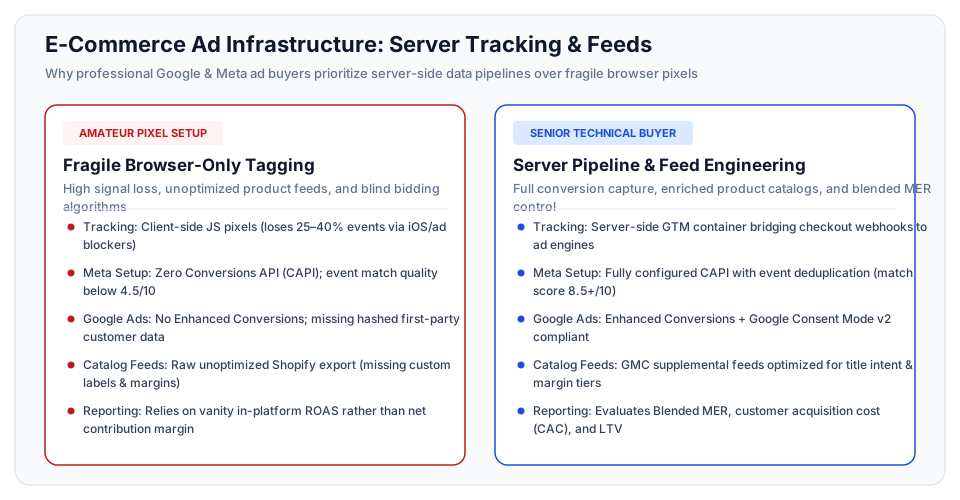
Browser pixel signal degradation: Traditional client-side tracking pixels rely on the visitor's web browser to report purchases back to ad networks. With Apple's App Tracking Transparency (ATT), private browsing modes, third-party cookie restrictions, and ubiquitous ad blockers, client-side pixels now miss between 25% and 40% of completed transactions. When an ad platform does not receive accurate purchase signals, its bidding algorithm optimizes toward lower-intent users, driving up customer acquisition costs (CAC) while reporting degraded return on ad spend (ROAS).
Neglected Google Merchant Center (GMC) feeds: In Google Shopping and Performance Max campaigns, ad copy matters far less than product feed data hygiene. Junior marketers plug in default Shopify or WooCommerce feed plugins and let them run. They fail to optimize product titles with high-intent search terms, leave GTIN and MPN barcode identifiers blank, and neglect custom label segmentation based on product profit margins. As a result, Google's algorithms bid aggressively on cheap, low-margin accessories while high-value hero products remain starved of impressions.
Obsession with platform-reported vanity ROAS: Ad networks routinely claim credit for the same transaction. A customer who clicks a Google Search ad, later sees an Instagram retargeting ad, and finally completes a purchase will be recorded as a conversion in both dashboards, artificially inflating reported platform ROAS. Inexperienced media buyers celebrate these inflated numbers while the business owner discovers that net bank deposits do not match the reported ad profits.
The Technical Foundation: What an Expert E-Commerce Media Buyer Actually Audits
A senior e-commerce performance marketer operates as a technical data engineer who establishes server-to-server data pipelines before spending a single dollar of live media budget. Rather than adjusting bids manually, an expert constructs an infrastructure where advertising algorithms receive complete, deduplicated first-party data.
Meta Conversions API (CAPI) with event deduplication: Professional Meta media buyers configure server-side tracking using server-hosted Google Tag Manager (sGTM) containers or direct platform webhooks. When an order completes, the backend server pushes an encrypted payload (containing hashed customer email, phone number, IP address, and browser user-agent) directly to Meta's servers. The specialist establishes identical event_id parameters across both browser and server events, allowing Meta to deduplicate duplicate entries while maintaining an Event Quality Match score above 8.5 out of 10.
Google Enhanced Conversions and Consent Mode v2: For Google Ads, the specialist implements Enhanced Conversions to capture first-party hashed customer data at checkout, allowing Google's Smart Bidding models to recover lost cross-device conversion paths. Furthermore, for stores selling into the European Union or United Kingdom, the expert configures Google Consent Mode v2 via an approved Consent Management Platform (CMP), ensuring ad tags automatically adjust data collection based on user cookie preferences without triggering platform account suspensions.
Custom label feed engineering: To prevent ad algorithms from wasting capital, an experienced Google Shopping specialist enriches product feeds using supplemental feeds or feed management tools (such as Feedonomics or DataFeedWatch). They categorize inventory using custom labels (Custom Label 0 through 4) based on business economics: High-Margin Winners, Clearance / Low-Stock, Low-Margin Break-Even, and New Arrivals. This segmentation allows the brand to set distinct Target ROAS (tROAS) thresholds matching real inventory profitability.
Blended Marketing Efficiency Ratio (MER) governance: Rather than evaluating advertising channels in isolation, a seasoned performance marketer tracks blended MER (Total Store Revenue divided by Total Ad Spend across all platforms) and Contribution Margin (Revenue minus Cost of Goods Sold minus Ad Spend minus Merchant Fees). This macro-level tracking ensures that acquisition campaigns generate real bottom-line cash flow rather than theoretical in-platform conversions.
Compensation Models: Freelance Media Buyer vs. Agency vs. In-House Marketer
Hiring an independent freelance e-commerce ad specialist on a monthly retainer ($1,500–$3,500/mo) delivers superior alignment and cost efficiency compared to percentage-of-spend agency contracts or full-time salaried hires. The structure of your compensation agreement directly impacts contractor behavior.
The table below compares the three standard hiring models across critical commercial dimensions:
| Engagement Model | Standard Cost Structure | Typical Ad Spend Focus | Operational Alignment & Risk |
|---|---|---|---|
| Independent Senior Freelancer | $1,500 – $3,500 / month flat retainer (or $55–$95/hr) | $5,000 – $60,000 / month | High alignment: direct founder contact, focus on net contribution margin, zero incentive to waste ad spend |
| Performance Marketing Agency | $3,500 – $7,500 / mo base + 10%–15% of ad spend | $40,000 – $250,000+ / month | Misaligned incentive: agency profits grow when you spend more, regardless of store profitability; communication through account managers |
| Full-Time Salaried In-House Marketer | $90,000 – $130,000 / year ($10k+/mo with taxes & benefits) | $80,000+ / month | Fixed financial liability; high risk if the individual specializes in Meta but lacks deep Google Shopping or technical tracking skills |
To establish realistic expectations, review the four campaign scale tiers and corresponding management investments below:
| Store Growth Tier | Monthly Ad Spend | Core Channels & Technical Scope | Recommended Contractor Fee |
|---|---|---|---|
| Tier 1: Validation & Launch | $2,500 – $7,500 | Google Brand Search + Standard Shopping feed, Meta single-angle creative testing, basic CAPI setup | $1,200 – $2,000 / month |
| Tier 2: Scaling E-Commerce | $8,000 – $25,000 | Performance Max segmented by margin labels, Meta Advantage+ Shopping Campaigns (ASC), GTM server tracking, weekly creative briefs | $2,200 – $3,500 / month |
| Tier 3: Multi-Channel Expansion | $30,000 – $80,000 | Non-brand Search, YouTube video action, Meta full-funnel retargeting, supplemental feeds, blended MER modeling, CRO landing page testing | $3,500 – $5,500 / month (or base + profit share) |
| Tier 4: Enterprise Global Brand | $100,000+ | Multi-country ad accounts, multi-currency feeds, automated bidding scripts, dedicated creative production team, custom attribution modeling | $6,000 – $10,000+ / month |
Three Real-World E-Commerce Ad Disasters and the Contractor Turnaround
Reviewing real-world campaign failures reveals that marketing losses frequently stem from technical tracking breakdowns and conflicting commercial incentives rather than creative fatigue. These documented case studies demonstrate how technical remediation restores commercial profitability.
Case Study 1: The Invisible iOS Conversion Trap
The Context: A direct-to-consumer sustainable footwear brand with €35,000 monthly ad spend noticed their reported Meta Ads ROAS plummet from 3.2x to 1.4x over a four-month period, prompting the founder to slash marketing budgets and prepare for staff layoffs.
The Breakdown: An audit by an independent media buyer revealed that during a Shopify theme update, the store's custom checkout tracking scripts were overwritten. The store was relying solely on client-side browser cookies without the Meta Conversions API. Because 78% of the brand's customer base used Safari on iOS devices, Apple's WebKit ITP (Intelligent Tracking Prevention) purged browser cookies after twenty-four hours, and iOS ATT blocked client-side purchase tracking entirely. The ad campaigns were still generating profitable customers, but because Meta received zero feedback signals, its machine learning algorithms stopped optimizing, driving actual acquisition costs up.
The Turnaround: The contractor deployed a server-side Google Tag Manager container on a custom subdomain, bridged Shopify checkout webhooks directly to Meta's CAPI endpoint, and implemented event deduplication. Within seven days, Meta's Event Match Quality score rose from 3.8 to 8.9 out of 10. With complete conversion data restored, Meta's automated bidding models successfully re-targeted high-intent buyers, lifting storewide revenue by 44% within sixty days at identical ad spend levels.
Case Study 2: The Google Merchant Center Feed Suspension
The Context: A specialty home kitchenware retailer generating $75,000 per month through Google Shopping was suddenly hit with a total Merchant Center account suspension for "Misrepresentation of Product Pricing and Missing Unique Product Identifiers."
The Breakdown: The store's previous marketing agency used a generic third-party Shopify app that failed to sync promotional discount pricing with automated structured schema on the product pages. When Google's automated web crawlers inspected the site, the price in the raw HTML microdata differed from the price submitted in the XML product feed. Compounding the issue, 400 product variants lacked valid GTIN barcodes, triggering automated policy strikes that shut down all Google Shopping campaigns overnight.
The Turnaround: An independent Google Ads and technical feed specialist took over the account. The specialist corrected the site's JSON-LD Schema markup to ensure automated price parity with the database, mapped manufacturer barcodes through a Google Sheets supplemental feed, and submitted an official Merchant Center appeal with complete photographic evidence of manufacturer packaging. Google restored the account within 48 hours, recovering $2,500 in daily lost revenue.
Case Study 3: The Spend-Incentivized Agency Squeeze
The Context: A specialty apparel brand paying a digital agency $4,000 per month plus 12% of total ad spend saw their ad budget climb from $20,000 to $65,000 per month over six months. The agency reported a steady 2.8x ROAS inside Meta Ads Manager.
The Breakdown: Despite the agency's glowing monthly reports, the business founder was running out of cash to pay inventory suppliers. A financial audit revealed that the agency was achieving its reported 2.8x ROAS by pouring 70% of the budget into heavy discounts on low-margin inventory items (where gross margins were only 22%), and allocating budget to aggressive brand-name Google Search ads that merely captured customers who were already searching for the company's URL. The agency prioritized gross ad spend because their contract fee scaled with spend, ignoring that every sale generated a net operational loss after factoring in shipping and cost of goods sold.
The Turnaround: The brand terminated the agency contract and engaged an independent performance marketer on a flat $2,800 monthly retainer with an incentive bonus tied strictly to Net Contribution Margin. The contractor cut brand search ad cannibalization, redirected budget into hero products with 65%+ gross margins, and established a blended MER target of 3.8x. While total ad spend decreased from $65,000 to $38,000 per month, the store's net cash profit increased by $14,200 per month.
How to Screen and Hire a Senior E-Commerce Ad Specialist
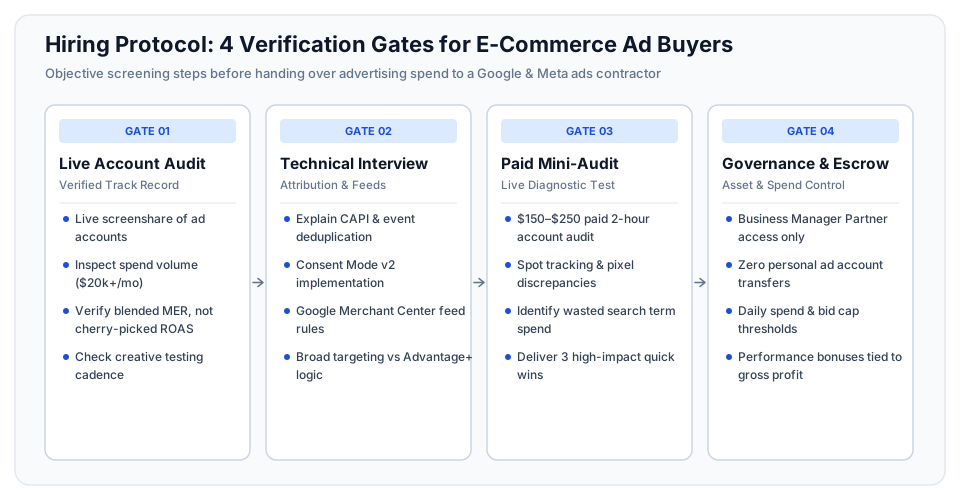
Screen prospective media buyers through a four-stage vetting filter: an unedited live account audit, a technical tracking and feed interview, a paid 2-hour mini-audit of your store, and strict Business Manager access governance. Following this process eliminates resume embellishers and identifies true operators.
Stage 1: The Live Account Walkthrough
Never rely on PDF case studies or static screenshots, which are easily manipulated or borrow results from team-managed enterprise accounts. Insist on a 20-minute live screenshare of an active or recent ad account the candidate personally managed:
- Verify Date Ranges and Spend: Have the candidate show a 6-month view to observe performance stability. Look for accounts spending at least $10,000 to $30,000 per month to ensure they have managed budgets comparable to your growth targets.
- Inspect Campaign Architecture: Look for simplified, streamlined account structures. In Meta, look for consolidated Advantage+ campaigns rather than dozens of fragmented ad sets targeting overlapping audiences. In Google, inspect Performance Max asset groups and search term negative keyword lists.
- Examine Creative Testing Cadence: Check how often new visual creatives, angles, and ad copy variants are tested. A senior buyer tests three to five distinct creative hypotheses every week rather than leaving static images running for months.
Stage 2: The Technical Infrastructure Interview
Conduct a technical discussion focusing on data collection, attribution, and product feed hygiene. Evaluate responses against documented e-commerce standards:
- Question: "How do you handle conversion tracking discrepancies between Meta Ads Manager and our Shopify backend?"
Senior Answer: Recognize that Meta uses an attribution window (typically 7-day click, 1-day view) and predictive modeling, whereas Shopify records last-click direct transactions. Explain how to verify tracking health via Meta Events Manager Event Match Quality scores and server-side deduplication, while using blended MER as the primary source of truth. - Question: "How do you segment a Google Performance Max campaign to prevent it from wasting budget on branded search?"
Senior Answer: Apply a Brand Exclusion list to the Performance Max campaign, or request Google Support to add negative brand keywords to the campaign backend. Concurrently, run a dedicated standard Brand Search campaign with exact match keywords to capture branded intent at a controlled, low cost-per-click. - Question: "What is your approach to creative testing on Meta Ads?"
Senior Answer: Separate creative testing from scaling campaigns. Use a dedicated multi-asset creative testing ad set (3 hooks, 2 bodies, 2 creatives) with a controlled budget. When a winning combination demonstrates high conversion volume and favorable first-order contribution margin, graduate that specific post ID (retaining social proof) into the primary scaling Advantage+ campaign.
Stage 3: The Paid 2-Hour Account Mini-Audit
Before committing to an ongoing retainer, commission a paid 2-hour mini-audit of your current Google and Meta ad accounts for a fixed fee of $150 to $250. Provide read-only analyst access and request a focused 2-page diagnostic report covering:
Audit Scope: "Inspect our Google Ads, Meta Ads Manager, Google Merchant Center, and Google Analytics 4 accounts. Identify: (1) Three tracking or data feed errors currently leaking budget, (2) The top three wasted search terms or ad sets over the past 60 days, and (3) A prioritized 30-day action plan to improve blended store profitability."
Evaluation Rubric: Grade the candidate on their ability to uncover technical issues (such as unmapped feed attributes or missing CAPI parameters) rather than offering generic advice like "test more video creatives." High-performing contractors immediately pinpoint concrete technical waste.
Account Security, Access Governance, and Asset Control
Maintain complete ownership over your digital marketing assets by granting access exclusively through Meta Business Manager Partner channels and Google Ads Manager Account (MCC) links. Never share personal account passwords or allow a freelancer to build ad campaigns inside a developer-owned advertising account.
Follow these five asset protection rules throughout the engagement:
- Rule 1: Always Own the Meta Business Manager and Ad Account: Your company must be the primary owner of the Meta Business Account, the Facebook Page, the Instagram account, the Meta Pixel, and the Ad Account. Grant the contractor access by requesting their Business Manager ID and adding them as an external Partner with specific administrative permissions. Never surrender Primary Business Admin status.
- Rule 2: Link Google Ads via Manager Account (MCC): Provide the contractor with your 10-digit Google Ads account ID so they can request link access through their official Google Ads Manager Account (MCC). Assign Standard access rather than Administrative access so they cannot add unauthorized third-party users or delete your billing profile.
- Rule 3: Maintain Billing Ownership on Your Credit Card: All ad platform media spend must be billed directly to company credit cards configured in your own payment profiles. Never wire media spend to a contractor's personal bank account or allow an agency to pay media bills on their own cards with hidden markups.
- Rule 4: Retain Creative Asset and Post ID Ownership: Ensure that all image and video assets are uploaded directly into your Meta Ad Account Creative Hub and Google Ads Asset Library. Winning ad post IDs (which accumulate customer comments, likes, and social proof) belong exclusively to your brand.
- Rule 5: Define Clear Daily Spend and Bid Thresholds: Set automated account spend rules that alert you or pause campaigns if daily ad spend exceeds predefined thresholds (e.g., more than 150% of target budget). This protects your business against accidental budget typos or automated bidding spikes over holiday weekends.
Frequently Asked Questions
How much does it cost to hire an e-commerce ad specialist?
An independent e-commerce ad specialist typically charges a monthly retainer between $1,500 and $3,500 per month for stores spending between $5,000 and $40,000 in monthly ad budget. For smaller initial campaigns or technical setup projects, hourly rates range from $55 to $95 per hour. Full-service digital agencies charge significantly more—typically $3,500 to $7,500 per month base fee plus 10% to 15% of total ad spend—making independent contractors far more capital-efficient for growing brands.
Should I hire one specialist for both Google and Meta Ads, or separate contractors?
For stores spending under $40,000 per month in total ad budget, hiring a single versatile e-commerce performance marketing contractor is generally optimal. A single specialist can balance budget allocations between Google (capturing high-intent search and shopping demand) and Meta (generating top-of-funnel discovery), eliminating channel competition and optimizing toward a unified blended MER. Once total monthly spend exceeds $60,000, separating Google and Meta management across dedicated channel specialists becomes advantageous.
What is the minimum ad spend required before hiring an ad specialist?
An e-commerce business should have an advertising budget of at least $2,500 to $3,500 per month before hiring a dedicated ad specialist. If your monthly media spend is below $2,000, paying a $1,500 contractor retainer consumes too large a percentage of your total capital, leaving insufficient budget for the ad algorithms to exit their learning phases. Below this spend threshold, founders should manage basic campaigns themselves or commission a one-off technical tracking audit.
What is Meta Conversions API (CAPI) and why is it necessary?
Meta Conversions API (CAPI) is a server-side tracking pipeline that transmits customer conversion events (such as ViewContent, AddToCart, and Purchase) directly from your web server to Meta's servers, bypassing the visitor's web browser. CAPI is necessary because browser-based pixels lose 25% to 40% of conversion data due to Apple iOS ATT restrictions, ad blockers, and cookie expiration policies. CAPI restores complete conversion visibility, stabilizes machine learning bidding models, and lowers customer acquisition costs.
What is the difference between platform ROAS and blended MER?
Platform ROAS (Return on Ad Spend) is the revenue reported directly inside Meta Ads Manager or Google Ads divided by that specific platform's ad spend, which frequently over-reports conversions due to overlapping attribution windows. Blended MER (Marketing Efficiency Ratio) is your store's total gross revenue across all sales channels divided by your total combined ad spend across all marketing platforms. MER represents an unmanipulated metric indicating whether your overall marketing ecosystem is commercially profitable.
How long does it take for a new ad specialist to generate profitable results?
A qualified ad specialist typically requires two to four weeks to audit tracking, optimize product feeds, test creative angles, and allow ad platform machine learning models to complete their initial learning phases. Significant scaling and stabilized acquisition costs typically materialize in months two and three. Be skeptical of contractors promising immediate doubling of revenue in week one, which usually indicates uncalibrated budget spikes that collapse under scale.
Why do Google Performance Max campaigns often cannibalize brand search?
Google Performance Max campaigns are programmed to maximize conversion value across all Google networks (Search, Shopping, YouTube, Display, Discover). Unless explicitly restricted, the algorithm bids heavily on your store's own brand name because branded searchers have near-100% purchase intent, allowing the campaign to artificially report high ROAS numbers while cannibalizing organic search traffic. A senior specialist configures Brand Exclusion lists to ensure Performance Max drives genuine incremental customers.
What access permissions should I grant an ad contractor?
In Meta, grant access via Business Manager by adding the contractor's Business ID as a Partner, assigning "Manage Campaigns" and "View Performance" permissions to your Ad Account and Catalogs, while retaining full administrative control yourself. In Google Ads, link the contractor's Manager Account (MCC) with Standard access permissions. In Shopify or WooCommerce, create a restricted staff account granting access only to Products, Discounts, and Analytics, without granting customer data export or billing management rights.
What assets must an e-commerce store provide to an ad specialist?
The store must provide: (1) High-resolution product imagery and lifestyle video footage (user-generated content / UGC, customer reviews, unboxing clips), (2) Accurate product cost of goods sold (COGS) data to determine target profit margins, (3) Access to advertising accounts, Google Tag Manager, Google Analytics, and product feeds, and (4) Clear customer value propositions, competitive differentiators, and promotional calendar details.
How do I know if an ad specialist is doing a good job?
Evaluate your ad specialist against four objective metrics: (1) Steady or improving Blended MER and Contribution Margin as ad spend scales, (2) Active weekly creative testing cadence with clear reporting on winning and losing creative hypotheses, (3) High technical tracking health scores in Meta Events Manager (8.0+ Match Quality) and zero critical errors in Google Merchant Center, and (4) Transparent weekly communication detailing operational learnings and next-step experiments.
What is Google Consent Mode v2 and is it mandatory?
Google Consent Mode v2 is an API framework that communicates user cookie consent status from your store's banner to Google tags. It is mandatory for any e-commerce store serving customers in the European Economic Area (EEA) and United Kingdom. Failure to implement Consent Mode v2 results in the immediate loss of conversion tracking and remarketing audience building across all Google Ads and Google Analytics accounts.
What happens to our campaigns if we terminate the ad specialist's contract?
If you followed proper access governance rules, all campaigns, ad creatives, audience lists, conversion pixels, and historical optimization data remain fully intact inside your own Google Ads and Meta Business Manager accounts. You simply revoke the contractor's Partner access permissions. The campaigns will continue running on your configured schedules and credit cards without interruption until your internal team or new contractor assumes management.
Written by Michael Melnyk
Senior IT Technical Writer & Technology Analyst
Senior Technical Writer and IT Industry Analyst with over 7 years of experience analyzing software engineering ecosystems, tech leadership models, and developer procurement frameworks.