How to Enhance Your Website Without Losing Rankings, Traffic, or Sales
A redesign that looked beautiful cost one business half its organic traffic because nobody mapped the old URLs. This guide shows how to enhance a site so every change compounds instead of destroying.

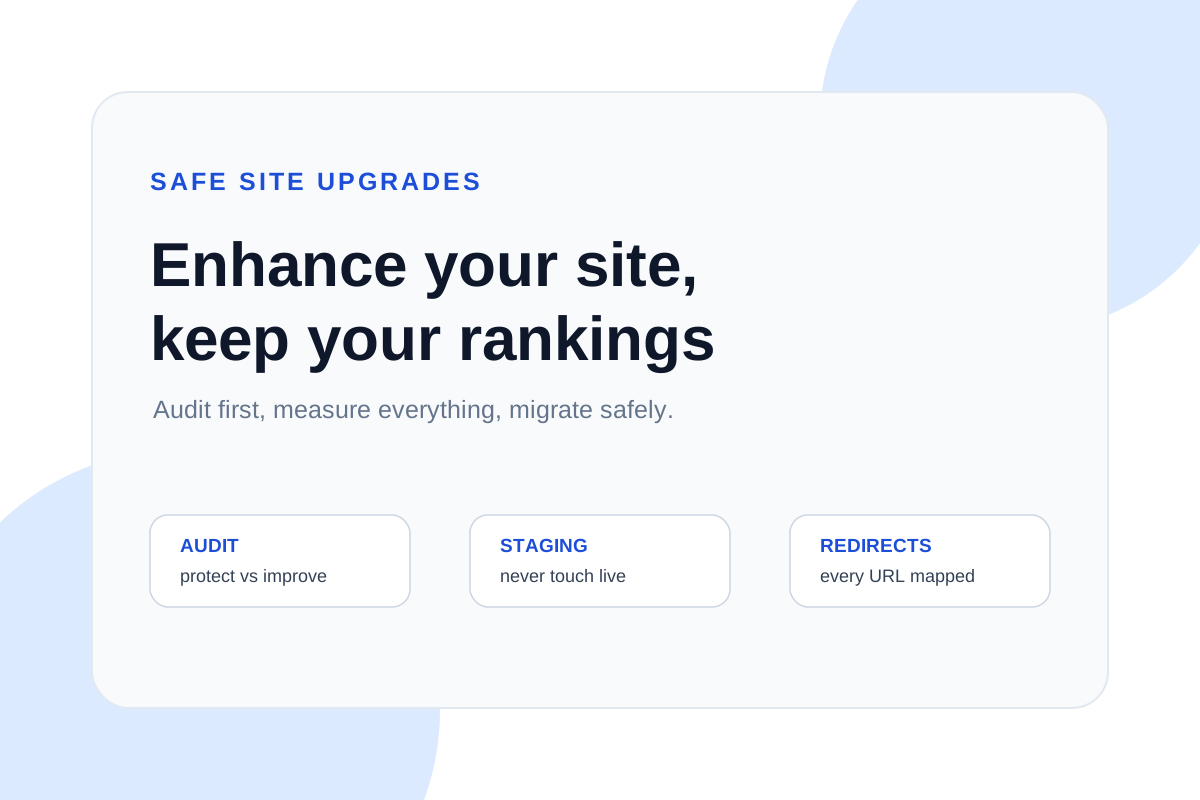
To enhance your website safely, audit before changing anything: protect what already ranks and converts, upgrade the weakest points on staging, and launch with a redirect map plus monitoring. Most enhancement damage is self-inflicted — redesigns that delete ranking pages, "optimizations" that break checkout, refreshes nobody measured. Reviewed September 2026. Figures below are illustrative planning examples, not market averages or ProofDevs quotes.
Site owners usually arrive with a vague brief — "make the site better" — which is how money turns into motion without outcomes. This guide turns enhancement into a sequence: diagnose, prioritize by return, choose refresh versus redesign, protect SEO through the change, and verify afterward. If the site is actually broken rather than merely weak, start with our repair cost guide; for judging any proposal you receive, use our quote checklist.
What does it mean to enhance a website?
Website enhancement means improving a live site along one or more axes — visual design, page speed, conversion rate, content depth, technical SEO, accessibility — without throwing away the equity the current site built: rankings, backlinks, indexed pages, and customer habits.
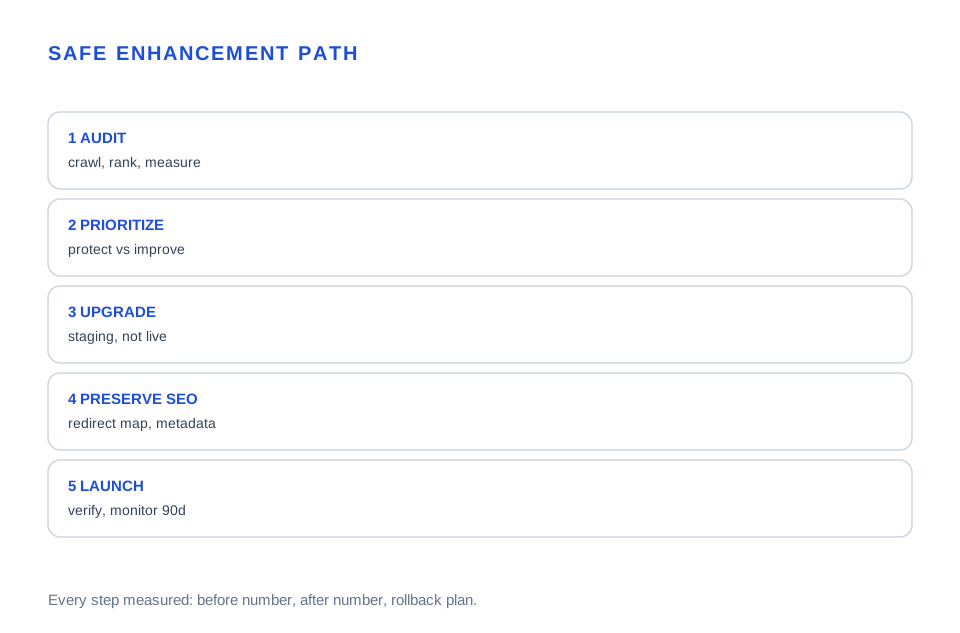
The definition matters because it excludes two things people confuse with enhancement. A rebuild from scratch is not an enhancement; it is a new site wearing the old domain, with all the migration risk that implies. And a plugin-installing spree is not enhancement either; it is weight gain disguised as progress. Real enhancement is measured: every change has a before number, an after number, and a rollback plan.
Start with an audit, not a redesign
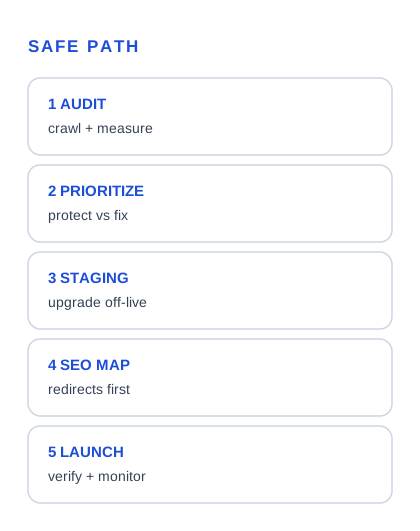
The audit tells you what to preserve at all costs and what to fix first. Crawl every URL, record ranking keywords and backlink targets per page, measure Core Web Vitals per template, map conversion paths with drop-off points, and list technical debt: outdated CMS, dead plugins, unoptimized assets, missing structured data.
The audit output is a two-column document: protect versus improve. High-traffic pages, ranking landing pages, and backlinked assets go in the protect column — they get rewritten carefully or left alone, never deleted casually. Slow templates, leaking forms, thin content, and dead weight go in the improve column, ranked by expected return. Any provider who proposes a new design before producing this document is decorating, not enhancing.
Refresh, template rebuild, or full redesign?
Three scopes solve different problems. A refresh updates styling, copy, and images within the existing structure — right when the foundation works but the surface aged. A template rebuild replaces one underperforming template (homepage, service page, product page) — right when analytics fingers specific pages. A full redesign rebuilds structure, design, and often platform — right when the CMS is end-of-life, the brand changed, or structural conversion problems resist local fixes.
| Scope | Right when | Typical shape | Main risk |
|---|---|---|---|
| Refresh | Structure converts, visuals aged | Styling, copy, images, CTA tuning | Change without measurement looks like progress |
| Template rebuild | Specific pages underperform | One template redesigned, rest intact | New template clashes with old system |
| Full redesign | Platform dead, brand changed, structural failure | New architecture, migration, redirect map | Ranking and traffic loss at launch |
Default to the smallest scope that solves the diagnosed problem. A focused template rebuild often costs a fifth of a full redesign and fixes the actual leak — agencies that only sell full rebuilds are selling what suits them. Our custom development guide helps judge when "enhance" has quietly become "rebuild" and should be scoped as one.
How to protect SEO during enhancement
SEO preservation is a deliverable, not a hope. Every URL on the old site gets a decision before launch: keep on the same URL, rewrite on the same URL, redirect with a 301 to the closest new equivalent, or merge into a stronger page carrying its equity along. Pages that rank or carry backlinks get individual attention; nothing ranking is deleted without a redirect target reviewed by a human.
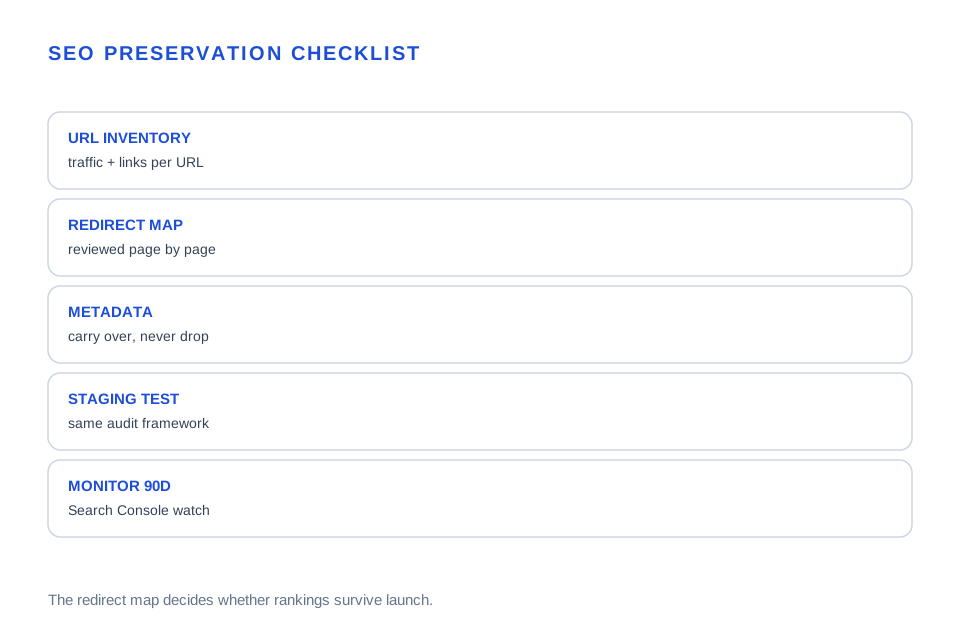
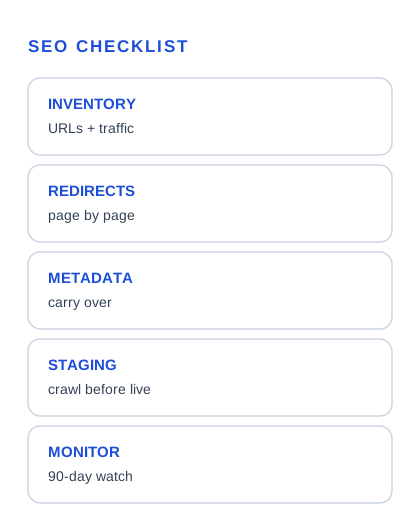
- URL inventory: full crawl with traffic, rankings, and backlinks attached per URL.
- Redirect map: spreadsheet of old-to-new reviewed page by page, tested on staging, verified at launch.
- Metadata carryover: titles, descriptions, and structured data preserved or deliberately improved — never dropped by a theme change.
- Sitemap + Search Console: updated sitemap submitted, coverage monitored for 30–90 days post-launch.
- Staging parity: the new version crawled with the same audit framework as the old before it goes live.
Speed enhancement that actually moves numbers
Speed work pays only when measured against Core Web Vitals per template: Largest Contentful Paint, Interaction to Next Paint, Cumulative Layout Shift. The usual high-return sequence is image modernization (AVIF/WebP, responsive sizes), script deferral and dead-code removal, caching with tested invalidation, and hosting-stack review when the server itself is the bottleneck.
Illustrative planning example: 10 hours of performance work at $70 per hour is $700. A template moving from 4-second to sub-2-second mobile loads typically recovers measurable bounce — against which the $700 is judged, not against abstract "fastness." Beware the plugin solution to a platform problem: caching plugins on a suffocating shared host buy single-digit gains while the real fix is architectural.
Conversion enhancement without a rebuild
Conversion leaks concentrate on few pages: homepage hero, key service pages, checkout or contact flow. The strategic refresh sequence is message sharpening (one clear promise per page), hierarchy repair (single primary CTA per viewport), friction removal (form fields, steps, mobile flow), and proof placement (reviews, cases, guarantees near the decision point).
Change one layer at a time and measure between changes — simultaneous redesign-plus-recopy makes attribution impossible. Publicly reported refresh projects for small businesses land around $2,000–$4,000 for a homepage plus a few conversion pages; treat that as the scoped alternative whenever someone quotes five figures for "a new site" against a conversion complaint.
Content enhancement: depth beats volume
Thin service pages and stale blog posts drag down sites that otherwise work. Enhancement here means consolidating near-duplicate pages into authoritative ones, rewriting ranking-adjacent pages (positions 5–20) with real depth, adding structured data the new content earns, and pruning or merging pages with zero traffic and zero links — with redirects, always.
The consolidation move deserves emphasis: five weak pages on overlapping topics almost always lose to one strong page, and merging carries link equity forward instead of deleting it. Map keyword cannibalization first — pages competing with each other for the same query — then merge deliberately rather than publishing a sixth competitor.
What enhancement typically costs
Cost follows scope, not site size. A measured refresh of styling and copy sits in the low thousands; a template rebuild with strategy and SEO care runs several thousand; a full audit-driven redesign with migration and monitoring reaches into five figures. The audit itself — the document everything else is built against — is the cheapest line and the highest leverage.
Price every engagement against the decision it improves. An enhancement that lifts conversion half a point on a lead flow worth $20,000 a month pays for itself in weeks; the same money spent on a visual refresh nobody measured is decoration. Demand before/after metrics in the proposal — traffic, speed scores, conversion rate — or admit you are buying taste, not performance.
Common enhancement mistakes
The costliest mistake is the unmapped redesign: new URLs with no redirects, ranking pages deleted, years of equity evaporated on launch day. Next is the staging skip — changes tested on production visitors instead of a mirror. Then the rebrand disguised as strategy, the page-builder migration that trades maintainability for lock-in, and the analytics gap: no baseline, so no one can prove anything improved.
Each has a one-line defense. Unmapped redesign: redirect map reviewed page by page before launch. Staging skip: mirror environment mandatory for structural change. Rebrand-as-strategy: audit first, aesthetics second. Builder lock-in: clean code or honest acknowledgment of the trade. Analytics gap: baseline numbers in the contract's first paragraph. If a provider resists all five, keep looking.
Case: template rebuild that doubled service inquiries
Starting point
A local services company ranked on page one but converted poorly: service pages carried thin copy, the contact form had nine fields, and mobile visitors bounced at over 70 percent.
What blocked progress
Two agencies proposed full rebuilds at five-figure quotes with 3-month timelines. The rankings were the asset; a rebuild risked exactly what earned the business.
Fix approach
A scoped template rebuild: service-page template rewritten with proof near the CTA, form cut to four fields, mobile flow repaired — on staging, with the URL structure untouched and metadata carried over.
Outcome
Service inquiries roughly doubled within two months while rankings held steady. Total cost under a fifth of the rebuild quotes — the planning example: the leak was conversion, so conversion got the budget, not a new site.
Case: redesign that preserved a decade of SEO
Starting point
A B2B supplier on an end-of-life CMS needed replatforming: the system could not pass Core Web Vitals, editing required developer time for trivial changes, and the brand had outgrown the design.
What blocked progress
Ten years of backlinks and ranking pages made any migration frightening — a previous partial attempt by another vendor had already cost them a visible keyword cluster through dropped redirects.
Fix approach
Audit-first redesign: full URL inventory with rankings attached, every old URL mapped to keep, rewrite, redirect, or merge, new build on staging crawled with the same framework, launch with day-one verification and 90-day rank monitoring.
Outcome
Rankings held through launch and improved over the following quarter as the faster structure compounded. The redirect map — a spreadsheet, not software — was the highest-value deliverable of the project.
Case: speed fix that recovered mobile traffic value
Starting point
A content site with strong desktop numbers watched mobile bounce climb past 65 percent while mobile share of traffic crossed 70 percent — the majority experience was the worst one.
What blocked progress
A caching plugin and a CDN had already been added with near-zero effect: the bottleneck was 4MB of unoptimized hero images plus render-blocking scripts from three retired marketing tools.
Fix approach
Measured performance pass: responsive AVIF images, dead-script removal, critical CSS, template-level Core Web Vitals before and after. No platform change, no redesign, staging-verified.
Outcome
Mobile loads under 2 seconds, bounce recovered by double digits, ad and affiliate revenue per mobile visit up. Lesson priced in: measure the bottleneck before buying the solution.
Decision framework: enhance, rebuild, or leave alone
Enhance when the audit shows working foundations with local leaks — fix the leaks on staging and measure. Rebuild when the platform is end-of-life, the structure cannot convert, or enhancement quotes approach rebuild cost without rebuild warranty. Leave alone when numbers are healthy and the itch is aesthetic — spend the budget on content or distribution instead.
Bring the audit to our review desk for an independent read before signing anything, or compare delivery models in our outsource-versus-hire guide. The cheapest enhancement is the one aimed at a measured leak.
FAQ about website enhancement
What does it mean to enhance a website?
Improving a live site — design, speed, conversion, content, technical SEO — while preserving its rankings, backlinks, and indexed pages. Every change carries before/after numbers and a rollback plan.
Will a redesign hurt my SEO rankings?
Only if run carelessly. With a URL inventory, page-by-page redirect map, metadata carryover, staging verification, and post-launch monitoring, rankings typically hold and then improve on the faster structure.
Should I refresh or fully redesign my site?
Refresh when the structure converts but the surface aged; rebuild one template when analytics fingers specific pages; redesign fully when the platform is end-of-life or structural conversion problems resist local fixes.
How much does website enhancement cost?
Refreshes sit in the low thousands, template rebuilds run several thousand, full audit-driven redesigns reach five figures. The audit is the cheapest line and the highest leverage — price everything against the decision it improves.
How long does a website enhancement take?
A refresh takes weeks, a template rebuild a few weeks, a full redesign 6–12 weeks including audit and monitoring. The bottleneck is usually content readiness and approvals, not engineering.
Can I enhance my site without downtime?
Yes. Structural work happens on a staging mirror while production serves visitors; launch is a verified switch with instant rollback. Never accept maintenance pages for planned enhancement.
What is a redirect map and why does it matter?
A spreadsheet assigning every old URL to keep, rewrite, redirect, or merge — reviewed page by page, tested on staging, verified at launch. It is the single deliverable that decides whether rankings survive a redesign.
How do I know enhancement worked?
Compare baseline versus post-launch numbers: ranking positions, organic traffic, Core Web Vitals per template, conversion rate on touched pages. No baseline in the contract means no proof afterward.
Should I hire a freelancer or agency for enhancement?
Freelancers suit scoped refreshes and template rebuilds with clear acceptance tests; agencies suit multi-discipline redesigns spanning design, content, and migration. Judge by the audit quality both produce before quoting.
What should I prepare before asking for a quote?
Analytics access, hosting and CMS logins (or a granter), the business goal in one sentence, and three competitor sites you admire. Providers quote tighter against evidence than against "make it better."
Written by Michael Melnyk
Senior IT Technical Writer & Technology Analyst
Senior Technical Writer and IT Industry Analyst with over 7 years of experience analyzing software engineering ecosystems, tech leadership models, and developer procurement frameworks.