How to Hire Flexible Developers: Part-Time, Contract, and On-Demand Options
A full-time hire is not the only way to add engineering capacity. Match the developer's commitment to the workload, test the relationship with a small delivery, and expand only when the evidence supports it.

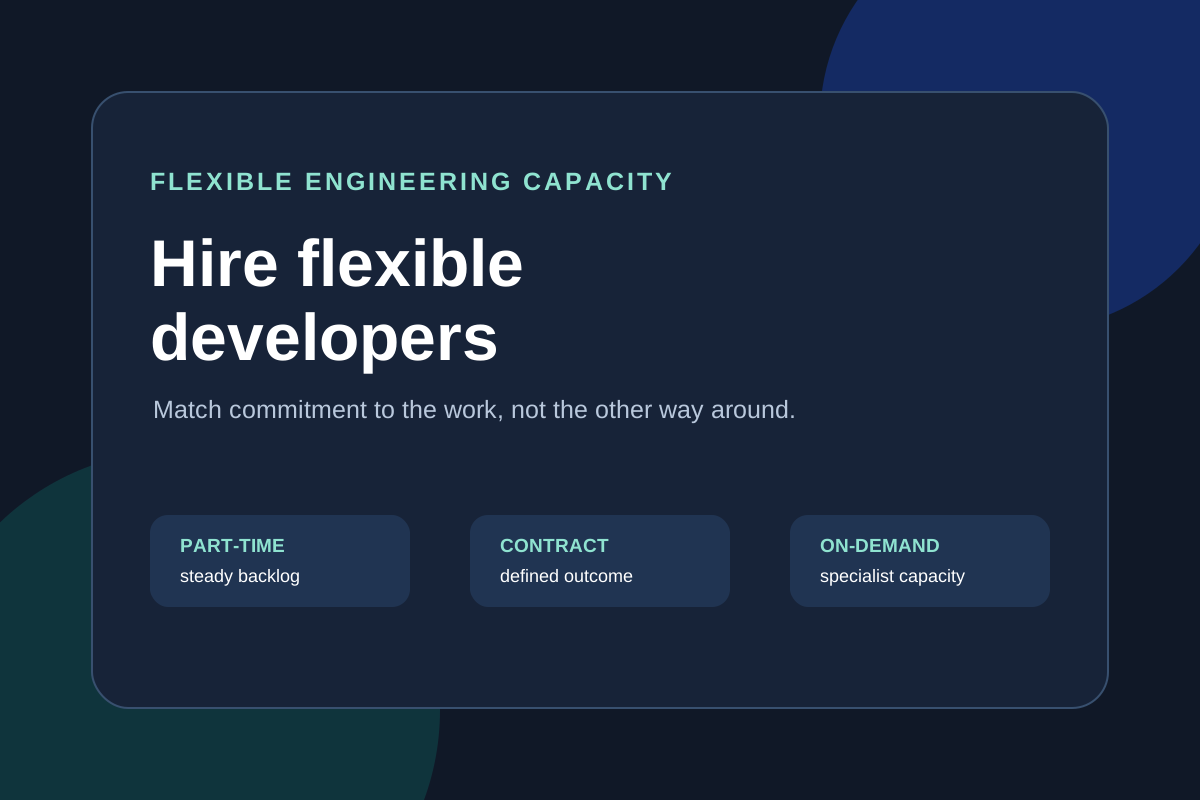
To hire flexible developers, match the engagement to the amount, uncertainty, and urgency of the work. A part-time developer can clear a steady backlog, a contract developer can deliver a defined feature, and an on-demand specialist can handle a short audit or urgent fix. The right choice is the smallest commitment that gives the business enough capacity without creating a permanent obligation.
Flexible hiring does not mean accepting vague availability or weak accountability. It means defining what the developer will own, when they will be available, how progress will be reviewed, and what happens if the work pauses. A short paid pilot can answer those questions more reliably than a long sales call or a polished portfolio.
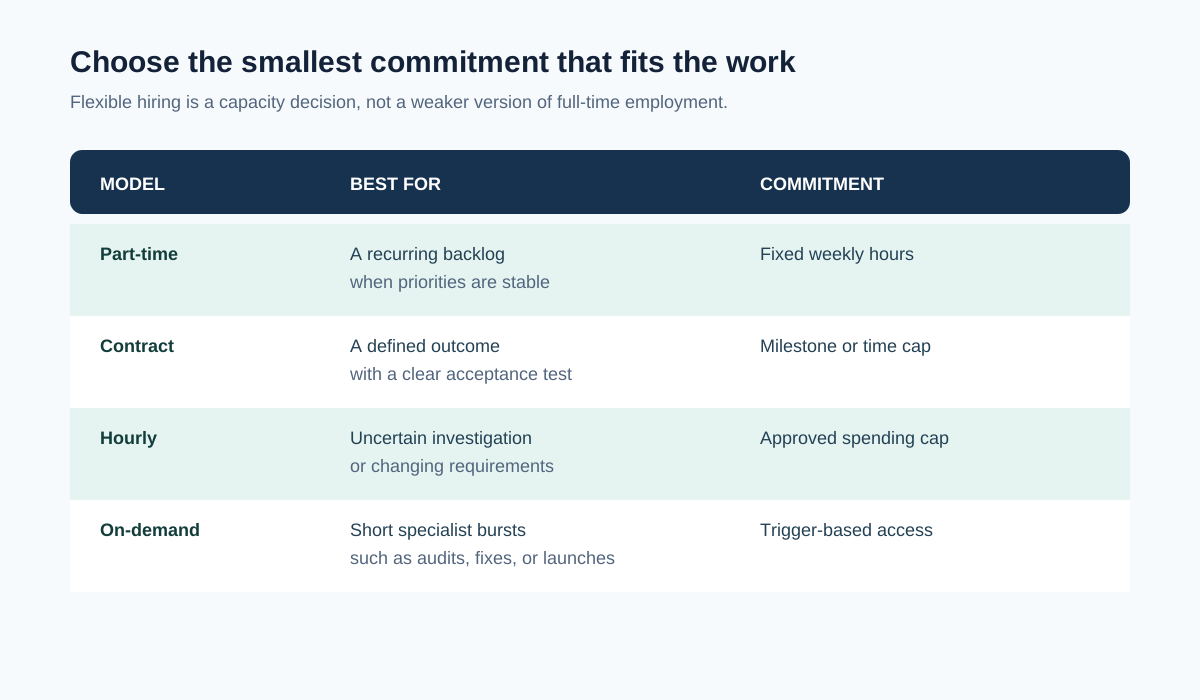
What does it mean to hire flexible developers?
To hire flexible developers means to buy engineering capacity in a shape that can change with the workload. The developer may work a fixed number of hours each week, complete a milestone, investigate an uncertain problem, or join only when a specific need appears. This is different from hiring a full-time employee whose primary expectation is continuous, predictable availability.
The model covers several forms of work: flexible web development services for a site or portal, flexible software development for a broader application, and flexible product development when the team is validating features or managing a changing roadmap. The label matters less than the commercial details behind it.
- Capacity: how many hours or deliverables are needed in the next four to eight weeks?
- Continuity: does the same person need to stay involved, or is a one-time specialist enough?
- Control: who sets priorities, reviews pull requests, and accepts the result?
- Commitment: what is the smallest contract that gives both sides a fair chance to succeed?
When is flexible developer hiring a good fit?
Flexible developer hiring fits businesses that have real technical work but cannot yet justify a permanent engineering role or a large delivery team. It is especially useful when the work is valuable, but its volume or timing is not stable enough for a full-time hire.
- A recurring but limited backlog: you need ten to twenty hours a week for improvements, integrations, or maintenance.
- A defined launch: a website, internal tool, feature, or migration has a clear acceptance test and end point.
- A specialist gap: the team needs short-term help with payments, performance, security, data, or a specific platform.
- A temporary capacity spike: an internal team is behind on a release and needs an experienced pair of hands for one or two sprints.
- Uncertain discovery: nobody knows whether the existing code can support the next feature, so an audit should precede a larger commitment.
It is a weaker fit when the business needs someone available every working day, has a large amount of predictable work for years, or cannot provide a decision-maker. Flexible capacity cannot compensate for missing product decisions, inaccessible accounts, or an acceptance process that changes every week.
Which flexible engagement model should you choose?
Choose a model based on the shape of the work rather than the developer's preferred label. Part-time, contract, hourly, and on-demand arrangements solve different problems.
| Model | Best when | What to define | Main risk |
|---|---|---|---|
| Part-time | You have a recurring backlog but not enough work for a full-time role. | Weekly hours, response window, priorities, and absence cover. | Small requests consume the available time without a measurable outcome. |
| Project contract | You can describe a result, milestone, or acceptance test. | Scope, deliverables, dependencies, payment points, and handover. | Unclear requirements turn a fixed result into an argument about extras. |
| Hourly with a cap | The problem needs investigation or requirements may change. | Hourly rate, spending limit, reporting cadence, and approval for more work. | Hours continue without a decision about whether the work is useful. |
| On-demand | You need occasional access to a specialist for audits, fixes, or launches. | Trigger conditions, response time, availability, and minimum charge. | The person is unavailable when the urgent issue arrives. |
| Staff augmentation | You already have a delivery process and need extra sprint capacity. | Team role, working hours, tools, code ownership, and manager. | The added developer has no clear backlog or reviewer. |
A simple rule works in most cases: use a project contract for a clear destination, hourly work with a cap for uncertainty, part-time work for a stable recurring backlog, and on-demand work for infrequent specialist needs.
How do flexible developers differ from outsourcing?
Flexible developer hiring usually gives you direct access to an individual contributor. You may assign tasks, review the code in your repository, and adjust the weekly workload. Outsourcing usually means buying a managed outcome from an agency or external team, with more delivery responsibility on the vendor and more communication through an account or project manager.
Neither model is automatically better. A multi-disciplinary programme with design, mobile, backend, QA, and delivery management may justify a coordinated agency. A bounded feature, code audit, integration, or temporary sprint gap often needs one senior developer rather than a large account structure.
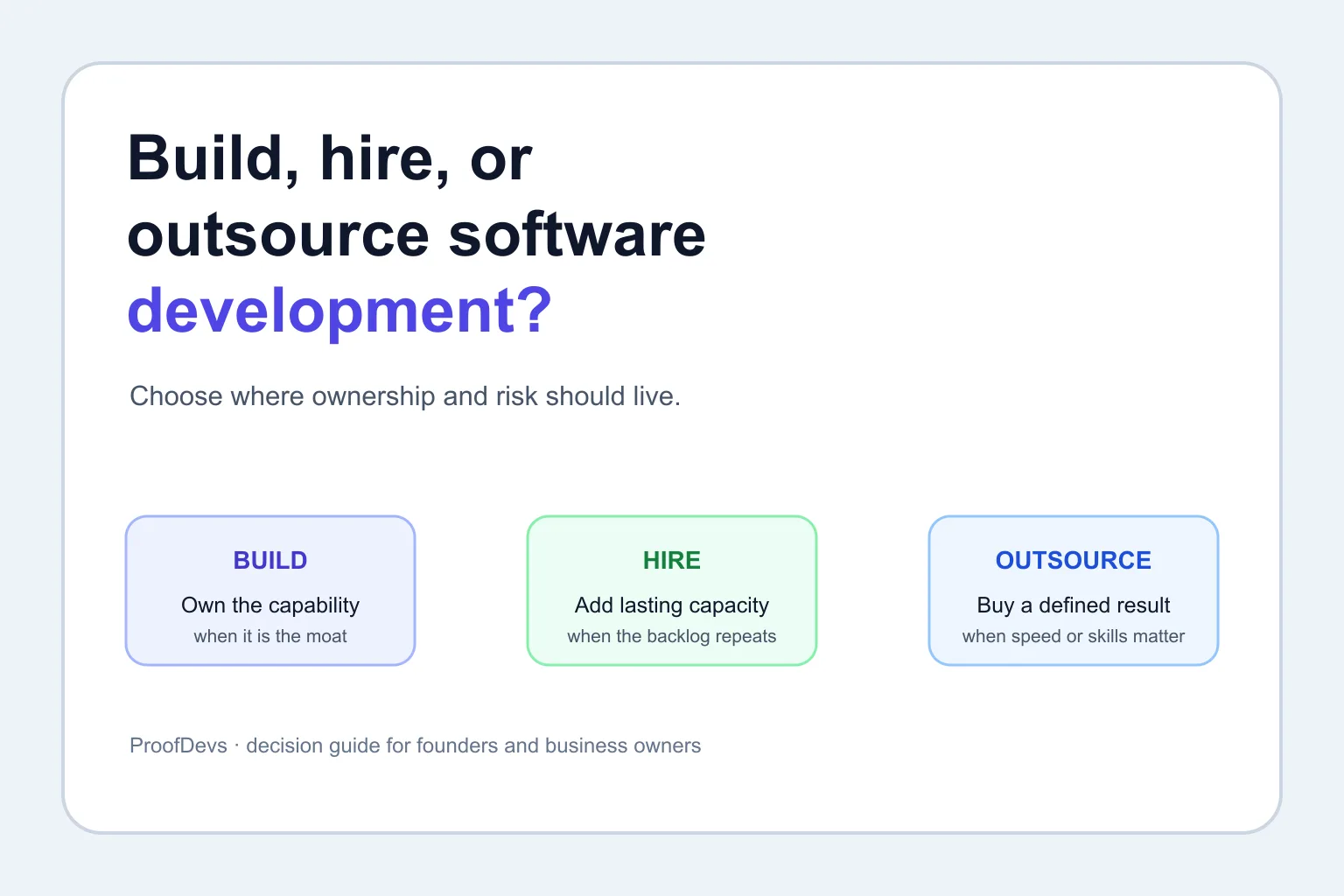
If you are deciding between flexible capacity and a fully outsourced project, compare the tradeoffs in our outsourcing versus hiring developer guide before signing a longer agreement.
How much does flexible developer hiring cost?
The price depends on seniority, location, technology, urgency, and the amount of context the developer must absorb. A lower hourly rate is not automatically cheaper if the developer needs extensive supervision or produces work that another person must rebuild.
| Cost driver | How it changes the budget | Question to ask |
|---|---|---|
| Seniority | Senior specialists cost more per hour but may need fewer review cycles. | What risk or decision will this experience remove? |
| Commitment length | A recurring arrangement may improve availability but can create unused capacity. | Can we forecast enough useful work for the next month? |
| Urgency | Immediate rescue work often costs more because the developer must interrupt other commitments. | What is the cost of waiting one more week? |
| Ambiguity | Unclear requirements increase discovery and communication time. | Should the first milestone be an assessment rather than implementation? |
| Handover | Documentation, tests, deployment notes, and training add time but reduce future dependency. | What must another developer be able to run without help? |
Set a budget boundary before the first task starts. For hourly work, approve a cap and require a short update that states what was learned, what changed, and what the next block of hours should produce. For fixed work, define acceptance criteria that can be checked without relying on a subjective feeling that the feature is “almost done.”
How should you scope flexible software development?
Scope the first engagement around one business result, one technical boundary, and one review point. “Improve the app” is not a flexible brief. “Add an invitation flow for existing team members, with email delivery, accepted-invite state, and tests for duplicate invitations” is much easier to estimate and review.
- Name the user action: what should a customer, employee, or administrator be able to do?
- State the current obstacle: what fails, takes too long, or requires manual work today?
- List the systems involved: repository, hosting, database, payments, analytics, or third-party APIs.
- Define “done”: describe the observable behavior, error states, tests, and deployment requirement.
- Choose the review rhythm: agree on a demo, pull request, written update, or checkpoint before work begins.
For flexible product development, keep discovery and delivery separate. A short discovery can identify the riskiest assumption, while a delivery milestone proves that the chosen solution works in a real workflow. Do not use a long retainer to hide the fact that the product decision is still unresolved.
How do you vet a flexible developer?
Vetting should test the developer's ability to understand your constraints, not only their ability to list technologies. Ask for one or two comparable shipped examples and request a clear explanation of what they personally owned. A team portfolio is not evidence that the person you are hiring wrote the relevant code.
- Relevant evidence: ask for a similar workflow, integration, platform, or failure mode.
- Technical reasoning: give a small scenario and ask what they would inspect before changing code.
- Communication: ask for a written first-week plan with assumptions and open questions.
- Availability: confirm working hours, response expectations, planned absences, and other commitments.
- Ownership: require work to happen in business-controlled accounts and repositories.
- Handover: ask how they document setup, decisions, deployment, and known limitations.
A paid pilot is often the fairest test. Give the developer a small task with a clear boundary, provide the minimum necessary access, and review the result against the agreed acceptance test. The pilot should be large enough to reveal working habits but small enough that a poor fit does not become an expensive dependency.
How should the first flexible engagement work?
The first engagement should be deliberately narrow. It should create useful output even if you decide not to continue. A codebase assessment, one production-safe integration, one customer-facing workflow, or one performance investigation can all work as first milestones.
- Kickoff: confirm the goal, repository, environments, access boundaries, and acceptance test.
- Inspection: let the developer examine the relevant code and list risks before making broad changes.
- First evidence: request a small pull request, prototype, test, or written finding early.
- Review: check behavior, maintainability, documentation, and whether assumptions were surfaced.
- Decision: extend, change the scope, or stop with a clean handover.
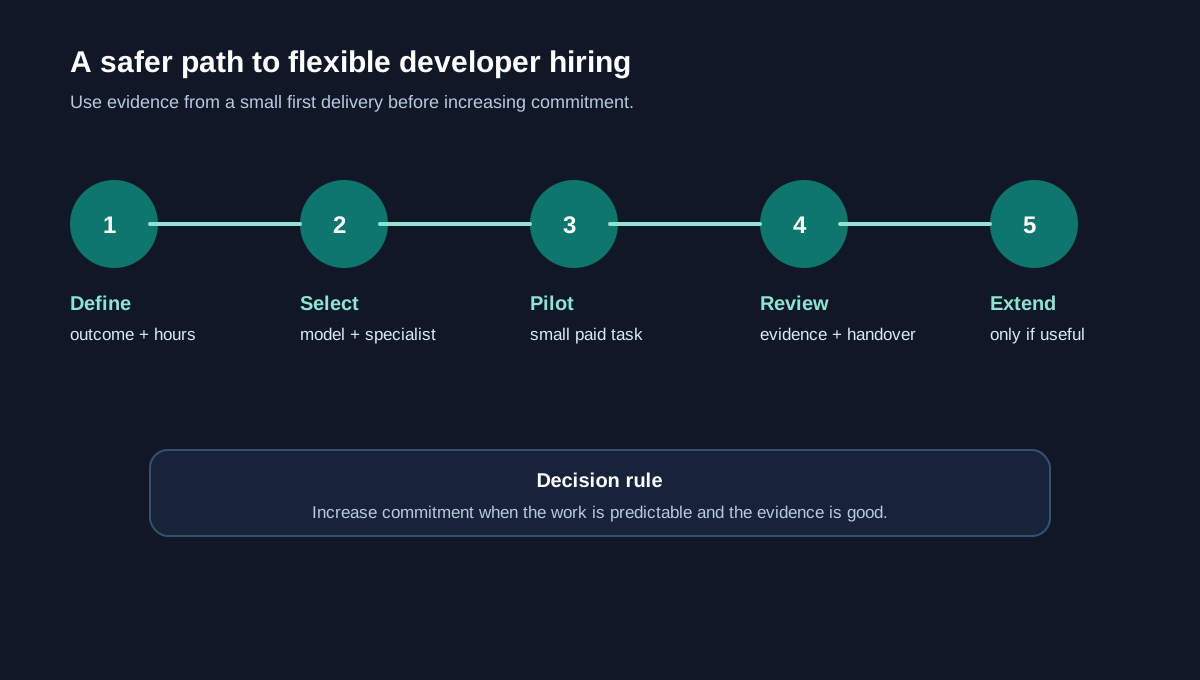
Do not wait until the end of a month to discover that the relationship is not working. Early evidence is cheaper than late disappointment, especially when the developer has access to production systems or a critical repository.
What should the contract and handover cover?
A flexible arrangement still needs a serious contract. The document should make the commercial shape explicit without pretending that every future requirement is known.
- Scope and acceptance: describe the first milestone and how it will be accepted.
- Rate and cap: state the hourly rate or fixed fee, payment points, and approval process for extra work.
- Availability: define working windows, response targets, and planned absences.
- Confidentiality and IP: document who owns project-specific work and how confidential information is handled.
- Accounts and access: keep the repository, hosting, domain, database, and third-party services under business control.
- Handover: require source code, tests, environment notes, deployment instructions, decisions, and known limitations.
- Exit: explain how either side can pause or end the engagement and what happens to unfinished work.
Worker classification, tax treatment, and contract requirements differ by country and relationship. Treat the commercial arrangement as a business and legal question, not just a label such as “freelancer” or “contractor.” In the United States, the IRS explanation of independent contractors is a useful starting point, but it is not a substitute for advice about your specific situation.
What are the common mistakes?
- Buying availability instead of an outcome: paying for hours without a priority list or review point.
- Calling an agency a flexible developer: expecting one named engineer while the contract permits unannounced substitution.
- Giving unrestricted production access: sharing more credentials than the task requires.
- Skipping the pilot: committing to three months before seeing a real pull request or deliverable.
- Accepting a low rate without checking total effort: saving on the invoice while paying for supervision and rework.
- Letting flexible work become invisible work: failing to document decisions, tests, or deployment steps.
- Keeping the wrong model too long: using a part-time arrangement after the workload clearly requires a permanent owner, or retaining a full team after the project has ended.
The best safeguard is a regular decision point. At the end of each milestone, ask whether the next unit of capacity has a defined business value, a responsible reviewer, and a realistic path to completion.
How do flexible developers fit different business stages?
| Business situation | Likely starting model | What to prove first |
|---|---|---|
| Early startup with an untested product idea | Short discovery plus a project-based developer | That one customer workflow can be delivered and tested. |
| Small business with a recurring website backlog | Part-time web developer | That priorities can be prepared and reviewed each week. |
| Growing product team behind on one release | Contract or staff-augmentation developer | That the existing team can onboard and review the added capacity. |
| Company with a broken payment or data workflow | On-demand specialist or capped audit | That the root cause and safe repair path are understood. |
| Product with sustained core engineering work | Internal hire, supported by flexible specialists when needed | That the role has enough durable work and technical ownership. |
The model can change as the business changes. A flexible developer may help validate the first release, support a product team during a peak, or transfer knowledge to an internal hire. Treat the arrangement as a stage-appropriate operating choice, not as a permanent identity for the company.
FAQ about hiring flexible developers
What is a flexible developer?
A flexible developer is an independent or contract developer engaged with adjustable hours, scope, duration, or availability. The arrangement may be part-time, project-based, hourly with a cap, or on-demand.
Is it cheaper to hire a flexible developer than a full-time employee?
It can be cheaper when the workload is temporary, specialized, or too small to fill a full-time schedule. Compare the complete cost of delivery, including management, recruiting, benefits, idle capacity, rework, and handover—not only the hourly rate.
What is the difference between a part-time and contract developer?
A part-time developer usually provides recurring capacity over a period, such as a fixed number of hours each week. A contract developer is usually engaged around a defined result or term, although the contract can also use hourly billing.
Can I hire a flexible developer for one project?
Yes. A clearly bounded project is often a good reason to use a fixed milestone or a capped hourly engagement. Define the acceptance criteria, dependencies, access, and handover before work begins.
What does flexible web development services include?
Flexible web development services can include a website build, landing page, portal, CMS integration, performance repair, analytics setup, or ongoing improvements. The service should state what the developer will deliver and who owns product decisions.
Is flexible software development suitable for startups?
It can suit startups that need to validate a workflow, ship an MVP slice, or add a specialist without consuming the runway on a permanent team. The founder or product owner still needs to make timely decisions and review progress.
What is flexible product development?
Flexible product development is an arrangement where engineering capacity expands or contracts as product evidence changes. It works best when discovery, prioritization, delivery, and review are treated as separate decisions.
What does “flexible development aps” mean?
“Flexible development aps” is a search phrase that usually means flexible development apps or flexible development services. In practice, the buyer is often looking for developers who can work part-time, on contract, or on demand.
How many hours should I give a flexible developer?
Start with the smallest block that can produce evidence. That may be a short audit, one milestone, or a limited number of weekly hours. Increase capacity only when the backlog, review process, and expected outcome justify it.
How do I manage a flexible developer remotely?
Use a written brief, a business-controlled repository, a visible backlog, agreed working windows, regular demos or pull-request reviews, and a short written update. Remote work becomes risky when decisions exist only in private messages.
Should I use hourly or fixed-price work?
Use fixed-price work when the result and acceptance test are clear. Use hourly work with a spending cap when discovery or changing requirements are material. In both cases, define the next review point before the developer starts.
How can I protect ownership when hiring a flexible developer?
Keep the repository, hosting, domain, database, and third-party accounts under the business’s control. Put IP assignment, confidentiality, access removal, source code delivery, and handover requirements in the contract.
When should I stop using a flexible developer?
Stop or change the model when the work is no longer valuable, the developer cannot meet the agreed standard, the workload has become a permanent full-time role, or the company lacks the reviewer needed to use the arrangement safely.
Flexible hiring works when the commitment follows the evidence. Define a useful first result, give the developer the access and context needed to deliver it, review the work early, and extend the engagement only when the next block of capacity has a clear purpose. If you need help choosing between a flexible developer, an internal hire, and an outsourced team, send ProofDevs a short project brief and start with the smallest safe next step.
Written by Michael Melnyk
Senior IT Technical Writer & Technology Analyst
Senior Technical Writer and IT Industry Analyst with over 7 years of experience analyzing software engineering ecosystems, tech leadership models, and developer procurement frameworks.