
Hire a PHP Developer to Remediate Vulnerabilities: Pen-Test Fixes, OWASP Audits, and Runtime Hardening
A comprehensive executive guide to hiring a senior PHP security engineer for vulnerability remediation, penetration test triage, OWASP patching, and runtime hardening.

Receiving an external penetration test report or discovering an unpatched vulnerability advisory in a production PHP application triggers immediate executive anxiety. For non-technical founders, Chief Technology Officers, and product leaders, the critical challenge is rarely finding a generalist web developer who can write PHP syntax. The true bottleneck is finding a disciplined application security engineer capable of translating complex Common Vulnerabilities and Exposures (CVE) findings and penetration test proofs of concept into clean, verified code patches without breaking production business logic or causing catastrophic regressions.
Most commercial PHP codebases accumulate security debt silently over years of rapid feature delivery. Legacy database abstraction layers, unvalidated request inputs, outdated Composer packages, and permissive server configurations often coexist with modern framework controllers. When a vulnerability is flagged, naive fixes—such as applying crude regular expression filters or placing an external Web Application Firewall (WAF) in front of vulnerable endpoints—create an expensive illusion of security while leaving the underlying architectural flaws completely exposed.
Remediating web vulnerabilities requires a structured engineering approach that bridges offensive security findings with defensive software architecture. Before granting repository access or signing a high-stakes consulting contract, engineering leaders must understand the full lifecycle of vulnerability remediation, evaluate the true economics of hiring independent security specialists versus cybersecurity agencies, and apply a rigorous, four-stage technical vetting protocol.
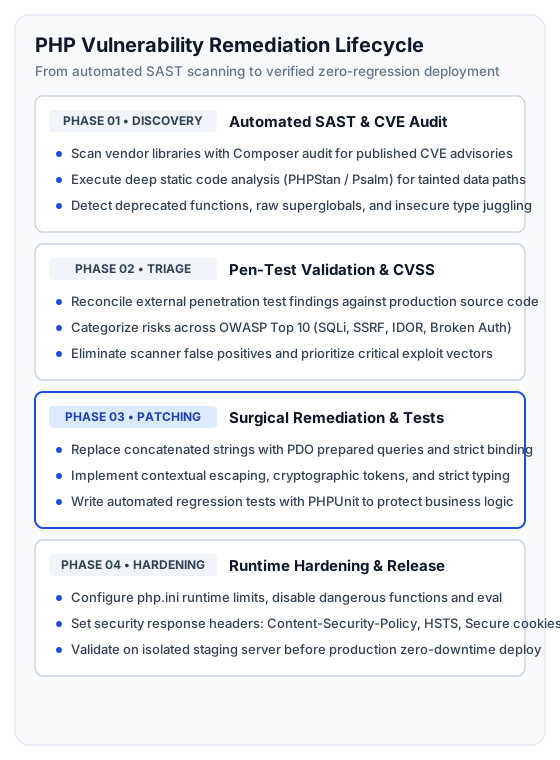
The Generalist Trap: Why Standard Web Developers Fail at Security Remediation
A frequent and costly mistake made by product teams is assigning vulnerability remediation to the same generalist front-end or full-stack developers who built the original features. While skilled product developers excel at optimizing user flows, shipping APIs, and meeting tight sprint deadlines, application security remediation requires an entirely different mental model: an offensive-defensive engineering posture focused on threat boundaries, data flows, and malicious edge cases.
Generalist developers consistently fall into predictable failure modes when tasked with closing security vulnerabilities:
- The Input Sanitization Fallacy: Attempting to strip malicious payloads (such as SQL keywords or JavaScript tags) via custom regex filters or global string replacements instead of enforcing parameterized database queries and contextual output encoding. Attackers routinely bypass blacklists using alternate character encodings, multi-line payloads, or SQL dialect idiosyncrasies.
- The WAF Band-Aid: Relying on cloud proxy rules or web application firewall signatures to block malicious traffic rather than refactoring vulnerable source code. WAFs are perimeter mitigations designed to buy emergency response time, not permanent code fixes; relying on them as a permanent substitute leaves internal microservices and bypass routes vulnerable.
- Collateral Business Logic Breakage: Modifying data validation or type casting on critical endpoints without comprehensive regression testing, which inadvertently disables third-party payment gateway webhooks, breaks mobile client serialization, or corrupts UTF-8 international characters.
- Surface-Level Patching: Fixing only the exact parameter identified in a penetration testing report while ignoring dozens of identical unsafe patterns repeated across legacy controllers, helper files, and background cron scripts.
Security Architecture Warning: Patching vulnerabilities is not an aesthetic refactoring exercise. A senior PHP security engineer views every incoming request as inherently untrusted, traces data taint pathways from entry point to database execution sink, and constructs automated verification tests to guarantee that security gates cannot be circumvented by alternative attack vectors.
Core Vulnerability Classes in PHP Architectures and Root-Cause Remediation
Vulnerability remediation in PHP spans both application-level programming defects and environment-level configuration weaknesses. When evaluating prospective developers, technical leaders should ensure candidates demonstrate deep familiarity with the primary vulnerability classes outlined in the OWASP Top 10 and know how to address them at the architectural root.
1. SQL Injection (SQLi) and Database Layer Vulnerabilities
SQL Injection remains one of the most destructive vulnerabilities in web applications, allowing unauthorized threat actors to dump proprietary user records, alter transactional records, or execute arbitrary operating system commands through database user-defined functions. In PHP applications, SQLi occurs when untrusted request variables are concatenated or interpolated directly into SQL query strings rather than bound via prepared statements.
A qualified developer does not attempt to fix SQLi with legacy functions or manual string escaping. The standard remediation involves refactoring raw database interactions into strict PHP Data Objects (PDO) prepared statements with typed parameters, or adopting modern Object-Relational Mapping (ORM) query builders (such as Doctrine ORM or Laravel Eloquent) that separate query structure from parameter values by default.
2. Cross-Site Scripting (XSS) and Content Injection
Cross-Site Scripting occurs when an application accepts untrusted data and renders it in a web browser without contextual output escaping, enabling malicious scripts to execute within the victim's session. In legacy PHP systems, this is frequently seen when template files echo request parameters or database fields directly into HTML attributes, JavaScript blocks, or dynamic event handlers.
Modern remediation replaces raw template output with compiled templating engines (such as Twig or Blade) that provide automatic, context-aware HTML entity encoding. For legacy codebases where migrating templating engines is impractical, a security specialist introduces strict helper wrappers with explicit UTF-8 character encoding flags and configures a Content Security Policy (CSP) HTTP header to prohibit unauthorized script execution.
3. Insecure Deserialization and Object Injection
PHP object injection occurs when untrusted input is passed to the native serialization parser. Attackers can leverage existing application classes (property-oriented programming or POP chains) to execute arbitrary code, manipulate file systems, or instantiate unauthorized application states. Qualified security contractors completely eliminate native deserialization of user-supplied data, replacing it with standardized data-interchange formats like JSON with strict schema validation.
4. Broken Object Level Authorization (BOLA / IDOR)
Insecure Direct Object References (IDOR) and broken authorization flaws occur when an endpoint accepts a database entity identifier (such as an order ID or account number) and returns or updates the record without verifying that the authenticated user possesses explicit ownership or administrative rights over that specific record. Remediating BOLA requires implementing centralized Policy and Gate architectures that enforce authorization checks at the service layer rather than relying on fragmented conditional checks scattered across individual controller methods.
5. Server-Side Request Forgery (SSRF) and Unsafe File Operations
Applications that fetch remote URLs (such as webhook testers, invoice PDF generators, or profile image fetchers) frequently introduce SSRF vulnerabilities, allowing attackers to access internal cloud metadata services, redis caches, or private network microservices. Remediating SSRF requires strict IP address resolution, DNS rebinding protections, and dedicated egress proxy configurations that restrict HTTP client calls to public internet addresses.
Independent Senior Engineers vs. Cybersecurity Consulting Agencies
When funding a security remediation initiative, organizations typically choose between engaging a traditional cybersecurity advisory agency or contracting a dedicated senior PHP application security engineer. Understanding the financial, operational, and communication trade-offs of each model ensures your budget is deployed effectively.
| Comparison Dimension | Independent Senior Security Engineer | Traditional Cybersecurity Agency | Offshore Generic Freelancer |
|---|---|---|---|
| Effective Hourly Rate | $55 – $95 / hr | $200 – $350+ / hr | $20 – $40 / hr |
| Primary Focus | Hands-on code refactoring, test suites, runtime hardening | Automated scanning reports, executive PDF decks, high-level policy | Quick visual fixes, superficial regex sanitization |
| Access to Source Code | Direct PRs into your Git repository; clean commit history | Often limited to scanning; client engineering must write actual patches | Direct access, high risk of introducing regressions or leaks |
| Communication Channel | Direct daily interaction via Slack, GitHub PRs, and screen sharing | Account managers, scheduled weekly status calls, formalized ticketing | Fragmented messaging, language barriers, unpredictable hours |
| Regression Prevention | High: writes automated PHPUnit unit/integration tests for each fix | Low: provides test re-scan only after your team deploys patches | Very Low: manual verification only; frequent feature breakage |
| Contract Flexibility | Hourly or weekly sprint retainers; pay only for engineering time | Rigid statements of work, minimum commitments ($15k–$30k) | Task-based, lack of accountability for lingering edge cases |
Traditional cybersecurity consultancies deliver significant value when an enterprise requires formal compliance audits (such as SOC 2, ISO 27001, or PCI-DSS certifications) to satisfy external enterprise auditors. However, when an audit report has already been produced and the concrete business requirement is to write, test, and merge secure code patches into a live repository, contracting an independent senior PHP engineer at $55–$95 per hour delivers 3x to 5x higher capital efficiency. You pay directly for engineering time rather than subsidizing agency sales overhead, account managers, and executive slide presentations.
Remediation Project Scopes, Time Estimates, and Budget Benchmarks
Vulnerability remediation budgets vary widely depending on application scale, framework vintage, and whether security fixes require structural database schema alterations. Below are transparent commercial benchmarks based on verified industry remediation engagements:
| Project Scope Tier | Typical Vulnerabilities & Deliverables | Estimated Hours | Budget Range ($55–$95/hr) |
|---|---|---|---|
| Tier 1: Emergency CVE Patching | Immediate patching of 1–3 critical CVEs (e.g. Composer dependency flaw, Remote Code Execution exploit), server php.ini hardening, and emergency zero-downtime deploy. | 8 – 16 hours | $440 – $1,520 |
| Tier 2: Pen-Test Report Remediation | Triaging 10–25 findings from an external penetration test report (OWASP Top 10: SQLi, XSS, CSRF, IDOR), refactoring vulnerable endpoints, and adding regression tests. | 30 – 60 hours | $1,650 – $5,700 |
| Tier 3: Comprehensive Security Audit & Code Refactoring | Full SAST pipeline integration (PHPStan/Psalm Level 8), complete dependency audit, authentication overhaul, session security, and database prepared query standard. | 70 – 120 hours | $3,850 – $11,400 |
| Tier 4: Legacy PHP Modernization & Security Re-Architecture | Modernizing unmaintained legacy PHP 7.x/5.6 applications to PHP 8.2+, migrating procedural database queries to PDO, replacing custom auth with secure identity standards. | 140 – 250+ hours | $7,700 – $23,750 |
For most commercial web applications seeking to remediate a standard penetration test report (Tier 2), a targeted budget of $2,500 to $5,000 provides sufficient engineering capacity to resolve all Critical, High, and Medium findings, build automated test safeguards, and prepare the codebase for clean re-testing by third-party auditors.
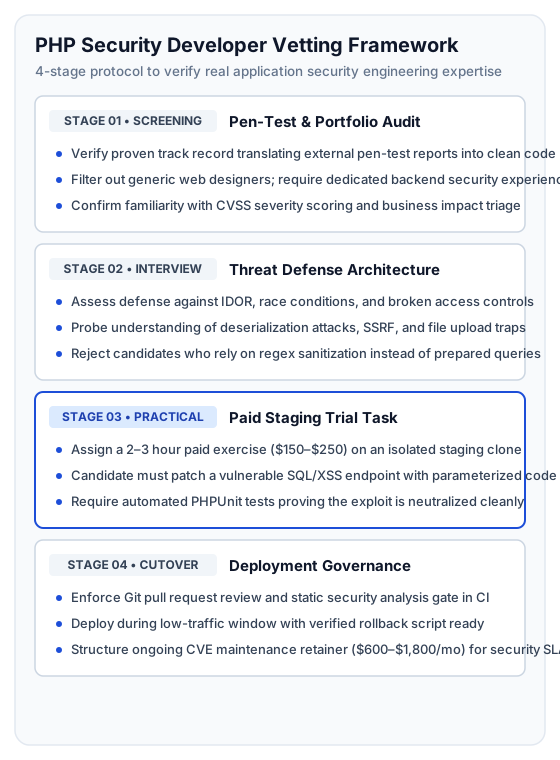
The 4-Stage Vetting Protocol for PHP Security Developers
Hiring for security remediation carries zero tolerance for operational failure. An unqualified contractor with repository access can inadvertently introduce subtle backdoors, corrupt production database records, or expose sensitive customer credentials. Follow this structured four-stage evaluation protocol to verify genuine technical competence before extending an offer.
Stage 1: Portfolio and Remediation History Verification
Filter candidates immediately based on concrete past performance in application security. Request anonymized examples of past remediation projects, pull requests, or penetration test triage summaries. Inquire specifically about their familiarity with the Common Vulnerability Scoring System (CVSS v3/v4), how they prioritize vulnerabilities with public exploit code versus theoretical vulnerabilities, and whether they maintain contributions to secure open-source PHP packages.
Stage 2: Technical Architecture and Threat Defense Interview
Conduct a live technical discussion focused on defensive system architecture. Ask the candidate to explain:
- How they distinguish between input validation, sanitization, and output encoding, and which mechanism is appropriate for neutralizing persistent Cross-Site Scripting.
- How to safeguard against race conditions and concurrent requests in transactional operations (such as digital wallet balances or coupon redemptions) using database row locking.
- The security implications of migrating a legacy PHP codebase from PHP 7.4 to PHP 8.3, specifically regarding type juggling changes, deprecation warnings, and strict typing.
- How they would structure a secure file upload pipeline handling user images to prevent Server-Side Request Forgery and Remote Code Execution.
Stage 3: The Paid 2–3 Hour Practical Staging Trial
Never rely solely on conversational interviews. Commission a paid 2–3 hour trial task ($150–$250) conducted on an isolated staging clone or containerized Docker environment. Provide the candidate with a sample PHP controller containing an intentional vulnerability (e.g. an unparameterized database query combined with unvalidated user input) and evaluate their solution against clear pass/fail grading criteria:
- Pass: The candidate refactors the query into a clean PDO prepared statement with explicitly bound parameters, introduces input validation rules, and writes a comprehensive PHPUnit test demonstrating that both standard traffic and SQL injection attack payloads execute safely without database syntax errors.
- Fail: The candidate attempts to fix the vulnerability by applying regex string replacement filters, fails to bind parameters, leaves other query parameters exposed, or modifies business logic in a manner that breaks existing test assertions.
Stage 4: Deployment Governance and Zero-Regression Cutover
Before any remediated code reaches your live production environment, verify the contractor's adherence to professional release engineering standards. Patches must be delivered via isolated Git feature branches, reviewed through formal pull requests with automated continuous integration checks (linting via PHPCS and static analysis via PHPStan), and deployed first to a staging environment for end-to-end regression validation.
Runtime Hardening: Server and Environment-Level Protections
Source code patching must be paired with environment-level runtime hardening to build depth in your defense posture. A qualified PHP security specialist will audit and configure your server environment to limit the impact of any potential future vulnerabilities.
PHP Runtime Configuration Hardening (`php.ini`)
In secure production environments, dangerous native PHP functions that allow operating system command execution, process spawning, or runtime file inclusion must be disabled unless explicitly required by core business architecture. A senior specialist configures standard hardening directives:
- Function Disablement: Disabling dangerous system execution functions (such as
exec,passthru,shell_exec,system,proc_open, andpopen) to neutralize Remote Code Execution exploit chains. - Error Suppression: Ensuring display of errors is permanently disabled in production while routing comprehensive error logs to secure, access-controlled logging aggregators. Exposing PHP stack traces to end users provides attackers with database schema details and directory structures.
- Remote File Inclusion Prevention: Disabling URL fopen and remote file inclusion directives to prevent attackers from executing remote scripts via dynamic include statements.
- Session Security: Enforcing strict session cookies, HTTP-only flags, secure transport attributes, and same-site policies to defend against session hijacking and Cross-Site Request Forgery.
HTTP Response Headers and Dependency Lockdown
At the web server layer (Nginx, Apache, or Cloudflare edge), the specialist ensures strict HTTP security headers are transmitted with every response: Content Security Policy (CSP), HTTP Strict Transport Security (HSTS), X-Content-Type-Options, and X-Frame-Options. Furthermore, Composer dependencies must be locked to specific semantic versions and scanned automatically within your CI/CD pipeline using automated security advisories.
Real-World Case Studies: From Critical Vulnerability to Resilient Architecture
Case Study 1: Resolving a High-Severity SQLi in a B2B SaaS Billing Engine
A B2B SaaS platform processing over $400,000 in monthly recurring subscriptions received a Critical finding from an enterprise client's vendor security audit: an account filtering parameter inside an export controller allowed arbitrary time-based blind SQL injection. The platform's internal developers attempted to fix the issue by sanitizing input with custom regex filters, but the client's penetration tester bypassed the filter within two hours.
The company engaged a senior independent PHP security specialist through ProofDevs. Within 14 engineering hours ($1,190 total cost), the engineer refactored the entire reporting query suite into parameterized PDO prepared statements, introduced strict input type validation, wrote automated PHPUnit test fixtures simulating blind injection payloads, and audited 18 related reporting endpoints to eliminate identical vulnerable patterns. The client's security team re-tested and issued a flawless sign-off within 48 hours.
Case Study 2: Mitigating an Unauthenticated RCE Flaw in a Custom E-Commerce System
A specialty e-commerce retailer running a high-traffic custom PHP application discovered unauthorized shell scripts uploaded to their web root via an exploited image upload endpoint. The store owner immediately engaged an emergency security engineer to contain the breach.
Over a 24-hour sprint (22 billable hours at $85/hr, $1,870 total), the engineer conducted forensic analysis, isolated the malicious files, rebuilt the file upload pipeline to store images in private cloud object storage with randomized non-executable hashes, hardened the server configuration to disable PHP execution in static asset directories, and configured a strict Content Security Policy. The store remained operational throughout the incident without data loss or payment gateway downtime.
Frequently Asked Questions
How much does it cost to hire a PHP developer to fix security vulnerabilities?
Hiring an independent senior PHP security developer costs between $55 and $95 per hour, with total project budgets typically ranging from $500 for emergency CVE patches to $2,500–$6,000 for comprehensive penetration test remediation across an entire application. In contrast, traditional cybersecurity agencies charge $200 to $350+ per hour with minimum contract commitments of $15,000 to $30,000.
How long does it typically take to remediate a penetration test report in PHP?
Remediating a standard penetration test report containing 10 to 20 findings typically takes between 30 and 60 engineering hours (approximately 1 to 2 weeks of focused work). Simple input validation and header updates take 1 to 3 hours each, while architectural refactoring of authentication, database abstraction, or access control logic requires 10 to 20 hours.
Can a Web Application Firewall (WAF) replace the need to hire a developer to fix code vulnerabilities?
No, a Web Application Firewall cannot replace source code remediation. While a WAF provides temporary perimeter protection by filtering known attack patterns, skilled attackers frequently bypass WAF rules using encoding variations, and a WAF cannot protect against internal threats, logic flaws, or direct backend access.
What qualifications should I look for in a PHP security developer?
Look for senior engineers with verifiable experience in application security, a deep working knowledge of the OWASP Top 10, hands-on expertise with static analysis tools like PHPStan and Psalm, and a proven track record writing automated unit and integration tests with PHPUnit. Candidates should be able to explain how to patch root architectural vulnerabilities rather than merely filtering inputs.
How do I safely grant a new developer access to our vulnerable codebase?
Never grant direct SSH or database access to your live production server. Instead, create an isolated staging environment populated with anonymized dummy data, grant restricted access to your Git repository on a dedicated feature branch, and require all proposed patches to be submitted via pull requests for code review and automated testing before merging.
What is the difference between static code analysis (SAST) and penetration testing?
Static Application Security Testing (SAST) analyzes source code from the inside without executing the application to detect insecure coding patterns, unescaped inputs, and outdated dependencies. Penetration testing simulates external attacks against the running application to identify exploitable business logic flaws, configuration mistakes, and access control bypasses.
Should I upgrade our PHP version to fix security vulnerabilities?
Yes, upgrading to an actively supported PHP version (PHP 8.2, 8.3, or newer) is critical because legacy versions (such as PHP 7.4 or 8.0) have reached End-of-Life (EOL) and no longer receive official core security patches. However, runtime upgrades must be accompanied by application code refactoring to address application-level logic vulnerabilities.
How do I verify that a patched vulnerability is actually fixed?
A patched vulnerability is verified by executing automated regression tests that simulate both benign user inputs and malicious attack payloads against the patched endpoint, running static analysis scanners (such as PHPStan and Psalm) to verify safe data flows, and commissioning a targeted re-test by the original penetration testing firm.
What are the most common security mistakes in legacy PHP applications?
The most common security mistakes in legacy PHP systems include concatenating user inputs directly into SQL queries, using global variables and superglobals without validation, storing sensitive credentials directly in source files instead of environment variables, and utilizing native PHP deserialization on untrusted cookies or parameters.
Why do traditional penetration testing firms not write the code fixes themselves?
Most penetration testing consultancies specialize exclusively in offensive security, vulnerability discovery, and compliance auditing; their analysts often lack deep software engineering expertise in specific programming frameworks and avoid taking legal liability for introducing code regressions or breaking production client systems.
How can we prevent new security vulnerabilities from being introduced in the future?
Prevent future vulnerabilities by integrating automated security scanning tools (such as composer audit and Psalm) directly into your CI/CD deployment pipeline, enforcing mandatory peer code reviews for all pull requests, providing secure coding training for internal developers, and establishing a regular monthly maintenance retainer with an experienced backend security engineer.
Written by ProofDevs
Senior Technical Writer and IT Industry Analyst with over 7 years of experience analyzing software engineering ecosystems, tech leadership models, and developer procurement frameworks.