
How Much Does a Custom CRM Cost? Pipeline Architecture, SaaS TCO, ERP Integrations & Real Rates
Explore realistic custom CRM development costs in 2026. Compare build tiers from $18,000 to $160,000+, 5-year SaaS TCO break-even benchmarks, and agency vs senior contractor rates.


Building a custom Customer Relationship Management (CRM) system typically costs between $18,000 and $160,000, depending on architectural complexity, workflow automation, third-party integrations, and team sourcing. A focused sales pipeline MVP ranges from $18,000 to $35,000; an operational B2B system with quoting, telephony, and custom roles lands between $35,000 and $75,000; while multi-entity enterprise platforms with deep ERP synchronization exceed $75,000 to $160,000+. Reviewed October 2026. Figures and timelines below represent standard commercial market benchmarks across North American and European engineering engagements.
Founders and Chief Operating Officers frequently reach an operational threshold where standard spreadsheet workflows break down, yet commercial off-the-shelf SaaS platforms like Salesforce or HubSpot demand astronomical annual subscriptions while forcing internal teams into rigid, unnatural sales processes. If you are evaluating custom systems architecture, cross-reference our detailed analysis on full-stack web application development, inspect baseline quotes in our guide on custom software development costs, or review the commercial economics in our build vs buy software guide.
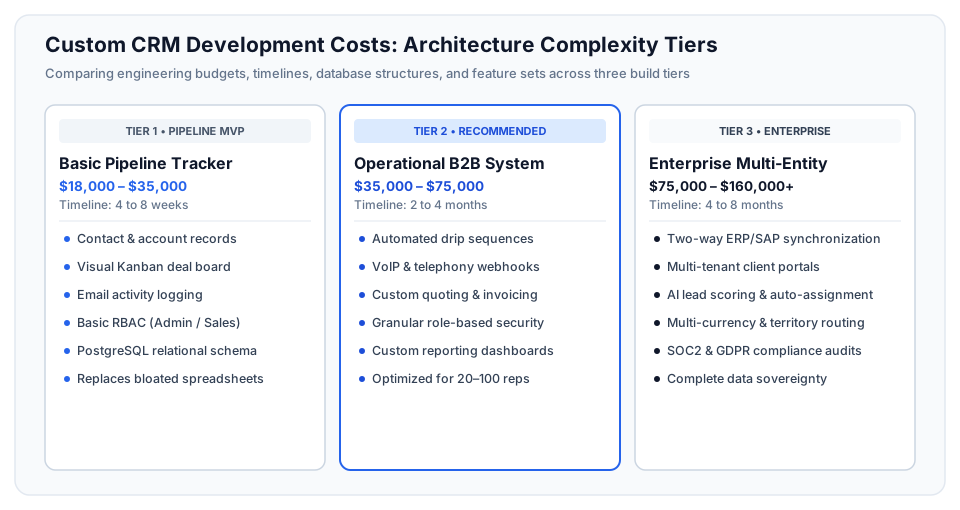
The Three Complexity Tiers of Custom CRM Development
The total capital required to engineer a proprietary CRM is governed strictly by feature depth, transaction volume, and system integration boundaries. Categorizing requirements into clear engineering tiers prevents scope inflation and allows businesses to deploy functional software within weeks rather than quarters.
| Complexity Tier | Standard Price Range | Development Timeline | Target Organization Size | Core Architectural Deliverables |
|---|---|---|---|---|
| Tier 1: Pipeline MVP | $18,000 – $35,000 | 4 to 8 weeks | 5 to 20 users | Contact/account tables, visual Kanban deal pipeline, email logging, basic admin permissions, CSV export |
| Tier 2: Operational B2B CRM | $35,000 – $75,000 | 2 to 4 months | 20 to 100 users | Automated email sequences, VoIP telephony webhooks, custom quote/invoice PDF generators, granular RBAC |
| Tier 3: Enterprise Platform | $75,000 – $160,000+ | 4 to 8 months | 100+ users / multi-branch | Two-way ERP/SAP synchronization, multi-tenant client portals, automated territory routing, SOC2 audit trails |
Tier 1: Basic Pipeline MVP ($18,000–$35,000): Built primarily for small teams graduating from Google Sheets or Airtable. The architecture centers on an optimized relational database schema (typically PostgreSQL) connecting leads, company accounts, activities, and commercial deals. It delivers a fast, responsive drag-and-drop Kanban board for moving deals across sales stages, centralized contact profiles, and simple user access tiers.
Tier 2: Operational B2B Workflow System ($35,000–$75,000): Designed for growing mid-market companies with specialized sales, fulfillment, or estimation procedures. Beyond pipeline visualization, Tier 2 incorporates automated event triggers (such as dispatching onboarding emails when a deal moves to "Closed Won"), bidirectional calendar synchronization, click-to-dial VoIP integrations, and integrated quoting modules that calculate customized margin thresholds.
Tier 3: Enterprise Multi-Entity Platform ($75,000–$160,000+): Required by large organizations managing complex compliance mandates, separate legal entities, or global dealer networks. This tier demands multi-tenant data isolation, deep bidirectional data pipelines connecting legacy ERP software (SAP, NetSuite, Microsoft Dynamics), automated currency conversions, and rigorous audit logging to comply with SOC2, GDPR, or HIPAA regulatory frameworks.
Core Architectural Modules That Dictate Development Budgets
In custom software engineering, software costs reflect the hours required to model relational entities, write business logic, secure API endpoints, and ensure UI performance. A custom CRM breaks down into six foundational engineering modules.
1. Relational Database Schema & Audit Logging: The data foundation. Modeling polymorphic relationships between individual contacts, parent organizations, multi-currency deal values, and historical interaction logs requires clean relational database design. Implementing row-level security (RLS) and immutable audit tables—which record every field change, user timestamp, and record modification—accounts for 15% to 20% of backend engineering effort. For high-volume data structures, explore our directory of pre-vetted PostgreSQL database engineers.
2. Visual Sales Pipeline & Deal State Machines: A visual Kanban board requires strict transaction state machines. If two sales representatives update a deal stage simultaneously, database locking mechanisms must prevent race conditions and invalid stage transitions. Implementing optimistic UI updates, drag-and-drop state listeners, and server-side validation takes 60 to 110 engineering hours.
3. Communication Streams & Telephony Webhooks: Capturing customer touchpoints automatically requires integrating email gateways (Gmail/Outlook IMAP and OAuth2 tokens), bidirectional SMS gateways (Twilio), and VoIP telephony webhooks. Handling asynchronous call recordings, parsing incoming email threads, and linking them to corresponding contact records adds $6,000 to $14,000 to project development.
4. Granular Role-Based Access Control (RBAC): While basic CRMs separate regular reps from system administrators, mature commercial teams require granular permission matrices. Account managers must only view assigned accounts; regional directors require territory-wide visibility; executive leadership needs consolidated financial dashboards. Engineering multi-layered permission filters across every database query requires 40 to 80 focused hours.
5. Custom Quoting, Invoicing & Payment Gateways: When off-the-shelf tools fail to support tiered discount rules, custom manufacturing formulas, or multi-currency exchange calculations, embedding a custom quoting engine is essential. This module generates branded customer proposal PDFs, captures cryptographic e-signatures, and triggers webhook payment requests via Stripe or banking APIs.
6. Analytical Dashboards & Forecasting: Executive teams require real-time conversion velocity, pipeline leakage metrics, rep quota attainment, and projected revenue forecasting. Rendering interactive analytics across tens of thousands of deal records without slowing application performance demands server-side query aggregation, pre-computed materialized database views, and optimized caching layers.
Custom Build vs Commercial SaaS: 5-Year Total Cost of Ownership (TCO)
Commercial SaaS solutions appear economical on day one but become massive recurring cost centers as headcounts expand, whereas custom software represents an upfront capital asset that eliminates per-seat licensing penalties forever.
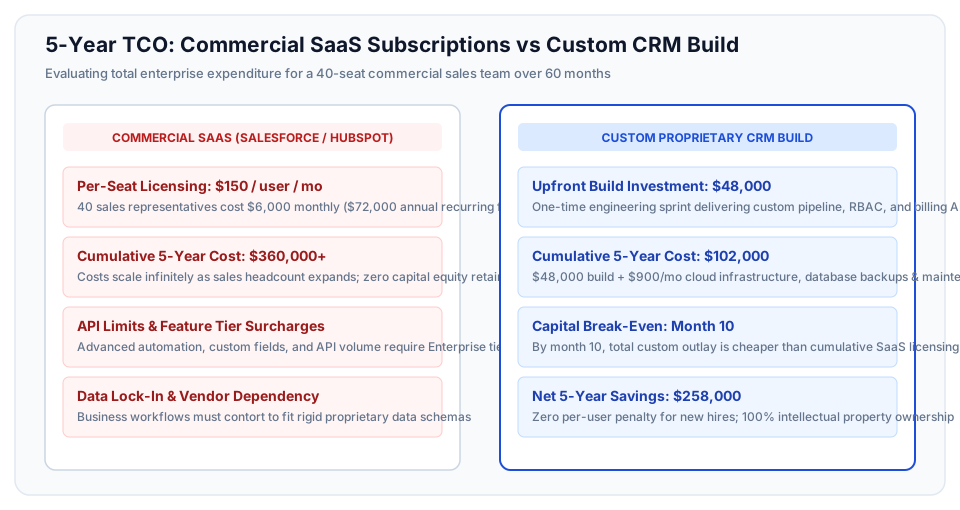
Consider an expanding mid-sized sales organization with 40 active representatives utilizing an enterprise tier of Salesforce or HubSpot. At an average negotiated rate of $150 per user per month, the recurring subscription fee totals $6,000 each month, or $72,000 annually. Over five years, the business pays a staggering $360,000 in pure subscription fees—excluding mandatory onboarding consulting ($8,000–$15,000), paid marketplace plugin add-ons, and expensive API call limit overage charges.
In contrast, developing a tailored, high-performance proprietary CRM with exact operational workflows costs roughly $48,000 in one-time engineering capital. Hosting the application on managed cloud infrastructure (AWS or Supabase) with automated daily backups, logging, and performance monitoring costs approximately $250 per month. Allocating an additional $650 per month for proactive engineering maintenance and periodic feature updates brings ongoing operational expenses to $900 per month ($10,800 annually).
The commercial break-even occurs between months 9 and 12: By month 10, total cumulative capital allocated to the custom build is lower than cumulative SaaS fees. Over a 60-month operating horizon, the custom build costs $102,000 total versus $360,000 for SaaS—yielding net cash savings of $258,000 while retaining 100% intellectual property ownership and the freedom to onboard new team members with zero per-user penalties.
Critical Cost Drivers: Integrations, Data Migration, and Mobile Access
Project budgets escalate when technical requirements cross organizational and platform boundaries. Understanding these three primary cost multipliers allows executive stakeholders to make strategic trade-offs during project scoping.
Legacy ERP and Accounting Synchronization (+$12,000 to $30,000): Connecting a new CRM to existing operational backbones like SAP, Oracle, QuickBooks, or custom legacy databases is notoriously complex. Legacy APIs often lack standard webhooks, requiring custom polling microservices, bidirectional data reconciliation logic, and conflict resolution rules when records are edited simultaneously in both systems.
Historical Data Migration and Cleansing (+$3,000 to $10,000): Migrating five to ten years of historical customer interactions from fragmented spreadsheets, disconnected email inboxes, or outdated CRM exports requires extensive ETL (Extract, Transform, Load) scripting. Data structures must be de-duplicated, invalid foreign keys corrected, and historical timestamps mapped to new relational schemas without corrupting sales attribution.
Native Mobile Applications vs Responsive Web (+$20,000 to $45,000): Building native mobile applications for iOS (Swift) and Android (Kotlin) alongside a web dashboard effectively triples front-end development hours. Component web frameworks like Next.js and React enable responsive mobile Progressive Web Apps (PWAs) that deliver offline lead entry, touch-optimized Kanban navigation, and camera receipt scanning through the mobile browser at a fraction of the cost.
Solo Senior Engineering Contractors vs Traditional Software Agencies
Sourcing strategy dictates whether your software budget pays for productive code commits or agency administrative overhead. Traditional software agencies bill between $150 and $250 per hour, applying a 50% to 65% markup to fund account managers, sales teams, and corporate office margins.
| Evaluation Metric | Traditional Software Agency | Independent Senior Contractor |
|---|---|---|
| Billing Hourly Rates | $150 – $250 / hour | $45 – $95 / hour |
| Operational Overhead Markup | 50% – 65% (Project managers, executives, office rent) | 0% (Direct capital to engineering) |
| Communication Flow | Filtered through junior account coordinators | Direct technical dialogue with the software author |
| Typical MVP Project Total | $60,000 – $110,000 | $22,000 – $42,000 |
| Code Ownership & IP Transfer | Often held hostage until final milestone releases | Continuous daily commits to client GitHub repository |
| Post-Launch Agility | Rigid change-order contracts for minor revisions | Flexible hourly sprints on demand |
Working directly with an independent senior full-stack developer ($45 to $95 per hour) allows businesses to build an identical operational CRM for less than half the financial outlay. The client maintains complete transparency: code is committed directly to your private GitHub repository daily, staging environments update with every pull request, and requirements are refined directly with the engineer building the system.
Post-Launch Operating Costs: Hosting, Maintenance, and Security
A custom software platform is a living asset requiring planned operational maintenance, infrastructure management, and regular security updates. Budgeting for post-launch operations ensures system uptime and prevents technical debt accumulation.
Cloud Infrastructure and Managed Database ($80 to $350 / month): Managed serverless runtimes (such as Vercel or AWS ECS) paired with managed relational databases (Supabase, AWS RDS, or Render) deliver high reliability with zero server patching overhead. For teams under 100 users, infrastructure costs rarely exceed $150 per month, including daily automated snapshots and SSL certificate renewals.
Third-Party API Usage Fees ($50 to $300 / month): Operational utility services bill strictly based on volume. Standard expenses include transactional email delivery via Resend or SendGrid ($20–$80/mo), SMS verification and VoIP call routing via Twilio ($30–$150/mo), and vector database hosting for AI features ($20–$70/mo).
Ongoing Technical Support & Feature Sprints ($800 to $2,500 / month): Software industry standards recommend allocating 15% to 20% of initial build costs annually for technical maintenance. Engaging an engineering contractor for 10 to 25 hours per month covers dependency updates, browser compatibility patches, database index tuning, and minor feature additions as sales workflows evolve. For continuous maintenance, review our dedicated maintenance and support services.
Candidate Screening & 4-Stage Vetting Protocol for CRM Developers
Hiring the wrong contractor to build business-critical software results in abandoned repositories, corrupted customer databases, and wasted capital. Apply this structured 4-stage screening protocol before awarding contracts.
Stage 1: Architecture & Schema Walkthrough: Ask the candidate to present a relational database diagram (ERD) from a past business web application. Verify how they handle database constraints, cascade deletions, and index strategies across millions of records. Reject candidates who suggest storing complex operational workflows inside unstructured NoSQL document collections.
Stage 2: Transaction Concurrency & Locking Test: Probe the engineer on how they protect deal data during concurrent updates. Ask: "How do you prevent two sales reps from claiming the same lead or modifying deal terms simultaneously?" A qualified senior developer will immediately explain PostgreSQL pessimistic locking (SELECT FOR UPDATE), database transactions, and optimistic concurrency control. A junior candidate will rely on naive front-end checks.
Stage 3: Paid 4-Hour Discovery Prototype ($200–$400): Before committing to a multi-week contract, fund a short paid trial. Provide a basic lead qualification scenario and ask the candidate to construct the database migration schema, API routes, and a functional React deal card with form validation on staging. Evaluate code cleanliness, git commit clarity, and error handling.
Stage 4: Security & Access Governance: Verify that the contractor enforces strict environment separation. Production API keys and database credentials must never exist in local repositories, client session tokens must use HTTP-only secure cookies, and all internal API endpoints must authenticate user permissions server-side.
Frequently Asked Questions
How much does it cost to build a custom CRM from scratch?
Developing a custom CRM typically costs between $18,000 and $75,000 for small-to-midsize businesses, while complex enterprise platforms with deep ERP synchronization range from $75,000 to $160,000+. Total investment depends on user roles, workflow automation, and custom API integrations.
What is the average timeline to build a custom CRM?
A functional pipeline MVP takes 4 to 8 weeks, an operational B2B workflow system requires 2 to 4 months, and a complex enterprise multi-entity platform requires 4 to 8 months from initial database architecture modeling to production launch.
When does building a custom CRM become cheaper than paying for Salesforce or HubSpot?
Custom CRM development achieves commercial break-even within 9 to 18 months for teams with 25 or more sales representatives. At 40 seats ($6,000/month in SaaS licensing), a custom $48,000 build saves over $255,000 in operating costs over a 5-year operating horizon.
What are the typical ongoing monthly costs of running a custom CRM?
Ongoing operational expenses range from $200 to $600 per month for cloud hosting (AWS or Supabase), automated backups, and transactional email/SMS APIs, plus an optional $800 to $1,800 monthly retainer for continuous engineering updates and support.
What programming languages and tech stacks are best for custom CRM development?
The standard technical stack comprises PostgreSQL for relational data integrity, Node.js, Python (Django), or Go for backend APIs, and React or Next.js with TypeScript and Tailwind CSS for responsive, high-speed front-end user interfaces.
Can a custom CRM integrate with legacy ERP or accounting software?
Yes. Custom CRMs can integrate with any software exposing REST, SOAP, GraphQL, or database connections, including SAP, Oracle, NetSuite, and QuickBooks. Building bidirectional synchronization typically adds $12,000 to $30,000 to the development budget.
What is the hourly rate for a freelance senior CRM developer?
Independent senior full-stack software engineers specializing in business applications charge between $45 and $95 per hour. In contrast, traditional software development agencies bill $150 to $250+ per hour for equivalent technical output.
How do I protect customer data and ensure CRM security compliance?
Security is enforced through server-side Role-Based Access Control (RBAC), row-level database security, encrypted database storage at rest, TLS encryption in transit, and immutable audit logs that record every user view, edit, and deletion event.
Is it better to hire a software agency or an independent developer for a CRM build?
Hiring an independent senior engineer delivers identical software quality at 50% to 65% lower total cost by eliminating agency overhead margins, providing direct technical communication and daily code commits into your private repository.
Can we migrate existing data from spreadsheets or older CRMs?
Yes. Custom ETL migration scripts extract, clean, de-duplicate, and re-map historical contacts, communication logs, and sales deal values into the new relational schema, typically requiring 20 to 50 engineering hours ($1,500–$4,500).
What features should be included in an initial CRM MVP?
An MVP should prioritize core operational necessities: centralized contact and company profiles, a visual drag-and-drop sales deal pipeline, activity/email logging, CSV import/export, and basic administrative role permissions.
How does a custom CRM handle offline sales data entry for mobile reps?
Offline-capable Progressive Web Apps (PWAs) utilize local browser IndexedDB storage and service workers to allow sales reps to log notes and update deal stages offline, automatically synchronizing data with the primary cloud database once an internet connection restores.
Written by Michael Melnyk
Senior IT Technical Writer & Technology Analyst
Senior Technical Writer and IT Industry Analyst with over 7 years of experience analyzing software engineering ecosystems, tech leadership models, and developer procurement frameworks.