
Hire a Drupal Developer: Drupal 10 Migration, Custom Modules, Rates, Code Audit
Navigate hiring a senior Drupal developer for enterprise platforms. Compare site builders vs engineers, Drupal 7 EOL migrations, custom module development, and hourly rates.


Hiring a senior Drupal developer typically costs between $45 and $95 per hour for independent technical contractors, $150 to $250 per hour for specialized digital agencies, and $25,000 to $120,000+ for fixed-scope migrations from legacy Drupal 7 to Drupal 10 or 11. Total expenditure depends strictly on whether your engagement requires standard content modeling, custom Symfony module engineering, high-volume database ETL, or headless frontend decoupling with Next.js. Reviewed October 2026. Financial benchmarks, candidate vetting frameworks, and migration milestones below reflect production engineering standards across North American and European enterprise deployments.
Organizations that choose Drupal typically operate at enterprise scale: government departments, university networks, media conglomerates, and multi-brand corporate ecosystems with complex role-based access controls and strict security mandates. However, business executives frequently encounter costly hiring failures because they treat Drupal like a conventional blogging CMS. When non-technical managers hire a "site builder" who stacks dozens of unvetted third-party plugins through the administrative user interface, the resulting platform suffers from severe database deadlocks, unmanageable upgrade paths, and critical security vulnerabilities. If you are assessing legacy infrastructure or evaluating engineering budgets, review our insights on legacy software modernization, examine baseline rates in our custom website cost guide, inspect our analysis on hiring full-stack developers for complex web applications, or explore our website maintenance and support programs.
The Critical Distinction: Drupal Site Builder vs Custom Module Engineer
The single most frequent mistake in Drupal talent acquisition is failing to differentiate between a Site Builder and a Custom Module Software Engineer. While both work within the same platform ecosystem, their technical competencies, day-to-day deliverables, and architectural impact represent entirely different engineering disciplines.
A Drupal Site Builder configures the platform primarily through the administrative web interface. They create content types, configure taxonomies, build database queries through the Views module, and assemble page layouts using core block systems or contributed modules. Site builders rarely write Object-Oriented PHP, do not maintain custom Symfony services, and often lack familiarity with automated testing pipelines. For small editorial portals with standard publishing workflows, a skilled site builder delivers rapid results at economical rates ($35 to $60 per hour).
Conversely, a Senior Drupal Software Engineer treats Drupal as an application framework built upon Symfony components. They architect custom modules using PSR-4 object-oriented standards, implement dependency injection, create event subscribers, interface directly with the Entity API, and write automated PHPUnit test suites. They manage site configuration strictly through version-controlled YAML files, orchestrate Composer dependency lifecycles, and optimize database queries for high-concurrency enterprise workloads. If your project involves integrating proprietary enterprise enterprise resource planning (ERP) systems, handling multi-lingual content replication, or building custom business logic, hiring a site builder will result in architectural failure.
| Technical Dimension | Drupal Site Builder | Senior Custom Module Engineer | Headless / Decoupled Architect |
|---|---|---|---|
| Core Competencies | Administrative UI, Content Types, Taxonomies, Views, Contributed Module Assembly. | Object-Oriented PHP 8.2+, Symfony Components, Custom Plugin APIs, Entity API, Event Subscribers. | Node.js, Next.js, React, TypeScript, JSON:API, GraphQL, Edge Caching, Server-Side Rendering. |
| Configuration Workflow | Often relies on administrative clicks; may struggle with staging-to-prod Git synchronization. | 100% automated Configuration Management (CMI); all settings tracked in Git as YAML artifacts. | Maintains schema contracts between backend content models and decoupled frontend presentation layers. |
| Custom Code Deliverables | Basic CSS/Twig overrides, hook implementations, and simple template tweaks. | Bespoke Drupal modules, custom service containers, queue workers, and batch processing logic. | Next.js frontend applications, incremental static regeneration (ISR) pipelines, API gateways. |
| Standard Hourly Rates | $35 – $60 / hour | $65 – $95 / hour | $75 – $110 / hour |
| Best Project Fit | Standard institutional websites, marketing landing pages, basic content taxonomies. | Enterprise migrations, bespoke business workflows, high-security portals, legacy refactoring. | High-speed multi-channel digital experiences, omnichannel e-commerce, mobile app backends. |
The Drupal 7 EOL Dilemma: Migration Architecture vs Complete Rebuild
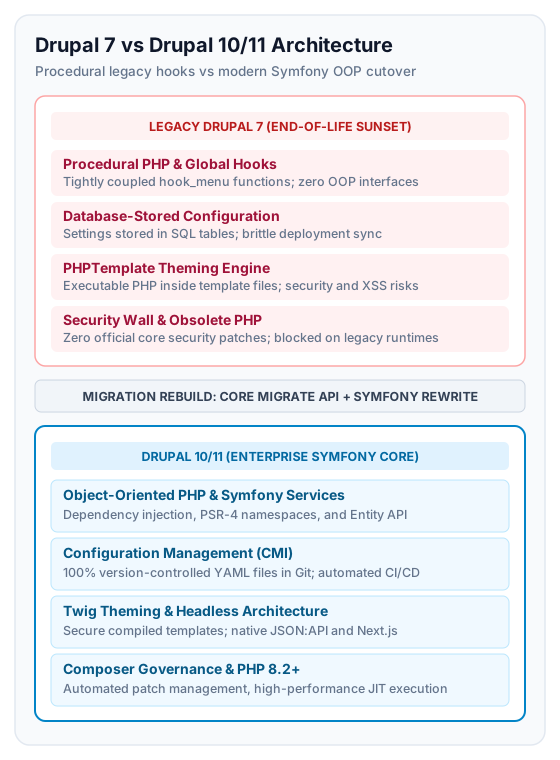
Migrating from Drupal 7 to current Drupal versions (Drupal 10 or 11) is not an incremental version upgrade; it is a full-scale architectural migration requiring a complete rebuild of the underlying codebase and theming layer. Because Drupal transitioned from procedural PHP hooks in Drupal 7 to an Object-Oriented Symfony architecture in Drupal 8+, zero legacy PHP code or template files can be ported directly without refactoring.
With official Drupal 7 community security support reaching its final end-of-life sunset, organizations running legacy platforms face critical operational liabilities: compliance breaches under PCI-DSS or HIPAA, unpatched remote code execution vulnerabilities, and incompatibility with current PHP runtimes (PHP 8.2 and 8.3). When planning this transition, engineering leaders must evaluate three distinct architectural pathways:
- Complete Enterprise Migration to Drupal 10/11: Utilizing the core Migrate API to extract legacy database tables, transform content models into relational field structures, and load them into a fresh Drupal 10 architecture. Custom business logic is rewritten as Symfony services, and layouts are recreated using Twig templates. This path preserves Drupal's editorial governance, multi-site capabilities, and granular permission systems.
- Decoupled / Headless Modernization: Upgrading the backend to Drupal 10 to serve strictly as a structured content repository via native JSON:API endpoints, while replacing the frontend presentation layer with a high-performance Next.js or Remix application. This architecture eliminates PHP theming technical debt and enables edge caching via global CDN platforms.
- Platform Replatforming: Migrating off Drupal entirely to custom full-stack frameworks (such as Next.js with PostgreSQL) or lightweight CMS alternatives. This option is commercially viable only when the platform's editorial complexity no longer justifies maintaining an enterprise Drupal infrastructure.
A typical enterprise migration from Drupal 7 to Drupal 10 spans 10 to 24 weeks and requires between $35,000 and $120,000 in engineering capital, governed by the volume of custom legacy modules that require reimplementation.
Commercial Engagement Models and Hourly Rates: Freelancers vs Agencies
Engaging Drupal engineering talent involves selecting between three primary operational models: direct independent senior contractors, specialized boutique Drupal agencies, and large system integrators. Understanding the cost structures and overhead distributions across these channels prevents budget inflation.
| Engagement Channel | Hourly Billing Rate | Monthly Cost (40 hrs/wk) | Agency Overhead Markup | Primary Deliverable Focus |
|---|---|---|---|---|
| Independent Senior Developer | $45 – $95 / hour | $7,200 – $15,200 | 0% (Direct daily engineering output) | Hands-on custom module coding, migration scripting, architectural audits, and technical bug remediation. |
| Vetted Talent Platforms (e.g., Toptal) | $80 – $140 / hour | $12,800 – $22,400 | 35% – 50% (Platform vetting fee) | Staff augmentation, senior engineering leadership, rapid trial deployment without long-term contracts. |
| Specialized Drupal Boutique Agency | $150 – $250 / hour | $24,000 – $40,000 | 55% – 65% (PM, account management, QA) | Turnkey digital transformations, end-to-end multi-disciplinary design and engineering retainers. |
| Global Enterprise System Integrator | $220 – $350+ / hour | $35,000 – $56,000+ | 70% – 80% (Corporate management layers) | Large public-sector RFPs, multi-department enterprise governance, and global multi-site implementations. |
For organizations possessing internal product ownership or technical project management capabilities, contracting independent senior Drupal engineers ($45 to $95 per hour) delivers exceptional capital efficiency. You bypass the administrative markup of traditional agencies while securing direct collaboration with specialists who commit code daily to your Git repositories.
Technical Code Audit: Red Flags in Candidate Repositories
Evaluating a Drupal developer requires inspecting actual code repositories to verify architectural discipline and adherence to Drupal 10/11 standards. Résumés listing extensive years of Drupal experience often conceal obsolete legacy habits that can compromise production stability.
Before extending a contractual engagement or hiring offer, review the candidate's GitHub or GitLab project samples against the following architectural benchmarks:
1. Configuration Management (CMI) Discipline
In current Drupal architecture, every content type configuration, view definition, user role permission, and system setting must be captured as a version-controlled YAML file in the config/sync directory. Review the candidate's commit history: if configurations are not tracked in Git, or if the candidate admits to modifying content structures directly on live production databases, disqualify them immediately. Live administrative configuration changes break deployment pipelines and cause catastrophic data overwrites.
2. The "Never Hack Core" Rule
Modifying core Drupal files or editing contributed modules directly within the /core or /modules/contrib directories is an absolute disqualification. A competent engineer implements custom extensions through properly isolated modules in /modules/custom, uses Composer patches via cweagans/composer-patches for upstream bug fixes, and leverages event subscribers or hook overrides to modify standard behavior.
3. Strict Dependency Injection and Clean PSR Standards
Drupal 10/11 production code must adhere to PSR-12 coding guidelines and utilize dependency injection through service container definitions. Examine candidate custom modules: if their PHP classes frequently call procedural static helpers (such as \Drupal::service(), \Drupal::database(), or \Drupal::currentUser()) directly inside controller methods rather than injecting dependencies through constructors, the developer is carrying over legacy procedural habits that hinder unit testing.
4. Active Drupal.org Contribution Profile
The global Drupal community maintains a transparent public tracking ledger on drupal.org. Ask candidate developers for their user profile link. An active profile displaying confirmed commit credits, issue queue participation, contributed module maintenance, or security patch reviews provides verifiable proof of technical competence and ecosystem familiarity.
The 4-Stage Technical Candidate Vetting Protocol
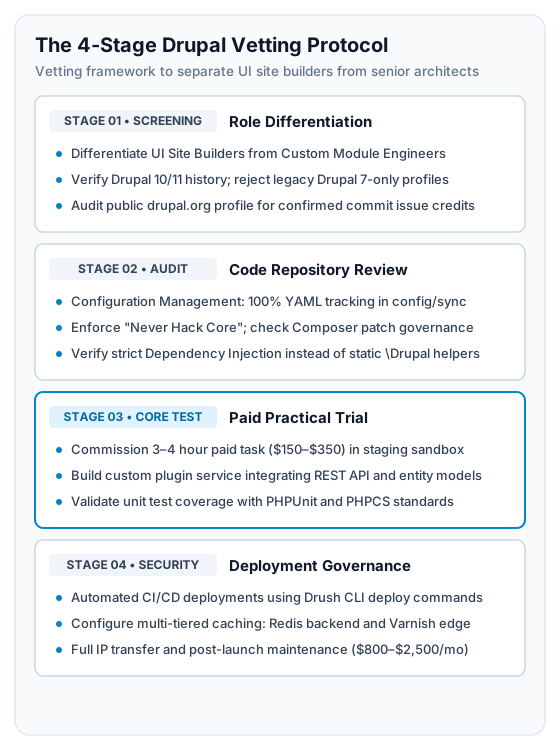
To eliminate unqualified candidates without wasting executive time, execute a structured 4-stage vetting framework that evaluates practical problem-solving, architectural standards, and deployment discipline.
Stage 1: Architectural Alignment & Role Screening
Conduct a focused 30-minute technical screening interview to establish the candidate's operational boundaries. Review their hands-on exposure to Drupal 10 or 11 core architectures and verify whether their past deliverables involved custom module engineering or visual site building. Ask how they coordinate local environments: candidates should describe containerized local setups using DDEV, Lando, or Docker, rather than legacy local stacks like XAMPP or MAMP.
Stage 2: Code Repository & Configuration Audit
Perform a thorough code review of candidate-authored modules and theme files. Verify proper service definitions in *.services.yml, inspect plugin annotations, check schema validation files, and examine whether database queries utilize secure parameterized syntax through the database abstraction layer to prevent SQL injection vulnerabilities.
Stage 3: Paid 3–4 Hour Practical Trial Task
Never rely on abstract theoretical whiteboard questions or unpaid take-home assignments. Commission a paid 3 to 4-hour trial task ($150 to $350) executed in an isolated staging environment or sandbox repository. Provide a concrete engineering objective, such as:
- Constructing a custom Drupal plugin service that consumes an external REST API, parses a JSON payload, and creates or updates a custom taxonomy entity.
- Writing a custom Drush command that validates database record integrity and exports an automated reconciliation report.
- Providing automated test coverage for the custom service using PHPUnit.
Evaluate the submission against an objective pass/fail rubric: Did the candidate structure the module correctly? Are dependencies injected cleanly? Does the code adhere to Drupal coding standards via PHPCS? Is the Git commit history logical and descriptive?
Stage 4: Production Security & Deployment Governance
Finalize the engagement by reviewing operational security and deployment protocols. Establish that all deployments must occur through automated CI/CD pipelines utilizing Drush commands (drush deploy, drush config:import, drush updatedb, and drush cache:rebuild). Ensure the developer is experienced with enterprise caching architectures (Redis or Memcached for object caching, Varnish for reverse-proxy edge delivery) and verify complete intellectual property and repository ownership transfer.
Production Deployment Governance & Post-Launch Maintenance
Maintaining an enterprise Drupal platform requires continuous security vigilance, automated dependency patching, and disciplined infrastructure management. Deploying production changes haphazardly risks catastrophic database downtime.
A properly governed Drupal production environment relies on the following operational foundations:
- Continuous Integration / Continuous Deployment (CI/CD): Code changes committed to the main Git branch must trigger automated linting (PHPCS), security audits via
composer audit, and automated deployment scripts that execute database migrations and configuration imports without human intervention. - Security Advisory Vigilance: The Drupal Security Team releases regular public security advisories on Wednesdays. Retained developers must monitor these notifications and apply critical security patches within 24 to 48 hours to protect infrastructure against automated exploit scripts.
- Caching and Performance Tuning: Large-scale Drupal instances demand multi-tiered caching: internal render caches, page-level caches, Redis for persistent backend caching, and edge CDN integration (Cloudflare, Fastly, or Pantheon Global CDN). Misconfigured cache tags result in database query saturation and degraded server response times.
- Monthly Maintenance Budgets: Expect to allocate between $800 and $2,500 per month for ongoing developer maintenance retainers (covering 10 to 30 engineering hours) to manage module updates, PHP runtime upgrades, database health checks, and minor workflow enhancements.
Frequently Asked Questions About Hiring a Drupal Developer
How much does it cost to hire a Drupal developer?
Hiring a senior independent Drupal developer costs between $45 and $95 per hour, while specialized digital agencies bill between $150 and $250 per hour. On a monthly contract basis (40 hours per week), an experienced solo engineer ranges from $7,200 to $15,200 per month, compared to $24,000 to $40,000+ per month for an agency team.
What is the difference between a Drupal site builder and a Drupal developer?
A Drupal site builder configures websites through the administrative user interface using contributed modules and Views without writing code, whereas a Drupal developer engineers custom Object-Oriented PHP modules, manages Symfony services, and writes custom APIs. Site builders handle basic content layouts and taxonomies ($35–$60/hr), while developers architect custom integrations, enterprise migrations, and high-concurrency systems ($65–$95/hr).
Why is migrating from Drupal 7 to Drupal 10/11 so expensive?
Migrating from Drupal 7 to Drupal 10 or 11 is expensive because it is a complete architectural rebuild rather than an in-place upgrade, requiring custom modules and themes to be rewritten from procedural PHP into Symfony-based OOP code. Migration projects typically require 10 to 24 weeks and cost between $25,000 and $120,000+ depending on database size, taxonomy complexity, and legacy module dependencies.
What happens if our organization stays on Drupal 7 after its end-of-life?
Staying on Drupal 7 after its official end-of-life leaves your infrastructure vulnerable to unpatched security exploits, causes regulatory compliance failures under PCI-DSS or HIPAA, and prevents hosting upgrades to secure PHP runtimes. As community security advisories cease, any newly discovered core vulnerability can be exploited by automated botnets without an official patch.
What core technical skills should a senior Drupal developer have?
A qualified enterprise Drupal developer must demonstrate proficiency in PHP 8.2+, Symfony core components, Object-Oriented programming, Twig theming, Composer dependency management, and Drupal's Configuration Management Initiative (CMI). They should also possess hands-on experience with Drush CLI, Git version control, and containerized local development environments such as DDEV or Docker.
How do you test a Drupal developer during the hiring process?
The most effective way to test a Drupal developer is through an audit of their public Git repositories followed by a paid 3 to 4-hour practical trial task ($150–$350) building a custom plugin service with dependency injection and automated PHPUnit tests. Avoid theoretical whiteboard puzzles; assess whether the candidate follows Drupal coding standards (PHPCS) and avoids hardcoding database queries or configuration values.
What are the biggest red flags when hiring a Drupal developer?
The most dangerous red flags include modifying core or contributed modules directly, altering configuration settings on live production environments instead of using Git-tracked CMI YAML files, and relying exclusively on legacy Drupal 7 experience. Candidates who treat Drupal like WordPress or call procedural static helpers (like \Drupal::service()) instead of using dependency injection should be disqualified.
What is headless Drupal and when should we hire a headless specialist?
Headless Drupal is an architecture where Drupal serves strictly as a backend content repository delivering structured data via JSON:API or GraphQL, while a separate frontend framework (like Next.js or React) renders the user interface. You should hire a headless specialist when you require sub-second page rendering, multi-channel content syndication (mobile apps, web, IoT), or when your team prefers JavaScript frontend frameworks.
How many hours does a typical Drupal migration take?
A typical enterprise Drupal migration requires between 250 and 800 engineering hours, spanning 2 to 6 months depending on data complexity and custom module scope. Standard editorial sites take roughly 200 to 350 hours, while complex corporate or university portals with hundreds of thousands of nodes and custom legacy integrations frequently exceed 600 to 1,000 hours.
How do I verify a candidate's reputation in the Drupal community?
You can verify a candidate's reputation by reviewing their public profile on drupal.org, checking their confirmed commit credits, and inspecting issue queue contributions. Active community members who maintain contributed modules, submit patches, or participate in security reviews possess verified technical expertise that cannot be falsified on a résumé.
How much should we budget for ongoing Drupal website maintenance?
Ongoing Drupal website maintenance typically costs between $800 and $2,500 per month, covering 10 to 30 developer hours for security patches, module updates, database optimization, and minor feature additions. Enterprise platforms with continuous integration pipelines and 24/7 incident response SLAs may require dedicated support retainers between $3,000 and $6,000 per month.
Written by Michael Melnyk
Senior IT Technical Writer & Technology Analyst
Senior Technical Writer and IT Industry Analyst with over 7 years of experience analyzing software engineering ecosystems, tech leadership models, and developer procurement frameworks.