What Is Generative Engine Optimization (GEO)? AI Search Citations, RAG Architecture & LLM Visibility
Learn what Generative Engine Optimization (GEO) is, how Perplexity, ChatGPT, and Google AI Overviews retrieve information, and how to engineer technical architecture for LLM citations.


Generative Engine Optimization (GEO) is the practice of configuring digital content, technical site architecture, and entity authority so that Artificial Intelligence engines—including ChatGPT Search, Perplexity, Google AI Overviews, Claude, and Microsoft Copilot—extract, cite, and recommend your platform in conversational answers. While traditional search engine optimization optimizes for search engine results pages (SERPs) and blue hyperlinks, GEO optimizes for passage-level Retrieval-Augmented Generation (RAG) pipelines, semantic vector retrieval, and Large Language Model (LLM) brand association. Reviewed October 2026. Data points, crawler behaviors, and architectural frameworks below reflect production search standards across North American and European digital markets.
The transition toward generative search represents an architectural shift in how commercial prospects discover products and services. Buyers no longer inspect ten blue links to formulate a vendor shortlist; instead, they query generative search agents with compound, context-rich questions such as "Which technical agency can migrate a high-volume PostgreSQL database with zero downtime?" or "Compare the maintenance costs of custom CRM platforms versus HubSpot Enterprise." If your corporate infrastructure lacks structured semantic data or blocks automated AI crawlers, your brand remains entirely invisible within generated answers. If you are examining your organic search investments, compare budgets in our breakdown of website SEO pricing models, inspect our guide on hiring a technical SEO specialist, or review architectural stability in our website maintenance services.
How Generative Search Engines Retrieve and Synthesize Information
Generative engines do not generate factual answers from static pre-training weights alone; they utilize Retrieval-Augmented Generation (RAG) to fetch live index data, chunk candidate passages into vector embeddings, and re-rank source material before generating a synthesized response with attributed citations. Understanding this multi-step pipeline is essential for positioning technical documentation and commercial content for maximum citation frequency.
When a user submits a natural-language query to an engine such as Perplexity Pro or ChatGPT Search, the engine executes four sequential computational phases:
- Query Intent Decomposition: The model transforms conversational input into 2 to 6 targeted keyword sub-queries. A prompt such as "What does it cost to build a fintech web application with Stripe integration?" triggers separate search sweeps for developer billing rates, compliance timelines, and API integration overhead.
- Live Index Retrieval: The engine issues API queries to underlying web indexes (such as Bing Index for ChatGPT and Copilot, or Google Web Index for Gemini and AI Overviews) to gather the top 20 to 50 relevant document URLs.
- Passage Extraction & Semantic Re-Ranking: Autonomous scraping agents (like
OAI-SearchBotorPerplexityBot) fetch the target HTML documents, strip layout elements, and segment text into discrete semantic chunks of 150 to 400 words. A cross-encoder re-ranking model scores each chunk based on factual density, entity consensus, and direct semantic alignment with the decomposed sub-queries. - Context Injection & Grounded Generation: The top 3 to 8 highest-scoring chunks are injected into the LLM's working context window as grounding reference data. The model generates its narrative synthesis while appending numerical footnote links directly pointing to the source URLs.
Because the LLM context window is strictly limited by token budgets and latency constraints (typically requiring generation within 1.2 to 2.8 seconds), pages structured as rambling personal narratives or buried beneath client-side JavaScript execution barriers are discarded during the re-ranking phase. Generative engines demand immediate, data-dense answers located at the very beginning of DOM sections.
Traditional SEO vs Generative Engine Optimization (GEO): Technical Comparison
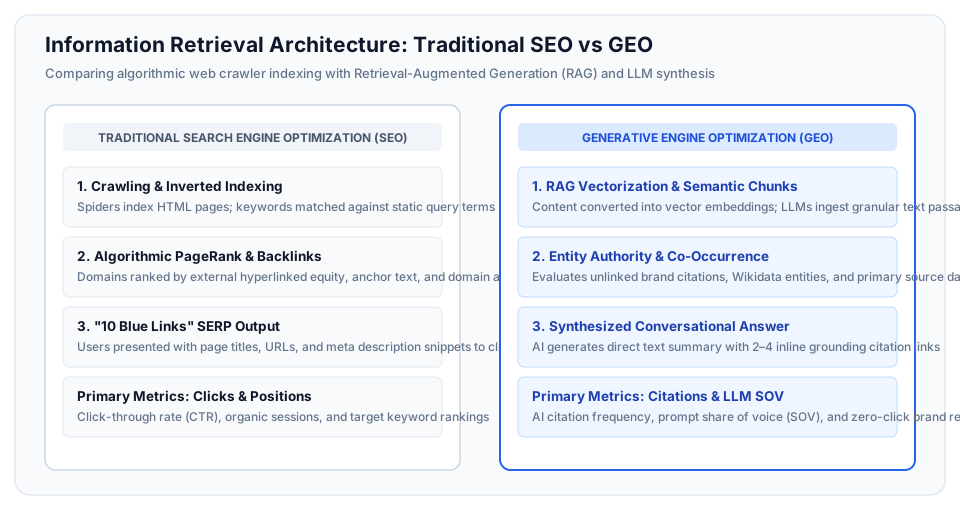
Traditional SEO focuses on domain authority, PageRank hyperlink graphs, and driving click-through volume to individual URLs, whereas GEO focuses on entity confidence, passage extraction, source citation share, and zero-click answer authority. Optimizing for generative visibility requires engineering content for machine parsers and vector embedding models rather than human scanning alone.
| Strategic Dimension | Traditional Search Engine Optimization (SEO) | Generative Engine Optimization (GEO) |
|---|---|---|
| Target Output Format | 10 blue hyperlinks, meta titles, rich snippets, and Google Maps local packs. | Direct conversational answer summaries with 2 to 5 grounding citation reference links. |
| Core Ranking Factor | Backlink equity (PageRank), anchor text distribution, and exact-match keyword placement. | Factual density, entity consensus across third-party sources, and semantic passage chunk relevance. |
| Content Structure Model | Longform skyscraper articles (2,500+ words) designed to retain visitors on-page for advertising impressions. | Inverted-pyramid semantic chunking with immediate quantitative answers in the opening 25% of each heading block. |
| Crawler & Parser Demands | Standard HTML crawlers capable of queued, deferred two-wave headless JavaScript rendering. | High-speed, low-timeout scraping bots requiring fast Server-Side Rendered (SSR) HTML or plain markdown. |
| Primary Success Metrics | Keyword positions (rank 1–10), impressions in Google Search Console, and organic landing page sessions. | Citation frequency, LLM Share of Voice (SOV), prompt recommendation inclusion, and referral conversion rates. |
| User Behavior & Funnel | High-volume top-of-funnel browsing; users evaluate 3 to 6 tabs before discovering relevant documentation. | Direct zero-click factual consumption; referral visitors possess high commercial purchase intent and pre-validated requirements. |
Companies that rely solely on historical SEO strategies face a steady decline in top-of-funnel organic sessions as search engines integrate AI synthesis at the top of the viewport. However, organizations that adapt technical architecture for GEO capture referral visitors who have already completed the preliminary research phase and are actively seeking implementation contractors.
The 5 Core Pillars of Generative Engine Optimization
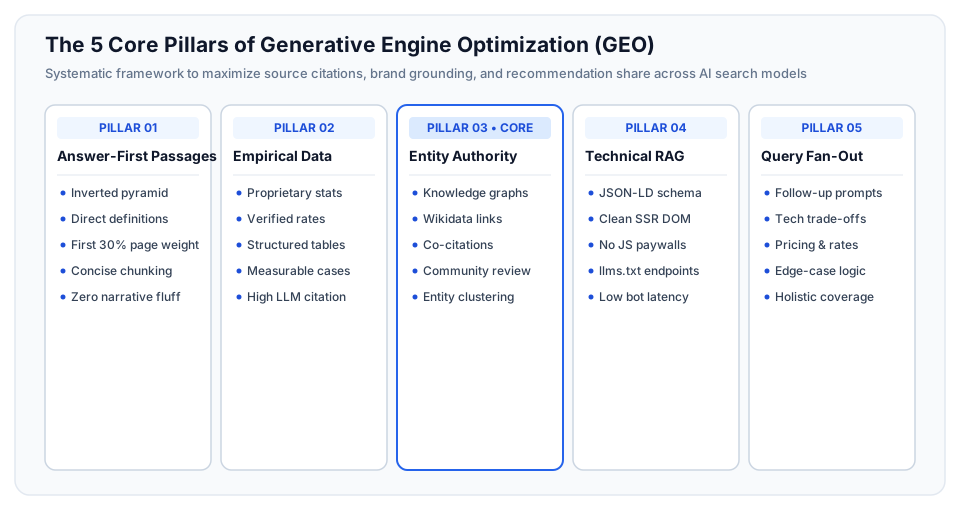
Securing consistent citations across AI platforms requires a structured framework addressing information architecture, data credibility, semantic authority, and bot accessibility. Princeton University researchers, in their foundational benchmark paper on Generative Engine Optimization, demonstrated that systematic content modifications increase generative citation visibility by 30% to 40% compared to standard web copywriting.
Pillar 1: Answer-First Passages & Inverted-Pyramid Chunking
Generative search models favor content formatted according to journalistic inverted-pyramid conventions. Every major content heading (<h2> and <h3>) must open with a direct, assertive answer statement of 30 to 60 words that fully satisfies the heading's implied question without requiring supplementary context. Subsequent paragraphs provide secondary qualifications, methodology details, and specific operational trade-offs.
When an embedding model generates vector representations of a page, text chunks containing complete, standalone factual assertions achieve significantly higher cosine similarity scores against user prompts than paragraphs that rely on introductory pleasantries or rhetorical questions.
Pillar 2: Empirical Data, Original Statistics & Citation Magnets
Large Language Models exhibit a pronounced mathematical bias toward citing sources that supply verifiable numerical benchmarks, concrete financial ranges, explicit timeline estimates, and structured data tables. When multiple web documents discuss a shared topic, the generation model selects the document containing precise figures (such as "$45 to $95 per hour" or "3 to 6 weeks") to ground its statements with high factual confidence.
Publishing proprietary survey data, platform performance telemetry, audited rate benchmarks, and structured comparison tables transforms standard articles into high-probability citation sources for AI knowledge retrieval.
Pillar 3: Entity Authority & Knowledge Graph Footprint
Generative models evaluate brand credibility through entity co-occurrence rather than direct hyperlink anchors alone. If an engineering consultancy claims expertise in PostgreSQL performance optimization, the model verifies whether that brand frequently co-occurs with terms like "database tuning," "connection pooling," and "query indexing" across third-party sources such as GitHub repositories, technical discussions, industry directories, and technical publications.
Establishing clean entity nodes in Wikidata, registering complete structured profiles in authoritative industry registries, and cultivating positive, unlinked brand references across developer communities reinforces the entity association weights stored within LLM vector embeddings.
Pillar 4: Technical Architecture for LLM Crawlers & Headless Parsers
While traditional search engines like Google dedicate substantial compute clusters to rendering complex Single Page Applications (SPAs) through multi-stage Chromium instances, AI search bots operate on stringent timeout thresholds. Scrapers such as PerplexityBot, ClaudeBot, and OAI-SearchBot frequently abort HTTP requests that exceed 2,000 milliseconds or fail to return complete semantic text in the initial HTML payload.
Deploying Server-Side Rendering (SSR) or Static Site Generation (SSG), configuring semantic HTML elements (<article>, <section>, <table>), implementing nested Schema.org JSON-LD microdata, and serving accessible markdown summaries ensures that RAG parsers ingest technical documentation without execution failures.
Pillar 5: Query Fan-Out, Prompt Variations & Conversational Depth
Conversational search operates across multi-turn interactions. A user rarely stops after a single query; they follow up with comparative questions, budget objections, edge-case inquiries, and vendor vetting criteria. Optimizing for generative discovery requires anticipating this "query fan-out" by integrating comparative technical trade-offs, pricing boundaries, migration risks, and implementation checklists within a single topic hub.
When a content hub addresses both high-level economics and granular engineering trade-offs, generative engines select it as a definitive knowledge source capable of grounding multi-turn conversational threads.
Technical Website Architecture for Generative Search Bots
Configuring a web platform for generative search requires eliminating technical bottlenecks that prevent AI indexing bots from accessing and parsing document structures. Implementing the following engineering requirements ensures that your infrastructure facilitates automated AI retrieval.
1. Unrestricted Server-Side Rendered (SSR) HTML
Frameworks that depend exclusively on client-side React, Vue, or Angular rendering introduce fatal indexing risks for generative engines. If the DOM body consists of an empty <div id="root"></div> placeholder awaiting asynchronous bundle downloads and JavaScript execution, AI scraping bots record an empty document and pass to competing sources. Ensure all critical technical copy, pricing tables, and headings are pre-rendered into static HTML on the edge or server before reaching the client.
2. Explicit Schema.org JSON-LD Entities
Structured data provides unambiguous semantic anchors for retrieval algorithms. Rather than relying on natural language parsers to infer relationships, embed detailed JSON-LD graphs defining entity types, authors, software applications, and question-answer pairs:
TechArticle: Declares the engineering topic, peer reviewers, technical dependencies, and publication timestamps.FAQPage: Maps high-intent prompt queries directly to definitive answer strings, facilitating direct excerpt extraction.Organization: Defines official company legal names, founders, service categories, and verified external knowledge profiles (Wikidata, LinkedIn, GitHub).SoftwareApplication: Outlines system requirements, architectural classifications, licensing models, and pricing tiers.
3. robots.txt Configuration for Generative User-Agents
Many organizations inadvertently block generative crawlers by copying restrictive boilerplate robots.txt files intended to prevent content scraping. While blocking model training scrapers may align with internal IP policies, blocking live search agents destroys AI search visibility. Ensure your web server permits access to verified search bots:
OAI-SearchBot: The live search crawler for ChatGPT Search (distinct fromGPTBot, which gathers broad training data).PerplexityBot: The real-time retrieval crawler for Perplexity AI search results.Google-Extended/Googlebot: Google's crawlers powering AI Overviews and Gemini search synthesis.ClaudeBot: The retrieval scraper powering Anthropic's Claude web search capabilities.
4. Markdown Endpoints and the llms.txt Standard
An emerging standard among technical web platforms is the deployment of an /llms.txt file located at the domain root. Inspired by robots.txt, this file serves as a structured markdown index directing LLMs to clean, plaintext documentation summaries without navigation boilerplate, cookie banners, or heavy HTML layout wrappers. Providing token-efficient markdown representations reduces parsing latency and dramatically increases the probability of source citation during live RAG retrieval.
Commercial GEO Implementation: Budgets, Rates, and Timelines
Implementing a dedicated Generative Engine Optimization program typically costs between $3,500 and $15,000 for technical architectural remediation, or $45 to $95 per hour when contracting specialized senior technical writers and full-stack engineers. Commercial pricing varies based on existing frontend rendering architecture, technical debt, and domain authority.
| Implementation Phase | Commercial Scope & Deliverables | Typical Timeline | Standard Budget Range |
|---|---|---|---|
| Technical RAG Audit & SSR Remediation | Server-side rendering migration, Core Web Vitals optimization, crawler accessibility audits, and JSON-LD entity graph deployment. | 2 to 4 weeks | $2,500 – $6,000 |
| Content Restructuring & Chunk Optimization | Rewriting top commercial landing pages into answer-first inverted pyramid passages, embedding empirical data tables, and eliminating conversational fluff. | 3 to 6 weeks | $3,000 – $7,500 ($45–$95/hr) |
| Entity Footprint & Knowledge Graph Expansion | Wikidata alignment, authoritative industry directory synchronization, and digital PR placements targeting high-authority technical communities. | 4 to 8 weeks | $2,000 – $5,000 |
| Ongoing LLM Citation Monitoring & Prompt Tracking | Weekly tracking of brand citation frequency across ChatGPT, Perplexity, and Google AI Overviews; competitive share-of-voice analysis. | Monthly ongoing | $1,500 – $3,500/month |
Engaging direct senior technical specialists who can directly modify production Next.js, Remix, or Astro codebases eliminates agency overhead while ensuring that structured data and server-rendered components deploy without communication latency.
Measuring Success: Generative Visibility Metrics and Tracking
Tracking the return on investment of GEO requires shifting from conventional position tracking to monitoring citation frequency, prompt share of voice, and high-intent referral conversions. Because generative search answers vary based on user context and personalization, organizations must deploy specialized monitoring practices.
- Citation Frequency (CF): The percentage of target industry prompts in which your domain appears as a numbered footnote or grounding link across test query sweeps in Perplexity, ChatGPT Search, and Google AI Overviews.
- Prompt Share of Voice (SOV): The proportion of brand recommendations your platform receives relative to direct competitors when users ask open-ended commercial questions (e.g., "What are the best boutique engineering consultancies for React Native development?").
- Referral Conversion Rate (RCR): Direct conversion tracking from AI search referrer headers (such as
chatgpt.com,perplexity.ai, orclaude.ai). Commercial data indicates that AI search visitors convert at 2.5x to 4x the rate of standard organic search visitors due to their pre-qualified commercial intent. - Sentiment and Context Alignment: Evaluating whether the generative engine presents your brand as an industry authority, an expensive enterprise solution, or a niche technical specialist within synthesized recommendations.
Frequently Asked Questions About Generative Engine Optimization (GEO)
What is the difference between SEO and GEO?
Traditional SEO optimizes websites to rank in search engine results pages (SERPs) across 10 blue links, whereas GEO optimizes content and technical architecture to be extracted, synthesized, and cited within AI-generated conversational answers. SEO focuses on backlinks, domain authority, and keyword density; GEO focuses on factual density, inverted-pyramid passage chunking, entity co-occurrence, and clean server-rendered HTML for RAG pipelines.
Which AI search engines does Generative Engine Optimization target?
Generative Engine Optimization primarily targets ChatGPT Search (OpenAI), Perplexity AI, Google AI Overviews, Microsoft Copilot, and Claude Web Search. Each platform uses automated web scrapers to gather real-time index data, breaks documents into semantic vector chunks, and generates synthesized summaries with direct citation links to source domains.
Does Generative Engine Optimization replace traditional SEO?
No, GEO does not replace traditional SEO; it builds directly upon sound technical SEO fundamentals while adapting content structure for AI vector retrieval. Generative search engines still rely on primary search indexes (such as Bing and Google) to identify candidate URLs before applying RAG extraction. Maintaining strong crawlability, indexability, and site performance remains mandatory.
How much does it cost to implement Generative Engine Optimization?
A dedicated GEO implementation typically costs between $3,500 and $15,000 for initial technical and content remediation, or $45 to $95 per hour when hiring specialized technical contractors. Ongoing monthly monitoring, prompt tracking, and entity expansion retainers range from $1,500 to $3,500 per month.
Why do JavaScript-heavy single page applications struggle with GEO?
JavaScript-heavy SPAs struggle with GEO because AI retrieval scrapers (such as PerplexityBot and OAI-SearchBot) operate on strict HTTP timeout limits (under 2,000 milliseconds) and frequently do not execute client-side JavaScript. If your server sends an empty HTML shell awaiting client-side script execution, AI bots read an empty document and discard your domain during the semantic re-ranking phase.
What is an Answer-First passage structure?
An Answer-First passage structure is a copywriting methodology where the first 1 to 2 sentences of every heading block deliver a direct, conclusive answer containing verifiable facts, dollar amounts, or technical specifications. This structure mirrors journalistic inverted-pyramid writing and maximizes the cosine similarity score between user prompts and your content chunks during vector database retrieval.
How do Large Language Models choose which sources to cite?
Large Language Models choose sources based on semantic relevance to the query, empirical data density (statistics, rates, tables), entity authority across third-party sources, and document parsing speed. In academic benchmarks from Princeton University, incorporating verified numerical benchmarks and authoritative citations increased LLM citation probability by 30% to 40%.
What is the llms.txt standard and does my site need one?
The llms.txt standard is a proposal to place a structured markdown file at your domain root (e.g., example.com/llms.txt) that provides LLMs with concise, token-efficient summaries of your core documentation and commercial offerings. While not yet an official W3C web standard, adopting llms.txt significantly improves the speed and accuracy with which AI search agents ingest your platform's core entities.
Should I block AI crawlers in my robots.txt file?
You should not block real-time search crawlers such as OAI-SearchBot or PerplexityBot if you want your business to be discovered and cited in AI search results. While some organizations choose to block broad model training scrapers (such as GPTBot or CCBot) to protect intellectual property, blocking search retrieval bots guarantees total commercial invisibility within AI conversational queries.
How do you track traffic and conversions from generative search engines?
Traffic from generative engines is tracked in web analytics platforms by monitoring referral domains such as chatgpt.com, perplexity.ai, and android-app://com.perplexity.app, alongside custom UTM parameters. Furthermore, organizations track citation frequency and prompt share of voice using automated synthetic prompt monitoring tools.
How quickly do GEO optimizations produce citation results?
Technical GEO enhancements (such as migrating to SSR and adding structured JSON-LD data) can produce noticeable citation improvements within 2 to 4 weeks once AI scrapers re-index your pages. However, building deep entity authority across third-party knowledge bases and developer communities typically requires 2 to 4 months of consistent technical execution.
Written by Michael Melnyk
Senior IT Technical Writer & Technology Analyst
Senior Technical Writer and IT Industry Analyst with over 7 years of experience analyzing software engineering ecosystems, tech leadership models, and developer procurement frameworks.