Hire a Part-Time Senior AI Engineer for Startup
Early-stage startups needing production AI capabilities can engage senior engineering talent on a 10–20 hour weekly retainer, avoiding six-figure full-time burn while shipping reliable RAG, agents, and evaluations.

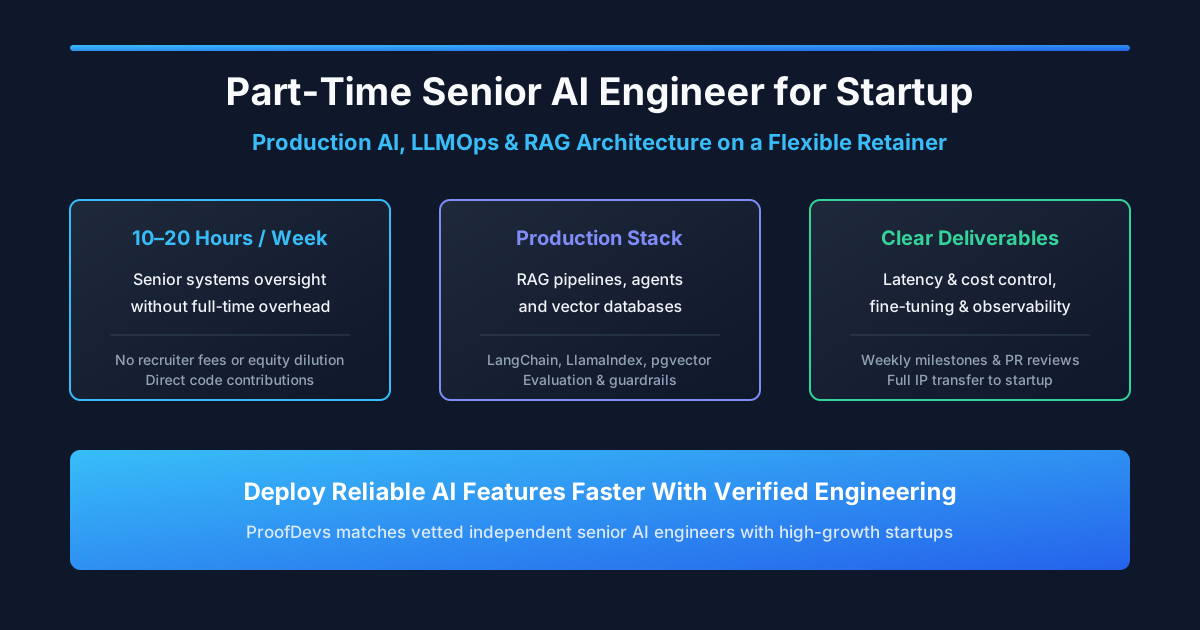
Building artificial intelligence into a startup product in 2026 rarely requires a full-time machine learning research department. Most software businesses do not train proprietary foundational models from scratch. Instead, their competitive advantage comes from connecting powerful foundation models to domain-specific business data, building resilient orchestration workflows, maintaining deterministic outputs, and operating low-latency data pipelines at predictable unit economics. For an early-stage company with limited runway, hiring a full-time senior artificial intelligence engineer at a $200,000 to $300,000 annual package—plus significant equity and extensive search time—is often premature and financially risky.
Engaging an experienced senior engineer on a dedicated part-time basis—typically 10 to 20 hours per week—bridges the capability gap. It provides immediate technical direction, infrastructure design, and direct code commits without draining seed capital. Rather than collecting theoretical advice, founders get production-grade implementations: hybrid retrieval-augmented generation systems, structured tool-calling agents, evaluation test harnesses, and automated observability.
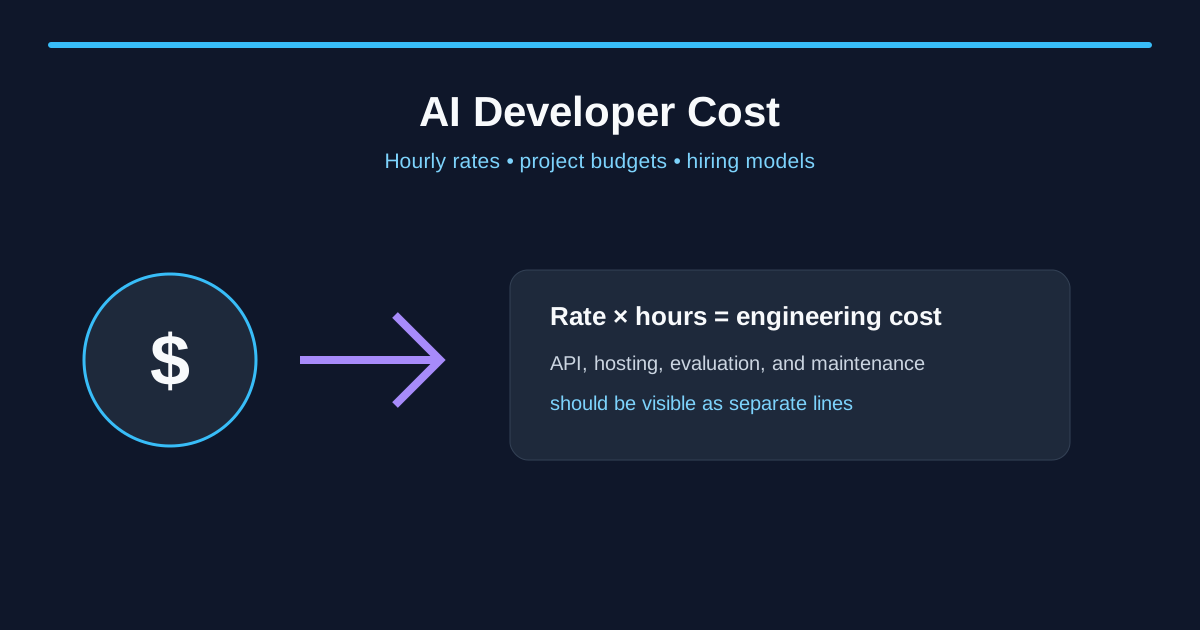
For planning ranges, see AI developer hourly rates and project costs, including separate lines for engineering, model usage, hosting, evaluation, and maintenance.
The Shift from Prompt Prototypes to Production AI
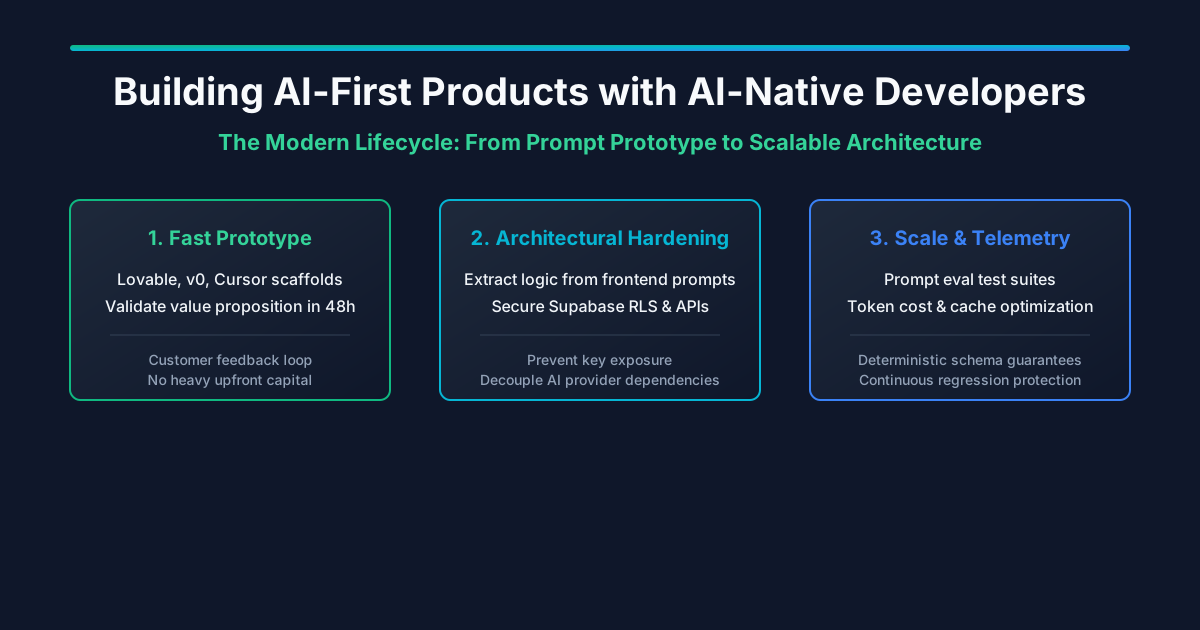
The barrier to generating a proof-of-concept AI application has dropped to near zero. A non-technical founder or junior developer can construct a demonstration using consumer tools or web-based UI builders within an afternoon. However, the operational gap between an internal prototype and software capable of serving paying enterprise customers is enormous. Prototypes fail when exposed to untrusted user input, unformatted data, unpredictable latency, API rate limits, and contextual drift.
A senior artificial intelligence engineer designs the software harness that surrounds the language model. When a prototype moves into customer hands, the primary challenges transition from prompt wording to systems engineering:
- Deterministic output validation: Ensuring the model produces structured JSON adhering strictly to schemas defined by Pydantic or Zod, allowing downstream APIs to consume responses safely.
- Context window efficiency: Preventing cost escalation by implementing semantic caching, dynamic token routing, and payload compaction.
- Defensive failure handling: Designing automated fallbacks between primary foundation models and secondary providers when cloud outages or rate limit spikes occur.
- Security and isolation: Defending applications against prompt injection attacks, sensitive information leakage, and unauthorized database access.
Startups utilizing our AI native developer directory routinely discover that senior developers identify architectural flaws within the first week of engagement. If you are still defining the role, start with our AI-native developer definition and hiring guide. Addressing these foundational elements early prevents catastrophic operational failures when user traffic scales.
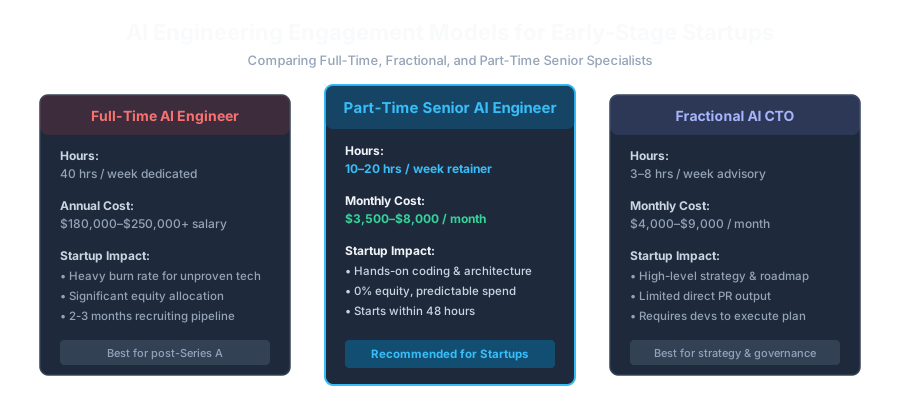
Comparing Part-Time Engineers, Full-Time Hires, and Fractional CTOs
Determining which technical arrangement best matches your current stage depends on whether your immediate bottleneck is high-level corporate governance, continuous product maintenance, or targeted systems delivery. Conflating these responsibilities leads to mismatched expectations and wasted capital.
| Dimension | Part-Time Senior AI Engineer | Full-Time Senior AI Engineer | Fractional AI CTO |
|---|---|---|---|
| Weekly Commitment | 10 to 20 hours per week | 40 hours per week | 3 to 8 hours per week |
| Typical Monthly Cost | $3,500 – $8,000 / month | $16,000 – $25,000+ / month | $4,000 – $9,000 / month |
| Equity Requirement | 0% (Pure cash contract) | 0.5% – 2.5% equity | 0.25% – 1.0% (optional) |
| Primary Output | Production code, pipelines, pull requests | Comprehensive product development | Roadmap, team hiring, vendor audits |
| Onboarding Speed | Immediate (24–48 hours) | 60–90 days recruiting cycle | 1–2 weeks |
| Best Fit Stage | Pre-seed, Seed, Bootstrapped MVP | Post-Series A, Scaling platform | Pre-seed strategy & diligence |
A fractional CTO advises leadership on technology strategy, evaluates vendors, and prepares technical documentation for venture capital due diligence, but rarely writes backend business logic or tunes vector database queries. Conversely, a full-time employee represents an ongoing commitment that demands continuous feature work to justify the expense. A part-time senior specialist provides the optimal middle ground: direct, hands-on engineering that ships production code while maintaining budgetary flexibility.
Core Technical Responsibilities of a Senior AI Engineer
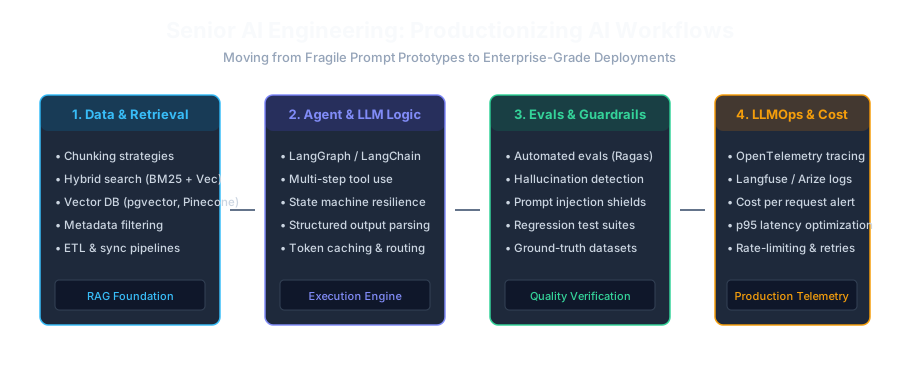
When contracting a part-time engineer, founders must establish explicit technical milestones. A senior practitioner focuses on four core domains that directly impact platform reliability and unit economics.
1. Retrieval-Augmented Generation (RAG) Architecture
Naive RAG implementations dump raw PDF documents into an embedding model and query a vector store using simple cosine similarity. In production, this produces irrelevant context, hallucinations, and high latency. A senior engineer designs advanced ingestion and retrieval pipelines:
- Hierarchical text chunking based on document structure rather than arbitrary character counts.
- Hybrid search combining traditional sparse keyword indexing (BM25) with dense vector representations using PostgreSQL and pgvector.
- Cross-encoder reranking layers that evaluate the top twenty retrieved documents to surface only the most accurate context fragments to the prompt.
- Metadata filtering ensuring multi-tenant data isolation so one user's prompt never queries another organization's proprietary database records.
2. Resilient Agent Workflows and State Machines
Single-prompt interactions fail when tasks require multiple steps, external API integrations, or real-time human approval. Senior developers implement deterministic state machines using orchestration frameworks such as LangGraph or custom execution loops:
- Explicit state persistence allowing long-running workflows to pause, wait for external webhooks, and resume without data loss.
- Idempotent tool execution preventing duplicate credit card charges or repeated database writes if a model retries an action.
- Structured error handling when third-party software APIs return validation errors or unexpected payloads.
3. Automated Evaluation Frameworks
You cannot improve software you cannot measure. Relying on visual inspections of model output is the most common reason AI startups experience sudden performance regressions after changing prompts or updating model versions. A senior engineer establishes synthetic and ground-truth evaluation pipelines:
- Continuous regression testing measuring context recall, faithfulness, and answer relevance across standardized test suites.
- Automated guardrail systems that scan outgoing tokens for hallucinations, sensitive credentials, or toxic language before rendering responses in client interfaces.
- Pre-deployment benchmarking comparing response latency and output quality across multiple model tiers (e.g., lightweight extraction models versus heavyweight reasoning models).
4. LLMOps, Observability, and Unit Economics
Uncontrolled token consumption can quickly ruin a startup's gross margins. Senior engineers implement deep instrumentation using tools like Langfuse, Arize Phoenix, or OpenTelemetry:
- Per-request cost tracing attributing token expenditure directly to individual user accounts or internal features.
- Tail latency optimization (p95 and p99) utilizing asynchronous streaming architectures in Python FastAPI or Node.js.
- Semantic caching mechanisms in Redis or Supabase, eliminating redundant calls for identical user queries.
Vetting Candidates: Separating Practitioners from Prompt Enthusiasts
The sudden expansion of generative artificial intelligence has led many generalist software developers to rebrand themselves as AI engineers after completing basic API tutorials. Hiring managers must distinguish between candidates who merely paste API keys into simple wrappers and engineers who understand distributed systems, data modeling, and failure modes.
Key Interview Questions and Evaluation Criteria
Question 1: "How do you systematically detect and prevent hallucinations in our RAG pipeline?"
Weak answer: "I write better system prompts telling the AI to only answer from the context and never lie."
Senior answer: "Prompt constraints alone are insufficient. We implement a three-tier defensive strategy: first, we enforce strict retrieval reranking and set minimum relevance thresholds; second, we run an automated evaluation layer that compares model assertions directly against source citation spans; third, if source confidence is low, the orchestration workflow triggers an explicit refusal branch rather than invoking generation."
Question 2: "Our user queries take seven seconds to complete. How do you reduce that latency?"
Weak answer: "We should switch to a smaller, faster model or ask the AI to write shorter responses."
Senior answer: "We decompose the request pipeline. We stream the initial tokens immediately so the user perceives immediate response time. Concurrently, we evaluate whether semantic caching can resolve repetitive queries from memory. For multi-step tasks, we parallelize non-dependent tool calls using asynchronous concurrency, and route extraction tasks to specialized smaller models while reserving larger reasoning models exclusively for synthesis."
Question 3: "How do you protect our system from indirect prompt injection when parsing user-uploaded documents?"
Weak answer: "I sanitize the user input by stripping special characters."
Senior answer: "Untrusted document content must be isolated from the system prompt instruction space. We use separate model passes: an isolated extraction worker converts raw text into rigid JSON according to a strict schema, completely disallowing executable commands or instruction overrides. The primary agent only interacts with the validated data structure, never with the raw, potentially malicious document text."
Structure of a 15-Hour Weekly Engagement
A part-time collaboration requires discipline to prevent fragmented communication. When an engineer commits 15 hours per week, unstructured ad-hoc meetings consume productive output. A structured cadence ensures steady velocity:
- Monday Alignment (30 minutes): Review preceding performance metrics, clarify current weekly sprint goals, and verify access prerequisites.
- Deep Work Blocks (12–13 hours): Autonomous engineering focus dedicated to writing code, setting up database migrations, configuring infrastructure, and submitting pull requests.
- Async Code Review & Handover (1.5 hours): Providing detailed PR walkthroughs, recording brief implementation videos, and documenting operational runbooks for the startup's team.
Our practical experience helping founders hire flexible developers confirms that asynchronous documentation and automated continuous integration pipelines allow part-time talent to ship software at comparable speeds to unfocused full-time teams.
Budgeting and Compensation Guidelines
Part-time senior artificial intelligence engineers typically operate on either an hourly billing schedule or a fixed monthly retainer. Transparent market pricing generally follows these ranges:
- Senior US/Western European Specialists: $100 to $175 per hour. On a 15-hour weekly retainer, expect monthly expenditure between $6,000 and $10,500.
- Senior Eastern European & LATAM Specialists: $60 to $95 per hour. On a 15-hour weekly retainer, expect monthly expenditure between $3,600 and $5,700.
In contrast to full-time employment, contract arrangements eliminate payroll taxes, medical benefits, hardware allowances, and recruiter fees (which typically average 20% to 25% of first-year base salary). Contracts should specify two-week notice periods and bi-weekly billing intervals tied to verified deliverables.
Frequently Asked Questions
Can a part-time AI engineer build an entire startup product from scratch?
No. A part-time senior engineer excels at building specialized AI subsystems, architecture, retrieval pipelines, and backend logic. They should collaborate with your existing full-stack developers or frontend specialists who handle user interfaces, customer billing, and account settings.
How quickly can a part-time senior AI engineer start?
Verified independent contractors on ProofDevs typically integrate into customer repositories and start contributing code within 24 to 48 hours following scope confirmation, bypassing conventional multi-month recruitment delays.
What intellectual property protections apply to part-time contract work?
Standard professional contracts mandate complete, immediate intellectual property assignment. Every line of code, prompt template, evaluation harness, and architecture diagram created during the engagement becomes the exclusive property of your startup.
When should a startup transition from part-time to a full-time hire?
Transition to a full-time engineer when your core AI feature has established clear product-market fit, daily customer traffic demands constant model fine-tuning and operational maintenance, and the company has closed institutional funding capable of supporting long-term payroll.
How do we measure output when an engineer works only 10 to 15 hours weekly?
Track tangible engineering artifacts: merged pull requests, test coverage scores, reduction in average token costs, decreased p95 API response times, and validated evaluation benchmark reports.
Does our startup need proprietary fine-tuned models immediately?
Rarely. In over 90% of early-stage software use cases, well-architected retrieval pipelines, thoughtful chunking strategies, and targeted few-shot prompt engineering outperform premature fine-tuning while costing significantly less to build and maintain.
Can a part-time engineer audit our existing AI prototype?
Yes. Many founders engage a senior specialist for an initial 20-hour technical audit to inspect prompt vulnerabilities, identify database indexing bottlenecks, and establish production readiness before launching to customers.
What tools and technologies should a qualified candidate know?
A qualified candidate must demonstrate expertise in Python, PostgreSQL (specifically pgvector), LangChain or LangGraph, LlamaIndex, evaluation suites (such as Ragas), vector databases, and observability platforms (like Langfuse or Arize).
How does a part-time AI engineer handle production outages outside working hours?
Part-time contractors focus on planned development and architectural hardening rather than 24/7 on-call monitoring. They build automated fallback mechanisms, rate limit handlers, and alerting integrations that keep services operational without requiring constant manual intervention.
Is equity compensation expected for part-time engineering roles?
No. Part-time senior engineers are compensated through cash hourly rates or monthly retainers. This preserves your cap table and equity pool for permanent founders and future full-time employees.
Accelerate Your AI Roadmap With Verified Engineering Talent
Shipping dependable artificial intelligence features does not require depleting your startup's bank account on permanent executive salaries. By securing senior engineering expertise on an agile part-time basis, you gain the technical rigor necessary to move beyond simple prototypes and deploy enterprise-grade software to your customers.
If your startup is preparing to build, optimize, or scale production AI capabilities, submit your project requirements on ProofDevs. We review your architectural scope and match you directly with vetted senior engineers ready to contribute to your codebase.
Written by Michael Melnyk
Senior IT Technical Writer & Technology Analyst
Senior Technical Writer and IT Industry Analyst with over 7 years of experience analyzing software engineering ecosystems, tech leadership models, and developer procurement frameworks.