
How to Hire an English–Ukrainian Translator: Document Types, Localization QA, and Rates
A cheap bilingual quote can still fail when a legal term, product string, or live meeting needs the right register. Use this hiring checklist to match English–Ukrainian work to the right specialist, price the scope, test quality, and protect confidential files.


To hire an English–Ukrainian translator, first define the deliverable, audience, direction, and risk level, then compare specialists using a short paid sample. A general translator may be suitable for internal correspondence, while a legal document, software interface, product launch, or live meeting needs a specialist with different evidence and quality controls.
The language pair alone does not tell you whether a candidate is right. English-to-Ukrainian and Ukrainian-to-English work can require different native-language strengths, terminology, and review processes. The practical hiring question is not “Does this person speak both languages?” It is “Can this person produce the exact output my audience will trust, in the required format and under the required deadline?”
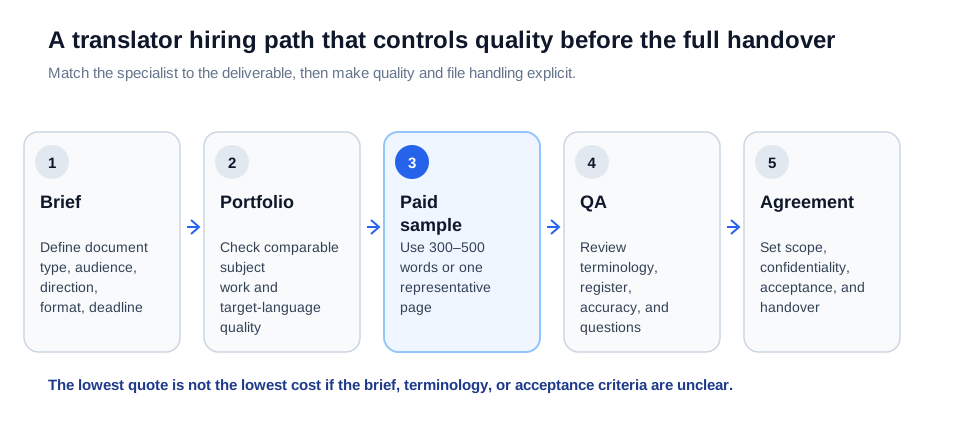
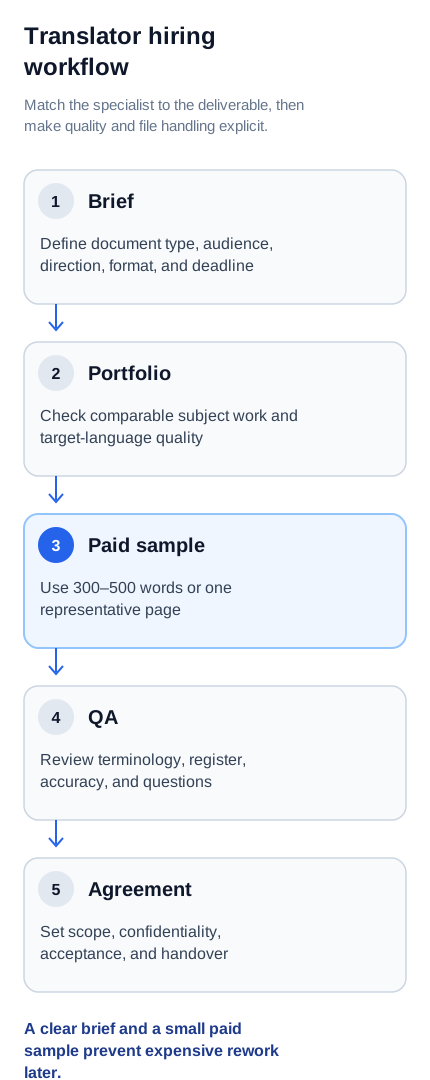
Figure 1: A short, paid evaluation gives better evidence than a generic claim of fluency.
What an English–Ukrainian Translator Actually Does
A translator converts written content, an interpreter works with spoken communication, and a localization specialist adapts content to the expectations of a Ukrainian or English-speaking market. One person may cover more than one role, but the evidence you should request changes with the assignment.
- Written translation: contracts, policies, reports, product documentation, correspondence, and other source files.
- Localization: websites, applications, onboarding, product pages, campaigns, support content, and interface strings where tone and local conventions affect conversion or trust.
- Proofreading and editing: correcting a translation supplied by another person or reviewing machine-assisted output against the source.
- Consecutive interpreting: translating after each speaker segment in a meeting, interview, appointment, or negotiation.
- Simultaneous interpreting: delivering the target language while the speaker continues, usually for conferences or larger events with specific preparation needs.
Do not describe live interpreting as “translation for a call” and expect comparable quotes. Interpreting is priced around time, preparation, subject matter, format, and sometimes equipment. Written translation is usually priced around source volume, language direction, complexity, deadline, and review scope.
Start With the Deliverable, Not the Language Pair
The deliverable determines the specialist you need. A short email and a certified birth certificate may use the same language pair but have different acceptance criteria, turnaround risk, and consequences of an error.
| Deliverable | Specialist profile | Evidence to request | Main hiring risk |
|---|---|---|---|
| General business text | Experienced written translator with strong target-language editing | Comparable samples, turnaround, revision policy | Correct words but unnatural tone |
| Legal or official document | Legal translator who understands certification and document conventions | Relevant document types, certification boundaries, confidentiality process | Incorrect legal meaning or unusable certification |
| Website or product localization | Localization specialist with UX, marketing, and terminology experience | Interface or landing-page samples, glossary approach, review workflow | Literal text that damages usability or conversion |
| Technical documentation | Translator familiar with the product domain and terminology management | Technical portfolio, terminology questions, source-file handling | Inconsistent terms that confuse users or support teams |
| Subtitles or video | Translator or subtitler who can control timing, length, and spoken tone | Timed sample, subtitle format experience, editing workflow | Readable translation that does not fit the spoken pace |
| Meeting or negotiation | English–Ukrainian interpreter with subject-matter preparation | Interpreting experience, preparation requirements, availability | Missed nuance, delay, or inability to handle specialist vocabulary |
When You Need a Specialist Instead of a Generalist
Hire a specialist when an incorrect phrase can create legal exposure, product confusion, reputational damage, or a failed commercial conversation. For low-risk internal text, a capable generalist may be enough. For high-risk content, domain familiarity matters more than a long list of language pairs.
Ask the translator to explain how they would handle terminology before asking for a price. A good answer identifies ambiguous source terms, asks who will read the result, and separates a direct translation from a market adaptation. A weak answer promises that every phrase will be translated “word for word” without discussing context.
- Legal: contracts, court materials, immigration documents, compliance policies, and powers of attorney.
- Medical: patient-facing instructions, clinical materials, and documents where a terminology error can affect care.
- Finance: investor communication, financial reporting, payment terms, and regulated disclosures.
- Technology: product interfaces, API documentation, cybersecurity content, and support knowledge bases.
- Marketing: campaigns where a literal translation may preserve grammar but lose cultural meaning, persuasion, or brand voice.
How Much Does an English–Ukrainian Translator Cost?
Indicative market prices range from about $15–$25 per hour for Ukrainian-to-English marketplace profiles in Ukraine, broader marketplace listings around $30–$70 per hour, and roughly €0.04–€0.06 per word for written translation from a Ukrainian agency. These are reference points, not a guaranteed quote: language direction, subject, volume, urgency, certification, and review requirements can move the price substantially.
| Pricing basis | Indicative reference | Best for | What changes the quote |
|---|---|---|---|
| Hourly freelance translation | $15–$25/hr for Ukraine-based Ukrainian-to-English profiles on Upwork; broader marketplace listings may show $30–$70/hr on Guru | Unclear source volume, editing, calls, or mixed tasks | Specialization, native editing, rush work, minimum charge |
| Per-word written translation | €0.04–€0.06/word is an indicative range published by Verbum | Stable text volume with a defined source file | Topic, language direction, formatting, repetition, certification |
| Per-character or agency quote | MovaPro lists English translation from 300 UAH per 1,800 characters; its published page was updated July 3, 2026 | Local document workflows and predictable source formats | Certification, urgency, layout, stamps, terminology, delivery format |
| Consecutive interpreting | €20–€35/hr in the Verbum reference range | Meetings, interviews, appointments, negotiations | Preparation, minimum booking, subject, location, travel |
| Simultaneous interpreting | €25–€50/hr in the Verbum reference range | Events where speakers cannot pause for interpretation | Preparation, team size, equipment, event format, specialist subject |
Use these figures as a way to spot an unexplained quote, not as a rule that every translator must follow. A very low rate may exclude proofreading, formatting, certification, or revision. A higher rate may include a second reviewer, a terminology database, urgent scheduling, or experience in a regulated field.
What Belongs in the Total Cost?
The translation fee is only one part of the budget when the project includes review, localization, certification, or live communication. Ask for the quote to separate the work that creates the target-language text from the work required to make it usable.
- Source preparation: cleaning files, removing duplicate content, confirming missing context, or extracting text from scans.
- Translation: producing the first target-language version in the agreed direction.
- Editing or proofreading: checking meaning, register, grammar, terminology, and consistency.
- Localization: adapting calls to action, dates, currency, examples, interface limits, or cultural references.
- Certification: preparing or arranging a certified translation where the receiving institution accepts that form.
- Formatting: returning a document that preserves tables, headings, layout, captions, and file conventions.
- Ongoing maintenance: updating a glossary or translation memory as a product, policy, or website changes.
Machine translation or AI assistance can reduce the time for a first pass on low-risk content, but it does not remove the need for a qualified human review when meaning, privacy, brand voice, or legal effect matters. Confirm whether the contractor will use external tools and whether confidential material may be submitted to them.
How to Write a Translation Brief That Produces Comparable Quotes
A useful brief makes at least five quotes comparable: source language, target language, content type, volume, and acceptance criteria. Send the same brief to every candidate and ask each person to flag assumptions before pricing.
- Language direction: state English to Ukrainian, Ukrainian to English, or both.
- Audience: identify customers, employees, a government office, legal counsel, patients, developers, or event attendees.
- Content type: name the document, product, domain, and intended channel.
- Volume: provide word count, character count, page count, video duration, or meeting hours.
- Source quality: disclose scans, screenshots, tracked changes, inconsistent terminology, or missing context.
- Reference material: include a glossary, previous approved translations, brand guidance, or examples of preferred tone.
- Deadline: include the final delivery date and whether partial delivery is acceptable.
- Review: specify whether you need translation only, proofreading, bilingual QA, or a second reviewer.
- Confidentiality: explain NDA, retention, storage, and external-tool requirements before sending sensitive files.
- Acceptance: define who approves the work, how revisions are requested, and what counts as a material error.
How to Screen an English–Ukrainian Translator’s Portfolio
Screen for relevant output, not the number of years or the number of language pairs on a profile. A candidate who has translated ten unrelated subjects may be less useful than one who has handled three comparable documents in your domain.
Ask for two or three redacted samples that match the assignment. For a website, review a landing page or onboarding flow. For legal work, ask which document types the translator knows and which certification steps they do not provide. For a meeting, ask how much preparation they require and whether they can work with an agenda and glossary in advance.
- Does the target-language text sound written for the reader, rather than mechanically converted?
- Are terms used consistently across headings, labels, tables, and repeated phrases?
- Can the translator explain a difficult choice without hiding behind “that is how the dictionary says it”?
- Does the sample preserve names, numbers, units, dates, negations, and the intended level of certainty?
- Does the candidate ask useful questions about audience, purpose, and source ambiguity?
Use a Small Paid Translation Trial
A paid trial of roughly 300–500 words or one representative page is enough to compare candidates without asking them to complete your project for free. Choose a passage that contains the same terminology, tone, or formatting challenge as the real assignment.
Pay for the sample and tell the translator how it will be assessed. Ask for the target text plus a short note about ambiguous source phrases and terminology choices. Do not grade only grammar: a fluent result that changes the meaning is a failure, while a candidate who flags an unclear source phrase may be showing exactly the judgment you need.
| Trial criterion | Pass signal | Warning signal |
|---|---|---|
| Meaning | Facts, conditions, omissions, and emphasis are preserved | Translation sounds fluent but changes a limitation or promise |
| Terminology | Terms follow the supplied glossary and candidate’s stated choices | One concept appears under several unrelated names |
| Register | Formal, conversational, technical, or marketing tone matches the brief | One generic tone is applied to every sentence |
| Judgment | Ambiguities are identified with practical questions | Candidate silently guesses or asks no questions on unclear text |
| File discipline | Names, layout, labels, and requested format are preserved | Important structure or comments disappear in delivery |
Quality Assurance for English–Ukrainian Work
Quality assurance should check meaning, terminology, target-language naturalness, and delivery format as separate risks. Reading the final text once for spelling is not enough for legal documents, public product copy, or technical content.
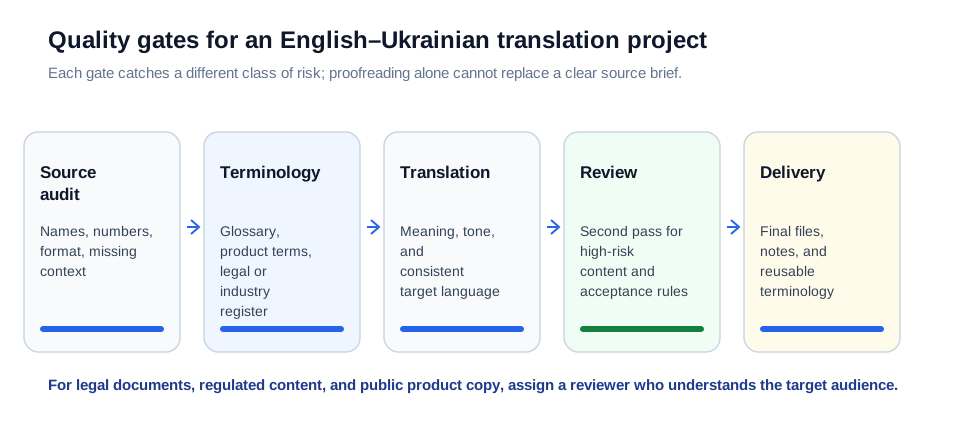
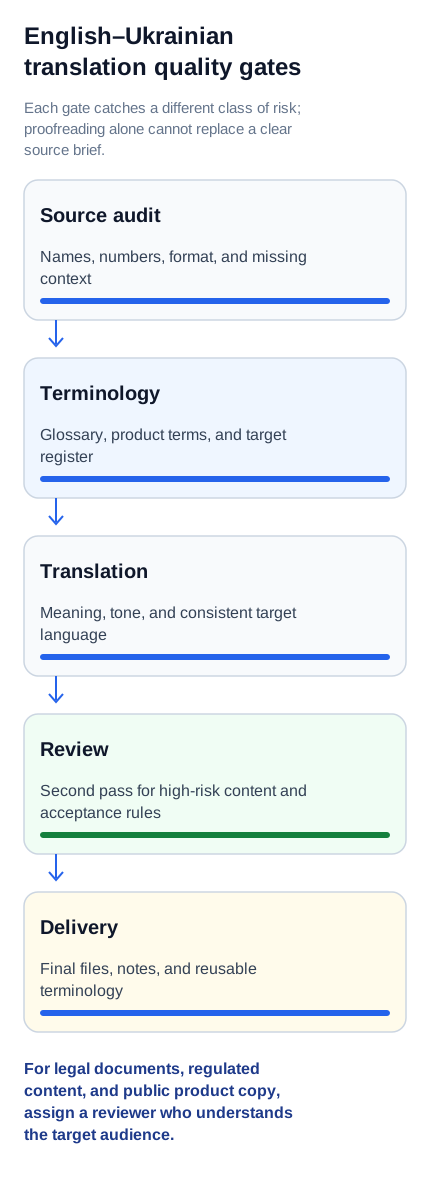
Figure 2: Separate source, terminology, translation, review, and handover checks reduce different failure modes.
For higher-risk work, use a second reviewer who is qualified in the target language and understands the subject. A back-translation can reveal omissions during an audit, but it is not a substitute for natural target-language editing. It can also introduce a second layer of interpretation if treated as the only quality test.
Written Translation, Localization, or Interpreting?
Choose written translation for a durable document, localization for content that must persuade or function in a market, and interpreting for a live exchange. If the contractor’s proposal uses one undifferentiated price for all three, ask what is included.
| Need | Choose | Typical acceptance question |
|---|---|---|
| Accurate written meaning | Translator | Does the target text preserve facts, intent, and terminology? |
| Market-ready website or product | Localization specialist | Would a local reader understand, trust, and act on the content? |
| Live conversation | Interpreter | Can the specialist keep pace and handle the subject after preparation? |
| Review of machine-assisted output | Bilingual editor or translator | Can the reviewer correct meaning, privacy, register, and consistency? |
Contracts, Confidentiality, and File Handover
Put confidentiality, ownership, deliverables, revision limits, and file retention in writing before sending sensitive material. A good agreement prevents a translation dispute from becoming a data-handling dispute.
- Confidentiality: define who may see the source, target, glossary, recordings, and client data.
- External tools: state whether the translator may use machine translation, AI tools, cloud CAT tools, or subcontractors.
- Ownership: clarify ownership of the final translation, terminology files, subtitles, and formatted source files after payment.
- Revisions: distinguish correction of a translation error from a new request or a changed source.
- Certification: name the receiving institution and confirm what form of certification it accepts; do not assume every translator can certify every document.
- Handover: specify naming, format, glossary updates, source comments, and deletion or return of confidential files.
Three Practical Hiring Scenarios
1. Product website localization
A SaaS company has English landing pages, onboarding screens, and support articles for Ukrainian customers. It should hire a localization specialist who can preserve product terminology across interface labels and marketing copy. The trial should include a call to action, a short help article, and an interface label where space is limited. The brief should identify whether the Ukrainian copy is for a formal business audience or a more conversational product voice.
2. Legal or official document
A person needs an English–Ukrainian translation for an institution, court, employer, or immigration process. The first question is not the word count; it is what the receiving institution accepts. The client should provide a redacted scan, confirm certification requirements, request a quote that separates translation and certification, and retain a copy of the final stamped or certified delivery.
3. Business meeting or negotiation
A Ukrainian team and an English-speaking partner need an interpreter for a two-hour negotiation. The client should send the agenda, participants, product terms, and any sensitive topics before the meeting. The quote should state whether preparation time, a minimum booking, recording restrictions, travel, and follow-up notes are included. An interpreter who asks for context is usually safer than one who promises to improvise every subject without preparation.
4. Technical support knowledge base
A software company wants to translate troubleshooting and onboarding content. It should choose a translator who can follow a glossary and understand the product’s user actions, not only a general-language profile. A small sample should include warnings, numbered actions, error messages, and terms that appear in the interface. The approval process should include someone who understands both the product and the Ukrainian reader’s expectations.
Common Hiring Mistakes
Most failed translation engagements are caused by a mismatch between the brief and the buying process, not by one typo. Avoid these mistakes:
- Hiring from the language pair alone: English and Ukrainian fluency does not prove legal, medical, technical, or marketing competence.
- Ignoring direction: a person who writes excellent Ukrainian may not produce publishable English, and the reverse can also be true.
- Comparing unlike quotes: one quote may include proofreading and formatting while another covers translation only.
- Requesting a large unpaid test: a short paid sample gives evidence without asking a professional to donate project work.
- Sending sensitive files before agreeing on tools: clarify cloud services, AI use, subcontracting, and deletion first.
- Using machine output without review: fluent-looking sentences can still reverse a condition, soften a warning, or mishandle a proper name.
- Leaving terminology decisions until the end: a glossary and approved examples are cheaper than rewriting an entire product or document set.
- Assuming certification is universal: check the receiving institution’s exact acceptance rule before commissioning the work.
- Choosing speed without a review plan: urgent delivery is possible, but it may require a higher rate, multiple people, or reduced scope.
Expert Advice
Buy evidence in stages: brief first, paid sample second, full assignment third. This keeps the initial decision reversible and reveals the candidate’s judgment before confidential files, large volumes, or public content are committed.
For a low-risk email, a direct hourly quote may be enough. For a website, product, legal file, or live negotiation, request a written scope with language direction, review responsibility, terminology handling, confidentiality, and handover. The best hiring signal is not a confident promise; it is a precise explanation of what could go wrong and how the translator will control it.
FAQ
How do I hire an English–Ukrainian translator?
Define the language direction, deliverable, audience, volume, deadline, and review level, then compare relevant samples and a short paid trial. Choose evidence that matches the real assignment instead of selecting the lowest profile rate.
What is the difference between an English–Ukrainian translator and an interpreter?
A translator handles written content, while an interpreter converts spoken communication during a live exchange. They use different workflows and should not automatically share the same hourly quote.
How much does an English–Ukrainian translator cost?
Indicative references range from $15–$25 per hour for some Ukraine-based marketplace profiles, $30–$70 per hour for broader marketplace listings, and €0.04–€0.06 per written word in one Ukrainian agency’s published range. Treat these figures as dated market references; specialization, urgency, certification, and review can change the quote.
Should I pay per word or per hour?
Use per-word pricing when the source volume and deliverable are stable, and hourly pricing when the work includes research, editing, calls, formatting, or uncertain source quality. Ask both models to state what proofreading and revisions include.
Does the translator need to be a native Ukrainian or English speaker?
The strongest target-language writing is usually produced by a translator who regularly writes and edits for the target audience. For high-stakes content, also verify domain expertise and use a second target-language reviewer when the risk justifies it.
Can an English–Ukrainian translator certify a legal document?
Not every translator can provide an accepted certification, and acceptance depends on the receiving institution. Confirm the required format first, then ask the candidate to separate translation, certification, notarization, and delivery costs.
How do I hire someone to localize an English website into Ukrainian?
Hire a localization specialist who can handle both language and user experience, then test landing-page copy, interface labels, and support content together. A literal translation can be grammatically correct while still sounding unnatural or breaking the page’s intended action.
How long does an English–Ukrainian translation take?
Turnaround depends on source volume, complexity, format, review, and urgency rather than the language pair alone. Ask for a delivery schedule with a sample or first batch if the full file is large.
Should I use machine translation for English–Ukrainian content?
Machine assistance can be acceptable for low-risk drafts, but publishable, legal, medical, confidential, or customer-facing content needs qualified human review. Confirm whether any external tool receives the source and whether the contractor will check meaning, terminology, register, and privacy.
What should be in a paid translation test?
Use 300–500 words or one representative page containing the same terminology, tone, and formatting challenge as the real project. Pay for the sample and assess meaning, target-language naturalness, terminology, judgment, and file discipline.
Do I need an NDA before sending the source file?
Use an NDA or equivalent confidentiality terms when the file contains personal data, trade secrets, unpublished product information, legal material, or customer content. Also define external tools, subcontractors, retention, deletion, and who can access the translation.
When should I hire an agency instead of a freelance translator?
Consider an agency when the project needs multiple languages, guaranteed reviewer coverage, formal certification coordination, large-volume scheduling, or a managed vendor process. Hire an independent specialist when one language pair, one domain, and direct communication provide enough coverage.
Plan the Assignment Before You Compare Candidates
A good English–Ukrainian hiring decision starts with a narrow brief and a realistic quality gate. If the work is part of a website, product, or customer workflow, describe the full project through ProofDevs project matching so language work can be evaluated alongside the surrounding business deliverables. For a standalone translation, keep the same discipline: define the output, test a representative sample, and make the acceptance rules visible before the first file is sent.
Written by Michael Melnyk
Senior IT Technical Writer & Technology Analyst
Senior Technical Writer and IT Industry Analyst with over 7 years of experience analyzing software engineering ecosystems, tech leadership models, and developer procurement frameworks.