
Hire an OpenCart Developer: OpenCart 3 vs 4, Extension Compatibility, Cost by Task, and Store Security
Your OpenCart store runs on twelve paid extensions and nobody remembers which ones touch checkout. That list decides whether an upgrade costs $900 or $19,000.


Updated October 24, 2026. An OpenCart developer is a PHP engineer who builds, repairs and upgrades online stores on OpenCart, the open-source ecommerce platform. The work is rarely "build a store from zero". It is usually one of five jobs: fix a checkout or payment problem, adapt or write an extension, upgrade the platform or PHP, clean up a hacked or slow store, or decide whether to stay on OpenCart at all. Hiring well starts with knowing which of the five you have.
An independent senior OpenCart developer costs $45 to $95 per hour. A small fix takes 2 to 8 hours ($90 to $760), a custom extension 20 to 60 hours ($900 to $5,700), and a move from OpenCart 3 to 4 for a store with 15 to 30 extensions takes 60 to 200 hours ($2,700 to $19,000), because the extensions drive the cost, not the platform. Agencies commonly charge $150 to $250 per hour for the same work. The current releases, published on August 11, 2026, are 3.0.5.1 and 4.1.0.4, and both add PHP 8.5 compatibility. If you want a vetted engineer, you can use an hourly arrangement or a fixed one-time task.
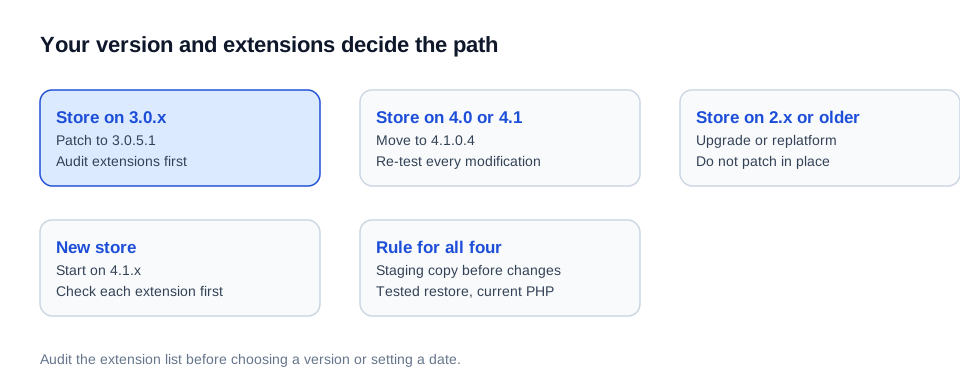
Figure 1: The right path depends on your current version and your extension list, so audit extensions before you pick a developer or a date.
OpenCart 3 or OpenCart 4: Which Version Should Your Store Run
Run the newest release of the branch your extensions support, and move to 4.x only when the extensions you depend on have 4.x versions or replacements. Both branches are still receiving releases: according to the official OpenCart release page, 3.0.5.1 and 4.1.0.4 shipped on the same day in August 2026.
| Question | OpenCart 3.0.x | OpenCart 4.1.x |
|---|---|---|
| Latest release | 3.0.5.1, with PHP 8.5 compatibility and a fix for admin login password encoding | 4.1.0.4, with PHP 8.5 compatibility and several security fixes, including one for cross-site scripting in the error log view |
| Extension ecosystem | Largest; one OpenCart news site notes most marketplace modules are still written for 3.0.x | Growing, but many 3.x extensions need rework or replacement |
| Modification system | OCMOD, plus the older vQmod some stores still use | Early 4.0 builds relied on an event system; OCMOD was restored in 4.1.0.0 |
| Best for | Stores with many paid extensions and a stable, working checkout | New stores and stores whose extensions are 4.x-ready |
| Main risk | Falling behind on PHP and security releases | Extension gaps and breakage between minor releases |
Third-party vendor blogs, which are not neutral, describe 4.x extension breakage between minor releases and recommend staying on 3.x for stores with many modules. The official release notes show that OCMOD returned in 4.1.0.0, which weakens some older vendor warnings. Treat both sides as input and decide with your own extension audit. Minimum PHP for new installs is 8.0 according to OpenCart's installation documentation.
Audit Extensions Before You Choose a Version or a Developer
The extension audit is the single most useful 3 to 8 hours you can pay for before any upgrade. It turns an open-ended fear into a table with one row per extension and a decision in each row: keep, update, replace, or remove.
- Is the vendor still active? Last update date, support responses and a 4.x version if you plan to move.
- What does it touch? Checkout, payments, shipping, pricing and orders are high-risk; a banner module is not.
- Does it modify core files? Extensions that patch core code through OCMOD or vQmod can conflict with each other and with core updates.
- Does it add database tables? Migration needs a data plan, not just a file upload.
- Can core do it now? Newer releases cover more, so some paid modules are no longer needed.
- Who owns the license? Make sure licenses are registered to the company, not to a former developer.
- What happens if it fails? Rank by revenue at risk, and test those first.
In practice, a store with 20 extensions often ends up with 6 to 10 that need work, 5 to 8 that can be dropped, and the rest unchanged. That ratio is why quotes for "upgrade my OpenCart store" vary by a factor of five.
What a Good OpenCart Developer Does Differently
A good OpenCart developer treats the store as a revenue system with a change history, not as a pile of folders. The signs are habits, not tools.
- Works on staging. Every change is tested on a copy of the live store with real products and a test payment, then released with a rollback plan.
- Avoids editing core files. Customizations live in extensions or modifications so that updates do not erase them.
- Documents extensions. Keeps a list of what is installed, what it does and who supports it.
- Understands the money paths. Cart, taxes, shipping rules, payment confirmations and order emails are tested every time.
- Knows search-friendly structure. Clean address structure, redirects after changes and multi-language handling, so an upgrade does not cost rankings. See the guide on changing a site without losing rankings.
- Keeps PHP current. Moves the store to a supported PHP version and tests extensions against it.
Security: Patch OpenCart and the PHP Underneath It
An OpenCart store is a PHP application that handles customer data and payments, so security means updating three layers: the platform, the extensions and PHP itself. On October 21, 2026 PHP released fixes for two critical remote code execution flaws (CVE-2026-109618 and CVE-2026-109619), and any store on an unpatched PHP is exposed regardless of how clean its OpenCart code is. The business-side steps are in the guide on updating PHP on a VPS after the php2shell flaws.
A practical security pass by an OpenCart developer covers:
- Moving to the latest release of your branch; for example, 4.1.0.4 closed an XSS issue in the error log view, and 3.0.5.1 fixed admin login password encoding.
- Updating or removing extensions that have not had a release for a year or more.
- Restricting access to the admin area and using strong, unique admin accounts for every person.
- Checking file permissions, removing unused files and old backups from the web root, and scanning for unknown files.
- Confirming off-site backups and testing a restore, not just taking them.
For a store that is already compromised, the first job is containment and cleanup, then hardening. Rotate admin and database passwords and payment credentials after cleanup, and rebuild from a clean copy if the infection is deep. The cost logic is covered in how much it costs to fix a broken website.
Cost: Hours and Budgets by OpenCart Task
The figures below assume an independent senior at $45 to $95 per hour and are planning estimates, not quotes. Extension licenses, theme purchases and hosting are extra.
| Task | What it includes | Hours | Cost ($45–$95/hr) |
|---|---|---|---|
| Small fix | Display bug, email template, small checkout issue | 2–8 | $90–$760 |
| Patch within a branch | Move to 3.0.5.1 or 4.1.0.4, test, release | 3–10 | $135–$950 |
| Extension audit | Inventory, risk ranking and keep/replace/remove plan | 3–8 | $135–$760 |
| Custom extension | Pricing rules, delivery logic, ERP or CRM link | 20–60 | $900–$5,700 |
| Payment or shipping integration | Gateway or carrier with sandbox testing and order status sync | 15–40 | $675–$3,800 |
| Theme customization | Layout changes, mobile fixes, brand updates | 40–120 | $1,800–$11,400 |
| PHP version upgrade | Compatibility testing, extension fixes, server change | 8–30 | $360–$2,850 |
| OpenCart 3 to 4 migration | 15–30 extensions, data migration, staging, cutover, redirects | 60–200 | $2,700–$19,000 |
| Hack cleanup and hardening | Containment, cleanup, secrets rotation, monitoring | 10–30 | $450–$2,850 |
| Full custom store build | Catalog, checkout, integrations, launch | 150–400 | $6,750–$38,000 |
For rate context see developer hourly rates. If the numbers for a migration exceed what a new store on another platform would cost, read the next section.
When Staying on OpenCart Is the Wrong Decision
Stay on OpenCart when the store works, extensions are maintained and your catalog and checkout fit the platform. Consider replatforming when your key extensions are abandoned, when your team needs a larger pool of developers, or when the migration quote approaches the cost of a new store.
| Situation | Usually the better move |
|---|---|
| Stable store, maintained extensions, small catalog changes | Patch within the branch and keep a yearly maintenance budget |
| Many abandoned extensions on 3.x or older | Consolidate to core features first, then upgrade; compare against a rebuild |
| Need content, blog and plugin ecosystem on one stack | Consider WooCommerce; see hiring a WooCommerce developer |
| Complex, brand-specific store with custom logic | Custom build; see hiring an ecommerce web developer |
Taking Over an Existing OpenCart Store: Pre-Hire Audit
Before a new developer touches the store, buy a 4 to 8 hour read-only audit. Ask for a written list with these answers:
- Which OpenCart version, which PHP version, which database, and how far behind each is.
- Which extensions and modifications are installed, with last update dates.
- Whether core files were edited, and where.
- When the last off-site backup ran and whether a restore has been tested.
- Whether a staging copy exists and runs the current code.
- Whether there are unknown files, unknown admin users or signs of earlier compromise.
- Who owns the hosting, domain, payment accounts and extension licenses.
Red flags: edits directly in core files, no staging, a database with no backups, admin accounts shared by several people and extensions from unknown sources.
Three Realistic Scenarios
Scenario 1: Stable 3.x store, one broken payment extension
A store on OpenCart 3.0.4 loses card payments after the host updates PHP. The developer isolates the failing payment extension, replaces it with the gateway's maintained module, moves the store to 3.0.5.1 and runs test orders. Estimated effort is 12 to 24 hours ($540 to $2,280). Lesson: schedule PHP updates with a developer present, not after the host changes them silently.
Scenario 2: 3.x to 4.x with 22 extensions
An audit finds 9 extensions with 4.x versions, 6 that can be replaced by core features, 4 that need custom rework and 3 abandoned ones. The migration runs on staging for three weeks, then cuts over on a low-traffic weekend with redirects in place. Estimated effort is 110 to 170 hours ($4,950 to $16,150). Lesson: the 4 custom reworks take half of the budget, so decide whether they are worth keeping.
Scenario 3: Hacked store with unknown files
A store redirects mobile visitors to spam pages. The developer finds modified files and an unknown admin user, restores from a clean backup, patches OpenCart and PHP, rotates all credentials and adds monitoring. Estimated effort is 14 to 28 hours ($630 to $2,660). Lesson: restore alone is not enough if the original entry point is still open.
How to Vet an OpenCart Developer
Ask for live OpenCart stores they maintain, then ask what they would change in each. A developer who can only show theme installs is a different hire from one who has upgraded stores with custom extensions.
| Question | Junior signal | Senior signal |
|---|---|---|
| How do you customize without losing changes on update? | "I edit the core files." | Uses extensions and modifications, documents each change and keeps it in version control. |
| Two modifications patch the same file. What happens? | No answer. | Explains conflicts, load order and how to detect and resolve them on staging. |
| How do you upgrade 3.x to 4.x? | "I run the upgrade script." | Starts with an extension audit, tests on a staging copy, plans data migration and redirects. |
| How do you test checkout after a change? | "I click through once." | Test orders for each payment and shipping method, taxes, emails and order status changes. |
| What do you do first on a hacked store? | Deletes suspicious files. | Contains, snapshots evidence, restores clean, patches the entry point and rotates secrets. |
The 3 to 5 hour paid trial
Pay the candidate their hourly rate. Give them a copy of your store on staging with three extensions and ask them to: list the risks of upgrading to the latest release of your branch, apply a small agreed change (for example, a delivery fee rule for one region) in an extension without editing core files, and write a one-page upgrade plan with order, hours and rollback steps.
| Criterion | Pass | Fail |
|---|---|---|
| Core files | No core edits; change lives in an extension or modification | Direct edits to core |
| Risk list | Extensions ranked by revenue risk with reasons | Generic "update everything" |
| Testing | Test orders for each payment and shipping method | "It loads, so it works" |
| Plan | Order, hours, rollback and redirect plan | No rollback |
| Handover | Written change log and notes for the next developer | Needs the author to explain |
Common Mistakes When Hiring for OpenCart
- Asking for an "upgrade quote" before an extension audit exists.
- Upgrading directly on the live store with no staging copy.
- Letting a developer edit core files because it is faster today.
- Leaving extension licenses, hosting and payment accounts under a freelancer's name.
- Skipping redirects, which can cost search rankings after address changes.
- Staying on an old PHP version because the store "still works".
- Treating backups as done when no restore has ever been tested.
Expert Tip: Make Extensions Pay Rent
Once a year, rank every paid extension by the revenue it protects and the cost of keeping it current. Anything that touches checkout earns its place; a decorative module with no support often does not. A shorter extension list is the cheapest upgrade you can buy, and it makes every future quote smaller.
Frequently Asked Questions
How much does it cost to hire an OpenCart developer?
An independent senior OpenCart developer costs $45 to $95 per hour. A small fix takes 2 to 8 hours ($90 to $760), a custom extension 20 to 60 hours ($900 to $5,700), and a 3.x to 4.x migration for a store with 15 to 30 extensions takes 60 to 200 hours ($2,700 to $19,000). Agencies typically charge $150 to $250 per hour.
What is the latest OpenCart version?
OpenCart 4.1.0.4 and 3.0.5.1 were both released on August 11, 2026 according to the official release page. Both added PHP 8.5 compatibility, and 4.1.0.4 includes several security fixes.
Should I upgrade from OpenCart 3 to 4?
Upgrade when the extensions you rely on have 4.x versions or can be replaced, and when you can test on a staging copy. If your store works and depends on many 3.x-only extensions, patching to 3.0.5.1 and planning the move for later is a legitimate choice.
What PHP version does OpenCart need?
New OpenCart installs require PHP 8.0 or later according to the installation documentation, and the latest releases of both branches add PHP 8.5 compatibility. Prefer a version that still receives security updates; PHP 8.2 gets security fixes only until December 31, 2026, and 8.3 until December 31, 2027.
Are OpenCart extensions compatible between versions 3 and 4?
Often not without changes. Vendors report that many 3.x extensions need rework for 4.x, and the safest approach is an extension-by-extension audit before any upgrade.
How long does an OpenCart upgrade take?
A patch within the same branch takes a few hours. A 3.x to 4.x migration typically takes 3 to 8 weeks calendar time including staging and testing, depending on the number of extensions and the amount of custom work.
Is OpenCart secure?
It is as secure as its patch level, its extensions and the PHP underneath it. Keep OpenCart on the latest release of your branch, remove unmaintained extensions, restrict admin access, and apply PHP security updates promptly.
My OpenCart store was hacked. What do I do first?
Contain it: take the store offline or restrict access, snapshot the server for evidence, and bring in a developer who will restore from a clean backup, patch the entry point and rotate all passwords and payment credentials. Cleanup takes about 10 to 30 hours ($450 to $2,850).
OpenCart, WooCommerce or Shopify?
Stay on OpenCart if your store works and your extensions are maintained. WooCommerce suits teams that want WordPress content and a larger developer pool, and Shopify suits teams that prefer hosted maintenance over customization. The migration cost decides when a switch pays off.
Do I need a staging site for OpenCart changes?
Yes. A staging copy lets a developer test upgrades, payments and extensions on real data without risking live orders, and it usually pays for itself on the first upgrade.
Who should own the hosting, domain and extension licenses?
Your company, from the first day. Register hosting, domain, payment accounts and extension licenses under company accounts and give developers limited access that you can revoke.
How do I test an OpenCart developer before hiring?
Give a paid 3 to 5 hour trial on a staging copy: a risk list for the upgrade, a small change made without editing core files, and a written upgrade plan with hours and rollback steps. Grade it against a pass or fail rubric.
Running OpenCart and unsure whether to patch, upgrade or replatform? Start with a fixed one-time task: an extension audit and upgrade plan, or a first safe fix, with your hosting, your licenses and your repository under your own accounts. For broader PHP work, see verified PHP developers.
Written by Michael Melnyk
Senior IT Technical Writer & Technology Analyst
Senior Technical Writer and IT Industry Analyst with over 7 years of experience analyzing software engineering ecosystems, tech leadership models, and developer procurement frameworks.