How to Hire a Freelance QA Tester: The Founder's Guide to Quality Assurance
Software developers have confirmation bias when testing their own code. Here is how startup founders and small teams can hire a freelance QA engineer to catch breaking bugs before paying customers do.

A software developer should never be the only person testing their own code before a production release. Software engineers naturally suffer from confirmation bias: they test the “happy path”—the exact sequence of clicks, data inputs, and conditions they had in mind while writing the architecture. A professional Quality Assurance (QA) tester does the opposite: they methodically stress-test boundary conditions, corrupted network responses, odd device viewports, and unpredictable user actions to find breaking defects before customers encounter them.
For early-stage startups, agencies, and small businesses, hiring a full-time in-house QA engineer is often financially impractical. The most efficient model is engaging an independent freelance QA tester for targeted pre-release audits or regression test creation. Reviewed September 2026. Rate estimates and workflows reflect current market norms for independent testing professionals.
Why Paying a Developer to Test Is an Expensive Mistake
Founders often ask: “Why should I hire a QA tester when my senior developer already tests their work?” The answer comes down to economics, attention, and cognitive incentives.
- Rate Arbitrage: A senior full-stack software engineer typically bills between $50 and $90 per hour. Having that engineer spend 15 hours testing cross-browser form submissions, button alignments on physical iPhones, and email confirmation flows costs $750 to $1,350. A seasoned manual freelance QA specialist billing $25 to $35 per hour executes the same testing with far greater rigor for less than half the total spend.
- Cognitive Blind Spots: When a developer builds a feature, they know how the backend database expects the payload. They will intuitively avoid typing unusual characters, leaving fields blank in specific orders, or double-clicking submit buttons. QA specialists approach software from an adversarial, exploratory perspective.
- Preventing Silent Revenue Loss: A broken checkout form, an unclickable mobile navigation drawer on Safari iOS, or a failed webhook confirmation rarely generates a customer support ticket. In most cases, prospective buyers simply leave the site and purchase from a competitor.
When launching new products or rebuilding legacy platforms, pair an independent tester with your engineering workflow. If you are currently structuring your development team, review our guide on hiring a developer for small business and startups to understand how engineering and quality assurance complement each other.
Manual QA vs. Automated QA: Which Do You Need?
Quality assurance is divided into two distinct disciplines. Hiring the wrong profile will lead to wasted budget and frustration.
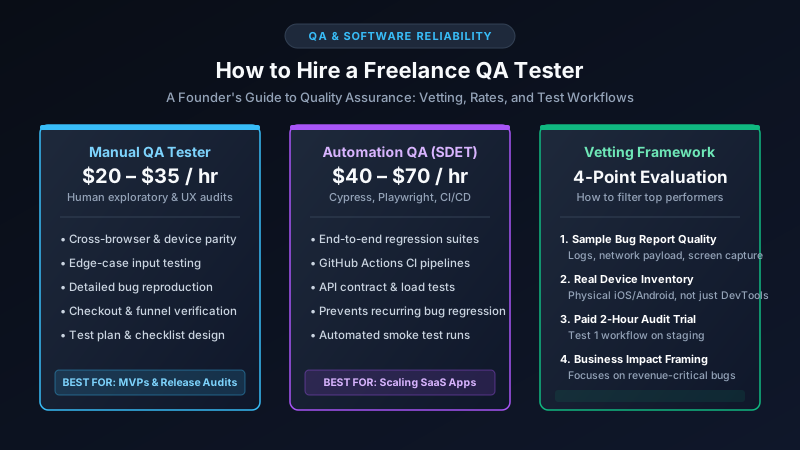
| Core Factor | Freelance Manual QA Specialist | Freelance Automation Engineer (SDET) |
|---|---|---|
| Primary Methodology | Human exploratory testing, cross-device verification, UX audits | Writing automated test scripts (Playwright, Cypress, Selenium) |
| Typical Hourly Rate | $20 – $35 / hour | $40 – $70 / hour |
| Best Timing to Hire | Early stage, MVP releases, bi-weekly deployment checks | Stable core product, frequent continuous integration (CI) builds |
| Deliverables | Reproducible bug reports, test cases, device compatibility matrices | End-to-end (E2E) test repositories, CI/CD pipeline triggers |
| Product Stability Needed | Low to Moderate (works effectively on changing interfaces) | High (frequent UI changes constantly break automation scripts) |
Choose a Manual QA Specialist When:
- You are testing an MVP, redesign, or major feature overhaul where user flows and button placements are still changing weekly.
- You need physical verification across real hardware (e.g., iPhone 12 vs. 15 Pro, low-end Android devices, iPad tablets, Safari on macOS).
- You want qualitative user-experience feedback regarding confusing navigation, micro-copy ambiguities, or layout inconsistencies.
- You need immediate, ad-hoc verification before a major marketing campaign or launch.
Choose a QA Automation Engineer (SDET) When:
- Your web application or SaaS has established core flows (login, billing, checkout, data export) that cannot break under any circumstances.
- Your developers deploy code to production multiple times per week and manual smoke testing has become an engineering bottleneck.
- You need backend API contract testing, load testing, or database stress tests under simulated traffic spikes.
How Much Does a Freelance QA Tester Cost in 2026?
Rates for independent testing talent depend on technical specialization, geographic location, and contractual structure:
| Specialist Profile | Eastern Europe / LatAm | US / UK / Western Europe | Fixed-Scope Retainer (Monthly) |
|---|---|---|---|
| Junior / Mid Manual QA | $15 – $25 / hr | $35 – $55 / hr | $600 – $1,200 / mo (15-20 hrs) |
| Senior Manual / Lead QA | $25 – $38 / hr | $55 – $85 / hr | $1,500 – $2,500 / mo (pre-release sweeps) |
| QA Automation Engineer | $35 – $55 / hr | $75 – $120 / hr | $3,000 – $6,000 / mo (suite construction) |
For most non-enterprise teams, a hybrid fixed-retainer or milestone model works best: booking 10 to 15 hours of manual QA during release weeks, rather than paying for idle time when engineers are writing initial code.
The 4-Step Framework to Vet a Freelance QA Tester
Anyone can claim to be a “tester” by clicking around a website. A professional QA engineer is distinguished by their methodology, documentation clarity, and technical diagnostic skill. Use this 4-step process to filter the top 10% of applicants.
1. Request a Redacted Bug Report Sample
Never hire a QA contractor without inspecting a bug report they wrote for a previous client. Low-quality testers submit vague notes like “Checkout button does not work on mobile.” A high-caliber QA professional delivers a ticket that includes:
- Clear Summary: [Severity: High] Checkout button unresponsive on Safari iOS 17.4 when discount code is applied.
- Exact Environment: Device model, OS version, browser build, viewport resolution, user permission level.
- Step-by-step Reproduction: Step 1 to Step 5 with exact test credentials and inputs used.
- Expected vs. Actual Result: Exactly what should occur per specifications vs. what actually happened.
- Diagnostic Artifacts: Annotated screen recording, developer console error logs, and Network tab HTTP payload failures (e.g.,
POST /api/checkout 422 Unprocessable Entity).
2. Inspect Their Physical Device Lab
Many amateur testers simply resize their desktop Google Chrome browser using Developer Tools. Chrome's device emulation does not replicate mobile Safari WebKit rendering quirks, physical iOS notch cutouts, keyboard overlay behavior, or low-RAM memory throttling. Ask candidates what physical devices and operating systems they own and maintain for testing.
3. Run a Paid 2-Hour Staging Audit (The Acid Test)
Do not rely on resume buzzwords or algorithmic interviews. Give your top two shortlisted candidates access to a staging environment for a defined workflow (for example, user registration, account settings, and checkout). Pay them for 2 to 3 hours of exploratory testing.
Evaluate them on:
- Did they uncover genuine edge cases (e.g., special characters in names, expired sessions, back-button caching)?
- Are their bug descriptions actionable without requiring follow-up questions?
- Did they prioritize bugs by business impact (differentiating between a cosmetic typo and a broken Stripe modal)?
4. Evaluate Business Impact Awareness
Great QA specialists understand that not all bugs are created equal. They do not block a launch over a 2-pixel margin misalignment if the core checkout pipeline functions flawlessly. Ask candidates: “How do you prioritize between 10 bugs discovered two hours before a scheduled production release?” The right candidate immediately separates blocker/critical items affecting revenue and data security from non-blocking cosmetic defects.
How to Set Up a Freelance QA for Immediate Success
A freelance tester can only be as effective as the environment and instructions you provide. Avoid these operational mistakes:
- Never Test Exclusively on Production: Provide a dedicated staging or preview environment (e.g., Vercel preview links or a test subdomain) populated with realistic dummy seed data. Give the tester test credit cards, mock accounts, and admin panel privileges.
- Standardize the Issue Tracker: Direct all bug submissions into your team's existing workflow (GitHub Issues, Linear, Jira, or Trello). Ensure each ticket includes label categories for Severity (Blocker, Major, Minor, Cosmetic).
- Provide Clear Acceptance Criteria: Give the tester your user stories or feature requirements so they know what intended behavior looks like before assessing defects.
- Establish a Direct Communication Channel: Add the tester to a dedicated Slack or Discord channel with the developer who built the feature so issues can be reproduced and resolved without intermediary delays.
By establishing an independent QA checkpoint, you protect your company’s reputation, safeguard checkout conversions, and let your developers focus entirely on writing high-quality code. If your project has suffered from persistent production errors or fragile builds, explore our network of verified independent developers who adhere to rigorous testing and delivery standards.
Written by Michael Melnyk
Senior IT Technical Writer & Technology Analyst
Senior Technical Writer and IT Industry Analyst with over 7 years of experience analyzing software engineering ecosystems, tech leadership models, and developer procurement frameworks.