What Is a Fractional CTO? Role, Rates, and When to Hire
A fractional CTO provides senior technology strategy, architecture oversight, and team vetting on a flexible retainer. Here is what the role covers, how pricing works, and when to hire one.

A fractional CTO is an experienced technical executive who provides part-time technology strategy, architecture governance, and engineering leadership on a contract or monthly retainer. Unlike a freelance developer writing daily tickets or an agency billing by project milestone, a fractional Chief Technology Officer operates as an embedded member of your executive team, aligning architecture and engineering roadmap decisions with commercial business goals without the full-time C-level overhead.
For early-stage startups building an initial product, bootstrapped companies scaling toward multi-million dollar annual recurring revenue (ARR), and non-technical founders managing contractors, hiring a full-time CTO is often premature. A permanent executive salary combined with benefits, recruiting fees, and equity dilution frequently exceeds $350,000 to $500,000 per year. Engaging an independent fractional CTO provides high-leverage technical direction in targeted 10-to-20-hour weekly increments, protecting your capital while keeping development velocity on track.
What Does a Fractional CTO Actually Do?
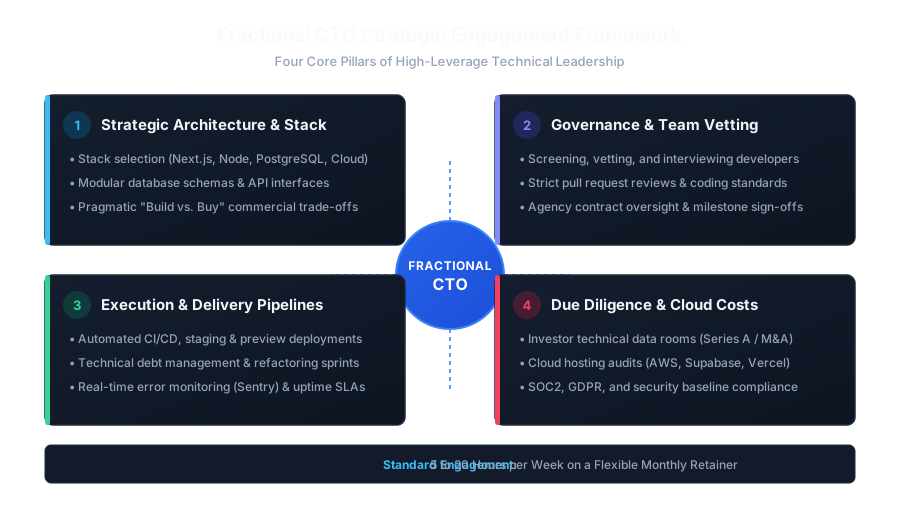
A fractional CTO translates commercial business requirements into a scalable technical roadmap while de-risking architecture, infrastructure, and hiring decisions. They do not spend their days working through routine feature tickets; instead, they establish technical direction, evaluate architectural trade-offs, and hold engineering teams to consistent delivery standards.
1. High-Level Architecture & Tech Stack Selection
Selecting the wrong foundation creates expensive migrations later. A fractional CTO evaluates your business model, expected concurrency, data privacy constraints, and team skillset to select maintainable technologies (such as Next.js, Node.js, Python, PostgreSQL, and managed cloud infrastructure). The goal is a modular architecture that supports rapid product iteration without accumulating unmanageable technical debt.
2. Engineering Governance, Code Quality, and CI/CD
Without senior oversight, software teams often ship without automated tests, linting, or structured deployment pipelines. A fractional CTO sets up automated CI/CD workflows, enforces pull request review standards, defines database migration safety rules, and configures monitoring tools (such as Sentry, Datadog, or OpenTelemetry) to catch bugs before users do.
3. Vetting Developers, Agencies, and Technical Talent
Hiring developers without a technical background carries high financial risk. A fractional CTO acts as your technical screener. When your company is ready to hire developer talent or assemble an internal engineering team, the fractional CTO defines technical job requirements, screens candidate repositories, conducts technical interviews, and structures onboarding roadmaps.
4. Technical Due Diligence & Investor Readiness
During fundraising rounds, venture capital investors inspect your software licenses, intellectual property (IP) assignments, data privacy posture, and infrastructure scalability. A fractional CTO prepares the technical data room, audits code repositories, addresses security baselines (such as SOC2, GDPR, or HIPAA requirements), and answers technical questions from investor diligence teams.
5. Vendor & Cloud Cost Optimization
Unmanaged cloud hosting (AWS, Google Cloud, Azure, Supabase, Vercel) can drain early-stage capital through oversized database tiers, unindexed database queries, and redundant SaaS tooling. A fractional CTO audits cloud infrastructure metrics, restructures inefficient database queries, and negotiates vendor tiers to reduce monthly burn.
Fractional CTO vs. Full-Time CTO vs. Interim CTO vs. Lead Developer
A common trap for founders is confusing technical execution (writing code) with technical strategy (business alignment, systems design, and team structure).
The table below outlines how executive roles compare across commitment, costs, and strategic scope:
| Role | Core Focus | Weekly Commitment | Typical Annual Cost (2026) | Equity Expectation | Best Suited For |
|---|---|---|---|---|---|
| Fractional CTO | High-level strategy, architecture, hiring oversight, due diligence | 5 – 20 hours / week | $45,000 – $150,000 | 0% – 0.5% (Optional advisory) | Pre-seed to Series A startups, SMEs ($1M–$15M ARR), agency oversight |
| Full-Time CTO | Full-time executive leadership, internal company culture, 24/7 accountability | 40+ hours / week | $250,000 – $550,000+ fully loaded | 1.0% – 8.0%+ | Series A/B+ companies with 15+ internal developers, proprietary core AI/R&D |
| Interim CTO | Full-time temporary turnaround, crisis management, executive search transition | 35 – 45 hours / week | $180,000 – $320,000 (annualized) | 0% | Companies undergoing sudden leadership departure or M&A restructuring |
| Lead Developer | Hands-on coding, sprint task completion, PR review, day-to-day tickets | 40 hours / week | $110,000 – $180,000 | 0.1% – 0.5% | Building specific features after architectural roadmaps are already established |
| Software Agency | Project-based feature delivery, multi-client team execution | Variable based on SOW | $50,000 – $250,000+ per milestone | 0% | Non-core turn-key project builds where long-term ownership is outsourced |
How Much Does a Fractional CTO Cost?
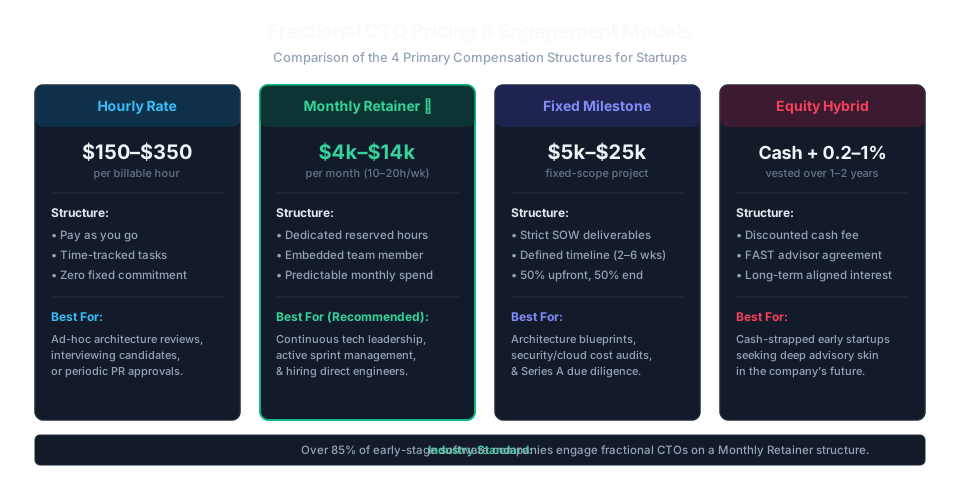
A fractional CTO typically costs between $4,000 and $15,000 per month on a retainer model, depending on the required hours, system complexity, and company stage. Compared to a full-time executive salary, businesses typically reduce cash expenditure by 60% to 75% while avoiding long-term equity dilution.
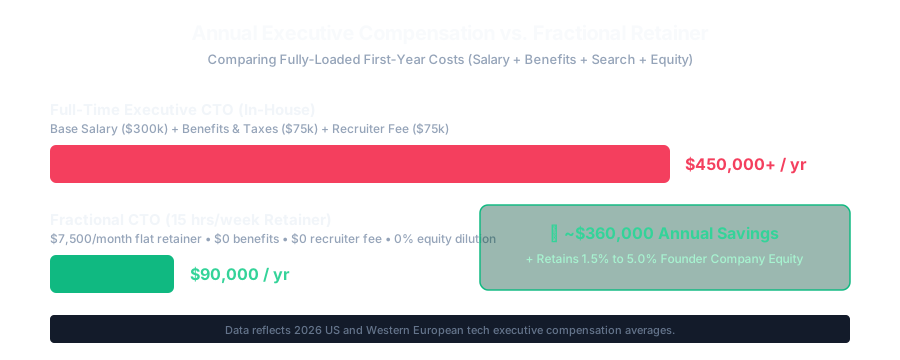
Full-Time vs. Fractional CTO Financial Comparison
| Cost Component | Full-Time CTO (In-House) | Fractional CTO (Retainer Model) |
|---|---|---|
| Annual Base Compensation | $250,000 – $400,000 / year | $60,000 – $120,000 / year ($5k–$10k/mo) |
| Benefits, Payroll Taxes & Bonuses (25–30%) | $60,000 – $120,000 / year | $0 (B2B vendor expense) |
| Recruitment & Executive Search Fees | $50,000 – $90,000 (20–30% of base) | $0 |
| Equity Dilution | 1.0% – 5.0%+ of company shares | 0% (standard B2B contract) |
| Severance & Contract Risk | 3 – 6 months salary liability | 30-day cancellation notice |
| Total First-Year Financial Investment | $360,000 – $610,000+ | $60,000 – $120,000 |
| Net Annual Cash Savings | — | $300,000 – $490,000 / year |
Typical Retainer Tiers
- Advisory & Architecture Oversight (5–8 hours/week): $3,500 – $6,000 / month. Best for weekly architectural guidance, pull request approvals, and roadmap planning.
- Active Strategic Leadership (12–20 hours/week): $7,000 – $14,000 / month. Includes active sprint governance, developer hiring interviews, vendor management, and investor readiness.
- Project-Based Architectural Audits ($5,000 – $20,000 fixed fee): Deep-dive audits into code quality, cloud infrastructure security, database query bottlenecks, or technical due diligence preparation.
When Should You Hire a Fractional CTO?
You should hire a fractional CTO when your business faces high-stakes technical decisions, rising architectural complexity, or developer management issues, but your current stage does not justify a permanent $300k+ full-time executive salary.
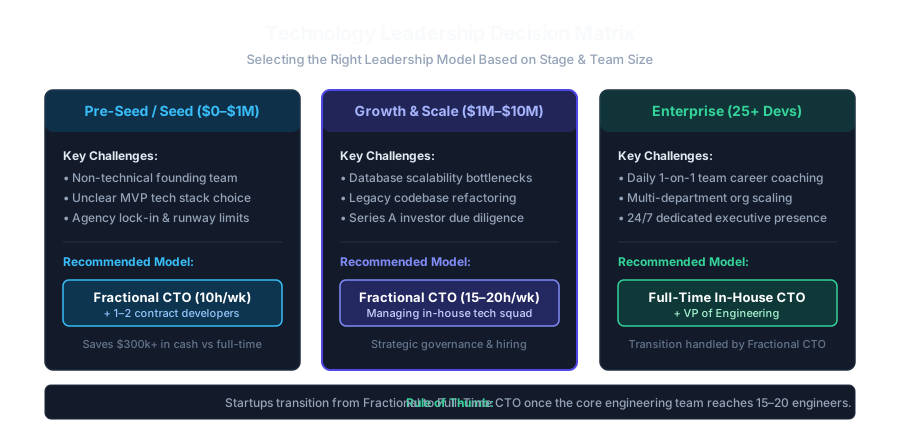
1. You Are a Non-Technical Founder Building an MVP
Non-technical founders frequently overpay software development agencies for bloated monolithic software or pick trendy frameworks that make future hiring difficult. An experienced fractional CTO designs a lean Minimum Viable Product (MVP) roadmap, picks standard, maintainable technologies, and protects your capital.
2. You Are Struggling with an Outsourced Agency or Offshore Team
If your offshore developers are missing deadlines, producing buggy builds, or claiming that simple feature updates require complete system rewrites, you need an independent technical authority. A fractional CTO inspects the Git history, tests code reliability, and provides an objective report on whether the team is performing honestly.
3. Your System Suffers from Scalability and Performance Bottlenecks
When an application experiences slow database queries, frequent downtime under traffic spikes, or brittle deployments where fixing one bug introduces three new regressions, strategic architectural intervention is necessary to restructure database indices, decouple monoliths, and introduce proper caching layers.
4. You Are Preparing for Venture Capital Due Diligence
Institutional investors conduct rigorous technical due diligence before wiring funds. A fractional CTO reviews your data security, verifies repository permissions, ensures all third-party dependencies are properly licensed, and prepares an institutional-grade technical presentation for investment committees.
5. You Need to Transition from Contractors to an In-House Team
Once product-market fit is established, relying exclusively on agencies becomes inefficient. A fractional CTO defines internal engineering compensation tiers, interviews full-stack engineers, sets up development guidelines, and manages the handoff smoothly. Before making that transition, compare the tradeoffs between outsourcing and in-house hiring for your project stage.
When You Should NOT Hire a Fractional CTO
A fractional CTO is not the right fit for every technical need. Understanding the boundaries helps avoid mismatched expectations and wasted spend.
Scenario A: You Just Need Someone to Write Routine Features
If your architecture, database schema, and product requirements are already clear and you simply need more development capacity to clear sprint tickets, do not hire an executive advisor. You should instead hire developer contractors or full-time engineers who can write code 40 hours per week.
Scenario B: Your Engineering Team Exceeds 25+ Full-Time Engineers
When an engineering organization grows beyond 20–25 developers, the company requires dedicated, full-time day-to-day people management, continuous 1-on-1 career coaching, internal performance reviews, and cross-departmental coordination. At this scale, a permanent, full-time CTO or VP of Engineering is required.
Scenario C: Standard Off-the-Shelf or No-Code Use Cases
If your digital operation is an uncomplicated content site or a standard Shopify e-commerce shop with no custom business logic or complex database workflows, you do not need executive architectural leadership. A specialized e-commerce developer or agency is sufficient.
4 Realistic Case Studies: Fractional CTO in Action
The following scenarios illustrate how fractional technical leadership solves specific business, architectural, and financial bottlenecks in real-world organizations.
Case Study 1: Pre-Seed B2B SaaS Founder Overcoming Offshore Agency Lock-in
Initial Situation
A non-technical founder raised $180,000 from angel investors to build a collaborative B2B compliance portal. The founder hired an overseas dev shop that quoted $60,000 for a 4-month MVP delivery.
What Was in the Way
Seven months in, the agency had billed $85,000, yet the application was non-functional, suffered from 4-second page load times, and crashed whenever two users edited compliance records simultaneously. The agency demanded an additional $35,000 to "refactor the microservices backend."
Solution
A fractional CTO was brought in on a 15-hour/week retainer ($7,500/month). The fractional CTO conducted an immediate repository audit:
- Identified that the agency had unnecessarily split a simple CRUD application into six convoluted Docker microservices.
- Replaced the broken stack with a clean, monolithic Next.js, Node.js, and PostgreSQL architecture hosted on Supabase and Vercel.
- Vetted and brought in two contract engineers through ProofDevs to write clean frontend components and API endpoints under the fractional CTO's architectural supervision.
Measurable Result
- $140,000 in saved engineering capital by terminating the bloated agency contract.
- MVP launched to 15 pilot enterprise customers in 8 weeks.
- Page load latency dropped from 4.2 seconds to 180 milliseconds.
Case Study 2: E-Commerce Scale-up ($6M ARR) Facing Database Deadlocks
Initial Situation
A direct-to-consumer lifestyle brand scaled rapidly from $1.5M to $6M in annual turnover. During major holiday sales campaigns, the checkout system stalled, causing abandoned shopping carts and lost customer orders.
What Was in the Way
The internal team consisted of two junior-to-mid-level full-stack developers who lacked deep database tuning and high-concurrency optimization experience. Their immediate proposal was to pay $4,000/month more for a massive enterprise AWS database cluster.
Solution
The company engaged a fractional CTO for 10 hours per week:
- Audited PostgreSQL slow query logs and identified missing composite indices on the
order_itemsandinventory_stocktables. - Replaced synchronous third-party ERP webhook processing with an asynchronous Redis queue worker.
- Implemented Edge caching and optimized database connection pooling via PgBouncer.
Measurable Result
- Zero downtime during Black Friday / Cyber Monday under 8x baseline traffic spikes.
- Cloud infrastructure spending decreased by 38% ($2,100/month saved) instead of increasing.
- Average checkout completion time improved by 65%.
Case Study 3: HealthTech Startup Preparing for Series A Due Diligence
Initial Situation
A digital health platform with $1.2M in annual recurring revenue entered term sheet negotiations with two venture capital firms for an $8M Series A investment round.
What Was in the Way
The lead VC's technical due diligence team requested a complete technical data room including SOC2 Type II compliance status, data encryption at rest/transit audits, IP assignment agreements for all historical contractors, and disaster recovery SLA documentation. The founding team had none of these prepared.
Solution
A fractional CTO stepped in for a focused 60-day sprint (20 hours/week):
- Standardized AWS security groups, enforced multi-factor authentication (MFA) across all staging and production environments, and rotated API credentials.
- Cleaned up Git commit history and executed formal IP assignment agreements with all past contract developers.
- Documented the disaster recovery plan, data pipeline architecture, and automated test coverage metrics for the investor due diligence portal.
Measurable Result
- Passed VC technical due diligence with zero red flags.
- Secured the $8M Series A round at the target valuation within the original exclusivity timeline.
- Established an ongoing technical governance framework ready for SOC2 certification.
Case Study 4: B2B Enterprise Startup Navigating "Build vs. Buy"
Initial Situation
A logistics software startup wanted to add an automated enterprise route optimization engine to its fleet management dashboard.
What Was in the Way
The internal developers estimated that writing an in-house algorithmic routing engine would require 9 months of engineering effort and $150,000 in dedicated developer salaries.
Solution
The company consulted a fractional CTO to assess the business trade-offs:
- Analyzed existing commercial APIs (Google Maps Platform, HERE Technologies, and open-source OSRM routing engines).
- Proved that 92% of the startup's customer requirements were already solved by an existing specialized routing API with an SLA guarantee.
- Architected a lightweight integration wrapper that connected the existing API to the company's PostgreSQL database in two weeks.
Measurable Result
- Delivered the complete routing feature in 3 weeks instead of 9 months.
- Saved over $125,000 in upfront custom software development payroll.
- Allowed internal engineers to stay focused on the core proprietary fleet tracking product.
How to Evaluate and Interview a Fractional CTO
Hiring the right fractional CTO requires evaluating commercial pragmatism, systems design capability, and communication clarity rather than algorithmic trivia.
The 7-Point Evaluation Framework
- Commercial Pragmatism Over Tech Hype: Do they prioritize revenue, maintainability, and business ROI rather than chasing unproven, trendy technologies?
- Proven Scaling Track Record: Have they successfully built and scaled architectures through multiple phases of growth (from 0 to 1, and 1 to 10)?
- Hands-On Architecture & Code Literacy: Can they deeply audit pull requests, spot security vulnerabilities, and evaluate database queries?
- Talent Vetting & Hiring Rigor: Do they have a structured methodology to screen, interview, and onboard high-performing software engineers?
- Clear Executive Communication: Can they explain technical trade-offs in plain business terms to non-technical founders, investors, and board members?
- Disciplined Availability & Response SLAs: Do they maintain structured weekly time blocks and predictable response windows for emergency escalations?
- Clean Contracts & IP Protection: Do they work under strict NDAs, comprehensive IP assignment agreements, and clear non-compete boundaries?
Essential Interview Questions to Ask Candidates
- "Can you share an example where you advised a founder NOT to build custom software, and what alternative you recommended?"
- What to look for: A great fractional CTO is a business advisor first. If their immediate instinct is always to write complex custom code, they lack commercial maturity.
- "How do you balance fixing existing technical debt against shipping new commercial features for the sales team?"
- What to look for: A balanced answer that ties technical refactoring directly to revenue risks, customer churn, and developer velocity.
- "How do you vet and evaluate engineers when a client needs to hire developer talent?"
- What to look for: A structured screening methodology including practical code review audits, architecture discussions, and work ethic assessment rather than arbitrary LeetCode puzzles.
- "What is your preferred tech stack for an early-stage SaaS, and why?"
- What to look for: Practical choices (e.g., TypeScript, Next.js, PostgreSQL, managed cloud) backed by arguments regarding talent availability, ecosystem stability, and maintenance simplicity.
- "How do you handle availability and emergency escalations on a fractional schedule?"
- What to look for: Transparent communication boundaries, defined SLA response windows, and clear weekly schedule blocks.
Common Mistakes Companies Make When Hiring a Fractional CTO
Avoiding these widespread implementation pitfalls ensures maximum return on your fractional tech leadership investment.
1. Treating the Fractional CTO as a Cheap Full-Time Coder
Expecting an executive on a 10-hour weekly retainer to churn out routine CSS fixes and frontend buttons squanders high-value strategic time. Let junior and mid-level developers handle daily tickets while the fractional CTO focuses on architecture, code quality standards, and technical direction.
2. Hiring Without Clear Deliverables and KPIs
Engaging a fractional leader on open-ended "general advice" leads to diffuse outcomes. Define clear milestones for each 30-to-90-day cycle: e.g., "Complete database migration," "Audit cloud infrastructure and cut monthly costs by 30%," or "Hire and onboard two senior backend engineers."
3. Waiting Until the Codebase Is Beyond Repair
Founders often wait until an application has crashed for three consecutive weeks or an agency has vanished before seeking senior help. Involving a fractional CTO early—even for 5 hours a month during initial planning—saves hundreds of thousands of dollars in rewrite costs.
4. Isolating the Fractional CTO from Business Stakeholders
If a technical leader only communicates with developers and never talks to sales, customer support, or product management, their technical roadmap will drift away from real customer needs. Ensure your fractional CTO has access to company roadmap discussions.
Expert Advice: How to Maximize ROI from Your Fractional CTO
To get the highest return from fractional technical leadership, establish structured operating rhythms from day one:
Strategic Principle: The highest leverage you can get from a fractional CTO is not having them write your code—it is having them prevent you from building the wrong things with the wrong architecture. One two-hour architecture review can prevent a $100,000 rewrite six months down the road.
- Establish a Weekly Cadence: Dedicate one fixed 60-minute weekly executive sync for strategic priorities, followed by a mid-week pull request / architecture review window.
- Empower Technical Authority: When the fractional CTO sets code quality standards or flags security risks, support their mandate across internal and contract development teams.
- Document Everything: Require architectural decision records (ADRs) so that all technology decisions remain institutional knowledge even when team members transition.
Frequently Asked Questions
What is the primary difference between a Fractional CTO and an IT Consultant?
An IT consultant typically delivers a one-time recommendations report or implements a specific third-party software package and exits. A fractional CTO is an ongoing, embedded member of your executive leadership team who takes ownership of technical outcomes, oversees engineering teams, and guides long-term strategy.
Can a fractional CTO write code for our application?
While fractional CTOs possess deep hands-on coding expertise, their primary value is strategic architecture, team governance, and code review. In early-stage startups, they frequently write core foundational boilerplate, API interfaces, and critical database schemas, but delegating day-to-day feature implementation to contract developers is more cost-effective.
How many hours per week does a typical fractional CTO work?
Most fractional CTO engagements range between 5 and 20 hours per week. Early-stage startups usually start with 5 to 10 hours weekly for architectural advisory and developer vetting, whereas companies actively preparing for funding rounds or platform migrations may require 15 to 20 hours weekly.
What happens when our startup outgrows a fractional CTO?
A core responsibility of a great fractional CTO is preparing your company for its next stage of growth. When your company reaches Series A/B funding and requires a full-time executive, the fractional CTO helps write the job specification, interviews candidates, selects your permanent full-time CTO or VP of Engineering, and ensures a seamless 30-day onboarding transition.
How does a fractional CTO manage intellectual property (IP) and confidentiality?
Professional fractional CTOs operate under comprehensive Non-Disclosure Agreements (NDAs) and clear IP Assignment contracts that assign 100% of all created software, architectural blueprints, and proprietary algorithms directly to your company.
Is a fractional CTO suitable for non-software businesses?
Yes. Many brick-and-mortar businesses, logistics companies, e-commerce brands, and professional service firms hire fractional CTOs to oversee digital transformations, select enterprise ERP/CRM platforms, audit cybersecurity, and manage external digital development agencies.
What qualifications should I look for in a fractional CTO?
Look for leaders with 10+ years of software engineering experience, a proven track record of having built and scaled production web applications, past experience as a founder or VP/CTO, and strong business communication skills.
How does a fractional CTO interact with freelance developers or offshore agencies?
The fractional CTO serves as the technical bridge between non-technical founders and developers. They review developer pull requests, verify milestones before invoice approvals, enforce automated testing, and ensure that external contractors write maintainable, well-documented code.
Strategic Technical Leadership for Your Next Milestone
Whether you are launching an initial MVP, auditing a legacy software architecture, or preparing for institutional due diligence, having seasoned executive technical oversight protects your capital and accelerates engineering velocity.
By aligning technology architecture with commercial business objectives, early-stage and growing companies gain the leadership leverage they need to build maintainable, scalable software systems.
Written by Michael Melnyk
Senior IT Technical Writer & Technology Analyst
Senior Technical Writer and IT Industry Analyst with over 7 years of experience analyzing software engineering ecosystems, tech leadership models, and developer procurement frameworks.