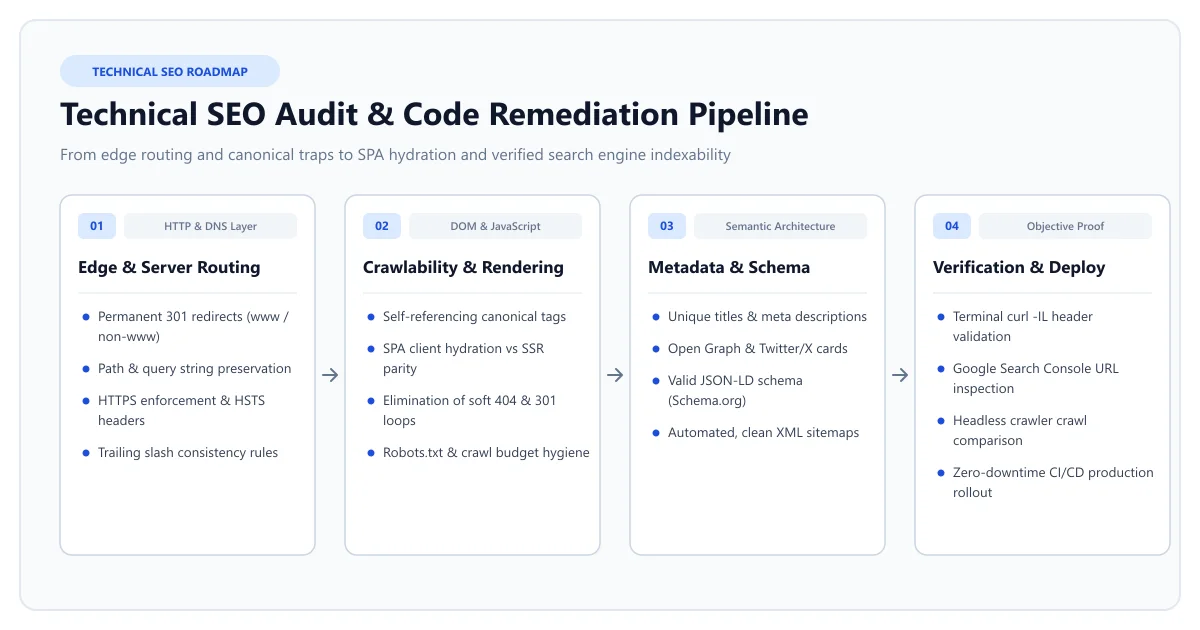
How Much Does SEO Cost? Retainer Economics, Technical Debt Surcharges, and Direct Engineering Budgets
Discover what website SEO actually costs in 2026. Compare agency retainers, direct engineering hourly rates, technical debt surcharges, and capital efficiency across SMB to enterprise tiers.


Website search engine optimization typically costs between $1,500 and $7,500 per month for managed retainers, $45 to $120 per hour for direct engineering contractors, and $2,500 to $12,000 for fixed-scope technical remediation sprints. Pricing varies based on existing architectural technical debt, platform scale, competitive search density, and whether you hire a traditional agency with overhead markups or engage direct technical talent who modifies production code. Reviewed October 2026. Figures and timelines below represent standard commercial market benchmarks for North American and European business deployments.
Executive leaders and marketing directors frequently confront wild discrepancies when soliciting SEO proposals: one vendor quotes $400 per month for automated rank tracking, an agency demands a $6,000 monthly retainer on a mandatory 12-month contract, and a boutique consultancy bills $15,000 for an architectural audit. When search visibility stalls, businesses waste capital paying for repetitive PDF reports that internal engineering teams never implement. If your platform has suffered crawl drops following a redesign, review our analysis on updating your website without losing search rankings, inspect our guide to hiring a technical SEO specialist, or explore our website maintenance and support options for continuous infrastructure stability.
The Four Commercial Pricing Models for Website SEO
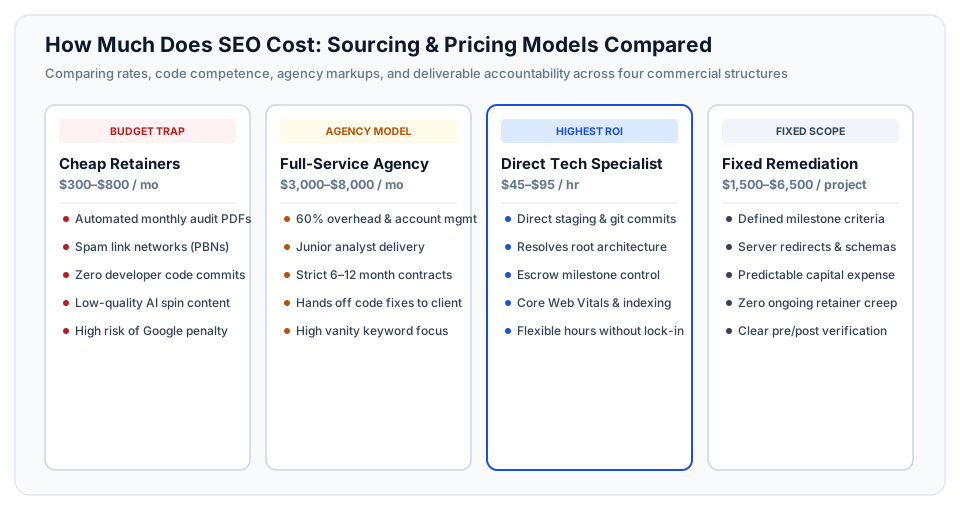
Search engine optimization services are billed under four distinct commercial structures: monthly management retainers, hourly engineering rates, fixed-scope technical sprints, and performance-based equity arrangements. Selecting the wrong commercial model creates perverse incentives where clients pay for passive monitoring instead of tangible site improvements.
| Billing Model | Standard Price Range | Primary Deliverables | Agency Overhead Markup | Best Commercial Fit |
|---|---|---|---|---|
| Monthly Retainer | $1,500 – $7,500 / month | Content architecture, link graph acquisition, crawl monitoring, monthly reporting | 40% – 60% margin for account management | Established businesses needing sustained keyword velocity and ongoing content production |
| Direct Technical Hourly | $45 – $120 / hour | Server routing rules, SSR hydration, canonical fixes, schema JSON-LD, Core Web Vitals | 0% (Direct contractor engagement) | Platforms needing code-level fixes, migrations, or custom CMS database optimizations |
| Fixed-Scope Project | $2,500 – $12,000 / project | Full-scope technical audit, repository remediation, zero-downtime domain cutover | 15% – 25% project scoping buffer | One-time architectural overhauls, platform migrations, or post-penalty recovery sprints |
| Performance / Revenue Share | $1,000 base + 10%–20% organic revenue | Conversion tracking setup, funnel optimization, high-intent buyer acquisition | Variable risk premium | High-margin e-commerce stores or lead-generation platforms with clean attribution models |
Monthly retainers: The traditional digital agency standard. The client commits to a recurring monthly payment ($1,500 to $7,500+) under a 6-month or 12-month agreement. While predictable for cash flow, retainers often suffer from diminishing returns after month four: once initial metadata and keyword research are complete, agencies bill the same fee while reducing active labor to automated crawler monitoring.
Direct technical hourly: Independent technical practitioners and senior engineering contractors bill strictly for productive hours worked ($45 to $120/hr). Unlike marketing consultants who diagnose problems without touching templates, technical contractors write server rewrite rules, optimize database queries, and test staging deployments. This model eliminates agency account management margins and delivers the highest capital efficiency for technical remediation.
Fixed-scope technical sprints: Ideal for bounded engineering tasks with unambiguous success criteria. Common project sprints include migrating an e-commerce catalog without losing PageRank ($4,000–$9,500), configuring Server-Side Rendering (SSR) for a Single-Page Application ($5,000–$12,000), or eliminating faceted filter indexation bloat ($2,500–$5,500). Payment milestones are tied to production delivery.
Performance-based arrangements: Paying exclusively for keyword rankings or raw traffic is dangerous. Low-end providers easily manipulate rankings by targeting obscure, zero-volume keywords that deliver zero commercial revenue. Legitimate performance contracts combine a baseline operational retainer with verified revenue or qualified lead-generation bonuses.
Budget Tiers by Business Model and Website Scale
The capital required to achieve meaningful search engine visibility scales directly with catalog size, platform complexity, and organic market competition. A local plumbing contractor does not require the seven-figure infrastructure budget of a national B2B SaaS platform.
| Scale & Complexity Tier | Monthly Investment | Projected 12-Month Total | Typical Scope & Focus | Expected Payback Timeline |
|---|---|---|---|---|
| Tier 1: Local Service & Small Business | $1,000 – $2,500 / mo | $12,000 – $30,000 | Google Business Profile, local service schema, localized landing pages, basic Core Web Vitals | 3 to 6 months |
| Tier 2: National B2B & Growth SaaS | $3,000 – $7,500 / mo | $36,000 – $90,000 | Bottom-of-funnel commercial pages, technical crawl hygiene, programmatic comparison templates, digital PR | 6 to 9 months |
| Tier 3: Enterprise & Large E-Commerce | $8,000 – $25,000+ / mo | $96,000 – $300,000+ | Faceted navigation control, headless SSR edge caching, multi-regional hreflang, automated link graph monitoring | 9 to 14 months |
Tier 1: Local service and regional companies ($1,000–$2,500/mo): Search competition is bounded by geographical boundaries. Optimization focuses on local schema markup, localized landing pages targeting high-intent service queries, review acquisition mechanics, and Google Business Profile optimization. Core Web Vitals fixes are usually straightforward adjustments to WordPress or Webflow caching.
Tier 2: Mid-market B2B and SaaS platforms ($3,000–$7,500/mo): Competition is national or international. The engagement requires high-authority editorial architecture, technical indexing hygiene across parameterized application routes, and bottom-of-funnel comparison pages that capture buyers evaluating software alternatives. If your application relies on JavaScript frontend frameworks, examine our developer directories for Next.js specialists and React engineers to ensure server-side hydration functions properly.
Tier 3: High-scale e-commerce and multi-regional platforms ($8,000–$25,000+/mo): Managing millions of individual product URLs, faceted search attributes, and multi-currency localized routes introduces massive architectural risk. Crawlers easily exhaust crawl budgets on duplicate filter combinations, while server latency under heavy traffic suppresses Core Web Vitals scores. Optimization at this scale requires dedicated devops and database tuning alongside search strategy.
Technical Debt Surcharges: Why Broken Infrastructure Multiplies SEO Costs
When a website suffers from severe architectural flaws, businesses spend up to 40% of their initial SEO budget paying a "technical debt surcharge" just to make pages crawlable and indexable. Publishing new content on an infrastructure that blocks search engine bots produces zero organic return.
Faceted navigation and URL parameter traps: E-commerce stores running on platforms like Shopify or WooCommerce often allow filters (color, size, price, sorting) to generate millions of parameterized URLs. Search engine crawlers spend days indexation-crawling worthless duplicate parameter combinations, completely ignoring newly published high-margin product pages. Remedying faceted navigation requires writing custom canonical logic and configuring server-side parameter exclusion rules.
Single-Page Application (SPA) client rendering: If an application is built on React, Vue, or Angular without server-side rendering (SSR), search engines receive an empty HTML shell. Crawlers must defer rendering to secondary headless browser queues, creating indexing delays of weeks or causing pages to be dropped entirely. Fixing this requires refactoring frontend routing to Next.js SSR, static generation, or edge pre-rendering.
CMS database query bloat: On aging WordPress installations, bloated wp_options tables filled with expired transients and unindexed database queries increase Time to First Byte (TTFB) past 2,000 milliseconds. Google's ranking algorithms actively penalize slow server response times. Before organic growth can occur, a database engineer must clean autoloaded records, implement Redis object caching, and optimize database indexes.
Redirect daisy chains and protocol loops: Years of website updates, domain rebranding, and SSL certificate renewals frequently leave legacy redirect chains (HTTP to HTTPS to non-www to trailing slash). Every hop in a redirect chain degrades page speed and bleeds link equity. Consolidating legacy redirects into single-hop edge rules is a prerequisite for organic recovery.
Capital Efficiency: Traditional Agency Retainers vs Direct Technical Talent
Traditional full-service digital marketing agencies spend less than 30% of a client's monthly retainer on actual technical execution, with the remaining 70% absorbed by sales overhead, account management meetings, and tool licensing. Engaging direct senior technical talent redirects capital into productive engineering.
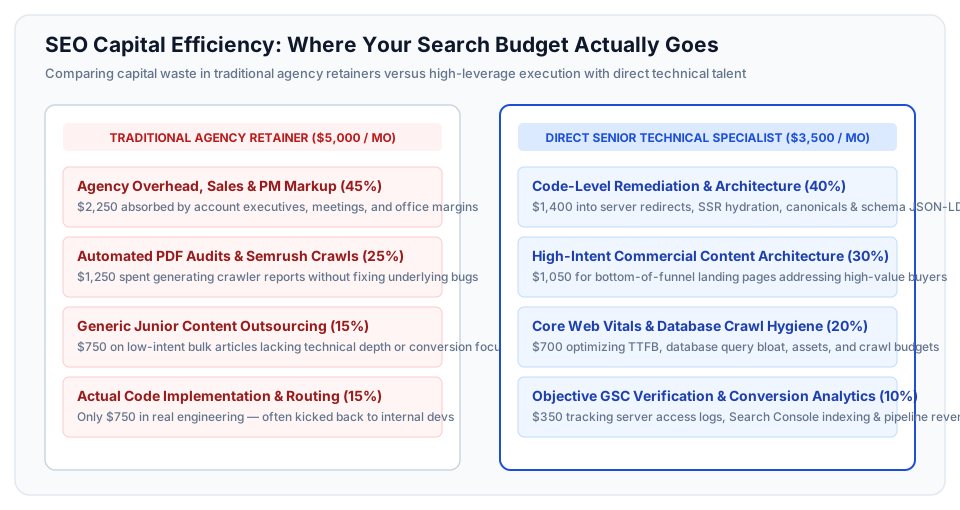
In a standard $5,000 monthly agency retainer, the client pays for an entire commercial infrastructure: agency owner margins, sales commission structures, project managers who act as communication buffers, and enterprise subscriptions for platforms like Semrush and BrightEdge. The actual work delivered often consists of junior account associates downloading automated audit checklists and writing generic content briefs.
Crucially, traditional marketing agencies rarely possess the technical capability to deploy code. When their crawlers flag broken structured data, canonical mismatches, or slow TTFB, they export a PDF report and instruct the client to "send this to your software developer." The business pays the agency to diagnose the issue and must subsequently pay their own internal or freelance engineering team to resolve it.
Conversely, hiring a verified independent technical specialist at $45 to $95 per hour eliminates management intermediaries. For a $3,500 monthly investment, the client receives 35 to 75 hours of direct senior labor. The specialist accesses staging environments, commits pull requests to GitHub, refactors server virtual hosts, embeds validated JSON-LD schema, and verifies fixes directly in Google Search Console. For specialized CMS deployments, consult our vetting guide on where to find WordPress SEO specialists.
The Cheap SEO Trap: Hidden Costs of $300 to $700 Monthly Retainers
Subscribing to low-cost SEO packages priced between $300 and $700 per month is one of the most expensive mistakes a commercial business can make. Legitimate search engine optimization requires hundreds of hours of high-skill technical engineering and subject-matter analysis; low-cost services achieve their margins through dangerous shortcuts.
Private Blog Networks (PBNs) and spam link building: Low-cost providers cannot afford genuine digital PR, outreach, or manual relationship building. Instead, they blast client domains with automated backlinks from expired domains, spun blog networks, and hacked forum profiles. While this may create a temporary artificial ranking bump, Google's algorithmic spam filters inevitably detect the pattern, triggering a catastrophic manual action or algorithmic suppression that wipes out organic traffic overnight.
Low-quality AI text generation: Inexpensive agencies cut costs by deploying unedited, automated AI content generators to publish dozens of generic articles per week. These articles lack original research, domain expertise, and commercial intent mapping. Search engines classify such content as unhelpful duplicate filler, leading to sitewide domain quality score downgrades.
The true cost of cleanup: Recovering from a severe search engine penalty or toxic backlink injection costs far more than doing SEO correctly from the beginning. Professional link audit and disavow campaigns cost between $2,500 and $6,000, while re-indexing a suppressed domain often requires four to nine months of lost revenue while waiting for search engine re-evaluation.
Deliverable Accountability: What Every Dollar Should Buy
To protect marketing capital, business leaders must demand clear, verifiable deliverables tied to code repositories, server access logs, and commercial pipeline growth rather than vanity ranking metrics.
| Operational Area | Low-Value Deliverables (Agency Red Flags) | High-Value Deliverables (Direct Technical Talent) |
|---|---|---|
| Technical Audits | Unfiltered 80-page automated crawler PDF exports listing generic warnings | Staging pull requests fixing specific canonical rules, redirects, and robots directives |
| Site Speed & CWV | Screenshots of Google PageSpeed Insights without code remediation | Asset minification, image WebP conversion pipelines, Redis caching, script deferral |
| Structured Data | Generic plugin toggles creating conflicting Schema.org markup | Handcrafted semantic JSON-LD graph structures verified in Google Rich Results Test |
| Content Architecture | High-volume top-of-funnel blog posts with zero buyer purchasing intent | Targeted bottom-of-funnel commercial landing pages targeting specific buyer pain points |
| Performance Reporting | Rankings for obscure, non-commercial keywords with zero search volume | Organic conversion tracking, Search Console indexing logs, pipeline revenue metrics |
Before releasing milestone payments or approving ongoing retainers, verify that your specialist delivers observable evidence. For new web builds or major redesigns, compare these deliverables with our baseline guide on how much a custom website costs.
Time-to-Payback and Realistic ROI Benchmarks
Organic search engine optimization is an infrastructure investment that operates on a delayed return curve, typically requiring four to nine months to achieve cash-flow neutrality and twelve to eighteen months to deliver peak ROI. Anyone promising first-page rankings in thirty days is either targeting meaningless keywords or using black-hat tactics that risk permanent domain penalties.
Months 1 to 3 (Infrastructure repair & baseline hygiene): Technical specialists audit server configurations, resolve redirect loops, eliminate duplicate canonical tags, fix XML sitemaps, and optimize site speed. Organic traffic may fluctuate or remain flat during this phase as search engines re-crawl updated URLs and clear legacy cache records.
Months 4 to 6 (Indexation parity & keyword velocity): Search engines update their internal link graphs and index clean pages. The site begins earning impressions for commercial keywords, moving from positions 50–100 into positions 11–30. Initial organic lead volume begins to register in analytics.
Months 7 to 12 (Traffic inflection & revenue compounding): Optimized commercial pages break into the top 3 to 5 positions for competitive buyer-intent search queries. Unlike paid advertising (PPC) where traffic drops to zero the moment ad spend halts, organic search assets compound over time, continuously generating high-intent customer inquiries at near-zero incremental marginal cost.
Frequently Asked Questions
How much does website SEO cost per month for a typical business?
Ongoing search engine optimization costs between $1,500 and $5,000 per month for small-to-medium businesses, while mid-market B2B and competitive e-commerce platforms invest $5,000 to $15,000+ monthly. Pricing reflects competitive keyword difficulty, catalog volume, and required content production velocity.
What is the typical hourly rate for an independent SEO specialist?
Senior freelance technical SEO contractors and engineers bill between $45 and $120 per hour. Lower rates ($20–$35/hr) typically represent junior plugin installers, while elite enterprise technical architects bill $150 to $250+ per hour for complex headless platform migrations.
Why are traditional agency SEO retainers more expensive than hiring direct developers?
Traditional agencies markup their fees by 40% to 60% to cover dedicated account managers, sales commissions, physical office overhead, and enterprise tool subscriptions. Direct technical contractors bill strictly for productive engineering hours without administrative overhead.
How much does a one-time technical SEO audit cost?
A full-scope technical SEO audit with hands-on code remediation typically costs between $2,000 and $6,000 for standard websites, scaling to $10,000+ for enterprise platforms with hundreds of thousands of database-driven URLs. Automated PDF exports costing under $500 provide negligible actionable value.
How long does it take for SEO investments to generate positive ROI?
Search engine optimization typically requires four to six months to produce noticeable traffic increases and six to nine months to achieve net positive commercial return on investment. Highly competitive national markets or newly registered domains with zero domain authority may require nine to twelve months.
What is a technical debt surcharge in SEO budgeting?
A technical debt surcharge represents the 30% to 40% of an initial SEO budget required to fix broken server redirects, slow TTFB, client-side SPA rendering errors, and database bloat before search engines can properly crawl and index your site content.
Is cheap SEO ($300–$500/month) worth it for small startups?
No. Retainers below $800 per month rely on automated crawler reports, spun AI content, or dangerous link farm schemes that expose your domain to severe Google algorithmic penalties. Small businesses achieve higher ROI by paying a senior specialist for a targeted $1,500 one-time setup sprint.
How does e-commerce SEO pricing differ from standard lead-generation websites?
E-commerce SEO costs 50% to 100% more than standard B2B websites due to faceted search taxonomy bloat, frequently changing product inventory turnover, high crawl budget consumption, and the necessity of managing schema markup across thousands of SKU variations.
Can I pay an SEO provider based only on performance and ranking results?
Pure performance pricing is usually a red flag because agencies manipulate rankings using obscure, low-competition keywords that generate zero actual paying customers. Legitimate performance contracts combine a baseline monthly operating fee with verified revenue or conversion sharing.
What are the warning signs of an overpriced or ineffective SEO agency?
Red flags include mandatory 12-month lock-in contracts without escape clauses, reporting vanity impressions rather than qualified conversions, refusing to provide staging pull requests or server-level fixes, and hiding link building sources behind non-disclosure policies.
How much does it cost to fix a Google manual penalty?
Recovering from an algorithmic or manual search engine penalty typically costs between $3,000 and $8,000 in professional forensic auditing, backlink profile cleanup, disavow file submissions, and reconsideration requests, with recovery timelines spanning three to six months.
What is the difference between marketing SEO and technical SEO pricing?
Marketing SEO ($1,500–$4,000/mo) focuses primarily on keyword research, copywriting, content calendars, and outreach links. Technical SEO ($45–$120/hr or $2,500–$10,000/sprint) focuses on code execution: server routing, SSR hydration, canonical tags, schema JSON-LD, Core Web Vitals, and database optimization.
Written by Michael Melnyk
Senior IT Technical Writer & Technology Analyst
Senior Technical Writer and IT Industry Analyst with over 7 years of experience analyzing software engineering ecosystems, tech leadership models, and developer procurement frameworks.