Hire a Crypto Developer: Smart Contracts, Wallets, Crypto Payments and Exchange APIs — Which Specialist Your Project Needs
The biggest crypto thefts of 2025 came from stolen keys, not clever code bugs. Before you pay anyone to write a contract, work out whether your project needs a contract at all.


Updated October 22, 2026. A crypto developer is a software engineer who builds products that hold, move or account for digital assets: smart contracts, wallet connections, crypto payment checkouts, exchange integrations and the backend systems around them. "Crypto developer" is not one job. A payments integrator, a smart contract engineer and a custody specialist have different skills, different risks and very different price tags, and hiring the wrong one is the most common and most expensive mistake.
For most businesses the answer is simpler than they expect. If you want to accept crypto payments, connect to an exchange or show wallet balances, you need an integration engineer: 20 to 120 hours, or $900 to $11,400 at an independent senior rate of $45 to $95 per hour. You need a smart contract engineer and an independent security audit only if your product itself must hold customer funds or issue a token, and that is where budgets move from thousands to tens of thousands of dollars. The sections below show how to tell which case you are in, what each costs, and how to test a candidate before you pay for a build.
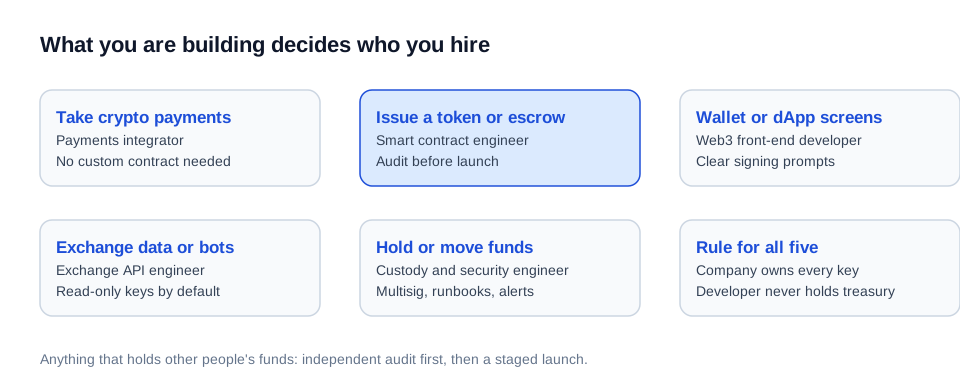
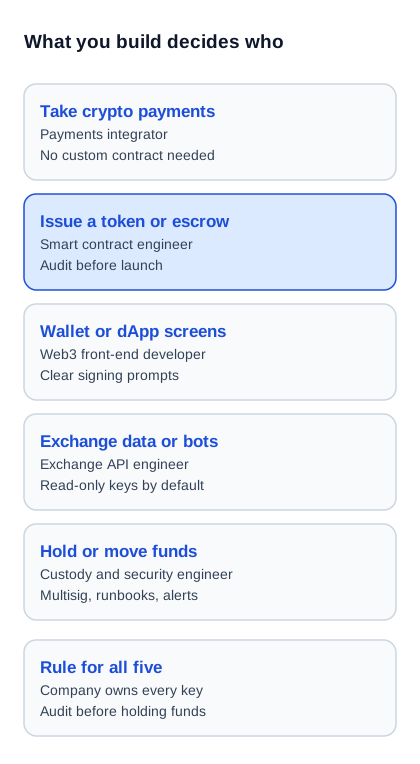
Figure 1: Start from what the product must do, then pick the specialist. Anything that holds other people's funds needs an independent audit before launch.
Five Different Jobs Hiding Behind "Crypto Developer"
Pick the specialist by the thing your product does with digital assets, not by the word "blockchain". The five roles below cover nearly every business request, and most projects need only one or two of them.
| Specialist | Builds | Typical stack | Main risk if done badly |
|---|---|---|---|
| Payments integrator | Crypto checkout, invoices, order matching, stablecoin payouts | Payment-processor APIs, webhooks, TypeScript or Python backend | Wrong amounts, double-credited orders, unreconciled books |
| Smart contract engineer | Tokens, vesting, escrow, staking, on-chain business logic | Solidity (Ethereum-compatible chains), Rust (Solana) | Permanent, public bugs that lose funds |
| Web3 front-end developer | Wallet connection, transaction screens, dashboards | TypeScript, React, wallet libraries | Users signing the wrong thing; unclear transaction prompts |
| Exchange and market-data engineer | Exchange API integrations, price feeds, reporting, trading bots | Node.js or Python, exchange REST/WebSocket APIs | Leaked API keys, rate-limit bans, bad order logic |
| Custody and security engineer | Key management, multi-signature setups, monitoring, incident response | Multisig wallets, hardware security modules, alerting | One stolen key empties the treasury |
Smart contract engineers are the scarcest and the most expensive. If a vendor tells you a store needs a custom contract to accept crypto, ask why a payment processor would not do the same job. Often it would, at a fraction of the cost and without putting your own code between customers and their money.
Why Crypto Projects Fail: Keys and Operations Before Code
The largest losses in crypto come from stolen keys and compromised accounts more often than from flaws in contract code. According to Chainalysis data reported by The Block in December 2025, about $3.41 billion was stolen from January to early December 2025, and the single $1.5 billion Bybit breach made up roughly 44% of it. Private-key attacks on centralized services accounted for 88% of stolen value in the first quarter, and personal-wallet compromises hit at least 80,000 victims.
The same report credits improved monitoring for keeping DeFi hack losses lower, citing one case where a monitoring tool flagged suspicious activity 18 hours before an attack. For a business owner the lesson is practical: budget for key custody, access control and monitoring alongside the code. A developer who talks only about the contract and never about who holds the keys has told you where the risk is not being managed.
Do You Need a Smart Contract at All?
You need a custom smart contract only when the rules of your product must be enforced on-chain without trusting your company. Examples are a token with a fixed supply, a vesting schedule investors can verify, or an escrow that releases funds on conditions. If a database and a payment processor can do the job, they are cheaper, faster to change and easier to support.
| Your goal | Usually the right answer | Custom contract needed? |
|---|---|---|
| Accept crypto from customers in a shop or SaaS | Payment processor integration with order reconciliation | No |
| Pay contractors or affiliates in stablecoins | Payout API or multisig wallet with a documented approval flow | No |
| Show balances or transactions in your app | Read-only blockchain data provider integration | No |
| Issue a standard token (membership, loyalty, community) | A standard token built from audited libraries | Yes, small |
| Lock, vest or escrow funds with public rules | Custom contract plus independent audit | Yes |
| Lending, trading, staking or any pooled funds | Specialist team, formal audit, monitoring, bug bounty | Yes, large |
Standard tokens are best assembled from widely reviewed building blocks rather than written from scratch. OpenZeppelin Contracts is a library of modular, reusable contracts for Ethereum-compatible chains, covering token standards and access control. A developer who proposes writing everything from zero for a plain token is adding cost and risk.
Smart Contract Security: What an Audit Does and Does Not Do
An independent audit is a paid review by a security firm that looks for flaws before launch, and it lowers risk without removing it. The Ethereum Foundation's smart contract security guidance says plainly that an audit is not a guarantee. It recommends combining it with automated testing, fuzzing, bug bounties, restricted access to sensitive functions and safeguards on upgrades.
Audit prices vary widely, and nearly every public price list comes from firms that sell audits, so treat the numbers as directional. Published 2026 ranges collected in October 2026 put standard DeFi-style audits mostly between $25,000 and $100,000 with 3 to 6 weeks of work, simple token reviews far lower, and bridges or multi-chain systems at $50,000 to $200,000 or more. Rush delivery commonly adds 20% to 50%, re-audits after fixes are usually quoted separately, and one 2026 pricing guide puts non-Ethereum-compatible stacks 20% to 30% above Solidity because fewer reviewers exist.
Ask any developer these questions before work starts:
- Who will audit, and is the audit budget in my quote or separate?
- What testing will exist before the audit, so the auditor does not spend paid time on basic bugs?
- Will the contract be upgradeable, who can upgrade it, and is that power protected by a timelock or multi-signature approval?
- What is the plan if a flaw is found after launch: a pause switch, a bug bounty, a communication plan?
Keys, Wallets and Who Controls the Money
The company, not the contractor, must own every key, wallet and account that can move funds. Never let a freelancer deploy a contract from a personal wallet that stays the owner, never share an exchange API key with withdrawal rights, and never store a recovery phrase in a chat, an email or a shared document.
- Multi-signature wallets: require two or three named people to approve a transfer, so one stolen laptop cannot empty the treasury.
- Separated roles: the developer who writes the contract does not hold the treasury keys.
- Read-only and trade-only API keys: exchange keys given to a bot or dashboard should not be able to withdraw.
- Offboarding: when a contractor leaves, rotate every credential they touched the same day.
Compliance: What the Developer Cannot Decide for You
If your product exchanges, holds or transfers crypto for customers, regulation can matter more than code, and it varies by country. A developer builds what you specify; a lawyer tells you whether you may operate. This is general information, not legal advice.
- European Union: national transitional regimes under the MiCA regulation ended on July 1, 2026. According to the French regulator AMF and ESMA, crypto-asset service providers without authorization must stop serving EU clients, and authorized providers cannot outsource custody to unauthorized firms. If you serve EU customers with custody, exchange or transfer services, confirm your authorization status before launching.
- United States: the GENIUS Act on payment stablecoins is law, but regulators had not finished final rules as of mid-2026, and secondary sources give January 18, 2027 as the latest effective date. Check the current status with counsel if you plan to issue a stablecoin.
- Everywhere: accepting crypto as payment is a different regulatory category from running an exchange or issuing a token. Define which one you are before you hire.
Cost: Hours and Budgets by Project Type
Integration work fits the usual independent senior range of $45 to $95 per hour, while contract work that secures other people's money is a specialist market where rates are often higher. For reference, one 2026 hiring guide lists US freelance blockchain rates of $75 to $200 or more per hour, and agencies typically charge $150 to $250 per hour. The figures below are planning estimates, not quotes.
| Project | Hours | Engineering cost ($45–$95/hr) | Extra budget |
|---|---|---|---|
| Crypto payment checkout for a shop or SaaS | 20–60 | $900–$5,700 | Processor fees; accounting setup |
| Wallet-connect dApp front end | 60–150 | $2,700–$14,250 | Design; testnet and mainnet RPC provider |
| Exchange API dashboard or reporting tool | 40–120 | $1,800–$11,400 | Hosting; monitoring |
| Blockchain data indexer and backend | 40–100 | $1,800–$9,500 | Node or data-provider fees |
| Standard token with tests and testnet rehearsal | 20–50 | $900–$4,750 | Audit (simple token: low thousands and up) |
| Custom escrow, vesting or staking contract | 150–400+ | $6,750–$38,000+ | Audit $25,000–$100,000; bug bounty |
| Key custody and multisig setup with runbooks | 10–30 | $450–$2,850 | Hardware devices; staff training |
For general rate context see developer hourly rates and the comparison of building, hiring and outsourcing software development.
Three Realistic Scenarios
Scenario 1: An online store adds stablecoin checkout
A store with 40 orders a day wants to accept stablecoins to avoid card fees on large orders. A custom contract is not required. An integration engineer connects a payment processor, handles webhooks for confirmed payments, ties each payment to an order, and builds a reconciliation report for the accountant. Estimated effort is 25 to 45 hours, about $1,125 to $4,275. The usual failure is underpayment: the customer sends slightly less than the invoice, and the order system has no rule for it.
Scenario 2: A community launches a membership token
A community platform wants a token that unlocks features for members. The developer builds it from audited libraries, writes tests covering transfers and permissions, rehearses on a public test network, then deploys with the company's multisig wallet as owner. Estimated engineering is 25 to 50 hours ($1,125 to $4,750) plus an independent review. The decision that matters most is who owns the admin role; the engineer should never keep it.
Scenario 3: A treasury team wants exchange reporting
A small company holds assets on two exchanges and its finance lead rebuilds a spreadsheet every month. An engineer connects read-only API keys, stores daily balances and trades in a database, and produces a monthly report. Estimated effort is 40 to 70 hours ($1,800 to $6,650). Read-only keys are non-negotiable: the system never needs withdrawal rights.
How to Vet a Crypto Developer
Judge candidates by shipped work you can inspect, not by white papers or follower counts. For contract engineers, deployed and verified contracts on a public block explorer and audit reports naming them are checkable evidence. For integration engineers, ask for a past payment or exchange integration and how they handled failed and duplicate events.
| Question | Junior or risky signal | Senior signal |
|---|---|---|
| Who should own the deployer and admin keys? | "I'll deploy it and send you the address." | The client's multisig owns admin rights from day one; the developer never holds treasury keys. |
| How do you test before mainnet? | "I tested it manually." | Automated tests, fuzzing, a test-network rehearsal and a written list of what was not tested. |
| A customer pays slightly less than the invoice. What happens? | No answer. | A defined tolerance, a partial-payment state and a manual review path. |
| Can we upgrade the contract later? | "Yes, I keep the upgrade key." | Explains trade-offs: immutable is simpler, upgrades need timelocks and multisig. |
| Do we need a custom contract? | "Yes, always." | Challenges the premise and offers a cheaper non-contract route when one exists. |
The 3 to 5 hour paid trial
Pay the candidate their hourly rate for a task that mirrors your actual risk. For an integration role: given a sandbox payment processor, build a small service that receives payment notifications, ignores duplicates, credits an order once, and logs every state change. For a contract role: review a short, intentionally flawed escrow contract supplied by you, list every issue by severity, and write the tests that would have caught the worst one.
| Criterion | Pass | Fail |
|---|---|---|
| Duplicate handling | Same event twice credits the order once | Double credit |
| Issue finding (contract task) | Finds the major flaws, ranks them, explains impact in plain words | Lists style nits and misses fund-loss paths |
| Key handling | No secrets in code or chat; uses environment-based secrets | Keys pasted into files or messages |
| Communication | States assumptions and what was left out | Claims "fully secure" |
| Handover | Setup and runbook work on a clean machine | Needs the author to explain |
Red Flags and Common Mistakes
- Promises of guaranteed returns, yield or "risk-free" tokenomics. Walk away.
- A developer who insists on holding the deployer or admin keys.
- Copy-pasted forks of other projects presented as original work, with no tests.
- Mainnet launch with no test-network rehearsal and no independent review.
- One shared wallet or one exchange API key with withdrawal rights for everything.
- Choosing a blockchain because it is popular instead of because users, tools and auditors exist for it.
- Skipping legal advice on custody, exchange or token issuance.
Expert Tip: Start With a Paid Scoping Sprint
Spend 6 to 12 hours ($270 to $1,140 at $45 to $95 per hour) on a written scope before any build: what the product holds, who controls the keys, which chain and why, what is custodial, what needs an audit and what regulators may require. Many projects discover in that sprint that a processor integration replaces a planned contract, saving months. A scope document also makes quotes comparable, which is the fastest way to expose inflated bids.
Frequently Asked Questions
How much does it cost to hire a crypto developer?
An independent senior developer for integration work costs $45 to $95 per hour: about $900 to $5,700 for a crypto payment checkout and $1,800 to $11,400 for an exchange API tool. Smart contract work that holds funds is priced higher and needs an audit that often costs $25,000 to $100,000 for standard DeFi-style projects.
What is the difference between a crypto developer and a blockchain developer?
The terms overlap. "Blockchain developer" usually means someone who writes contracts or works on chain infrastructure, while "crypto developer" in a business brief often means anyone building products around digital assets, including payments, exchange integrations and wallets. Define the exact job instead of relying on the label.
Do I need a smart contract to accept crypto payments?
No. Most shops and SaaS products use a payment processor with webhooks and order reconciliation, which takes 20 to 60 hours. A custom contract adds cost and security risk without helping a standard checkout.
Is a smart contract audit mandatory?
No law requires it, but any contract that holds other people's funds should be independently reviewed before launch. An audit lowers risk without guaranteeing safety, so combine it with tests, a bug bounty and a pause or upgrade plan.
How long does a smart contract audit take?
Simple token reviews take days, standard DeFi-style audits typically 3 to 6 weeks, and complex multi-chain systems 2 to 6 months, according to public 2026 audit-firm price guides. Rush requests often add 20% to 50%, and re-audits after fixes are usually quoted separately.
Which blockchain should I build on?
Choose where your users, wallets and auditors already are. Ethereum-compatible chains use Solidity and have the largest tooling and auditor pool; Solana uses Rust and reviews can cost 20% to 30% more because fewer auditors specialize in it, per a 2026 audit pricing guide. For payments you may not need to choose at all if a processor handles it.
Should the developer hold the keys to my contract or wallet?
No. The company should own the admin role and treasury keys, ideally through a multi-signature wallet requiring two or three named approvers. Keep the developer's access limited to deployment tasks and revoke it afterward.
Is hiring a crypto developer legal advice or compliance?
No. A developer builds the product; a lawyer decides whether you may offer it. In the EU, MiCA transitional regimes ended July 1, 2026, so custody and exchange services need authorization. In the US, stablecoin rules under the GENIUS Act were still being finalized as of mid-2026.
Can a crypto developer guarantee my project is secure?
No honest developer can. Security comes from tests, an independent audit, controlled keys and monitoring, and even then risk remains. Treat a promise of "fully secure" as a red flag.
How do I test a crypto developer before hiring?
Give a paid 3 to 5 hour task: an integration role builds a payment-notification service that ignores duplicates, and a contract role reviews a flawed escrow contract and ranks the issues. Pay their normal hourly rate and grade against a written pass or fail rubric.
Do I own the code a crypto developer writes?
You do if the contract assigns all work product to you and the code lives in your repository and accounts. Require your company to own the deployer and admin wallets and the repository from the first commit.
What is the biggest risk in a crypto project?
Key and access compromise, more often than code flaws. Chainalysis data reported in December 2025 attributes 88% of stolen value in the first quarter of 2025 to private-key attacks on centralized services, and the single Bybit breach was about 44% of the year's total.
Not sure whether your idea needs a contract, a processor or just an exchange integration? Get matched with a verified senior engineer for a short paid scoping sprint or a fixed one-time task, with your keys, your repository and your accounts from day one. Teams building on Solana can look at Rust developers directly.
Written by Michael Melnyk
Senior IT Technical Writer & Technology Analyst
Senior Technical Writer and IT Industry Analyst with over 7 years of experience analyzing software engineering ecosystems, tech leadership models, and developer procurement frameworks.