How to Hire an AI Developer: Skills, Interview Questions, and a Paid Trial
Hiring an AI developer is a delivery decision, not a keyword search. Use this checklist to define the milestone, verify production skills, ask useful interview questions, and run a paid trial before a larger contract.

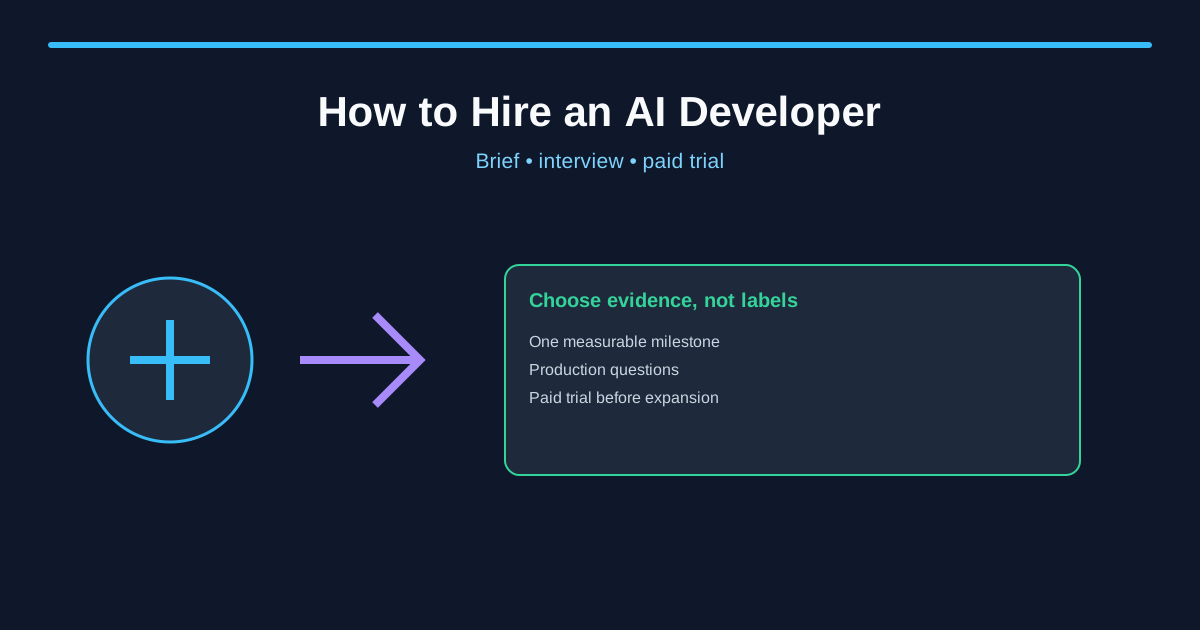
The safest way to hire an AI developer is to hire against one measurable delivery milestone, verify how the person handles data, tools, failures, and evaluation, then run a paid 3–5 hour trial on sanitized material. Do not select a contractor because a profile lists every model or framework. Select the person who can explain the boundary around the model and leave your team with tested, understandable code.
This guide is for founders and product owners hiring a freelance or contract AI developer for an application, RAG workflow, agent, API integration, or prototype hardening. It does not cover employee compensation, courses, certifications, career paths, or a semantic comparison between AI developer and AI engineer. For the role definition itself, see what an AI-native developer means.
If you already know the technical capability you need, start with AI engineering specialists for LLM, RAG, and integrations. If the work involves AI-assisted product delivery as well as the AI feature, review the AI-native developer category. The rest of this article helps you decide what to ask for and how to verify the answer.
Production expectations should be explicit from the first conversation. The OpenAI production guidance and Anthropic’s agent design guidance both point toward the same hiring lesson: model calls sit inside an application boundary with inputs, tools, controls, tests, and monitoring.
Start with the outcome, not the AI label
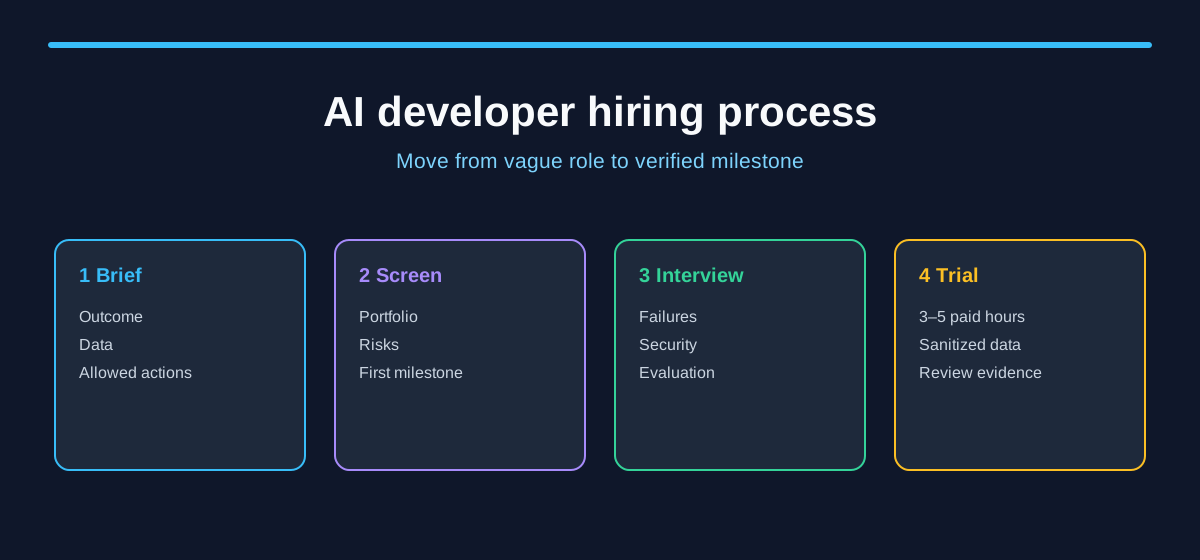
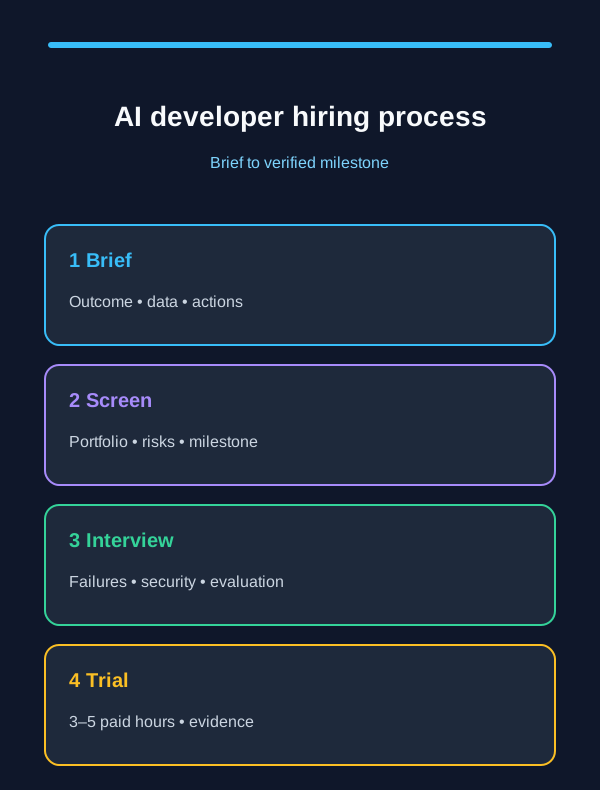
“We need an AI developer” is not a usable brief. Write the user decision or business action first: classify incoming support requests, answer questions from private documents with citations, draft a quote for human approval, extract fields from invoices, or connect an assistant to an internal system.
Then document the current state. Say whether there is an existing repository, which data sources are authoritative, where authentication lives, which providers are already approved, and what the system must never do. A candidate cannot estimate an agent that can “manage tickets” until you define whether it may read, draft, update, close, or delete a ticket.
| Brief element | Example | Why it matters |
|---|---|---|
| User outcome | Answer support questions with source citations | Prevents a prompt demo from being mistaken for a product |
| Inputs and systems | PostgreSQL records plus approved help-center documents | Reveals ingestion, permissions, and integration work |
| Allowed actions | Draft a reply; a person sends it | Sets the tool and approval boundary |
| Quality evidence | 40 representative questions with expected sources | Gives the developer something to evaluate |
| Handover | Code in your repository, tests, prompts, and runbook | Protects ownership and future maintenance |
What skills should an AI developer have?
Look for a combination of application engineering and model integration. A person who can call an API but cannot trace a failed request, protect a tenant boundary, or validate tool arguments is not ready for an unsupervised production milestone.
- Backend delivery: server-side secrets, authentication, data access, queues, retries, timeouts, and clear API contracts.
- Model integration: structured outputs, streaming where useful, token limits, model fallbacks, prompt versioning, and provider error handling.
- Retrieval: ingestion, chunking, embeddings, metadata filters, citations, refresh rules, and a way to inspect why a document was retrieved.
- Agent boundaries: narrow tools, schema validation, authorization, approval for irreversible actions, idempotency, and an audit trail.
- Evaluation: representative cases, pass criteria, regression checks, failure transcripts, latency measurements, and cost per completed task.
- Software practice: readable commits, tests around important paths, reproducible setup, security review, and a handover your team can run.
Ask for evidence rather than accepting a list of keywords. A strong portfolio entry explains the user problem, the architecture, the failure that appeared after launch, the measurement that exposed it, and the change that improved the result. A screenshot of a chatbot does not prove any of those things.
How to screen an AI developer before the interview
Use a short written screen before spending an hour on calls. Give the candidate a sanitized scenario and ask for a one-page response. The response should identify unknowns, propose a first milestone, name two risks, and state what they would measure.
Reject answers that jump directly to a framework or a larger model. A candidate may reasonably choose Python, TypeScript, a hosted provider, or a self-hosted model, but the choice should follow the data, latency, privacy, and operating constraints. You are testing judgment, not collecting brand names.
| Signal | Positive evidence | Concern |
|---|---|---|
| Scoping | Separates a first milestone from later features | Promises a complete autonomous system immediately |
| Data | Asks who may access which records | Treats private data as generic context |
| Quality | Requests representative cases and pass criteria | Uses a few hand-picked demo prompts |
| Safety | Restricts tools and adds approval before side effects | Lets the model call arbitrary endpoints |
| Operations | Names logs, spend limits, retries, and rollback | Stops at “the API returns an answer” |
Interview questions that reveal production ability
Use questions that force the candidate to describe a decision and its consequence. You do not need to know every technical term in advance; ask for a diagram, a trace, or a small code excerpt when the answer is abstract.
- Show how a request moves from the user interface to the model and back. Where are keys, authorization, validation, and logs?
- What would you put in an evaluation set for this workflow, and what result would make you stop the rollout?
- How would you prevent one tenant’s documents from appearing in another tenant’s retrieval context?
- What happens when the provider times out, returns malformed JSON, or exceeds the token budget?
- Which actions may the model prepare, and which actions require a person to approve?
- How would you investigate a sudden increase in cost, latency, or unsupported answers?
- What would you keep as deterministic application code instead of delegating it to the model?
- What is the smallest first commit you would make after taking over the repository?
For a RAG candidate, ask them to explain chunking, metadata filters, retrieval evaluation, and source citations. For an agent candidate, ask about tool schemas, state, retries, idempotency, and approval logs. For a prototype takeover, ask what they would inspect before changing prompts. Their sequence of investigation often tells you more than their framework list.
Run a paid 3–5 hour trial
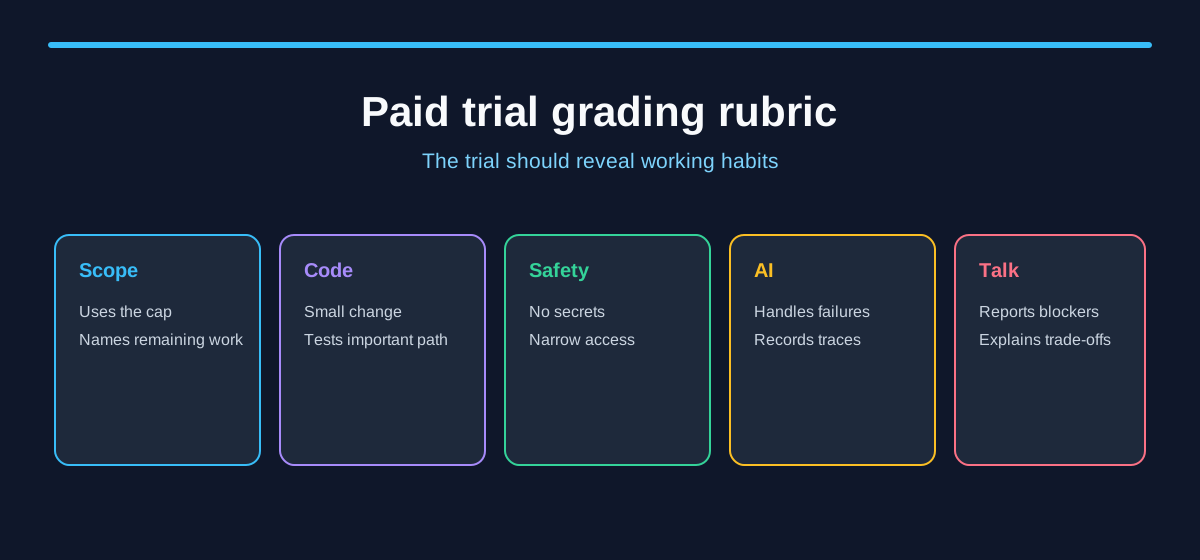
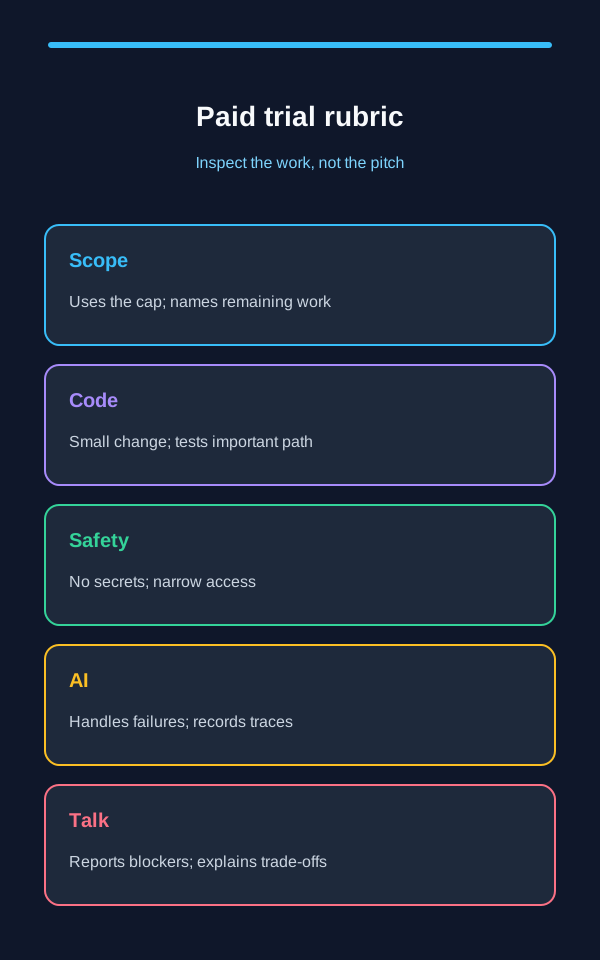
A paid trial should resemble the work you may actually assign, use sanitized data, and have a narrow definition of done. Do not ask for a free production feature. The goal is to inspect working habits, not to extract unpaid delivery.
Good trial options include adding citations to five answers, writing a small evaluation harness for 20 representative cases, placing one tool behind a human approval step, fixing a server-side key leak, or reviewing a generated repository and listing the first safe changes. Give the candidate a test repository, a time budget, and an explicit stop condition.
| Area | Pass signal | Fail signal |
|---|---|---|
| Scope | Works within the agreed hours and states what remains | Spends the time on unrelated cleanup |
| Code | Small change, clear names, tests for the important path | Large generated patch with no explanation |
| AI behavior | Handles malformed output and records useful traces | Assumes every response is valid |
| Security | No secrets in client code or commits; access is limited | Copies credentials or bypasses authorization |
| Communication | Reports assumptions, blockers, and next step | Disappears until the time limit ends |
After the trial, ask the developer to walk through one trade-off and one thing they would change with another four hours. You are looking for honest boundaries and a safe next step, not a theatrical demo.
Choose the contract after the trial
Use the engagement model that matches uncertainty. An hourly developer arrangement fits discovery, debugging, and a takeover where the repository needs inspection. A one-time task fits a defined integration, evaluation setup, or hardening milestone. For recurring delivery, compare the practical guidance on hiring a part-time senior AI engineer.
Ask for the rate and expected hours separately. The AI developer cost guide covers project hour bands and operating costs such as model calls, hosting, evaluation, and maintenance. Do not let a low engineering quote hide an unbounded provider bill or a missing handover.
Red flags before signing
- The proposal promises “fully autonomous” behavior without listing allowed tools or approvals.
- The candidate cannot show a test, trace, evaluation example, or production failure they learned from.
- The work will happen in the developer’s private repository, with code transferred only at the end.
- Provider accounts and API keys must belong to the contractor rather than your organization.
- The quote has a model or framework list but no acceptance criteria, hour band, or exclusions.
- The trial requires free work, access to real customer data, or a broad feature with no time box.
What to put in the agreement
State the repository and account ownership, permitted data, confidentiality, intellectual property assignment, rate, hour cap, approval point, acceptance criteria, and handover materials. Include who pays provider bills and who can change prompts, models, indexes, and evaluation cases.
If the system supports consequential decisions or can change records, add an explicit human review path and incident process. The agreement should describe the boundary in plain language so a product owner can tell whether a proposed change is inside or outside the milestone.
Hire for the first verified milestone
The right AI developer is not the person with the longest list of tools. It is the person who can reduce an unclear request to a testable milestone, protect the data boundary, explain failure modes, and leave a codebase another developer can operate. Start with a paid trial, keep the first scope small, and expand only when the evidence supports it.
When you need help turning that brief into a candidate match, ProofDevs can connect you with independent developers who have shipped the relevant application work. Keep the brief, trial, code, and acceptance evidence in your own repository from day one.
Frequently asked questions
How do I hire an AI developer?
Define one user outcome, screen for production evidence, ask scenario-based interview questions, and run a paid 3–5 hour trial on sanitized material. Choose the contractor who can explain data access, failures, evaluation, and handover in addition to the model call.
What skills should I look for in an AI developer?
Look for application engineering, server-side security, model integration, structured outputs, data and retrieval work, tool boundaries, evaluation, testing, and deployment. The exact stack matters less than evidence that the person has operated the relevant workflow.
What should an AI developer portfolio show?
A useful portfolio entry explains the user problem, architecture, data boundary, evaluation method, production failure, and measurable result. Screenshots or prompt demos alone do not establish production skill.
What questions should I ask an AI developer in an interview?
Ask how they protect tenant data, validate model output, handle provider failure, restrict tools, measure quality, control cost, and roll back a bad change. Request a trace or code example when an answer stays abstract.
Should I give an AI developer a test task?
Yes, use a paid 3–5 hour task with sanitized data and a narrow definition of done. Grade scope control, code quality, tests, security, AI failure handling, and communication rather than demanding a free feature.
What is a good trial task for a freelance AI developer?
Good options include adding citations to five answers, creating a 20-case evaluation harness, gating one tool behind approval, removing a client-side key, or auditing a generated repository. Use a task that resembles the milestone you may actually buy.
How can I tell whether an AI developer has built production systems?
Ask for the failure modes they saw after launch, the measurements they used, the change they made, and the rollback or fallback path. Production experience appears in details such as authorization, malformed output, retries, traces, and data refreshes.
Can a freelance AI developer work in our existing repository?
Yes, and they normally should. Give least-privilege access to your repository and environments, require small reviewable commits, and agree how secrets, customer data, prompts, tests, and documentation are handled.
How long should an AI developer trial last?
Three to five paid hours is enough to inspect a narrow task, communication, and code hygiene. It is not enough to validate a whole product, so use the trial to decide whether to approve the next milestone.
Should the contractor own the AI provider account?
No. The client should normally own the model provider, hosting, repository, and billing accounts. The contractor can receive scoped access while your organization keeps control of usage, data, invoices, and account recovery.
How do I hire an AI developer for a RAG project?
Ask for evidence with ingestion, chunking, metadata filtering, retrieval evaluation, citations, refresh rules, and tenant isolation. A trial can add citations or an evaluation harness to a sanitized document set before you approve a larger build.
How do I hire an AI developer to build an agent?
Define the tools and actions first, then check for schema validation, authorization, state handling, retries, idempotency, audit logs, and human approval. Do not approve an agent based only on a conversational demo.
Written by Michael Melnyk
Senior IT Technical Writer & Technology Analyst
Senior Technical Writer and IT Industry Analyst with over 7 years of experience analyzing software engineering ecosystems, tech leadership models, and developer procurement frameworks.