No-Code vs. Freelancer vs. In-House: How Small Businesses Should Build Software
Small businesses waste money in two opposite ways: buying complex custom development before validating their workflow, or forcing inflexible no-code tools past their breaking point. Here is how to choose the right path.

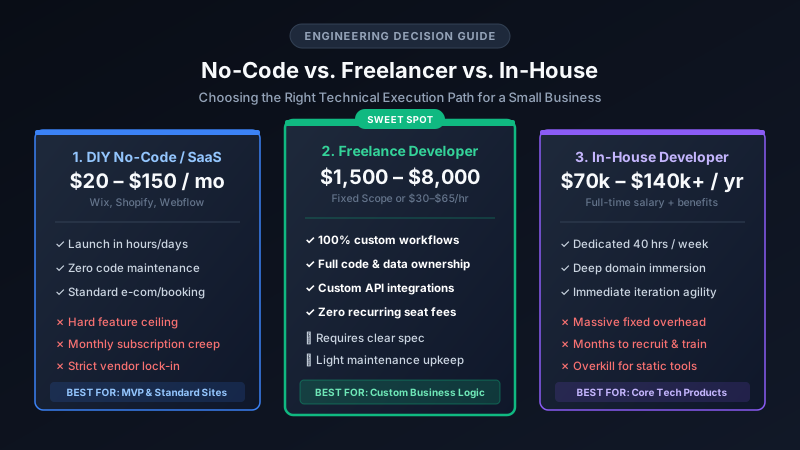
A small business should choose its software execution model based on workflow uniqueness and ongoing rate of change, not on technical ideology. No-code platforms like Webflow, Shopify, or Wix excel when you need to test an offer quickly without maintenance debt. Independent freelance developers deliver the highest return when off-the-shelf software cannot handle your proprietary business logic. Full-time in-house engineers are rarely justified unless proprietary software is your core revenue-generating product.
Too many founders trap themselves in extremes: either spending $30,000 on custom development for an unproven concept, or spending months wrestling with fragile no-code workarounds that crash as soon as transaction volume scales. Reviewed September 2026. Financial figures and architectural guidelines reflect standard small-business implementations.
Executive Summary: The Three Options Compared
Before examining specific use cases, compare how the three paths differ across five critical operational dimensions: initial expenditure, deployment speed, customization ceiling, ongoing overhead, and system ownership.
| Evaluation Metric | DIY No-Code / SaaS | Freelance Developer | In-House Engineer |
|---|---|---|---|
| Setup Investment | $100 – $1,500 (tool licenses + templates) | $1,500 – $8,000 (defined milestone scope) | $15,000 – $35,000+ (recruiting + onboarding) |
| Time to First Value | 3 to 14 days | 2 to 6 weeks | 2 to 4 months (including search cycle) |
| Customization Ceiling | Low to Moderate (constrained by API and builder UI) | Complete freedom within modern code standards | Complete freedom within modern code standards |
| Recurring Cost Burden | $30 – $400/month (per-seat, transaction, app fees) | Near-zero (static hosting $5-$20/mo + ad-hoc support) | $75,000 – $140,000/year (salary, benefits, taxes) |
| Data & Code Ownership | Platform-locked (cannot export proprietary backends) | 100% company-owned git repository & database | 100% company-owned git repository & database |
| Best Starting Context | Standard websites, simple stores, rapid prototypes | Custom workflows, unique customer portals, integrations | Venture-funded tech startups with daily core shifts |
Path 1: When No-Code and Website Builders Win
No-code tools (including visual builders like Webflow and Framer, e-commerce engines like Shopify, and workflow automation tools like Make or Zapier) are the optimal starting point when your business process conforms to industry conventions.
If your requirements match an established pattern—such as an informative corporate brochure, a service booking calendar, or an online catalog with standard Stripe checkout—building custom software is an inefficient allocation of capital. For an in-depth breakdown of hosted platforms, see our comparison of the best website builders for small business.
Signals that No-Code is your best choice:
- The business model is unproven: You are launching a new service line or product idea and need customer validation before investing thousands of dollars into software infrastructure.
- Standard workflows suffice: Your booking, inventory, or lead capture requirements do not require custom multi-tier pricing, complex role-based permissions, or offline device synchronization.
- Internal team members must edit content daily: Non-technical marketing and operational staff need to create landing pages, modify product descriptions, and publish blog articles without developer intervention.
- Cash runway is limited: Spending $10,000 on custom engineering would jeopardize inventory acquisition, marketing spend, or working capital.
Path 2: When to Hire a Freelance Developer (The Sweet Spot)
The limitation of no-code is not how fast you can start; it is where the platform stops. As a small business grows, standard software features begin clashing with operational reality. This is where partnering with an experienced independent contractor yields the highest return on investment.
Unlike an agency with heavy account management overhead, a senior independent engineer directly translates your operational requirements into clean, maintainable software. For a deeper look at scoping these projects, read our guide on how to hire a developer for a small business or startup.
Critical indicators that you have outgrown No-Code:
- The “Zapier House of Cards” is failing: Your business relies on five connected no-code apps via webhook chains. When one API payload changes or an auth token expires silently, customer data is lost or orders fail to synchronize.
- Proprietary pricing or scheduling logic: You offer dynamic volume discounts, complex tiered rentals, regional tax calculations, or custom quoting algorithms that off-the-shelf checkout forms cannot calculate.
- Accumulating subscription creep: You are paying $50/month for a builder, $80/month for integration connectors, and $150/month for specialized plugins. A custom web application deployed on modern serverless infrastructure (like Supabase and Vercel) can reduce recurring platform costs to less than $25/month.
- Customer portal and security requirements: You need clients to access private dashboards, manage confidential documents, or interact with historical order records under strict data segregation guidelines.
- Performance bottlenecks affecting conversion: Bloated template scripts and third-party tracking plugins degrade mobile Core Web Vitals, suppressing organic search visibility and mobile checkout conversion rates.
When you reach this inflection point, hiring a specialist through a vetted platform like ProofDevs verified developers allows you to purchase senior-level engineering on a milestone basis without ongoing payroll liabilities.
Path 3: When Does an In-House Developer Make Sense?
Hiring a full-time in-house software engineer is one of the most expensive decisions a small business can make. In addition to a competitive annual base salary ($75,000 to $140,000+ depending on geography and seniority), employers incur payroll taxes, benefits, equipment costs, recruitment fees, and management overhead.
For roughly 90% of traditional small and medium businesses (SMBs), an in-house developer is an unnecessary financial drag. A small business rarely possesses 40 hours per week of high-leverage software development once the primary application or workflow automation is delivered.
You should only hire in-house if:
- Software is your primary sellable product: You are not a service or commerce business using software as an operational tool; you are a technology company where users pay directly for access to proprietary software.
- Daily architectural iterations are required: The product roadmap requires continuous daily deployments, rapid algorithmic testing, and constant interaction between engineering and customer success teams.
- Deep, proprietary domain IP must remain internal: The core algorithm or architecture is a patentable trade secret that requires perpetual internal oversight.
If your business does not meet all three criteria, a full-time hire will inevitably spend a significant percentage of their salaried time performing low-leverage maintenance, creating organizational friction and inflated overhead.
Real-World Financial Scenarios: 3-Year Total Cost of Ownership (TCO)
To illustrate the economic difference, consider a service firm that needs a client portal to accept custom orders, process payments, and sync records with internal fulfillment.
| Cost Category | No-Code Stack (Bubble + Add-ons) | Freelance Custom Build (Next.js + Postgres) | In-House Junior/Mid Engineer |
|---|---|---|---|
| Year 1 Capital Cost | $2,400 (subscriptions + plugins) | $5,500 (one-time engineering fee) | $92,000 (salary + equipment + tax) |
| Year 2 Capital Cost | $3,200 (plan tier upgrades) | $600 (hosting + minor feature tweaks) | $96,000 (salary + benefits) |
| Year 3 Capital Cost | $4,100 (workload unit surcharges) | $600 (hosting + minor maintenance) | $101,000 (salary + benefits) |
| Total 3-Year Outlay | $9,700 | $6,700 | $289,000 |
| Long-Term Asset Value | Zero (rented platform, no exportable IP) | High (proprietary IP, portable codebase) | High (proprietary IP, internal team) |
As demonstrated above, forcing a complex system into high-tier no-code plans often ends up costing more over three years than hiring an independent senior contractor to build a lean, custom solution that runs on economical infrastructure.
Practical Decision Matrix: How to Choose Today
Use this diagnostic checklist to determine your next operational step:
- Are you still testing whether customers will pay for this?
Action: Launch on Webflow, Wix, or Shopify. Validate demand in days. Do not write custom code yet. - Have you validated the workflow, but standard platforms require clumsy workarounds, manual spreadsheets, or multiple third-party subscriptions?
Action: Hire an experienced freelance developer. Define a strict milestone scope, build a custom web app or integration, and own your software asset completely. - Is your company a tech startup with substantial funding whose software requires daily feature releases and continuous adaptation?
Action: Begin recruiting an in-house core team or hire a technical co-founder.
If you have an existing workflow that is currently breaking your no-code setup or manual spreadsheets, submit your scope to our team for a transparent technical review and connection to verified developers ready to execute.
Written by Michael Melnyk
Senior IT Technical Writer & Technology Analyst
Senior Technical Writer and IT Industry Analyst with over 7 years of experience analyzing software engineering ecosystems, tech leadership models, and developer procurement frameworks.