What Is an AI-Native Developer and When Should You Hire One?
An AI-native developer directs AI coding agents, verifies the generated work, and builds AI-first products with production controls for models, tools, and retrieval.

An AI-native developer is a software engineer who directs AI coding agents, reviews their output, and builds production systems where models, tools, or retrieval are part of the workflow. The term describes a working method, not a certification: the developer still owns the architecture, security decisions, tests, and code that ships.
For technical leaders, startup founders, and product executives, the useful distinction is between AI-assisted development and AI-native development. An AI-assisted developer uses autocomplete or chat for individual tasks; an AI-native developer specifies work for agents, validates the generated changes, and applies the same engineering discipline to AI features and AI-assisted delivery.
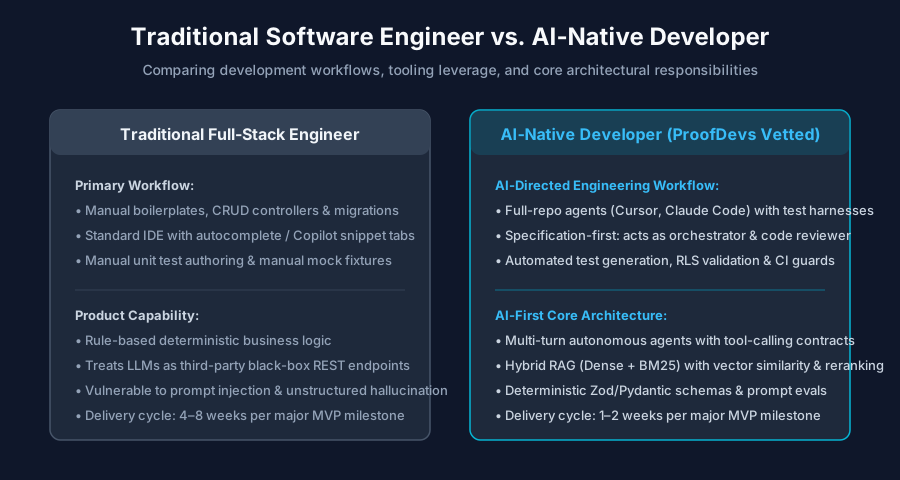
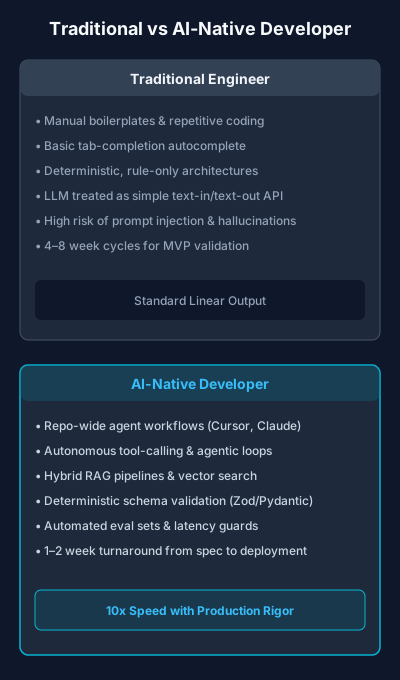
What Is an AI-Native Developer?
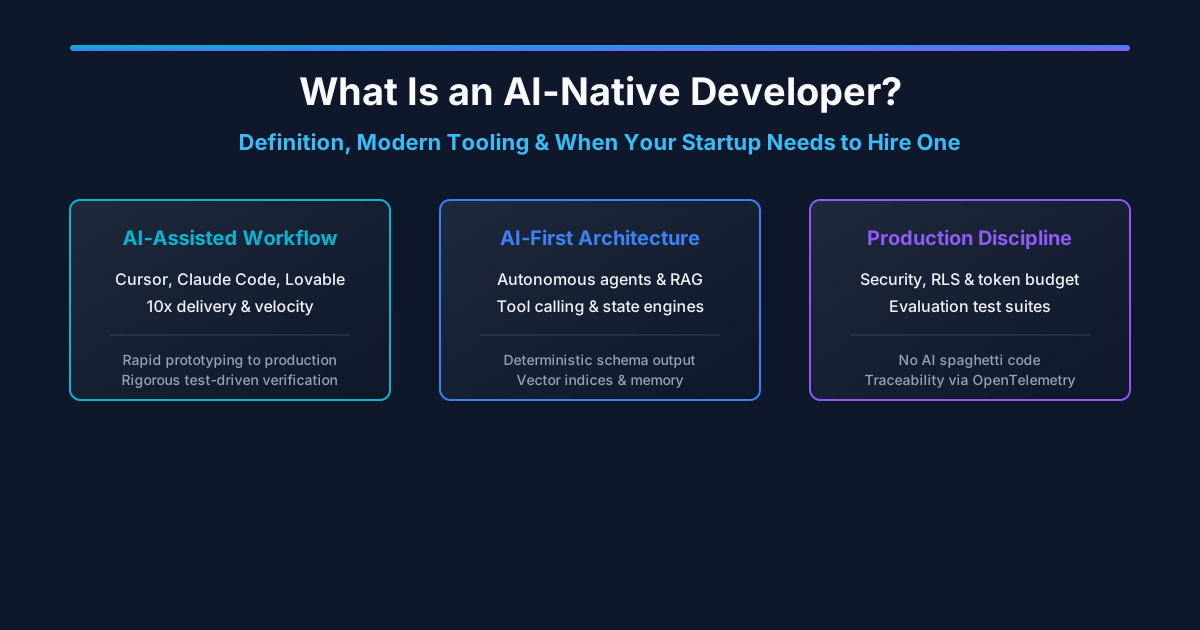
To accurately evaluate candidates, teams must understand that an AI-native developer operates across two complementary dimensions:
- 1. The AI-Augmented Workflow Dimension (How they build): Instead of manually typing repetitive boilerplate, writing routine migration scripts, or manually composing boilerplate CRUD handlers, the AI-native developer orchestrates autonomous coding environments (such as Cursor, Claude Code, Lovable, or Codex). They function as a system architect, technical specification author, and rigorous code reviewer. They leverage AI agents to scaffold, refactor, and write unit tests across entire repositories simultaneously, achieving delivery velocities 5 to 10 times higher than traditional manual workflows while maintaining strict type safety and architectural coherence.
- 2. The AI-First Architecture Dimension (What they build): Beyond writing code with AI, an AI-native engineer designs software systems where intelligence is embedded in the core runtime. They architect multi-step autonomous agent loops, construct resilient Retrieval-Augmented Generation (RAG) pipelines, enforce deterministic output schemas with validation libraries like Zod and Pydantic, and implement tool-calling protocols that safely bridge language models with transactional databases and external APIs.
If your project requires dedicated engineering capacity to build intelligent agents or ship a full-stack product with rapid velocity, you can hire an AI-native developer from our verified specialist directory.
Key Capabilities of a Vetted AI-Native Engineer
A capable AI-native developer differs substantially from an amateur prompting enthusiast. When evaluating engineers, verify their competence across these production-grade disciplines:
1. Deterministic Output Guarantees
Foundation models are inherently probabilistic. Production software, however, demands absolute determinism. A junior developer accepts unstructured strings from an API and attempts to parse them with regular expressions. An AI-native engineer strictly enforces structured outputs using schema validation engines (such as OpenAI Structured Outputs, instructor, or Zod schemas). Every response must satisfy rigid type constraints before reaching business logic or database writes.
2. Resilient Tool Calling and Sandboxing
When an LLM is granted agency to execute functions—such as querying a PostgreSQL database, updating a Stripe customer account, or triggering an email campaign—security and boundary management are paramount. Experienced AI-native developers implement idempotent tool contracts, least-privilege database roles, and strict parameter validation to prevent model manipulation or catastrophic execution loops.
3. Production RAG Beyond Naive Cosine Similarity
Basic vector retrieval often fails in commercial production due to context dilution, loss of semantic nuance, and retrieval hallucinations. AI-native engineers design sophisticated hybrid search architectures combining dense vector embeddings with sparse keyword search (BM25), reciprocal rank fusion (RRF), cross-encoder reranking, and dynamic metadata filtering. They ensure the model receives precisely the relevant context while minimizing token overhead.
4. Automated Evaluation Test Suites (Evals)
Traditional unit tests verify deterministic functions: given input A, expect output B. In an AI application, subtle model updates or system prompt tweaks can quietly degrade output quality across edge cases. An AI-native developer builds automated evaluation pipelines using golden benchmark datasets. These eval harnesses score model outputs on accuracy, groundedness, relevance, and latency before any prompt change is merged into production.
When Should Your Startup Hire an AI-Native Developer?
Not every technology product requires an AI-native specialist, but in several scenarios, engaging one is the single most capital-efficient decision a founder can make:
- Accelerating Time-to-Market for an Early-Stage MVP: If you are a startup needing to validate a functional product with real users in weeks rather than quarters, an AI-native engineer can build the entire frontend, backend, authentication, and database layer with astonishing speed without accumulating technical debt.
- Building Core AI Features (Agents, Copilots, Automated Workflows): If your value proposition relies on analyzing documents, automating customer actions, generating domain-specific content, or providing interactive assistants, you need an engineer who understands token budgets, context caching, and agent state machines.
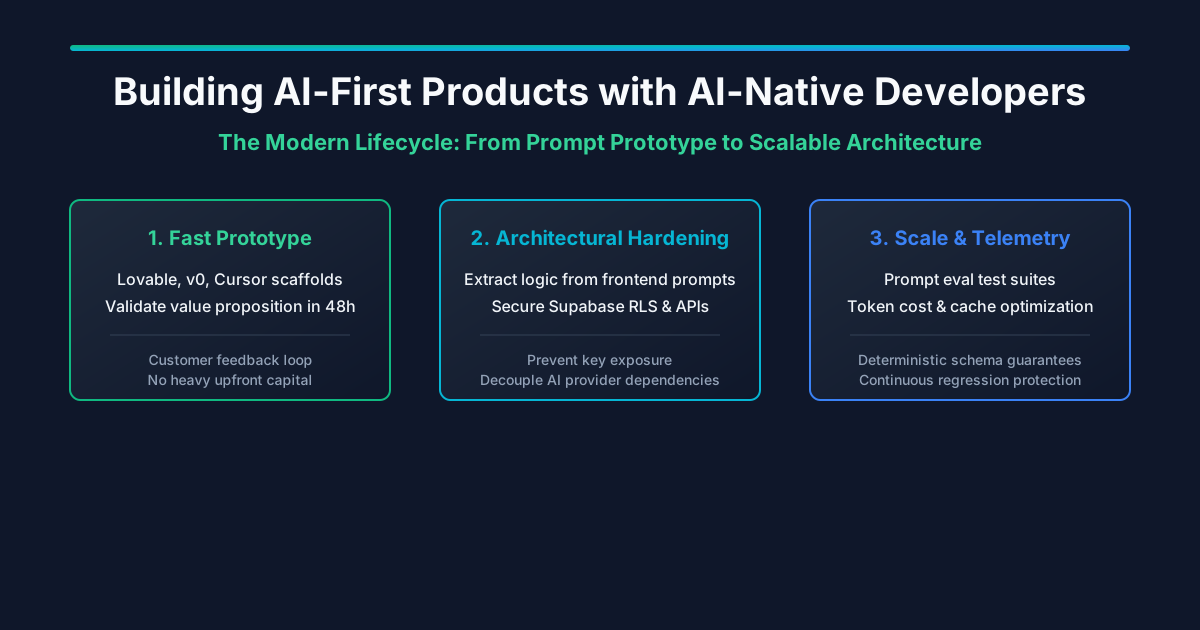
- Productionizing a Scaffolding or No-Code Prototype: Founders who started with prototype builders like Lovable, v0, or Replit often hit an architectural wall when scaling user concurrency, securing Row Level Security (RLS), or handling complex background jobs. An AI-native developer can take over the generated codebase, harden the architecture, and prepare it for enterprise security reviews. See our guides to finishing a v0 prototype, deploying a Bolt.new app, and stabilizing an AI-generated codebase for those takeover scenarios.
- Extending an Existing Engineering Team: For companies that already employ senior backend engineers, adding an AI-native specialist introduces modern AI toolchain workflows, automated test harnesses, and model integration expertise without needing to retrain your core team from scratch. For more on structuring fractional retainers, explore our guide on hiring part-time senior AI engineers.
Vetting Checklist: How to Screen AI-Native Candidates
When interviewing candidates, bypass generic trivia questions about transformer theory and focus on operational, code-level execution:
- Ask for their actual AI toolchain: Do they actively use multi-file coding agents (Cursor, Claude Code, Aider) with structured architectural context files, or do they merely copy-paste snippets from a chat window?
- Examine their error-handling philosophy: How do they handle model rate limits, API timeouts, and unexpected JSON formatting errors? Look for retry backoffs, circuit breakers, and deterministic fallback models.
- Review their security awareness: How do they protect system prompts from prompt injection attacks? How do they ensure user tenants cannot access other users' embeddings in a vector database?
- Inspect their git commit hygiene: AI-generated pull requests can easily balloon into unmanageable 2,000-line diffs. A senior AI-native engineer writes atomic, reviewable commits accompanied by comprehensive automated test coverage.
Related resources
- Hire an AI-native developer for AI-first products, agents, and LLM workflows.
- Read the AI-first product development workflow from prototype to production.
- Compare a vibe coder, AI builder, and AI consultant before hiring.
- Refactor a Cursor or Claude Code project when generated code has become difficult to maintain.
- Fix and deploy a Bolt.new app when a prototype needs a production handoff.
Connect with Vetted AI-Native Engineers on ProofDevs
Whether you need to architect an autonomous agent, build a high-performance RAG pipeline, or build a scalable SaaS application with modern AI acceleration, finding the right talent makes all the difference. At ProofDevs, we evaluate engineers on production code commits, system architecture depth, and real-world delivery velocity.
Ready to build your next breakthrough product? Describe your project requirements on ProofDevs or explore available talent directly on our AI native developer category page.
Written by Michael Melnyk
Senior IT Technical Writer & Technology Analyst
Senior Technical Writer and IT Industry Analyst with over 7 years of experience analyzing software engineering ecosystems, tech leadership models, and developer procurement frameworks.