Hiring a Website Security Specialist for Small Business: What It Costs and How to Vet
Cybersecurity agencies charge $25,000 retainers meant for banks. This guide shows small business owners how to hire an independent website security specialist for audits, hardening, and malware cleanup without agency overhead.

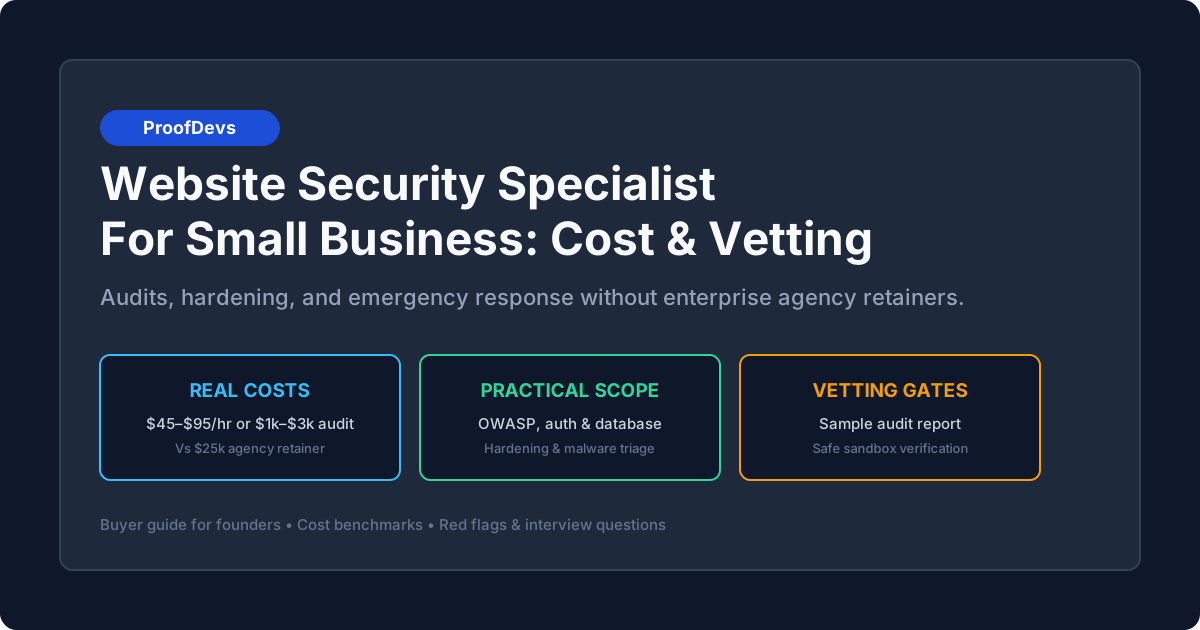
Updated September 2026. Small businesses operate under a persistent security paradox: automated botnets scan their web servers constantly, yet enterprise cybersecurity firms demand $20,000 to $40,000 annual retainers that exceed small engineering budgets. The middle ground is contracting an independent senior website security specialist who charges transparent hourly rates ($45–$95/hr) or fixed audit milestone fees ($1,000–$3,500) to audit, harden, and defend web applications directly.
A website security specialist is an independent software security engineer or penetration tester who audits codebases, configures defensive infrastructure, identifies vulnerabilities before malicious actors exploit them, and isolates breaches if an intrusion occurs. Unlike general software developers, they specialize in defensive application architecture, threat modeling, authentication logic, database access controls, and compliance. If you need urgent assistance with an active compromise or broken checkout, you can request emergency website bug fixes and outage recovery or connect directly with verified independent developers who resolve critical production failures.

Figure 1: The small business website security lifecycle — four disciplined engineering stages from public attack surface mapping to verified code-level remediation.
Why Small Businesses Are Targeted by Automated Attacks
A frequent misconception among non-technical founders is that hackers target websites through manual, deliberate personal vendettas: "We only sell $40,000 a month in plumbing supplies, why would anyone hack us?"
Real-world web security telemetry shows that over 85% of small business attacks are automated, untargeted scans launched by botnets. These scripts traverse IP blocks and search engine indices scanning for known CVEs (Common Vulnerabilities and Exposures): unpatched WordPress plugins, exposed .env files containing database passwords, misconfigured AWS S3 buckets, and unauthenticated API endpoints.
Once automated scripts find an unpatched flaw, they execute secondary payloads within seconds:
- SEO Spam Injections: Injecting hidden pharma, gambling, or phishing URLs into your database, resulting in Google Search Console blacklisting and immediate organic traffic collapse.
- Digital Skimming (Magecart attacks): Modifying checkout JavaScript to quietly siphon customer credit card details straight to an offshore server while payments continue processing normally.
- Resource Hijacking & Cryptojacking: Spinning up background mining workers that push server CPU to 100%, causing constant 502/504 gateway timeouts and crashing hosting servers.
- Database Exfiltration & Ransom Extortion: Dumping user tables, credentials, and customer order histories, followed by extortion demands under threat of GDPR/CCPA reporting.
Three Options Compared: Specialist vs Cybersecurity Firm vs Plugins
Business owners usually choose between three approaches to secure their web properties. Each carries stark differences in cost, speed, and actual protection depth.
| Model | Typical Cost | Deliverable Type | Strengths | Critical Limitations |
|---|---|---|---|---|
| Independent Security Specialist | $45–$95 / hr or $1,000–$3,500 / audit |
Hands-on code audit, penetration report, and direct Git commits fixing flaws | Writes real code fixes; cost aligned with small business budgets; direct communication with the engineer | Capacity constrained to individual bandwidth; requires clear milestone scope |
| Cybersecurity Agency | $15,000–$35,000 upfront or $3,000–$5,000/mo retainer |
Lengthy PDF compliance reports, automated scanner output, quarterly calls | Formal brand backing; liability insurance policies; enterprise compliance checkboxes (SOC2, ISO27001) | Prohibitive expense for SMBs; generates generic vulnerability lists without writing the actual code patches |
| Automated Security Plugins (Wordfence, Sucuri, Cloudflare free) | $0–$300 / yr | Rule-based WAF filtering, malware file scanning, login brute-force limits | Inexpensive; fast single-click installation; blocks commodity bot traffic | False sense of security; cannot detect logical authorization flaws (IDOR/BOLA); causes database bloat |
Automated security plugins are useful baseline filters, but treating a plugin as a complete security strategy creates vulnerability blind spots. A plugin checks whether known malicious file signatures exist on disk; it cannot determine whether an authenticated user on your Next.js SaaS can manipulate a parameter from /api/invoices/104 to /api/invoices/105 and read another customer's confidential payment data. Detecting and preventing architectural flaws requires human engineering analysis.
Real-World Engagement Scenarios and Pricing Benchmarks
When you contract an independent specialist, engagements fall into four distinct operational structures. Knowing which structure your business requires keeps budgets predictable.
| Engagement Type | Trigger Situation | Typical Duration | Deliverables | Realistic Budget |
|---|---|---|---|---|
| Emergency Breach Cleanup | Site hacked, redirecting to spam, or hosting account suspended | 12–36 hours | Malware quarantine, backdoor removal, vulnerability closure, host unblocking, Google blacklist revocation | $600 – $1,800 |
| Pre-Launch Code Audit | New web application, eCommerce rebuild, or SaaS MVP before public launch | 3–7 business days | Repository review, static analysis, secrets scan, auth flow verification, prioritized remediation checklist | $1,200 – $2,800 |
| Penetration Testing (Greystoke) | Validating defenses against active business logic exploitation | 4–8 business days | Authorized attack simulation, proof-of-concept exploits, executive summary, remediation re-test | $2,000 – $4,500 |
| Ongoing Hardening Retainer | Quarterly dependency patching, log analysis, WAF tuning, server hardening | 5–10 hours / month | Quarterly vulnerability scans, dependency upgrades, SSL/TLS auditing, on-call incident priority | $350 – $850 / month |
For businesses operating on flexible sprint rhythms, hiring via hourly and part-time arrangements with pre-approved weekly caps ($45–$95/hr, capped at 10–15 hours/week) provides access to senior security engineering without long-term retainer lock-ins.
Stack-Specific Vulnerabilities: What Your Specialist Must Know
Website security is not generic; it differs fundamentally depending on your underlying framework and infrastructure. When interviewing candidates, verify that their technical expertise matches your production stack.
1. Custom Web Applications (Next.js, Node.js, Python, PostgreSQL)
Modern JavaScript and full-stack frameworks separate the client and server layers, introducing specific architectural risks that traditional server scanners miss completely:
- Broken Object-Level Authorization (BOLA / IDOR): Endpoints failing to verify whether the requesting user token actually owns the requested database record before executing SQL updates.
- Accidental Secret Exposure: Misnaming environment variables (e.g. prefixing private Stripe API secret keys or service-role tokens with
NEXT_PUBLIC_), exposing them in client-side JavaScript bundles. - Supabase / Firebase RLS Bypasses: Flawed Row-Level Security policies where
SELECTpolicies are protected, butINSERTorUPDATEpolicies remain permissive (e.g.USING (true)), allowing malicious users to overwrite arbitrary rows. - Server Action CSRF & Input Sanitation: Unvalidated Server Actions that accept raw payload parameters without strict schema validation (such as Zod validation), permitting parameter pollution.
- Unverified Webhook Receivers: Failing to verify cryptographic signature headers on Stripe, PayPal, or Supabase webhooks, enabling attackers to spoof successful subscription events.
2. Content Management Systems (WordPress, WooCommerce)
WordPress powers over 40% of the web, making it the primary target of mass automated exploit kits:
- Plugin Supply Chain Poisoning: Abandoned plugins acquired by third parties or unmaintained extensions harboring zero-day vulnerabilities.
- Database User Enumeration & XML-RPC: Automated brute-force credential stuffing through exposed
xmlrpc.phpendpoints or REST API author queries. - Unrestricted File Uploads: Contact forms and checkout upload fields allowing malicious
.phpor executable script extensions disguised as image files. - Privilege Escalation: Flaws in membership plugins allowing subscriber-tier accounts to update user capabilities to administrator.
3. Headless & eCommerce Platforms (Shopify, Custom Checkout)
In managed platforms like Shopify, core server infrastructure is maintained by the platform, but application-layer risk remains high:
- Third-Party Script Injection: Marketing pixels and customer service widgets injected via Google Tag Manager that can be hijacked to read checkout inputs.
- Exposed Storefront Admin Scopes: Custom private apps granted excessive API write permissions that leak customer addresses and order volumes through client API tokens.
How to Vet a Website Security Specialist: 5 Essential Questions
Anyone can download open-source scanning tools like OWASP ZAP or Nikto, run a automated scan, and paste the 40-page PDF into an email while demanding a $2,500 consulting fee. To separate theoretical scanner operators from engineers who write durable defensive code, use these targeted interview questions:
Question 1: "Can you show me an anonymized sample audit report from a previous project?"
- Red Flag: The candidate sends a raw export from an automated tool (Nessus, ZAP, WPScan) loaded with hundreds of generic "info-level" items, lacking risk prioritization or tailored remediation guidance.
- Green Flag: A concise 5 to 10 page document organized by business risk (Critical, High, Medium, Low). Each finding includes a clear proof-of-concept demonstrating the flaw, an explanation of the business impact, and the exact lines of code or configuration changes required to fix it.
Question 2: "Do you write the code fixes yourself, or do you only deliver vulnerability recommendations?"
- Red Flag: "I only identify vulnerabilities; your developers have to write the patches." (This forces you to pay twice and requires an internal engineer to decipher obscure security jargon).
- Green Flag: "I conduct the audit, draft the vulnerability report, and can directly submit pull requests in your GitHub/GitLab repository with tested fixes for your team to review and merge."
Question 3: "How do you test our production environment without causing downtime or data loss?"
- Red Flag: The candidate intends to run heavy, aggressive fuzzing scripts directly against your live production database during business hours without taking backups or coordinating testing windows.
- Green Flag: The specialist requests a sanitized staging environment or an isolated read-replica database. For live production reconnaissance, they execute non-destructive testing with defined request rate limits, off-peak scheduling, and immediate rollback procedures.
Question 4: "Which web security standard do you use to structure your audits?"
- Red Flag: Vague answers like "I check common hacking techniques and test standard server passwords."
- Green Flag: Explicit references to established frameworks such as the OWASP Top 10, OWASP ASVS (Application Security Verification Standard), or the SANS Top 25, tailored to your platform's specific attack surface.
Question 5: "How do you handle credential exchange and repository access during the audit?"
- Red Flag: Asking you to send master hosting passwords, domain registrar logins, or root database credentials via plain email or unencrypted chat.
- Green Flag: Requiring dedicated, least-privilege individual accounts with MFA enabled, encrypted credential sharing via Bitwarden or 1Password, and an explicit reminder to revoke all temporary access tokens once audit testing concludes.
Pre-Hire Practical Trial: The 3-Hour Sandbox Audit
Never grant full administrative access to your live infrastructure based solely on a resume or portfolio. Before commissioning a comprehensive site-wide audit, conduct a focused, paid pre-hire trial:
- Scope an Isolated Component: Provide read-only repository access to a single feature branch, an isolated staging instance, or a sanitized export of your authentication and payment webhook handlers.
- Define the Objective: Commission a 3 to 4 hour focused review: "Audit our Supabase RLS policies and Stripe webhook handler. Identify potential authorization bypasses and recommend code adjustments."
- Evaluate the Deliverable: Grade the output based on clarity, technical accuracy, and code hygiene:
- Did they identify subtle configuration oversights?
- Are their recommended code modifications clean, idiomatic, and non-breaking?
- Can they explain the technical risks in plain business language that non-technical stakeholders understand?
If the engineer passes this focused milestone with clear, actionable insights, you can confidently expand the scope to a full penetration test or codebase takeover audit. For stalled or legacy projects where previous developers left messy infrastructure behind, combining a security check with a comprehensive codebase takeover and audit ensures both code stability and security resilience before launching.
Safe Access Delegation: Protecting Your Business During an Audit
Granting an external contractor access to audit your security requires strict operational boundaries so the audit itself does not introduce new liabilities:
- Never Share Domain Registrar Logins: Keep Cloudflare, GoDaddy, Namecheap, and AWS Route53 accounts under strict founder-only ownership. Never hand over registrar credentials to any contractor.
- Use Principle of Least Privilege (PoLP): Create an individual contractor seat in GitHub, Vercel, or AWS with read-only access for initial inspection. Upgrade to write permissions only on dedicated feature branches when implementing verified patches.
- Sanitize Staging Databases: Never replicate raw customer credit card logs, plaintext customer notes, or real passwords to external staging environments. Replace sensitive user records with synthetic mock data before sharing sandbox databases.
- Mandatory Non-Disclosure & IP Assignment: Ensure your contractor agreement includes clear confidentiality clauses and confirms that all custom security patches and documentation belong 100% to your company upon invoice settlement.
- Revoke Access Immediately Upon Completion: Once the final audit report is delivered and pull requests are merged, systematically revoke API tokens, SSH keys, staging credentials, and repository invitations.
Frequently Asked Questions
How much does a website security audit cost for a small business?
A comprehensive website security audit from an independent senior specialist typically costs between $1,000 and $3,500 depending on application complexity. A standard marketing or content website runs $800 to $1,500, while a custom full-stack SaaS application with payment flows and multi-role authentication costs $2,000 to $3,500. This is significantly less than cybersecurity agency retainers, which start at $15,000 to $25,000.
Can a regular web developer do a security audit?
General web developers understand software functionality, but frequently lack specialized training in defensive threat modeling, penetration testing techniques, and authorization edge cases. A specialized security engineer knows how attackers actively chain minor configuration oversights into critical data breaches. For high-risk areas like payment gateways, user data storage, and authentication, hiring a dedicated security specialist is essential.
What is the difference between vulnerability scanning and penetration testing?
Vulnerability scanning is an automated, passive process that runs tools to identify known software versions and unpatched CVEs. Penetration testing is an active, human-led engineering simulation where an authorized specialist attempts to exploit business logic flaws, bypass authentication, and access unauthorized data. Automated scanners identify surface-level issues, while penetration testing discovers actual exploit pathways.
How long does it take to clean up a hacked website?
A senior security engineer can isolate and clean up a compromised website within 12 to 36 hours. The process involves taking complete system backups, quarantining malicious code, inspecting access logs to identify the initial entry point, closing the vulnerability, and requesting review with Google Search Console or web hosting providers to remove blacklists.
Do I need ongoing security maintenance or just a one-off audit?
Most small businesses benefit from a hybrid model: an intensive initial security audit and codebase hardening, followed by a lightweight quarterly maintenance check (5 to 10 hours per quarter). This ensures dependency updates are patched, new features are checked for authorization leaks, and backup systems are verified regularly without paying expensive monthly agency retainers.
Written by Michael Melnyk
Senior IT Technical Writer & Technology Analyst
Senior Technical Writer and IT Industry Analyst with over 7 years of experience analyzing software engineering ecosystems, tech leadership models, and developer procurement frameworks.