How to Negotiate Price With a Developer: Practical Tips for Clients
A founder got three quotes — $2,000, $6,500, and $14,000 — for the same brief. None of them was lying. This guide shows how to compare them line by line and negotiate a fair price that keeps the project alive.

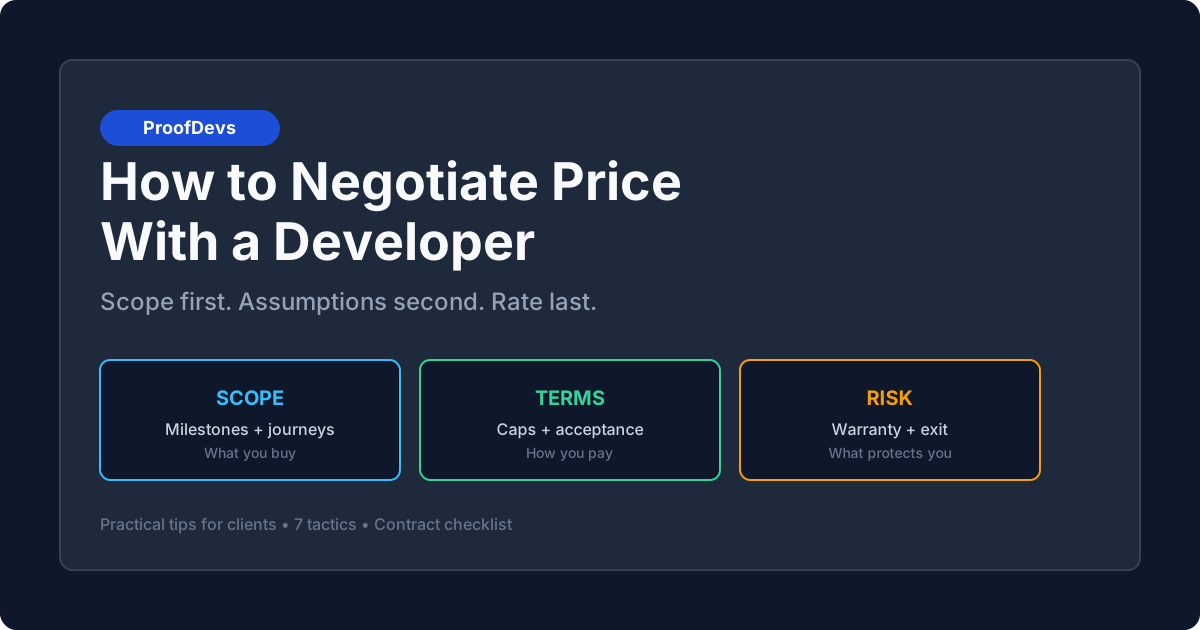
Negotiating price with a developer means aligning scope, assumptions, and payment terms — not pushing the hourly rate down. Three quotes for the same brief can differ 5x because one includes discovery, testing, and launch support while another prices only coding hours. Reviewed September 2026. Figures below are illustrative planning examples, not market averages or ProofDevs quotes.
Most clients start with the wrong question: "how do I get this cheaper?" The productive question is: "what exactly am I buying, what is excluded, and which lever — scope, timeline, payment structure, or risk — moves the price without breaking quality?" This guide answers that. For the price map behind any quote, see our custom website cost breakdown; for choosing who to negotiate with in the first place, use the outsource-versus-hire comparison.
Why the same brief gets three different prices
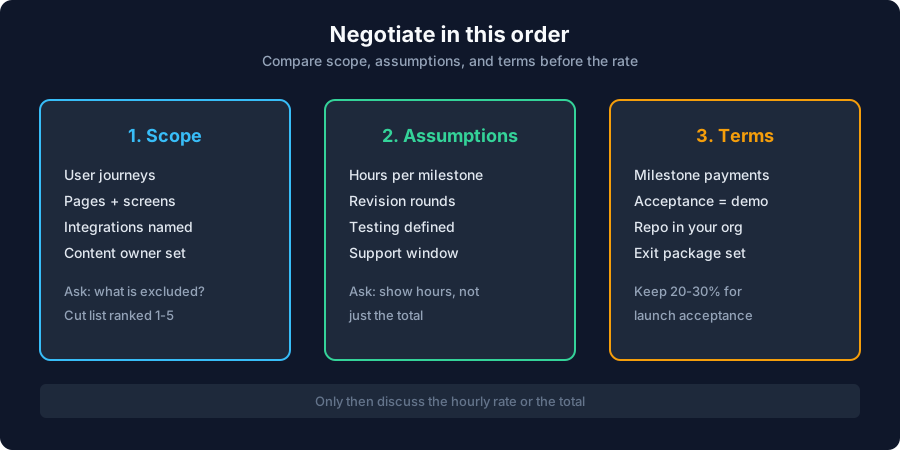
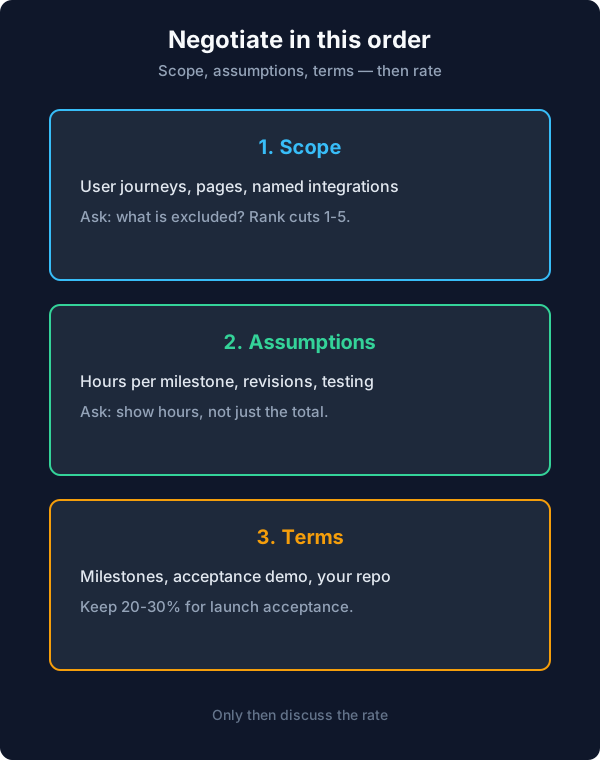
The same brief gets different prices because every developer prices different assumptions about content, integrations, revisions, testing, and support. The total is the last thing to compare; the assumption list is the first.
A $2,000 quote often assumes you deliver final copy and images, accept a configured theme, allow two revision rounds, and handle testing yourself. A $6,500 quote may include copy polish, custom layout, three integrations, QA across devices, and launch with redirects and backups. A $14,000 number usually adds discovery workshops, project management, documentation, and a warranty window. None of these is dishonest — they are simply different products hiding under one brief.
Before negotiating a dollar, ask each candidate to answer five questions in writing:
- What content do you expect from me, and what happens if it arrives late?
- Which integrations are included, and how many hours are budgeted per integration?
- How many design revision rounds are included, and what counts as a new request?
- What testing is included — browsers, devices, accessibility checks?
- What happens after launch — warranty length, response time, and what counts as a defect?
Two developers who answer these identically can be negotiated on price. Two who answer differently cannot be compared yet.
What to prepare before you talk price
Prepare a one-page scope, a budget corridor instead of a fixed number, and a ranked cut list before any price call. Developers discount decisions, not pressure.
Your one-pager needs: goal in one sentence, 5–10 user journeys ("a visitor books a call", "an admin refunds an order"), pages or screens list, integrations by name (Stripe, HubSpot, booking tool), content status (ready / draft / missing), and deadline with reason. A founder who sends this gets an itemized quote; a founder who sends "I need a website like X" gets a risk premium.
Set a corridor, not a point: "planning envelope $4,000–$6,000 depending on what is included." A corridor invites the developer to propose options. A hard "$3,000 max" invites them to silently cut testing and documentation to fit.
Rank what you would cut first: multilingual version, animations, custom illustrations, admin reports, second payment method. Negotiation works when you can say: "if we are over budget, drop items 4 and 5 and keep checkout and speed." That sentence saves more money than an hour of haggling over the hourly rate.
How to read a developer quote line by line
A fair quote names milestones, hours or fixed fees per milestone, assumptions, exclusions, and payment terms. Anything missing from that list becomes your future invoice.
| Line item | What good looks like | Warning sign |
|---|---|---|
| Discovery / scope lock | 4–10 hours, written milestone list as output (example) | "We will figure it out as we go" |
| Design | Named pages, revision rounds, source files handover | "Modern design included" with no page count |
| Development | Features mapped to milestones with hours each | Single lump sum with no breakdown |
| Integrations | Each system named with test scenario | "Third-party connections" without names |
| Content & migration | Who writes, who uploads, page count | Assumes your content is "ready" |
| Testing & launch | Devices, browsers, redirects, backups | "Testing included" with no definition |
| Support | Warranty days, defect definition, response time | "Free support" with no limits |
Run this arithmetic as a planning example: 60 development hours at $60 per hour is $3,600. Add 10 design hours at $70 ($700), two integrations at 6 hours each ($720), and launch plus 30-day warranty ($500). The envelope is about $5,500 before licenses and hosting. Change the rate to $30 or $120 and the hours to 30 or 150, and you cover the real-world spread. Use the math to compare scope, not to declare a universal market rate.
For a neutral checklist to test any number against, use our quote reasonableness checklist and the developer rates overview.
Fixed price vs hourly vs milestones: what to choose
Choose fixed price for bounded scope, hourly for discovery and evolving scope, and milestone payments in both cases. The payment model is a risk tool, not a discount tool.
| Model | Best for | Client risk | Negotiation lever |
|---|---|---|---|
| Fixed price | Defined pages, features, integrations | Change requests billed extra; quality squeezed if underpriced | Narrow scope, freeze requirements per milestone |
| Hourly / time and materials | Unclear scope, audits, rescue work | Open-ended total without caps | Weekly cap, burn-down reports, kill-switch review |
| Milestone-based | Almost every project over $2,000 (example threshold) | Weak acceptance criteria | Pay per accepted user journey, not per hour logged |
| Retainer | Ongoing updates, care plans | Paying for idle hours | Rollover hours, monthly deliverable list |
The sprint model described by Scrum.org explains why milestone thinking works: short cycles with a defined increment and review. Even without formal Scrum, structure payment as 20–30% to start, 40–50% across accepted milestones, and 20–30% on launch plus warranty. Never agree to 100% upfront or 100% on delivery — both extremes remove the other side's incentive to finish well.
7 negotiation moves that keep quality intact
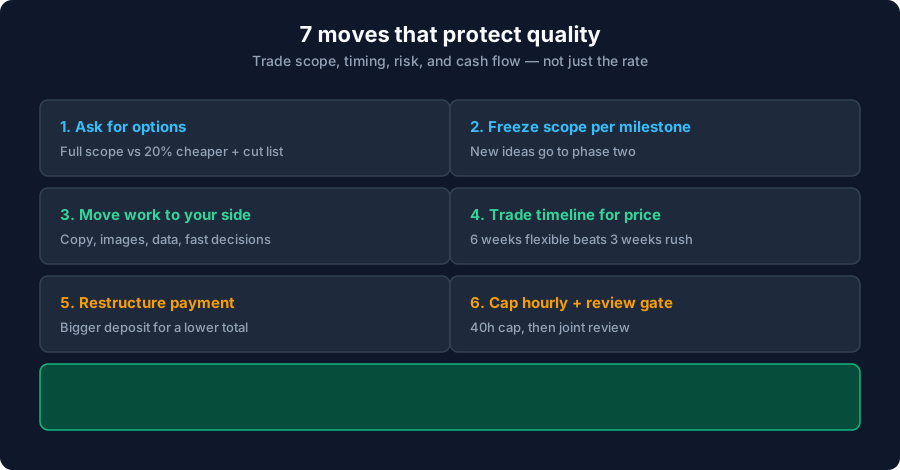
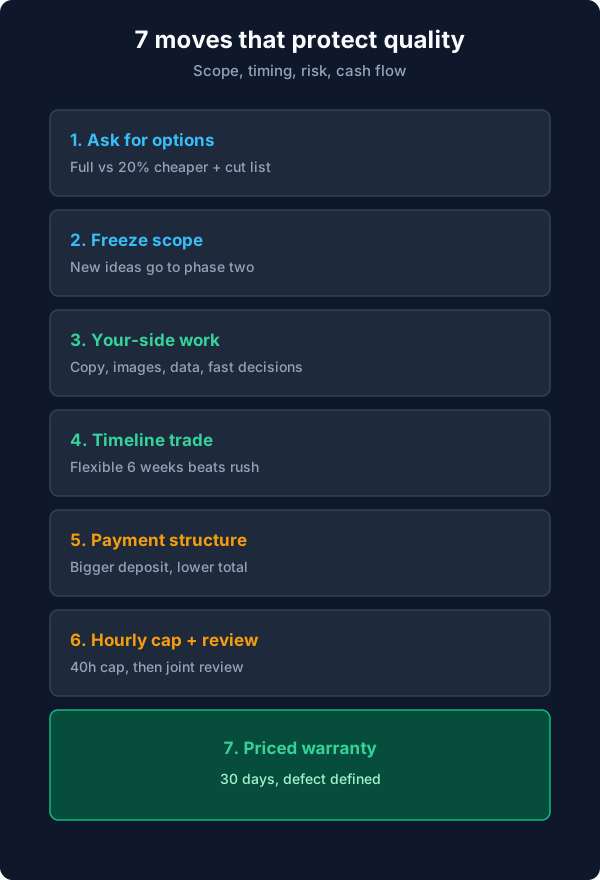
The moves that lower price without lowering quality trade scope, timing, risk, and cash flow — never just the rate. Use them in this order.
1. Ask for options, not discounts. "Show me this scope at the current price, a version 20% cheaper, and what you would cut to get there." You get a visible cut list instead of invisible quality erosion.
2. Freeze scope per milestone. Offer the developer something valuable: no mid-milestone changes; all new ideas go to a phase-two list. Developers routinely add a 15–25% buffer for churn (planning example based on typical practice, not a measured market figure) — a change freeze earns that buffer back.
3. Move work to your side. Provide final copy, compressed images, logo files, product data in a spreadsheet, and decisions within 48 hours. Each week of client delay costs the developer context-switching; fast clients get better numbers.
4. Trade timeline for price. "If we allow six weeks instead of three, can you fit this between other work at a lower rate?" Rush premiums are real; flexibility is tradable.
5. Restructure payment, not just total. Offer a larger deposit for a lower total, or faster milestone approvals for a fixed fee. Cash flow certainty is worth 5–10% to most independents (illustrative range — ask what it is worth in your case).
6. Cap hourly with a review gate. "Up to 40 hours at your rate, then a joint review before continuing." Caps plus demos beat blind hourly billing and beat fixed-price fights over change requests.
7. Buy the warranty explicitly. Instead of "include free support," price 30 days of defect fixes with a 48-hour response definition. Paid, defined warranty is cheaper than free, undefined promises that end in disputes.
Negotiation cases: what worked and what backfired
The same 20% saving can come from smart scope surgery or from silent quality cuts — the cases below show the difference.
Case 1. Booking site: cut the second language, kept the launch date
Starting situation: a service business needed booking, payments, and two languages for $7,000 quoted against a $5,500 envelope (illustrative figures).
What blocked it: translation and double QA across every page consumed roughly a quarter of the estimate.
Solution: the client deferred the second language to phase two, supplied final service descriptions upfront, and accepted a configured date-picker instead of custom calendar logic. Stack stayed standard: Next.js frontend with Stripe checkout.
Result: price fit the envelope, launch stayed on schedule, and phase two was priced separately after revenue started. No warranty dispute because exclusions were written down.
Case 2. Catalog startup: hourly cap instead of fixed-price fight
Starting situation: a 400-product catalog with filters had unclear data quality — suppliers sent spreadsheets in five formats.
What blocked it: no developer would fix the price without seeing data cleanup effort; the client feared an open-ended hourly bill.
Solution: 20-hour paid discovery with a sample import of 50 products, then a fixed price for the remaining import plus filter logic, with a 40-hour cap per milestone and weekly demos.
Result: discovery exposed that 30% of products lacked images; the client assigned an assistant to fill gaps. Total stayed within 10% of the post-discovery estimate (planning example outcome), and both sides renewed for phase two.
Case 3. The backfire: 40% discount with no scope change
Starting situation: a founder pushed a $6,000 quote to $3,600 by repeating "my budget is fixed" without cutting anything.
What blocked it: the developer accepted to fill a gap between projects but silently dropped testing, documentation, and the warranty.
Solution attempted too late: after launch, checkout failed on one mobile browser, no one owned the fix, and a replacement developer needed a paid audit to take over. See our developer replacement guide for how that handover should work.
Result: the "saving" cost two months and a second payment larger than the discount. The lesson the founder kept: never negotiate the total without negotiating the scope document in the same sentence.
Typical mistakes clients make when negotiating
Most negotiation damage comes from five repeatable mistakes, not from tough bargaining itself.
- Anchoring on the cheapest quote. Demanding everyone match the lowest number without matching its exclusions guarantees the thinnest scope wins.
- Negotiating rate instead of structure. "$40 instead of $60" with unchanged scope produces rushed hours; capped hours with clear acceptance produce real savings.
- Hiding the budget entirely. Developers pad unknown-budget quotes against worst-case scope. A corridor plus a cut list gets a sharper number than secrecy.
- Adding features mid-milestone. Every "small tweak" during a fixed milestone re-prices trust. Batch changes into phase two.
- Skipping the written acceptance. "Done" must mean a working user journey on staging — booked, paid, refunded — not "code pushed to GitHub."
- Paying 100% upfront for a discount. You lose all leverage for the warranty period. Keep a final 20–30% tied to launch acceptance.
- Comparing agency and freelancer totals directly. An agency total includes management and QA layers; a freelancer total assumes you manage. Compare delivered-outcome cost including your hours — our outsource-versus-hire guide shows the math.
Expert advice
Send this message before the price call: "Here is my one-page scope, my corridor, and three items I can defer. Please return two numbers — full scope and reduced scope — with hours per milestone, exclusions, and payment terms." Then stay silent for 48 hours. Developers who reply with itemized options negotiate honestly; developers who reply with a single lower number and no changed document are planning to cut corners you cannot see. Pick the first type even if their total is 10–15% higher (illustrative premium) — they are the cheapest over twelve months.
Red flags: when a low price will cost you more
Walk away when the price drops but the document does not change, when ownership stays vague, or when testing has no definition.
- 40–50% undercut with identical scope promises — testing and warranty were deleted silently.
- No repository in your organization from day one — you are renting code, not buying it.
- "Unlimited revisions" with no hourly cap — the developer will either burn out or freeze you out.
- No defect definition — every bug becomes a paid change request.
- Pressure to pay in full before any demo — legitimate developers accept milestone splits.
If you already signed a deal that went wrong — missed deadlines, vanished developer, withheld code — do not keep negotiating with someone who stopped delivering. Read our 48-hour recovery plan for abandoned projects and the developer replacement service that takes over code, repository access, and milestones without starting from scratch.
How to lock the agreement: contract checklist
A one-page written agreement beats a ten-page template nobody reads — if it names scope, acceptance, money, ownership, and exit.
- Scope: milestone list with user journeys, page counts, named integrations.
- Acceptance: demo on staging per milestone; payment within 3–5 days of acceptance.
- Money: fixed fee or rate plus cap per milestone, license and hosting costs separated.
- Ownership: code in your repository from day one, IP transfer on final payment, credentials in your accounts.
- Warranty: 30 days as a planning example (agree your own window), defect vs change-request definition, response time.
- Exit: handover package — pushed branches, environment variables, run instructions, deploy steps — required before final payment.
Rate context helps here: the Stack Overflow Developer Survey shows how experience, specialization, and region shift what developers charge, which is why identical briefs attract different numbers. Use it as background, not as a price list — your quote's assumption list matters more than any global average.
FAQ: negotiating price with a developer
How do I negotiate with a developer without offending them?
Negotiate scope and terms, not worth. "What would you cut to fit my corridor?" respects expertise; "your rate is too high" without context ends the conversation.
What is a reasonable discount to ask for?
10–20% via scope cuts, timeline flexibility, or payment restructuring is normal discussion territory (illustrative range). Demanding 40% off unchanged scope usually deletes testing and support instead.
Should I tell the developer my budget?
Share a corridor plus a cut list, not a single hard ceiling. Corridors get itemized options; secrecy gets padded quotes.
Fixed price or hourly — which is cheaper?
Neither is inherently cheaper. Fixed suits defined scope; hourly suits discovery and evolving work. Milestone payments with acceptance criteria protect you under both.
How much deposit should I pay?
20–30% to start is standard practice (planning example). Keep 20–30% for launch acceptance and warranty — never 100% upfront.
How do I compare quotes with different totals?
Normalize five factors first: content responsibility, integrations, revision rounds, testing definition, and support terms. Then compare hours per milestone, not just totals.
Can I ask for a paid trial before committing?
Yes — a 3–5 hour paid trial on a real task (fix a bug, build one screen, document one integration) predicts collaboration better than interviews. Agree what "done" means before it starts.
What if the developer says my budget is unrealistic?
Ask what fits inside it and what the next viable scope costs. A professional redraws the milestone map; an evasive reply signals you should get a second quote.
How do I handle "small changes" during the project?
Freeze scope per milestone and batch new ideas into a phase-two list with separate pricing. Mid-milestone tweaks are the top cause of budget overruns.
Who owns the code and accounts?
You should: repository in your organization from day one, IP transfer on final payment, domain and hosting in your accounts. Get this in writing before the first payment.
What should the warranty cover?
Defects against accepted user journeys within a defined window (for example 30 days) with a response time. New features are change requests, not warranty work.
When should I replace the developer instead of renegotiating?
When demos stop, communication goes silent, or code is withheld. Secure credentials and backups first, then use a structured handover — see how to replace a developer mid-project — instead of funding more delay.
Ready to get a number tied to your scope? Find a verified independent developer or send your one-page brief to ProofDevs for an itemized planning estimate — and if a previous engagement already failed, start with our developer replacement service.
Written by Michael Melnyk
Senior IT Technical Writer & Technology Analyst
Senior Technical Writer and IT Industry Analyst with over 7 years of experience analyzing software engineering ecosystems, tech leadership models, and developer procurement frameworks.