Why Hiring a Backend Developer on Freelance Platforms Beats Traditional Agencies
Traditional software agencies mark up junior developers by 300% and filter technical decisions through project managers. Learn why hiring a verified freelance backend developer directly provides superior capital efficiency, instant niche stack liquidity, and complete repository ownership.


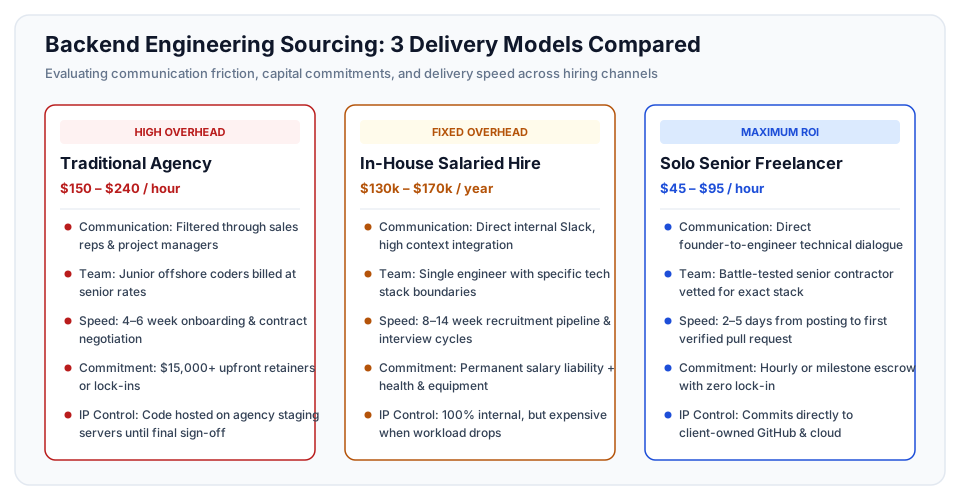
Hiring a backend developer through freelance platforms outperforms traditional agencies and full-time hiring because it gives founders direct technical access to specialized senior talent without administrative markups, long recruitment cycles, or permanent payroll liabilities. When building or scaling a web application, the backend represents the operational heart of the business: it manages user authentication, relational databases, financial transactions, third-party API webhooks, and data privacy. While agencies sell the illusion of total peace of mind, they routinely bill between $150 and $240 per hour while delegating core architecture to junior coders buffered by non-technical account managers. Reviewed October 2026. Financial benchmarks, contractor rates, and delivery timelines below reflect documented market standards across North American and European tech ecosystems.
For early-stage founders, CTOs, and non-technical business operators, choosing the right talent acquisition channel determines both capital burn and software survivability. Sourcing an independent engineer directly through reputable freelance marketplaces provides direct repository access, fractional billing flexibility ($45–$95/hr), and milestone-based escrow protection. If you are comparing broader engagement models for your engineering organization, explore our breakdown of outsourcing versus hiring an in-house developer; for managing urgent technical infrastructure bugs, review our emergency repair options.
The Agency Illusion: Paying $200 per Hour for Junior Code
Traditional software agencies charge enterprise hourly rates primarily to subsidize non-technical overhead, while filtering critical backend architectural decisions through account managers who cannot evaluate database schemas. When a company signs an agency contract, between 50% and 70% of the invoice covers sales commissions, executive salaries, office leases, and multi-layered project management rather than production engineering hours.
The destructive game of telephone: In backend software development, precision is paramount. A misunderstanding regarding transaction isolation levels, webhook idempotency, or database foreign key constraints can lead to corrupted ledgers or security breaches. When working with an agency, a founder communicates requirements to a non-technical project manager, who translates them into internal Jira tickets for an offshore junior developer. This communication buffer eliminates nuance: edge cases are missed, performance bottlenecks are ignored, and technical feedback cycles take days instead of minutes.
Bait-and-switch staffing: During sales presentations, agencies introduce prospective clients to senior solutions architects with impressive resumes. However, once the contract is signed and the deposit is secured, those senior engineers move to the next sales pitch. Day-to-day coding is quietly reassigned to entry-level developers or offshore subcontractors who learn on your company's dime while the agency bills senior rates.
Hostage code repositories and vendor lock-in: Many software development agencies retain administrative control over GitHub repositories, cloud infrastructure, and staging deployments until the final project invoice is cleared. If a dispute arises over missed deadlines or defective code, the client has zero leverage because their production assets remain locked on the agency's private servers. Migrating away from an uncooperative agency frequently costs tens of thousands of dollars in legal fees and code rescue audits.
Direct Communication: Why Backend Logic Cannot Tolerate Middlemen
Direct communication between the business decision-maker and the backend engineer is essential because backend development involves complex business logic, regulatory compliance, and architectural trade-offs that cannot survive intermediation. Unlike frontend styling, which can be evaluated visually by a project manager, backend architecture operates invisibly beneath the surface.
Immediate alignment on data models: A database schema represents the physical embodiment of a company's business rules. If a marketplace needs to split payments between vendors, hold funds in escrow, deduct platform commissions, and remit sales tax, the backend developer must understand the commercial flow intimately. Working directly with an independent senior freelancer allows the founder to review entity-relationship diagrams (ERDs) in real time, catching architectural flaws before code is written.
Rapid troubleshooting in production: When an API integration fails or an external payment webhook drops customer orders, every minute of latency damages business reputation. On a freelance platform, the founder or product lead pings the developer directly in Slack or GitHub pull requests. The engineer inspects server logs, reproduces the bug, deploys a hotfix to a staging branch, runs automated tests, and pushes to production within hours. In contrast, an agency requires submitting an official support ticket, awaiting business-hours triage by an account representative, and negotiating change orders before an engineer is assigned.
Empowered technical ownership: Senior freelance backend engineers view themselves as technical partners rather than ticket-completers. Because their marketplace reputation, client reviews, and future hourly rates depend entirely on successful client outcomes, they proactively challenge flawed assumptions, recommend cost-effective cloud services (such as choosing Supabase or Hetzner over bloated AWS enterprise tiers), and optimize queries before they reach production scale.
Fractional Velocity: Capital Efficiency for Growing Businesses
Hiring a freelance backend developer provides fractional capital efficiency by allowing companies to pay strictly for high-impact architectural sprints rather than carrying permanent $160,000 annual payroll liabilities. Most startups and mid-market companies do not require forty hours of senior backend engineering fifty-two weeks a year.
The typical backend lifecycle consists of an intensive initial build (80 to 140 hours to architect database schemas, build authentication, and deploy core REST or GraphQL APIs), followed by weeks of frontend integration and user testing where backend requirements drop to five to ten hours per week. Once the platform stabilizes, ongoing backend needs transition to routine maintenance, security patching, and minor feature additions.
Hiring a full-time salaried backend engineer forces a business to pay $11,000 to $14,000 every single month regardless of whether there are twenty hours of work or two hours. Furthermore, full-time employment carries employer taxes, health insurance, paid leave, equity dilution, and hardware stipends, increasing the true cost by 25% to 35% above base salary. Conversely, engaging a senior freelancer at $65 to $85 per hour on an on-demand fractional basis allows the founder to activate engineering hours on demand, pausing spend during marketing or fundraising cycles without managing layoffs.
Global Talent Liquidity: Hiring for Exact Stack Alignment
Freelance marketplaces provide immediate access to global talent liquidity, allowing businesses to hire senior engineers who have already mastered the exact combination of backend technologies required for their product. Traditional local recruiting pipelines are constrained by geography and average 60 to 90 days to fill a single senior technical position.
If your application requires a specific backend ecosystem—such as Python with FastAPI and PostgreSQL pgvector for an AI-driven search engine, or Go with Redis and WebSockets for a high-concurrency trading platform—finding a local qualified candidate within a fifty-mile radius can take months of recruiter fees (typically 20% to 25% of first-year salary). If you are looking for specific language specialists, explore our curated directories for Python backend engineers or Node.js specialists.
On freelance platforms, geographic barriers disappear. A business operator in New York, London, or Sydney can post a focused job specification and review verified proposals from senior engineers in Eastern Europe, Latin America, or across North America within forty-eight hours. These contractors have built identical architectures dozens of times, enabling them to import proven boilerplate code, secure authentication patterns, and database migration routines on day one.
The Financial Comparison: Agency vs. In-House vs. Marketplace Freelancer
Independent senior backend freelancers deliver the highest capital return on investment by eliminating agency margins and employee overhead while maintaining senior-level code quality. The table below provides a side-by-side comparison of the three primary sourcing models across critical commercial metrics:
| Evaluation Metric | Traditional Digital Agency | Full-Time In-House Hire | Freelance Marketplace Senior |
|---|---|---|---|
| Hourly Cost Benchmark | $150 – $240 / hour | $75 – $110 / hr equivalent ($140k–$170k base + 30% overhead) | $45 – $95 / hour |
| Minimum Financial Commitment | $15,000 – $40,000 upfront retainers or milestone locks | $70,000+ (6-month salary liability + severance risk) | $500 – $2,000 (Milestone escrow per deliverable) |
| Time to First Verified Commit | 4 – 8 weeks (Discovery, legal reviews, onboarding) | 8 – 14 weeks (Job posts, screenings, notice periods) | 2 – 5 days (Direct screening to private repository) |
| Communication Path | Account Manager → PM → Junior Developer | Direct internal Slack / Daily Standup | Direct founder-to-engineer technical collaboration |
| Repository & IP Ownership | Held on agency staging until final dispute settlement | 100% company-owned through employment IP assignment | 100% company-owned; commits pushed directly to client GitHub |
| Flexibility to Pause / Scale | Rigid 60-day notice contract cancellation clauses | High friction (Severance, legal liability, team morale) | Immediate: scale hours up or down based on verified workload |
To help founders budget realistically, the following scope tiers illustrate standard engineering hours and total investments for backend projects executed by senior independent contractors:
| Backend Project Scope | Core Technical Deliverables | Estimated Senior Hours | Total Investment ($55–$85/hr) |
|---|---|---|---|
| Tier 1: Core API & Database Architecture | PostgreSQL schema design, Alembic/Prisma migrations, JWT/OAuth authentication, basic REST/GraphQL endpoints, Docker Compose setup | 25 – 45 hours | $1,500 – $3,800 |
| Tier 2: Transactional & Payment Pipeline | Stripe Connect / Webhook infrastructure, automated invoice generation, idempotent processing, email dispatch queue, role-based access control (RBAC) | 40 – 70 hours | $2,400 – $5,900 |
| Tier 3: Concurrency & Database Optimization | Query refactoring, Redis caching layer, connection pooling (PgBouncer), indexing audits, background Celery/BullMQ workers | 30 – 50 hours | $1,800 – $4,200 |
| Tier 4: Enterprise Multi-Tenant SaaS Backend | Tenant schema isolation, rate limiting, audit logging, complex third-party CRM syncing, automated CI/CD deployment pipelines on AWS/Hetzner | 80 – 150+ hours | $5,000 – $12,500+ |
Three Real-World Scenarios Where Freelance Backend Hiring Saved the Business
Analyzing real-world commercial scenarios demonstrates how direct contractor engagement resolves technical deadlocks that traditional agencies and salaried hires fail to fix. These case studies illustrate the commercial advantage of direct architectural access.
Case Study 1: The FinTech Duplicate Transaction Disaster
The Context: A European B2B payments startup contracted an agency for €48,000 to build their core payment disbursement backend connecting to banking APIs.
The Breakdown: During initial merchant testing, several large payouts were processed twice. The agency's project manager assured the founder that the issue was an "intermittent third-party banking timeout." In reality, the offshore junior coders failed to implement an idempotency key pattern in their database: when network hiccups delayed bank responses, automated retry loops dispatched duplicate payout calls. Because communication ran through an account manager who did not understand database concurrency, fixing the bug dragged on for four weeks while merchants threatened legal action.
The Freelance Solution: The founder paused the agency contract and engaged a senior independent backend contractor on a freelance platform at $85 per hour. Within forty-eight hours, the freelancer audited the code, introduced a PostgreSQL table storing unique idempotency hashes with database row-level locking, and configured automated unit tests simulating network timeouts. The total freelance engagement cost $1,870 (22 hours), permanently resolving the double-spending defect.
Case Study 2: The E-Commerce Black Friday Checkout Freeze
The Context: A high-growth Shopify Plus store running a custom headless product configurator experienced database connection exhaustion during peak promotional campaigns, causing the checkout page to throw HTTP 504 Gateway Timeouts.
The Breakdown: The store's in-house team consisted of two frontend developers who lacked deep database administration expertise. They attempted to solve the problem by upgrading their managed cloud database tier, quadrupling their monthly hosting bill from $300 to $1,400 without resolving the timeouts. The database CPU still pegged at 100% under five hundred concurrent shoppers.
The Freelance Solution: The owner hired an experienced freelance PostgreSQL backend engineer for an emergency 20-hour audit. The freelancer analyzed the slow query log and discovered that the product configurator executed twelve unindexed subqueries on every cart update. The contractor created composite indexes on high-cardinality foreign keys, configured PgBouncer for transaction connection pooling, and offloaded inventory read queries to an in-memory Redis cache. The database CPU dropped from 100% to 14% under identical traffic loads, and the client downgraded back to their original $300 hosting tier.
Case Study 3: The Early-Stage Startup Runway Trap
The Context: A healthcare technology startup raised a $400,000 pre-seed round and immediately hired a full-time senior backend engineer with an annual salary of $150,000 plus benefits.
The Breakdown: During the first four months, the engineer performed exceptional work, designing the core FHIR-compliant database and building the user management APIs. However, in months five and six, the startup entered a prolonged clinical partner onboarding phase where backend engineering requirements dropped to roughly five hours per week. Despite having minimal coding tasks, the company was legally obligated to pay $14,500 every month in salary and taxes, burning through 25% of their remaining runway during an operational plateau.
The Freelance Solution: With the engineer's mutual agreement, the startup shifted to an on-demand contract model. The company engaged a vetted independent backend contractor at $75 per hour with a guaranteed 15-hour monthly retainer ($1,125/mo) and an option to scale up during product releases. This operational transition extended the company's financial runway by seven months, enabling them to reach commercial profitability before raising their Series A round.
How to Screen and Hire a Senior Backend Developer on Freelance Platforms
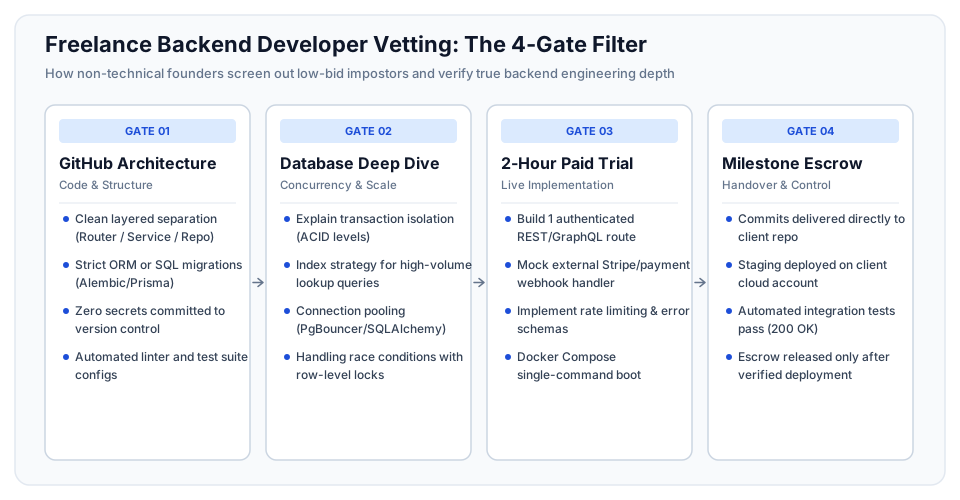
To extract maximum value from freelance marketplaces while avoiding low-bid impostors, execute a rigorous four-stage vetting protocol: repository architectural inspection, database concurrency screening, a 2-hour paid trial task, and milestone-governed escrow delivery. Marketplace bidding algorithms reward aggressive low bids, making objective technical qualification mandatory.
Stage 1: The Repository and Architecture Inspection
Require candidates to provide links to public or sanitized GitHub repositories containing backend code they personally authored. Evaluate their architecture against commercial benchmarks:
- Layered Separation of Concerns: Professional backends strictly separate routing/controllers from business logic and database access layers. If a candidate places database queries directly inside route handlers without service abstractions, their codebase will become unmaintainable as features grow.
- Strict Migration Hygiene: Production backends manage schema changes through version-controlled migration tools such as Alembic, Prisma, or Flyway. Reject developers who alter database schemas manually through web dashboards or raw SQL scripts executed directly on production databases.
- Environment and Secret Isolation: Ensure all database passwords, JWT signing keys, and external API credentials are read exclusively through environment variables. The repository must feature a clean
.env.exampleand a thorough.gitignorepreventing accidental secret exposure.
Stage 2: The Concurrency and Database Technical Interview
Conduct a 25-minute technical discussion focusing on edge cases, database integrity, and high-concurrency failure modes. Evaluate candidate responses against standard engineering principles:
- Question: "How do you prevent race conditions when two users attempt to purchase the final inventory item at the exact same millisecond?"
Senior Answer: Wrap the inventory check and reservation inside an atomic database transaction using row-level locking (SELECT ... FOR UPDATEin PostgreSQL) or an atomic Redis decrement operation (DECR) with distributed locks. A junior developer will naively perform a standard read followed by an update, which creates race condition oversells under concurrency. - Question: "What is the difference between connection pooling and direct database connections?"
Senior Answer: Opening a new database connection consumes server memory and CPU during TLS handshakes. Under high concurrent traffic, creating a connection per incoming request exhausts database memory and leads to connection refusal crashes. A senior engineer implements a connection pool (like PgBouncer or built-in ORM pools) that keeps a fixed set of open connections reused across requests. - Question: "How do you handle background tasks that take longer than the standard HTTP request timeout?"
Senior Answer: Acknowledge the HTTP request immediately with an accepted response (HTTP 202 Accepted) and push the task metadata onto an asynchronous message queue (such as Celery, BullMQ, or AWS SQS) consumed by dedicated worker processes.
Stage 3: The 2-Hour Practical Paid Trial Task
Before committing to a multi-week engagement, commission a small, self-contained 2-hour practical task with a fixed payment of $100 to $150. Provide a specific, testable business prompt:
Trial Specification: "Build a minimal authenticated backend service in Python (FastAPI) or Node.js (TypeScript) that accepts a user registration, hashes passwords using bcrypt, saves the user to an SQLite database, and exposes an endpoint that validates an external payment webhook payload using HMAC-SHA256 signature verification. Include unit tests and a functional Dockerfile."
Evaluation Rubric: Review the submission on four criteria: (1) Does the Dockerfile build and run with a single command? (2) Are passwords hashed with a secure work factor rather than stored in plain text? (3) Does the webhook handler reject forged signatures with HTTP 401 Unauthorized? (4) Are unit tests automated and passing?
Milestone Contracts, Escrow Protection, and Infrastructure Control
Maintain complete operational authority over your platform by structuring freelance contracts into discrete deliverable milestones, using platform escrow, and deploying exclusively to company-owned cloud infrastructure. Business risk arises when founders surrender infrastructure management or release funds before verifying software functionality.
Follow these five governance rules when managing a freelance backend engagement:
- Rule 1: Commits Must Flow to Your Private Repository: Never permit a freelancer to host your proprietary code on their personal GitHub or GitLab account. Invite the developer as an outside collaborator to a private repository owned by your organization, with branch protection rules requiring pull request reviews before merging into the main branch.
- Rule 2: Deploy to Company-Owned Cloud Accounts: Create your own accounts with cloud infrastructure providers such as Hetzner, AWS, Supabase, or DigitalOcean. Provide the contractor with restricted IAM developer roles rather than primary root login credentials. You must retain complete administrative billing and ownership rights at all times.
- Rule 3: Tie Escrow Releases to Automated Test Verification: Break projects into 25% to 35% milestone payments tied to objective technical criteria: (1) Schema design and authenticated route stubs on staging, (2) Core business logic with unit test coverage, and (3) Production deployment, load testing, and documentation runbook delivery. Only release escrow funds after running automated test suites on your staging environment.
- Rule 4: Require a Detailed README Runbook: A backend without documentation creates dangerous developer dependencies. Require the contractor to deliver a complete
README.mddetailing local environment setup, Docker commands, database migration steps, and a list of all required environment variables. - Rule 5: Rotate Production Secrets Post-Handover: Once final deliverables are approved and the freelance contract concludes, rotate all production database credentials, JWT secret keys, and third-party API tokens. This standard security hygiene ensures that previous contractors retain zero residual access to live production databases.
Frequently Asked Questions
How much does it cost to hire a freelance backend developer?
Hiring an independent senior backend developer costs between $45 and $95 per hour depending on technological specialization and geographic location. For project-based scopes, a basic API and database architecture costs $1,500 to $3,800 (25–45 hours); a payment pipeline and transactional webhook system costs $2,400 to $5,900 (40–70 hours); and an enterprise multi-tenant backend costs $5,000 to $12,500+ (80–150+ hours). Fixed-price bids below $500 on freelance marketplaces almost always indicate junior coders or unmaintained boilerplate templates.
Why is a freelance backend developer better than a digital agency?
A freelance backend developer is superior to an agency because you work directly with the engineer writing your database queries and APIs, eliminating the communication friction, delays, and 300% pricing markups associated with agency account managers and overhead. Furthermore, freelancers push commits directly to your private GitHub repository on day one, whereas agencies frequently withhold code access on private staging servers until final payment disputes are resolved.
When should a company hire a full-time backend engineer instead of a freelancer?
A company should hire a salaried, full-time backend engineer only when product development has stabilized with consistent 40-hour weekly backend requirements, the business has secured at least 18 to 24 months of operational runway ($250k+ in cash reserves), and the architecture requires ongoing internal domain stewardship. For early-stage platforms, MVP development, major infrastructure upgrades, or post-launch optimization, an independent freelance contractor delivers far higher capital efficiency.
Which backend programming language should I choose for my application?
For most commercial web applications, Python (with FastAPI) and TypeScript (with Node.js) represent the optimal backend choices due to massive developer liquidity, mature ecosystems, and rapid development speed. Choose Python if your application heavily incorporates machine learning, data engineering, or automated AI pipelines. Choose TypeScript if your team values unified code-sharing between frontend React/Next.js interfaces and backend APIs. For extreme concurrency, low-latency microservices, or financial engines, consider Go (Golang).
How do I know if a freelance backend developer is truly senior?
A true senior backend developer demonstrates mastery of database normalization, query indexing, transaction isolation (ACID), and connection pooling rather than merely writing basic CRUD endpoints. During interviews, senior engineers proactively discuss race conditions, error handling schemas, automated testing, and security practices (such as parameterized queries preventing SQL injection and constant-time signature verification). They write clean, modular code separated into controller, service, and repository layers.
What are the biggest risks of hiring a backend developer on freelance platforms?
The primary risks include hiring low-bid junior developers who introduce security vulnerabilities (such as SQL injection or hardcoded secrets in Git), poor communication or unannounced contractor abandonment mid-sprint, and lack of automated test coverage. You can neutralize these risks by reviewing public GitHub code portfolios, conducting a 2-hour paid trial task before awarding large contracts, and releasing milestone payments strictly through escrow after verifying deployment on your own staging servers.
How do I protect my intellectual property when hiring a freelance backend developer?
Protect your intellectual property by: (1) Signing a clear Independent Contractor Agreement with explicit Work-for-Hire IP assignment clauses before sharing code, (2) Hosting all source code in a private GitHub organization owned by your business, (3) Generating restricted cloud IAM credentials rather than sharing root passwords, and (4) Storing sensitive production data in separate test databases so the contractor only works with synthetic dummy records during development.
Can a freelance backend developer also handle cloud DevOps and deployment?
Yes. Most senior backend engineers possess direct DevOps skills, including Docker containerization, Docker Compose configuration, CI/CD pipeline automation (GitHub Actions), reverse proxy configuration (Nginx or Caddy), and cloud deployment on providers like AWS, Hetzner, or DigitalOcean. However, for massive multi-region Kubernetes clusters or advanced infrastructure-as-code (Terraform) requirements, engaging a dedicated DevOps specialist alongside your backend developer is recommended.
How should milestone payments be structured for a backend development project?
Structure milestone payments across 3 or 4 functional deliverables: Milestone 1 (25%) for Database Schema Design, Migrations, and Local Docker Environment; Milestone 2 (35%) for Core Authenticated API Endpoints with Automated Unit Tests; Milestone 3 (25%) for External Third-Party Integrations (Stripe/CRM webhooks); and Milestone 4 (15%) for Staging Deployment, Load Testing, and Documentation Runbook Handover. Never release escrow funds until you personally verify that the deliverable functions as specified.
What is the difference between an ORM and raw SQL in backend development?
An Object-Relational Mapper (ORM) like Prisma, SQLAlchemy, or Django ORM allows developers to interact with database tables using object-oriented code, accelerating development and preventing SQL injection vulnerabilities. Raw SQL involves writing database queries directly, which provides maximum execution speed and granular optimization for complex aggregation reports. Senior backend developers leverage ORMs for standard transactional operations while writing optimized raw SQL queries for heavy reporting and analytical lookups.
How do I verify backend code quality if I am not a technical founder?
If you lack technical expertise, verify code quality by: (1) Confirming the repository contains automated tests (unit and integration tests) that pass with green checkmarks in GitHub Actions, (2) Verifying that the application runs locally and on staging using a single Docker Compose command, (3) Testing API error handling by submitting invalid inputs to ensure the server returns descriptive HTTP 400 errors rather than crashing with unhandled HTTP 500 errors, and (4) Commissioning a brief 2-hour independent code audit from a fractional CTO or third-party senior engineer before final milestone payout.
What documentation should a freelance backend developer provide at project completion?
The developer must provide: (1) A detailed README.md file detailing prerequisites, local environment configuration, and deployment procedures, (2) An OpenAPI/Swagger specification or Postman collection documenting all endpoints, request headers, payload schemas, and response codes, (3) Database migration runbooks explaining how to upgrade or roll back schemas, and (4) A list of all required environment variables with non-sensitive placeholder examples.
Written by Michael Melnyk
Senior IT Technical Writer & Technology Analyst
Senior Technical Writer and IT Industry Analyst with over 7 years of experience analyzing software engineering ecosystems, tech leadership models, and developer procurement frameworks.