Hiring a Freelance Telegram Bot Developer Who Builds Beyond Fragile Long-Polling Scripts
Most $100 freelance Telegram bots crash the moment fifty users click at once. Learn how to hire a freelance Telegram bot developer who writes production webhooks, isolates database sessions, prevents rate-limit bans, and hands over full code ownership.


To deploy a business-critical Telegram automation without downtime, hire a freelance Telegram bot developer who architects asynchronous webhooks and persistent state machines rather than a budget bidder running synchronous long-polling scripts. On freelance marketplaces like Upwork and Fiverr, hundreds of developers bid between $50 and $200 promising turnkey bots within forty-eight hours. However, roughly 80% of these implementations rely on beginner tutorials: single-file Python scripts that poll Telegram servers over HTTP, store customer conversations in temporary server memory, and freeze completely when more than twenty users interact simultaneously. Reviewed October 2026. Financial benchmarks and development hours below reflect standard market rates for senior independent backend engineers.
Founders, marketing directors, and operations managers turn to Telegram because its 950 million active users provide an immediate, high-engagement channel for lead generation, customer onboarding, digital subscriptions, and transactional notifications. Yet the difference between a prototype built by a student and a commercial system engineered by an experienced contractor determines whether your business captures revenue or suffers brand damage during a traffic spike. If your team is evaluating underlying framework choices, review our technical guide on building custom Telegram bots for business; if you are deciding between chat-based dialogues and rich graphical interfaces, explore our comparison of Telegram Mini Apps vs chatbots.
The Marketplace Trap: Why $100 Freelance Telegram Bots Collapse
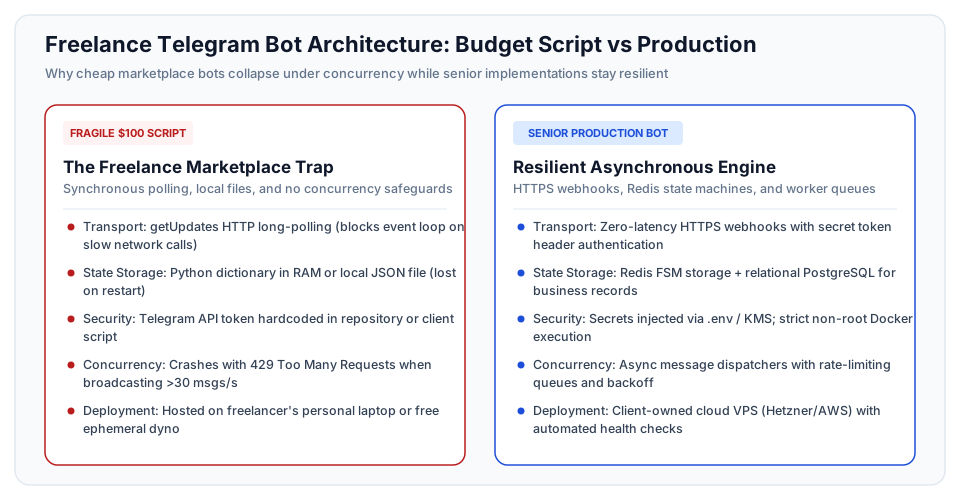
Budget freelance Telegram bots collapse under real-world usage because entry-level freelancers build them using synchronous long-polling loops, in-memory state storage, and hardcoded API credentials. When an employer posts a job description requesting a "custom Telegram bot," marketplace algorithms flood the listing with low-cost bids from junior coders who copy code from YouTube tutorials. While these bots appear functional during a five-minute demonstration with a single test user, their underlying architecture contains fatal engineering shortcuts that guarantee production failure.
Synchronous long-polling versus asynchronous push webhooks: An entry-level bot uses HTTP long-polling via methods like getUpdates. In this model, the bot continuously queries Telegram servers asking for new messages. If the developer writes synchronous code—common with libraries like basic telebot—every incoming message blocks the execution thread while the server queries a database or calls an external API. If user Alice triggers an order lookup that takes three seconds, user Bob's message waits in an unhandled buffer. When fifty users send commands at once, the bot hits connection timeouts, drops messages silently, and eventually crashes.
In-memory session state versus database persistence: Multi-step conversational flows—such as booking an appointment, filling out an insurance questionnaire, or selecting product variants—require tracking user state across separate messages. Inexperienced freelancers store this Finite State Machine (FSM) state in Python dictionaries or local JSON files on the server's disk. If the server process restarts, crashes, or redeploys, all active user conversations reset to zero. Customers find themselves stuck in broken loops where the bot repeatedly prompts for their phone number or fails to complete payment processing.
Ignoring Telegram rate limits and flood controls: The Telegram Bot API enforces strict throttling rules: a bot cannot send more than 30 messages per second across all chats, nor more than one message per second within a single group or private chat. Junior freelancers frequently write naive for loops to broadcast marketing announcements or order status updates. Within seconds, Telegram returns an HTTP 429 Too Many Requests status code with a mandatory retry delay. Because budget scripts lack retry queues and exponential backoff logic, the bot either terminates with an unhandled exception or gets temporarily banned by Telegram's firewall.
Security vulnerabilities and leaked bot tokens: The API token provided by BotFather represents total administrative control over your bot. Inexperienced contractors routinely commit production tokens directly into public GitHub repositories or leave them hardcoded in executable files. Malicious automated scanners detect these tokens within minutes, allowing unauthorized actors to intercept customer conversations, exfiltrate user phone numbers, or redirect payment flows to fraudulent crypto wallets.
Commercial Bot Architecture: What a Senior Contractor Actually Delivers
A senior freelance Telegram bot engineer delivers a distributed, event-driven web application comprising HTTPS webhook gateways, isolated state stores, background message queues, and encrypted credential management. Rather than treating the bot as an isolated script running on a personal computer or a free cloud dyno, an experienced contractor treats the bot interface as an asynchronous presentation layer on top of a resilient backend database.
HTTPS webhook ingress with secret token validation: Professional bots do not poll Telegram. Instead, the developer configures an SSL/TLS-encrypted endpoint using an asynchronous framework such as FastAPI or Node.js HTTP servers. When a user sends a message, Telegram pushes an immediate JSON payload to your server. The contractor configures Telegram's secret_token header verification, ensuring your webhook endpoint immediately rejects spoofed HTTP requests from unauthorized third parties.
Redis-backed Finite State Machines (FSM): To ensure conversational resilience, user interaction stages are decoupled from application memory. A senior engineer stores active conversational state in an in-memory Redis instance with automatic time-to-live (TTL) expiration. If the application server restarts during a blue-green deployment, user sessions persist without interruption. Relational data—such as registered accounts, order histories, and payment invoices—is persisted in an ACID-compliant database such as PostgreSQL or Supabase.
Asynchronous message dispatchers and worker queues: High-volume operations, such as generating PDF invoices, syncing contacts to HubSpot, or broadcasting announcements to ten thousand subscribers, are delegated to background job workers like Celery or BullMQ. The webhook receiver responds to Telegram with an immediate HTTP 200 OK within 500 milliseconds, preventing Telegram from resending duplicate webhook payloads, while background workers process intensive tasks asynchronously while respecting Telegram's 30-message-per-second broadcast ceiling.
Containerized deployment and isolated environments: A qualified freelancer delivers clean Docker containers managed via Docker Compose or Kubernetes, complete with separate staging and production environments. Secrets and credentials live exclusively in environment variables managed through secure parameter stores, ensuring zero sensitive data enters version control.
Freelance Telegram Bot Developer Rates and Cost Benchmarks
Hiring a competent freelance Telegram bot developer costs between $45 and $95 per hour, with total project budgets ranging from $600 for single-purpose utility bots to over $6,500 for complex transactional bots with CRM and payment integrations. Fixed-price bids below $300 almost invariably signal template-based builders or junior developers who lack production backend experience.
The table below compares the three primary hiring models available to business operators seeking Telegram automation talent:
| Hiring Model | Standard Rate / Cost | Typical Delivery Time | Code Quality & Architecture | Risk Profile |
|---|---|---|---|---|
| Marketplace Budget Bidder (Upwork / Fiverr) | $50 – $300 (Fixed bid) | 2 – 5 days | Single-file Python/telebot script, long-polling, local JSON/RAM state storage | High: crashes under concurrency, no tests, token leaks, zero post-launch support |
| Independent Senior Freelancer | $45 – $95 / hr ($1,500 – $5,000) | 1 – 3 weeks | Async webhooks (Aiogram 3 / Grammy), Redis FSM, PostgreSQL, Docker, rate limiters | Low: production resilience, client owns 100% of code, clear architectural documentation |
| Full-Service Chatbot Agency | $120 – $220 / hr ($8,000 – $25,000+) | 4 – 10 weeks | Custom enterprise architecture or proprietary white-label dashboard | Moderate: high overhead, slow communication through account managers, vendor lock-in |
When budgeting for a Telegram bot project, define the exact scope tier required for your commercial operation. The following benchmarks outline standard engineering hours and total investments across common business use cases:
| Bot Scope Tier | Core Technical Features | Estimated Senior Hours | Budget Range ($55–$85/hr) |
|---|---|---|---|
| Tier 1: Single-Workflow Notification Bot | One-way alert dispatching, basic command routing (/start, /help), error logging, webhook setup | 10 – 18 hours | $600 – $1,400 |
| Tier 2: Interactive Lead Generation & Support | Multi-step FSM questionnaire, CRM synchronization (HubSpot/Pipedrive), admin notification alerts, Redis state | 25 – 45 hours | $1,500 – $3,500 |
| Tier 3: E-Commerce & Paid Subscription Bot | Product catalog navigation, Telegram Stars / Stripe webhooks, digital license delivery, private channel invite link generation with auto-revocation | 45 – 75 hours | $2,800 – $5,800 |
| Tier 4: Full Telegram Mini App (TMA) Ecosystem | Embedded React/Next.js web interface, backend API authentication via initData HMAC-SHA256, cloud database, custom checkout |
80 – 140+ hours | $5,000 – $11,000+ |
Three Real-World Freelance Bot Failures and the Engineering Fixes
Examining documented failure cases reveals that most commercial bot breakdowns stem from unhandled edge cases, architectural shortcuts, and vendor lock-in rather than Telegram platform outages. Reviewing these three authentic scenarios illustrates the structural difference between hobbyist code and commercial engineering.
Case Study 1: The Black Friday Broadcast Crash
The Context: A European direct-to-consumer apparel brand hired an Upwork freelancer for $250 to develop a Telegram bot for flash sales. The bot accumulated 12,000 subscribers over three months through Instagram campaigns.
The Breakdown: On Black Friday morning, the marketing director triggered a broadcast announcement containing an image and a discount link. The freelancer's code executed a synchronous for user_id in user_list: bot.send_photo(...) loop without delay or worker delegation. After dispatching roughly 90 messages in two seconds, Telegram's API returned an HTTP 429 Too Many Requests with a retry_after: 420 response. The unhandled exception crashed the script. Worse, because the bot used long-polling without tracking message delivery offsets, restarting the script caused the bot to re-send duplicate messages to the first 90 users while 11,910 subscribers received nothing. The business lost an estimated €18,000 in promotional sales.
The Senior Fix: A senior backend contractor refactored the broadcast module into an asynchronous Celery task backed by Redis. The new dispatcher implemented a token bucket rate-limiter capped at 25 messages per second, logged successful message IDs to PostgreSQL, handled 429 responses with exponential backoff, and automatically flagged users who blocked the bot with HTTP 403 Forbidden to prune the database.
Case Study 2: The Vanishing Booking State
The Context: A regional medical clinic commissioned an independent coder to build an automated Telegram appointment scheduling system, allowing patients to select doctors, choose dates, enter contact information, and receive confirmation codes.
The Breakdown: Patients repeatedly complained that after entering their medical history and preferred dates, the bot suddenly replied: "Please send /start to begin." An architectural audit revealed that the freelancer was storing conversational steps inside an in-memory Python dictionary keyed by chat_id. The cloud hosting service utilized by the freelancer performed automated daily container restarts to apply security patches. Every time the container recycled, all patients currently navigating the appointment funnel had their conversational state erased, resulting in abandoned bookings and customer frustration.
The Senior Fix: The contractor replaced the in-memory dictionary with Redis-backed FSM storage using Aiogram 3's native RedisStorage adapter. User inputs were committed to an intermediate JSON schema in Redis after each interaction step, with a 30-minute inactivity timeout. If a container restarted mid-dialogue, the incoming webhook immediately retrieved the patient's exact step from Redis, ensuring zero interrupted consultations.
Case Study 3: The Hardcoded Bot Token Hijack
The Context: A cryptocurrency education community paid $400 for a Telegram bot designed to grant paid users access to a private research channel upon verifying a monthly membership payment.
The Breakdown: Two weeks after deployment, the community owner noticed that their bot was broadcasting phishing links promoting fraudulent token pre-sales directly to the group. The original freelancer had created a public GitHub repository to store the project files and hardcoded the production BotFather API token in the main configuration file. Automated GitHub scraper bots indexed the credential within forty seconds of the commit. The attackers used the token to issue unauthorized admin commands, kick legitimate moderators, and post malicious links to 4,500 members.
The Senior Fix: The owner hired an emergency contractor to revoke the compromised token via BotFather, configure strict two-factor authentication on Telegram, migrate the codebase to a private client-owned repository, and move all API credentials to encrypted environment variables injected during runtime. The new engineer also configured Telegram's /setprivacy mode so the bot could only inspect commands explicitly directed to it rather than logging all channel messages.
How to Vet a Freelance Telegram Bot Developer
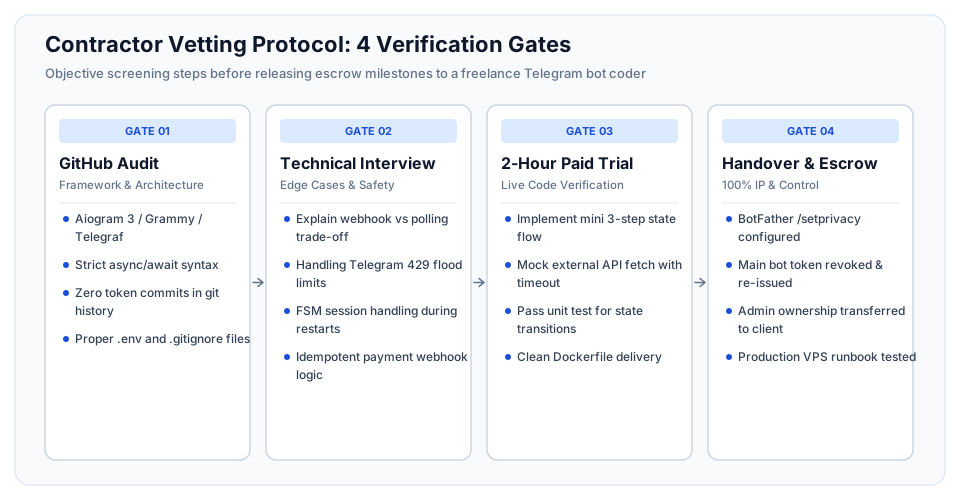
Vet freelance Telegram bot candidates through a four-stage qualification filter: a public code audit, an architectural edge-case interview, a 2-hour paid trial task, and a structured milestone escrow contract. Following this screening process eliminates unqualified bidders before any contract commitments are finalized.
Stage 1: The Repository and Portfolio Audit
Request links to public GitHub or GitLab repositories containing Telegram bots the candidate has personally authored. Inspect the codebase for the following senior versus junior architectural signals:
- Current Framework Ecosystems: Look for mature asynchronous libraries. In Python, senior developers use
Aiogram 3.x; in JavaScript/TypeScript, they useGrammyor recent releases ofTelegraf. If the candidate's portfolio consists entirely of synchronouspyTelegramBotAPI(telebot) scripts with global variables, they lack enterprise concurrency skills. - Environment Isolation: Check whether API tokens, database connection strings, and webhook secrets are imported via
os.getenvor configuration management libraries. The repository must include a clean.env.examplefile and an active.gitignorepreventing credential leakage. - Data Modeling: Examine how user data is persisted. Look for SQL migrations (Alembic, Prisma, or raw SQL scripts) rather than arbitrary file writing operations like
open("users.json", "w").
Stage 2: The Architectural Edge-Case Interview
During a 20-minute video call or technical message screening, ask candidate developers how they handle production failure modes. Evaluate their answers against standard commercial criteria:
- Question: "How does your bot handle an incoming webhook when an external CRM API takes 15 seconds to respond?"
Senior Answer: The webhook controller immediately returns an HTTP 200 OK to Telegram within 200–500 milliseconds to acknowledge receipt, and offloads the external CRM call to an asynchronous background worker task (such as Celery or BullMQ). If the worker were synchronous, Telegram would treat the delay as an HTTP timeout and retry the webhook, causing duplicate user messages. - Question: "How do you protect the bot from crashing when broadcasting messages to thousands of users?"
Senior Answer: The application uses a rate-limited queue enforcing Telegram's global 30-message-per-second limit. It captures HTTP 429 exceptions to respect the returned retry-after header and handles HTTP 403 Forbidden errors by marking users who blocked the bot as inactive in the database. - Question: "How do you ensure a user does not lose their progress in a 5-step registration form if our server restarts?"
Senior Answer: State transitions are decoupled from process memory using Redis FSM storage. Each step updates the user's state key in Redis with an explicit TTL, allowing any restarted worker instance to continue the dialogue without data loss.
Stage 3: The 2-Hour Practical Paid Trial Task
Never hire a developer for a $3,000 project based purely on conversational claims. Commission a paid, self-contained 2-hour trial task with a fixed payment of $100 to $150. Provide a specific business prompt:
Trial Specification: "Build a minimal Telegram bot using Aiogram 3 or Grammy that prompts the user for their email and order ID across two steps, validates the email format, queries a mock REST API endpoint with a 3-second timeout, stores the completed submission in an SQLite database, and runs via Docker Compose with environment variables. Submit a private GitHub repository with a README."
Evaluation Rubric: Grade the candidate on four objective criteria: (1) Does the bot function properly without unhandled crashes? (2) Is the code organized cleanly into separate router, service, and database layers? (3) Does it handle network timeouts gracefully by alerting the user? (4) Does the repository contain a functional Dockerfile that builds with a single command?
Milestone Contracts, BotFather Control, and Handover Protocol
Maintain complete administrative control over your digital assets by registering the bot through your personal Telegram account and structuring payments across verifiable technical milestones. Disagreements on freelance marketplaces often occur when business owners allow contractors to create the primary bot token or host the application on developer-owned servers.
Follow this five-step asset protection checklist throughout the engagement:
- Step 1: Create the Bot via Your Own BotFather Account: Never permit the freelancer to register your bot. Open Telegram, start a dialogue with the official verified
@BotFather, run/newbot, configure the name and username, and copy the API token yourself. Share the token with the freelancer only after contract signing, and inform them that you will regenerate the token upon final delivery. - Step 2: Configure BotFather Privacy Settings: Run
/setprivacyin BotFather and ensure privacy mode is set to Enabled. This ensures that if your bot is added to group chats, it only receives messages that start with a slash command or explicitly tag the bot's username, drastically reducing server load and protecting user privacy. - Step 3: Tie Escrow Releases to Functional Milestones: Structure the project into three distinct milestone payments: (1) Architecture & Database Schema on Staging (30%), (2) Feature Complete with External API Integrations (40%), and (3) Production VPS Deployment, Load Testing & Full Code Handover (30%). Never release final payment until you verify that the bot runs on your server.
- Step 4: Host on Your Own Infrastructure: Require the contractor to deploy the bot on a cloud virtual private server (such as Hetzner, DigitalOcean, or AWS) registered in your company's name. You must possess the primary root access credentials and billing management. If you need assistance setting up a dedicated virtual server, review our guide on migrating to a VPS.
- Step 5: Post-Launch Token Regeneration: Once the final code is pushed to your private GitHub repository and verified in production, visit BotFather, execute
/revoketo invalidate the development token, and paste the newly generated production token into your server's.envfile. This ensures that previous freelancers or subcontractors retain zero access to your bot's live communication stream.
Frequently Asked Questions
How much does it cost to hire a freelance Telegram bot developer?
Hiring a senior freelance Telegram bot developer costs between $45 and $95 per hour. In terms of total project budgets, a straightforward notification or alert bot costs $600 to $1,400 (10–18 hours); an interactive customer support or lead generation bot with database storage costs $1,500 to $3,500 (25–45 hours); and an e-commerce or subscription bot with payment integrations costs $2,800 to $5,800 (45–75 hours). Fixed bids under $300 on freelance marketplaces almost always represent fragile long-polling scripts that fail under concurrent user loads.
What is the difference between Telegram bot webhooks and long-polling?
Long-polling forces your server to continuously query Telegram's servers asking for new messages, which consumes significant CPU and blocks threads during slow network requests. Webhooks reverse this model: your server exposes a secure HTTPS endpoint, and Telegram pushes user messages directly to your application within milliseconds of transmission. Webhooks are mandatory for production commercial bots because they support instant event-driven concurrency, eliminate redundant network queries, and integrate cleanly with serverless or containerized cloud infrastructure.
Which programming language is best for developing custom Telegram bots?
Python and TypeScript/Node.js represent the industry standards for commercial Telegram bot development. Python is the premier choice when using production asynchronous frameworks like Aiogram 3.x, particularly for projects incorporating machine learning, OpenAI APIs, or complex backend data processing. TypeScript with Grammy or Telegraf is ideal for teams whose infrastructure centers on JavaScript/Node.js, offering high I/O throughput, strict static typing, and unified code-sharing with web frontends or Telegram Mini Apps.
Can a freelance Telegram bot process credit card payments directly?
Yes. Telegram supports native payment processing through two primary mechanisms: Telegram Stars for digital goods, subscriptions, and virtual services (compliant with Apple App Store and Google Play billing guidelines), and integrated payment providers like Stripe, Razorpay, or PayMock for physical goods. A qualified freelancer configures the BotFather payment provider connection, handles pre_checkout_query callbacks to validate order inventories, and verifies successful webhook payloads before fulfilling customer purchases.
How do I prevent my Telegram bot from being banned for spam or flood limits?
To avoid rate-limit bans, a developer must implement asynchronous worker queues (such as Celery or BullMQ) that enforce Telegram's platform constraint of 30 messages per second globally and 1 message per second in individual chats. The code must implement an automatic token bucket or leaky bucket rate limiter, intercept HTTP 429 Too Many Requests exceptions to respect the returned retry delay, and immediately deactivate user records when an HTTP 403 Forbidden indicates a user has blocked the bot.
Where should a business-critical Telegram bot be hosted?
A production Telegram bot should be hosted on a cloud Virtual Private Server (VPS) such as Hetzner, DigitalOcean, AWS EC2, or a container platform like Fly.io or Render with dedicated resources. Avoid free hosting tiers or shared cPanel web hosting, which frequently kill background processes, lack persistent storage for databases, and do not provide static dedicated IP addresses or custom SSL certificate termination required for webhooks.
What is a Telegram Mini App and does a freelance bot developer build it?
A Telegram Mini App (TMA) is a full-featured web application built in React, Vue, or Next.js that runs inside the Telegram client via an embedded webview, providing rich graphical interfaces, shopping carts, and interactive dashboards. Building a TMA requires full-stack engineering: a frontend developer to build the responsive web interface and a backend developer to validate Telegram's initData cryptographic signature (using HMAC-SHA256) and manage APIs. Many senior Telegram bot freelancers possess full-stack skills to build both layers.
How can I verify that a freelance bot developer will not steal my customer data?
Protect your data by registering the bot token under your own personal Telegram account via BotFather, enabling /setprivacy mode so the bot cannot read group messages, hosting the database on your own cloud provider account (such as Supabase or AWS RDS), and never sharing production database passwords. Additionally, commission an independent code review before launch to ensure the developer has not embedded hidden webhook forwarding endpoints or external logging scripts.
What happens to active user conversations when the bot server restarts?
If the freelancer built the bot using in-memory state storage (Python dictionaries), all active user sessions reset to the beginning upon restart. If the engineer implemented a persistent state machine using Redis or a relational database, active conversation steps and temporary form inputs persist indefinitely. Always specify in your project requirements that Finite State Machine (FSM) state must be stored in Redis rather than local application RAM.
How do I write a technical specification for a freelance Telegram bot developer?
An effective technical specification must define: (1) A user journey diagram detailing each command (/start, /help) and multi-step conversation funnel, (2) The database entity requirements (e.g., users, transactions, product catalogs), (3) Required third-party API integrations (CRM webhooks, payment gateways, Google Sheets), (4) Expected peak traffic volume (messages per minute), and (5) The delivery stack (Aiogram 3/Grammy, PostgreSQL, Redis, Docker Compose). Detailed specifications prevent scope creep and eliminate low-quality template bidders.
Can a Telegram bot work without a backend database?
A Telegram bot can function without a database only if it performs stateless, one-off utility tasks—such as calculating a currency exchange rate or echoing formatted text. Any commercial bot handling user accounts, recurring subscriptions, appointment bookings, customer support tickets, or order histories strictly requires a persistent database (PostgreSQL, MySQL, or Supabase). Bots that attempt to store data in text files or Google Sheets suffer data corruption and severe latency under concurrent usage.
What should be included in the final handover when a freelance contract ends?
The final handover must include: (1) Full transfer of the private Git repository containing clean source code and Docker configuration, (2) A clear README.md runbook detailing local setup, environment variables, and deployment instructions, (3) Database migration scripts to initialize production schemas, (4) Direct deployment to the client's cloud server with verified SSL webhooks, and (5) Revocation and re-issuance of the primary BotFather API token so only the client possesses live production credentials.
Written by Michael Melnyk
Senior IT Technical Writer & Technology Analyst
Senior Technical Writer and IT Industry Analyst with over 7 years of experience analyzing software engineering ecosystems, tech leadership models, and developer procurement frameworks.