Vibe Coder vs AI Builder vs AI Consultant: Who to Hire for Your Project
A founder paid for a chatbot demo when the business needed someone to decide whether a chatbot was the answer at all. This comparison maps three AI-era roles to the problems each actually solves.

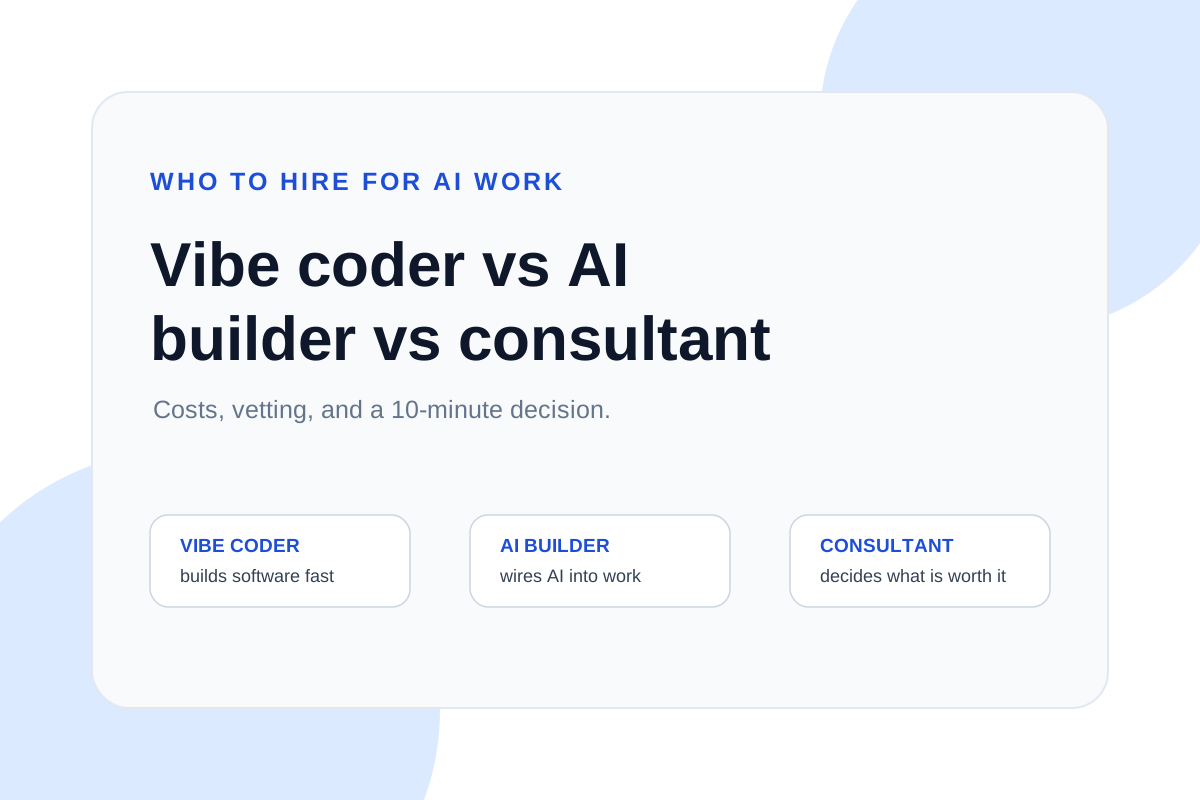
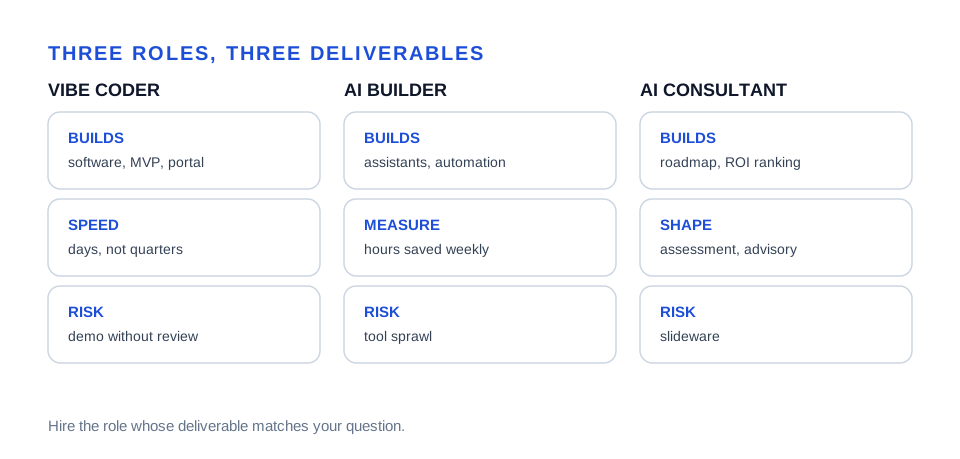
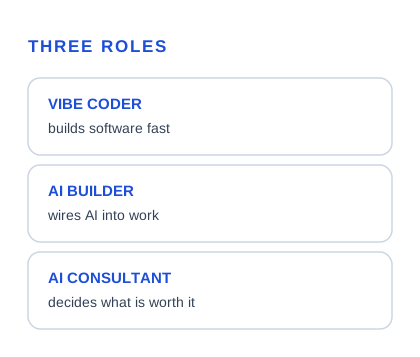
A vibe coder builds software fast with AI-assisted tools, an AI builder implements AI systems like assistants and automations inside your business, and an AI consultant tells you which of those moves is worth paying for before you commit. Hiring the wrong one buys speed without direction or direction without delivery. Reviewed September 2026. Figures below are illustrative planning examples drawn from publicly reported 2026 ranges, not market averages or ProofDevs quotes.
Founders searching for "AI help" meet three labels that sound interchangeable but solve different problems. This guide defines each role, maps them to project types with cost bands, gives you vetting questions that expose pretenders, and ends with a decision framework you can apply in ten minutes. For background on the engineering profile behind the first two roles, see our guide to AI-native developers; if your problem is a broken product rather than a new build, start with our fix hub instead.
What is a vibe coder?
A vibe coder is a software developer who builds applications with AI-assisted tools — Cursor, Claude Code, GitHub Copilot, Lovable, Bolt — as the core of the workflow, directing the model with natural language and then reviewing, testing, and hardening what it produces.
The title is new but the job test is old: anyone can generate code, far fewer can tell when it is wrong. A production-worthy vibe coder combines fluent prompting with conventional engineering literacy — version control, testing, debugging, security basics, deployment. Without that second half you get a working demo that collapses under real users, which is exactly the failure mode behind most vibe-coding horror stories. The non-negotiables before hiring one: you own the code, the repository, and every account; there is a real security story for auth, payments, and data; and post-launch support is agreed in writing.
What is an AI builder?
An AI builder is a practitioner who implements AI-powered systems inside a business: support assistants, lead-qualification flows, document extraction, RAG pipelines over company knowledge, voice agents, workflow automation across CRM and operations tools.
Where the vibe coder's output is software, the AI builder's output is a working business capability — usually measured in hours saved per week rather than features shipped. Many AI builders are freelancers or fractional engineers who combine business-operations sense with tooling fluency (LLM APIs, LangChain, n8n, Make, vector search). The label also causes the most confusion in search results, because "AI builder" additionally names website-builder products; clarify in every conversation whether you are hiring a person who builds AI systems or buying a tool that generates a website. Our free AI website builders guide covers the tool side of that ambiguity.
What is an AI consultant?
An AI consultant is an advisor who identifies which AI moves are worth making, in what order, at what cost, and with what expected return — before you spend on tools or development.
The typical engagement runs audit, design, training: map where hours leak, match tools to the leaks, connect them to existing systems, and teach the team to run everything after departure. Good consultants scope to one workflow and prove ROI on a pilot before widening anything; the classic failure is a strategy deck nobody acts on. Hire a consultant when the question is "what should we do" rather than "who will build it" — and be wary of anyone whose roadmap always ends in their own implementation contract.
Vibe coder vs AI builder vs AI consultant at a glance
The three roles differ in deliverable, engagement shape, and the question they answer. Use this table to locate yourself before reading further.
| Factor | Vibe coder | AI builder | AI consultant |
|---|---|---|---|
| Core question answered | "Who builds this fast?" | "Who wires AI into our work?" | "What is worth doing?" |
| Deliverable | Working software: MVP, dashboard, portal, feature | Working capability: assistant, automation, agent | Decision: roadmap, ROI-ranked priorities |
| Typical engagement | Hourly, fixed-scope build, or sprint | Fixed-scope implementation, sometimes retainer | Assessment, workshop, advisory retainer |
| Success metric | Shipped, tested, deployed software | Hours saved, response time, conversion lift | Correct prioritization, avoided waste |
| Biggest hiring risk | Demo without engineering discipline | Tool sprawl without integration | Slideware without implementation |
| When to hire | Scope known, speed matters | Workflow known, automation wanted | Nothing known, direction needed |
What does each cost?
Publicly reported 2026 ranges cluster distinctly. Freelance vibe coders sit around $50–$150 per hour, with bounded MVPs roughly $1,500–$8,000; boutique studios run $8,000–$40,000 per build. AI builders price per implemented workflow — small automations a few thousand, multi-system rollouts an order of magnitude more. AI consultants charge $100–$300 per hour for advisory, $2,500–$10,000 for a fixed-scope assessment or quick win, and $1,500–$8,000 per month for fractional retainers.
Illustrative planning example: a support-triage assistant scoped as one workflow — builder implementation at $6,000 fixed, plus $60 per month in model API costs, plus 6 hours of team training. Compare against the alternative: a consultant assessment at $3,000 that ranks five candidate workflows and recommends starting elsewhere. The arithmetic shows why sequencing matters more than hourly rates — the cheapest engagement is the one aimed at the right target.
When to hire a vibe coder
Hire a vibe coder when the scope is describable and speed is the constraint: validating a concept, replacing spreadsheet workflows, building an internal dashboard, connecting business systems, creating a customer portal, or accelerating a defined backlog.
It is the wrong hire when the requirements are unknown (you need discovery first), when the domain is regulated or safety-critical without a reviewer (you need senior oversight, not speed), or when the "app" is really an excuse to avoid deciding what the business needs (you need a consultant). A practical rule from hiring guides that keeps reappearing: if you are still validating the idea, build a rough version yourself with Lovable or Bolt for nearly nothing first — you will hire far better afterward. Our tool comparison helps pick the starting point.
When to hire an AI builder
Hire an AI builder when one repeating workflow eats ten or more hours a week and your records live in known places: support triage with draft replies, invoice and document extraction, lead intake with CRM updates, after-hours call answering with booking.
Demand the same ownership terms as with any developer — repository, prompts, integrations, and accounts are yours — plus one builder-specific term: measured ROI. The engagement should name the hours saved or the response time improved before work starts, with a review point that checks the number. Builders who talk models before workflows are selling fascination; builders who start from your weekly repetitive work are selling value.
How to vet a vibe coder
Vetting tests review discipline, not prompting vocabulary. Ask for one live application you can log into and use — not screenshots — then ask the candidate to open the repository, trace a request from interface to database, and explain what the model initially got wrong and how it was caught.
- Live evidence: a deployed app with real users beats ten demos; check commit history, tests, and monitoring.
- Security answers: how are API keys stored, how is auth implemented, what happens when the model suggests an insecure default? "The AI handles it" fails instantly.
- Tool reasoning: why this tool for your project — a one-tool candidate fits one project shape.
- Paid trial: an 8–16 hour scoped task with an ambiguous requirement and one flawed suggestion baked in, to observe clarification and judgment.
- Ownership: code, repo, and accounts in your name from day one, maintenance terms in writing.
How to vet an AI builder and an AI consultant
For builders, ask to see one workflow automated end to end: the hours it saves weekly, the systems it touches, and how a human stays in control of anything customer-facing. Confirm who exactly does the work — the pitch person is rarely the delivery team — and require a fixed-scope phase one with a working pilot in weeks, not quarters.
For consultants, ask for two case studies from businesses your size with named outcomes in dollars or hours, a sample assessment deliverable, and total cost of ownership in writing including tooling and running costs. Red flags: a custom build recommended on the first call, Fortune-500-only logos, jargon instead of bookkeeper-plain explanations, disappearance clauses at launch. The one question that handles most of it: will they teach your team, or quietly make you dependent on them?
Common mistakes when hiring AI help
The most expensive mistake is hiring a builder before a decider: a beautiful assistant for a workflow that was never the bottleneck. Next is the vibe-coded production app with no reviewer — Veracode's testing found insecure patterns in nearly half of AI-generated code samples, which is why human review is infrastructure, not polish. Then the consultant-to-implementation pipeline with no competitive quote, the tool-subscription sprawl (three overlapping AI subscriptions six months later), and the ownership trap where the app lives in the builder's account.
Each has a one-line defense. Builder before decider: run the assessment first. Unreviewed AI code: require tests, staging, and a security checklist before production. Captive implementation: separate the advisory contract from the build quote. Subscription sprawl: name every tool and its monthly cost in the scope. Ownership trap: business-owned accounts before work begins. Our flexible hiring guide covers engagement structures that enforce these defenses contractually.
Case: prototype that needed a vibe coder, not an agency
Starting point
A non-technical founder with a validated B2B workflow needed a customer portal to show two pilot clients — real logins, real data, eight weeks to a board meeting.
What blocked progress
Two agencies quoted $50,000+ with six weeks of scoping before the first commit. The timeline made both quotes useless regardless of quality.
Fix approach
A senior vibe coder was hired on a fixed-scope build: auth, two user roles, one integration, tests, staging deployment. A paid trial task preceded the contract; the repository lived in the founder's account from day one.
Outcome
Portal live in week five, demoed at the board meeting, both pilots converted. Total build cost under a fifth of the agency quotes — the planning example, not a promise: speed came from scoped ambition plus review discipline, not from skipping tests.
Case: support inbox that needed an AI builder, not a chatbot subscription
Starting point
A 30-person services company drowned in repetitive support email: same ten questions, 15 hours a week across two staff members, response times slipping.
What blocked progress
They had already bought a chatbot subscription. It answered confidently, integrated with nothing, and the team stopped trusting it within a month.
Fix approach
An AI builder scrapped the subscription, connected triage to the actual inbox and CRM, added draft-reply review by a human, and measured deflection weekly. One workflow, fixed scope, training included.
Outcome
Roughly 12 hours a week returned to the team within two months, response times halved, and the subscription spend dropped to API costs. Lesson priced in: the tool was never the expensive part — integration and trust were.
Case: three departments that needed a consultant before anyone built
Starting point
A growing distributor faced competing AI pitches: sales wanted lead scoring, operations wanted document extraction, support wanted a voice agent — each with a vendor attached.
What blocked progress
Every vendor's roadmap started with their own product. Nobody had ranked the opportunities by return, and the combined quotes exceeded the annual IT budget.
Fix approach
A consultant ran a two-week assessment: workflow audit, ROI ranking, tool picks, integration plan. Document extraction won on payback; the voice agent was deferred as negative ROI at current call volumes.
Outcome
One fixed-scope build instead of three, payback inside two quarters, and a ranked backlog for next year. The assessment fee was the highest-ROI money the company spent — it prevented two builds, not just guided one.
Decision framework: which one in ten minutes
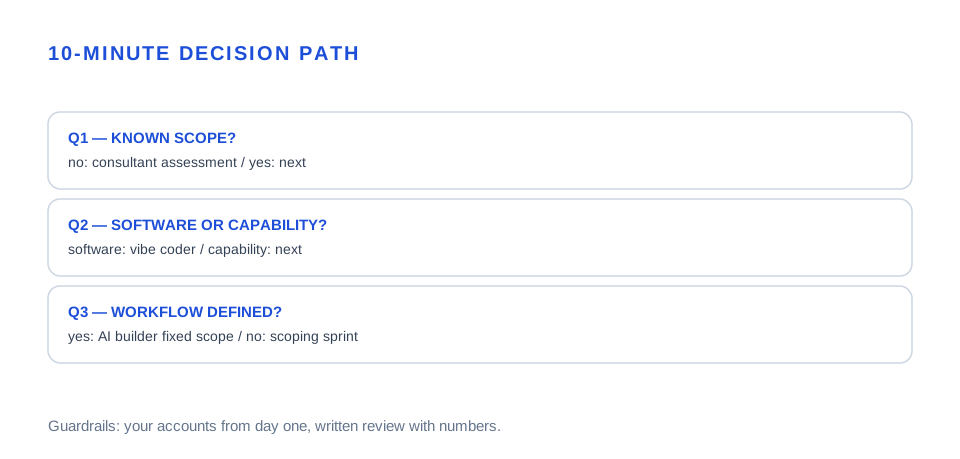
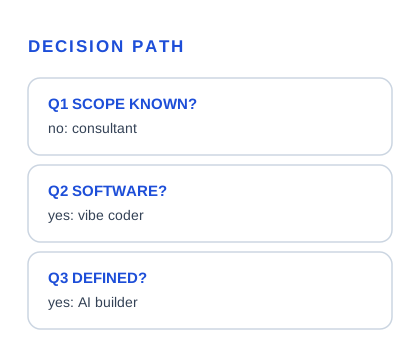
Answer three questions in order. First: do you know what should be built? No — hire an AI consultant for an assessment. Yes — continue. Second: is the deliverable software users log into, or a capability inside existing work? Software — hire the vibe coder. Capability — continue. Third: is the workflow precisely defined with measurable return? Yes — hire the AI builder against a fixed scope. No — loop back to a consultant for a focused scoping sprint.
When the answer is a consultant first
Hire an AI consultant when several departments could use AI, nobody agrees on priorities, or past tool spending produced logins nobody opens. The consultant's product is a ranked plan with costed options — and the honest ones will sometimes conclude you need a $20-per-month tool and an afternoon, not an engagement. Structure it as assessment first, implementation second, never bundled blind: fixed-scope phase one with named deliverables protects against the open-ended retainer that bills while deciding.
Two guardrails apply regardless of path: business-owned accounts and repositories from day one, and a written review point with numbers before any extension. Bring the answers to our review desk if you want an independent read before signing, or compare engagement models in our outsource-versus-hire guide.
FAQ: vibe coder, AI builder, AI consultant
What is a vibe coder?
A vibe coder is a software developer who builds applications using AI-assisted tools like Cursor, Claude Code, or Lovable, then reviews, tests, and hardens the output. The title is new; the hiring test is classic engineering judgment.
What is an AI builder?
An AI builder implements AI systems inside a business — assistants, automations, RAG pipelines, agents — measured in hours saved rather than features shipped. Confirm whether a person-means-person or a website-builder tool in every conversation.
What is an AI consultant?
An AI consultant advises which AI moves are worth making, in what order and at what cost, before you spend on tools or development. Typical work: workflow audit, ROI-ranked roadmap, tool selection, team training.
Which should I hire first?
If direction is unknown, the consultant. If scope is known and speed matters, the vibe coder. If the workflow is defined and repetitive, the AI builder. Assessment before implementation is the sequence that avoids the costliest mistakes.
How much does a vibe coder cost?
Publicly reported 2026 ranges: roughly $50–$150 per hour freelance, $1,500–$8,000 for a bounded MVP, $8,000–$40,000 through boutique studios. Price the underlying engineering role, not the label.
How much does an AI consultant cost?
Roughly $100–$300 per hour for advisory, $2,500–$10,000 for a fixed-scope assessment or quick win, $1,500–$8,000 per month for a fractional retainer. Demand fixed-scope phase one with named deliverables.
Can one person be all three?
Sometimes a senior fractional AI engineer advises and builds, which suits single-workflow projects. For multi-workflow programs, separate the advisory from the build — combined roles create captive roadmaps that always recommend their own implementation.
Is vibe-coded software safe for production?
Yes, when a skilled developer reviews the code, tests it, and follows standard security practice for auth, data, and keys. Most public failures trace to AI output shipped without review, not to the tools themselves.
Should I just use AI website builders instead of hiring?
For validation and simple sites, often yes — tools are cheap and fast. Hire when you need production quality, integrations, data security, or someone accountable after launch. See our free builders breakdown for the tool side.
Who owns the code and accounts?
You should. Repository, prompts, integrations, hosting, and third-party accounts stay business-owned with handover documentation. Providers insisting on their own accounts are selling dependence, not delivery.
Written by Michael Melnyk
Senior IT Technical Writer & Technology Analyst
Senior Technical Writer and IT Industry Analyst with over 7 years of experience analyzing software engineering ecosystems, tech leadership models, and developer procurement frameworks.