
Hire a Flutter Developer: Flutter vs React Native vs Native, Cost by App Type, and the Store Deadlines to Budget For
A Flutter app that shipped fine in 2024 can be blocked from Google Play updates on February 1, 2027. Here is how to hire for the build and for the upgrades nobody put in the quote.


Updated October 23, 2026. A Flutter developer is a mobile engineer who builds iOS and Android apps (and optionally web and desktop) from one codebase using Google's Flutter toolkit and the Dart language. The business appeal is one team, one release process and a user interface that looks identical on every device. The catch is that "one codebase" still has to pass two stores' rules, and those rules are changing on a schedule that most quotes ignore.
An independent senior Flutter developer costs $45 to $95 per hour. A focused cross-platform app with login, lists and an API takes about 120 to 250 hours ($5,400 to $23,750), while an MVP with payments, push notifications and offline mode takes 250 to 500 hours ($11,250 to $47,500). Agencies often charge $150 to $250 per hour for the same scope. Budget extra for maintenance: Flutter 3.47, released on August 12, 2026, raised minimum OS versions, and Google Play will stop accepting updates from apps that do not support 16 KB memory pages on February 1, 2027. If you want a vetted engineer on an hourly arrangement or a fixed one-time task, this guide shows what to scope, what to ask and how to test.
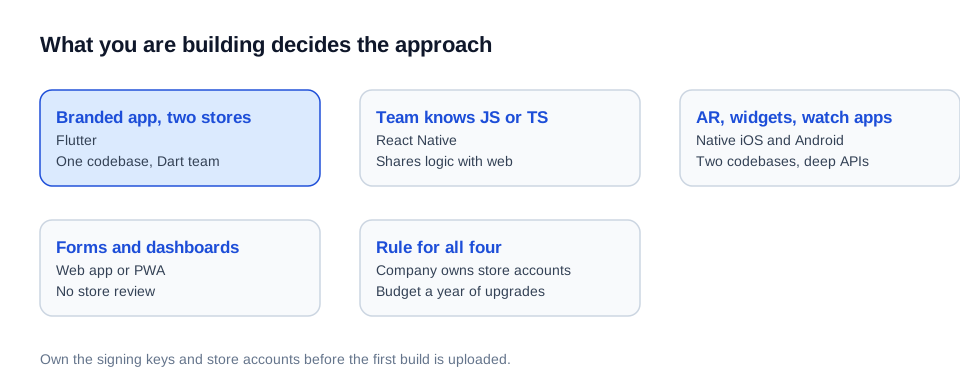
Figure 1: The approach follows the product and the team you already have, not the framework's popularity.
When Flutter Is the Right Choice, and When It Is Not
Choose Flutter when you need one team to ship the same custom-designed app on iOS and Android and your product is mostly screens, forms, lists, maps and charts. Choose something else when your team already writes JavaScript and shares logic with a web app, or when the product depends on deep, new platform features.
| Approach | Strength | Weakness | Best for |
|---|---|---|---|
| Flutter | One codebase, consistent custom UI, strong for animation and branded design | Dart talent pool is smaller; some platform features need native bridge code | Startups and businesses shipping a branded app on two platforms |
| React Native | Large JavaScript and TypeScript talent pool; logic can be shared with web | Look and feel depends more on platform components and libraries | Teams already strong in React and TypeScript |
| Native iOS and Android | Earliest access to platform features, best platform fit | Two codebases, two teams, higher cost | Camera, AR, widgets, watch apps, heavy hardware use |
| Web app or PWA | Cheapest, no store review | Limited device access, weaker discoverability inside stores | Content, forms and dashboards where an app icon is not essential |
Comparison guides published in 2026 mostly agree that both Flutter and React Native are mature enough for business use and that the decision comes down to team skills, design needs and growth plans. Most of those guides are written by agencies, so treat their performance and market-share numbers cautiously. If your plan includes heavy platform integration, read the companion guide on hiring an iOS developer before committing to a cross-platform stack.
What a Flutter Developer Should Be Able to Do
A senior Flutter developer owns the whole path from design handoff to a live store listing, not just the screens. The difference between a screen builder and an engineer shows up after launch, when crashes, store rejections and operating system updates start arriving.
- Architecture: a consistent way to manage app state and separate screens from business logic, so the second developer can join without a rewrite.
- Native integration: writing bridge code in Swift and Kotlin when a plugin does not exist or is abandoned.
- Offline and sync: local storage, retry rules and conflict handling for users on unstable networks.
- Quality: automated tests for the money and login paths, crash reporting, and performance checks on low-end phones.
- Release engineering: signing keys, build pipelines, test tracks, phased rollouts and store listing compliance.
- Dependency hygiene: choosing maintained packages and replacing the ones that stop being updated.
The 2026–2027 Store and Toolchain Deadlines to Budget For
An app already in the stores still needs engineering time in the next six months, and that time should be in your budget, not a surprise invoice. The items below come from Flutter's own release notes and Google's developer documentation.
| Change | Source and date | What it means for your app | Typical effort |
|---|---|---|---|
| Google Play 16 KB page size | Google Android docs: updates blocked from Feb 1, 2027 for apps without support | Flutter apps include native libraries, so the app and every native plugin must be rebuilt and tested | 8–24 hours ($360–$2,280) |
| Xcode 27 and iOS 27: new app lifecycle | Flutter 3.47 breaking-change notes | Apps that do not adopt the new lifecycle fail to launch with the iOS 27 SDK | 6–20 hours ($270–$1,900) |
| Flutter 3.47 minimum OS versions | Flutter 3.47 (Aug 12, 2026) | iOS 15 and Android API 24 become the default minimums, so older devices drop out | 2–8 hours plus analytics review |
| Material and Cupertino split | Flutter 3.47 blog: core versions scheduled for deprecation in the November stable | Design-system code moves to separate packages; migrate on your schedule, not in a rush | 6–30 hours depending on UI size |
| Intel Mac wind-down | Flutter 3.47 notes | Build machines and CI runners on Intel Macs need replacing | 2–6 hours |
Hours are planning estimates. Flutter ships a new stable roughly every quarter, so a healthy app gets a short upgrade pass four times a year rather than one painful catch-up every two years. A developer who has not upgraded the project in a year is a risk even if the app "works".
Cost: Hours and Budgets by App Type
Cost follows the number of screens, the number of integrations and how much offline behavior you need. The figures assume an independent senior at $45 to $95 per hour and exclude design, store fees and backend hosting unless stated.
| Project | Typical scope | Hours | Cost ($45–$95/hr) |
|---|---|---|---|
| Simple app | Login, lists, forms, an existing API | 120–250 | $5,400–$23,750 |
| MVP | Accounts, payments, push notifications, offline mode, admin backend | 250–500 | $11,250–$47,500 |
| Marketplace or fintech-style app | Roles, chat, payments, identity checks, audit trails | 500–900 | $22,500–$85,500 |
| Native module or plugin bridge | Bluetooth, background tasks, custom payments SDK | 20–60 | $900–$5,700 |
| Release pipeline and store setup | Signing, build automation, test tracks, store listings | 12–30 | $540–$2,850 |
| Audit and rescue of an existing app | Code review, upgrade plan, crash and dependency fixes | 12–30 | $540–$2,850 |
| Yearly maintenance | Four upgrade passes, store compliance, small fixes | 40–100 | $1,800–$9,500 |
For broader rate context see developer hourly rates and the comparison of building, hiring and outsourcing software. Note that a cross-platform app is usually cheaper than two native apps, but not half the price: shared code is typically the largest part, while store setup, native bridges and platform-specific testing remain per-platform costs.
Own the Accounts, Keys and Code From Day One
Your company, not the developer, must own the Apple Developer account, the Google Play Console account, the signing keys and the repository. Stores tie an app's identity to its publisher account and signing keys, so an app published under a contractor's personal account is hard to move and impossible to update if the contractor disappears.
- Register both store accounts under your company and invite the developer with limited roles.
- Store signing keys and recovery information in a company password manager, with a backup that two people can reach.
- Keep the repository, the backend, analytics and crash reporting in company-owned accounts.
- Require a written assignment of all work product and a handover document with build instructions.
Taking Over an Existing Flutter App: Pre-Hire Audit
Before extending an app someone else built, spend 6 to 12 hours on a read-only audit and pay for it as a separate task. The audit turns "it works" into a list of risks and a price.
- Which Flutter version does the project use, and how far behind the current stable is it?
- Does one consistent approach to state management run through the app, or three different ones?
- How many packages are unmaintained or pinned to old versions, and do any contain native code?
- Are there automated tests on login, payments and sync, and does the build pipeline run them?
- Where are the signing keys, and can the company rebuild and release without the original developer?
- Is crash reporting active, and what do the last 90 days of crashes show?
- Does the app collect personal data, and does the store privacy declaration match what it really does?
- Choosing Flutter because "one codebase" sounds half-price, without budgeting store setup and maintenance.
- Letting the developer publish under a personal store account.
- Skipping a pre-launch test on low-end Android phones and older iPhones that your users really own.
- Accepting an app with no crash reporting and no release pipeline.
- Ignoring the store deadlines until a rejection or a blocked update arrives.
- Hiring an agency that sells Flutter and then staffs the project with juniors.
Red flags are a project that no longer builds on a fresh machine, a single huge file holding most of the logic, secrets inside the repository and no one who can explain how a release is made.
Three Realistic Scenarios
Scenario 1: A booking MVP for a service business
A salon network wants a booking and loyalty app on both platforms in 10 weeks. The developer builds accounts, calendar booking, push reminders and a simple payment flow on an existing backend. Estimated effort is 280 to 380 hours ($12,600 to $36,100). The usual overrun comes from store review feedback and push notification setup, so a buffer of 10 to 15% is sensible.
Scenario 2: A three-year-old app facing the 2027 deadlines
A delivery company's app was built on an old Flutter version and cannot be updated for Google Play's 16 KB requirement. The engineer first upgrades the toolchain and dependencies on a branch, replaces two abandoned packages, rebuilds the native parts and tests on devices. Estimated effort is 40 to 90 hours ($1,800 to $8,550). Starting the work in autumn leaves room before the February 1, 2027 cutoff.
Scenario 3: Founder inherits a freelancer's app
A founder's freelancer vanished, and the Google Play listing sits under the freelancer's account. The audit finds no tests and signing keys on one laptop. The new engineer negotiates a publisher transfer, rebuilds the signing setup and adds a release pipeline. Estimated effort is 25 to 50 hours ($1,125 to $4,750) before any new feature. The lesson is that ownership is a purchase requirement, not a technical detail.
How to Vet a Flutter Developer
Judge candidates by apps in the stores and by how they handle release and upgrade problems, not by a list of packages on a resume. Ask for live app links, then ask what they would change in each one.
| Question | Junior signal | Senior signal |
|---|---|---|
| How do you structure a project so a second developer can join? | "I put everything in the screens." | Describes separated layers, one state-management approach and a written convention. |
| A package we depend on stops being updated. What now? | "We wait." | Assesses usage, wraps it behind an interface, plans replacement or a maintained fork. |
| How do you release safely? | Uploads builds by hand from a laptop. | Automated builds, internal test track, phased rollout and a rollback plan. |
| What happens when a user goes offline mid-payment? | No answer. | Describes idempotent requests, pending states and reconciliation after reconnect. |
| When would you not use Flutter? | "Always use Flutter." | Names cases such as heavy AR, widgets and watch apps, or a team with a strong React base. |
The 3 to 5 hour paid trial
Pay the candidate their hourly rate. Give them a small spec: a two-screen app that signs in against a test API, loads a list, caches it for offline reading, and shows a clear error state when the network fails. Ask for a short README stating how to run it, what they chose not to build and how they would structure the next ten screens.
| Criterion | Pass | Fail |
|---|---|---|
| Offline behavior | Cached list loads with no network and shows a clear stale indicator | Blank screen or crash |
| Structure | Separated layers and one consistent state approach | Logic spread through widgets |
| Error handling | User sees what failed and can retry | Silent failure or raw exception text |
| Tests | At least the data layer is covered by automated tests | No tests, "tested manually" |
| Handover | Builds on a clean machine from the README | Needs the author to explain |
Common Mistakes When Hiring for Flutter
Expert Tip: Ask for a Two-Part Quote
Request one price for building the app and a second, separate price for the first twelve months of upgrades, store compliance and crash fixes. A developer who cannot estimate the second part has not run an app through a full store cycle. Combined with the account-ownership rules above, this one habit prevents most surprise invoices.
Frequently Asked Questions
How much does it cost to hire a Flutter developer?
An independent senior Flutter developer costs $45 to $95 per hour. A simple app takes 120 to 250 hours ($5,400 to $23,750), an MVP with payments and offline mode takes 250 to 500 hours ($11,250 to $47,500), and agencies typically charge $150 to $250 per hour.
Is Flutter good for business apps in 2026?
Yes, for apps made mostly of screens, forms, lists and maps that must look the same on iOS and Android. Flutter 3.47 shipped on August 12, 2026, and Google continues to release a new stable roughly every quarter. It is a weaker fit for projects that rely on new platform features such as AR or widgets.
Flutter or React Native: which should I choose?
Choose Flutter for a custom branded interface and a team that can learn Dart, and choose React Native if your team already works in JavaScript or TypeScript and shares logic with a web product. Both are mature, so team skills usually decide.
Is a Flutter app cheaper than two native apps?
Usually yes, but not by half. Shared code is the biggest part of the work, while store setup, native bridges and platform-specific testing stay per platform.
How long does it take to build a Flutter app?
A simple app takes 4 to 8 weeks and an MVP takes 8 to 16 weeks with one senior developer, depending on integrations and design readiness. Store review adds several days for the first submission.
What is the Google Play 16 KB page size requirement?
From February 1, 2027, Google Play will not accept updates from apps that do not support 16 KB memory pages on 64-bit devices (for apps targeting Android 15 or higher). Apps with native libraries, including Flutter apps and their plugins, must be rebuilt and tested; Google's Android documentation covers the tooling.
What changed in Flutter 3.47?
Flutter 3.47 made Impeller the default renderer on macOS, Windows and Linux, released Material and Cupertino as standalone 1.0 packages with the core versions scheduled for deprecation in the November stable, and raised the minimum iOS version to 15. It also warns that apps must adopt a new iOS lifecycle to launch with the iOS 27 SDK.
Can Flutter apps be published to both stores from one developer?
Yes, but each store has its own account, review rules and signing process. Register both under your company and add the developer as a limited user.
Who should own the source code and store accounts?
Your company, from the first day. Use company-owned Apple and Google accounts, keep signing keys in a company vault and sign a contract that assigns all work product to you.
How do I check a Flutter developer's skills?
Ask for live apps and inspect them, then give a paid 3 to 5 hour task such as a two-screen app with sign-in, a cached list and clear error states. Grade it against a written pass or fail rubric.
Do I need a backend for a Flutter app?
Almost always, unless the app is fully offline. A Flutter app is the client; accounts, payments, data and notifications need a backend or a managed service, which should be priced separately.
How much does Flutter app maintenance cost per year?
Plan 40 to 100 hours a year ($1,800 to $9,500 at $45 to $95 per hour) for four upgrade passes, store compliance changes and small fixes. Apps with many native plugins or heavy custom UI sit at the upper end.
Not sure whether Flutter, React Native or native fits your product, or whether your current app survives the 2027 deadlines? Start with a fixed one-time task: a scoped audit or a first release, with your repository, your store accounts and your signing keys from day one.
Written by Michael Melnyk
Senior IT Technical Writer & Technology Analyst
Senior Technical Writer and IT Industry Analyst with over 7 years of experience analyzing software engineering ecosystems, tech leadership models, and developer procurement frameworks.