Lovable vs. Bolt vs. Cursor vs. Replit: Which AI App Builder Fits Your Project?
AI development tools are not interchangeable. Here is a clear, honest breakdown of Lovable, Bolt.new, Cursor, and Replit to help you choose the right tool for your skill level and product roadmap.

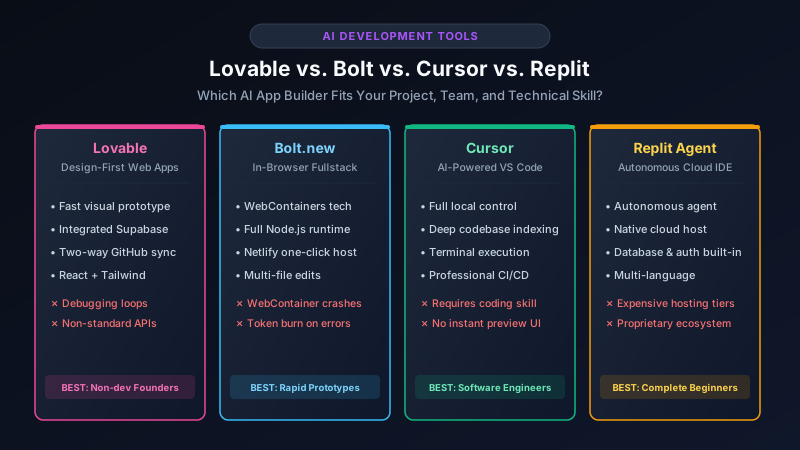
The explosion of generative AI coding tools has created immense excitement, but also widespread confusion among founders. It is easy to assume that Lovable, Bolt.new, Cursor, and Replit are competing for the exact same job. In reality, each platform was engineered for a completely different user profile and development phase.
Choosing the wrong platform can leave a non-technical founder trapped in debugging loops, or force an experienced engineer into an inflexible visual sandbox. Here is an honest, practical comparison of how these four leading AI builders compare across speed, database support, code export, and production readiness. Reviewed September 2026. Feature sets reflect current releases across all four platforms.
Executive Overview: The 4 Tools at a Glance
| Feature / Dimension | Lovable | Bolt.new | Cursor | Replit Agent |
|---|---|---|---|---|
| Primary Target User | Non-technical founders, product designers, marketers | Founders & developers wanting fast fullstack browser sandboxes | Professional software engineers & technical leads | Beginners & solo builders wanting all-in-one cloud apps |
| Core Technical Strength | Exceptional UI aesthetics, clean React code, instant Supabase | Runs full Node.js in-browser (WebContainers), multi-file edits | Deep local codebase indexing, terminal execution, unlimited Git control | Autonomous agent installs dependencies and configures cloud hosting |
| Primary Database Match | Supabase (PostgreSQL) | Flexible (Supabase, SQLite, Firebase) | Any database engine or ORM (Prisma, Drizzle, etc.) | Replit PostgreSQL (native cloud DB) |
| Code Export & Portability | High: Clean two-way GitHub sync, Vite/React stack | High: Download ZIP or push to GitHub/Netlify | Total: Code resides 100% on your local machine | Moderate: Exportable, but heavily tied to Replit environment |
| Biggest Weakness | Credit burn when asking AI to resolve complex backend bugs | WebContainer memory limits and browser crashes on large repos | Steep learning curve; requires software engineering competence | Higher recurring cloud hosting fees and proprietary lock-in |
1. Lovable: The Design-First Web App Specialist
Lovable’s defining characteristic is its visual taste. Where other tools generate generic, dated bootstrap interfaces, Lovable consistently produces polished, modern web applications utilizing Tailwind CSS and shadcn/ui components.
Best For:
- Founders creating a client-facing MVP or SaaS dashboard that needs to look investor-ready on day one.
- Applications requiring a relational database: Lovable’s native Supabase integration sets up tables and user authentication in clicks. Learn how to secure this in our Lovable Supabase security guide.
- Teams planning to export to GitHub and collaborate with independent developers. Our guide on exporting Lovable code to GitHub shows how smooth this workflow is.
2. Bolt.new: The In-Browser Fullstack Sandbox
Powered by StackBlitz’s WebContainers technology, Bolt.new runs a complete Node.js environment entirely inside your web browser. This enables Bolt to execute backend scripts, install npm packages, and spin up development servers without external cloud sandboxes.
Best For:
- Rapidly testing experimental npm libraries, frameworks (Astro, Svelte, Next.js), and fullstack prototypes.
- Developers who want to generate working prototypes in seconds and deploy immediately to Netlify.
- Watch out for: Large projects can crash the browser tab when memory limits are reached, and token consumption can accelerate quickly during iterative prompt sessions.
3. Cursor: The Professional Engineer’s Weapon of Choice
Cursor is not a prompt-to-app generator for beginners. It is a professional desktop code editor—a fork of VS Code—infused with frontier AI models (Claude 3.5 Sonnet, GPT-4o) that index your entire local repository.
Best For:
- Professional developers building enterprise-grade, scalable production systems.
- Refactoring complex codebases, writing unit tests, and automating multi-file architecture changes.
- Hardening AI prototypes: A common, highly effective workflow is to build a prototype in Lovable, export it to GitHub, and have a senior engineer refine it in Cursor. Read our guide to the Lovable app creator to understand how developers execute this bridge.
4. Replit Agent: The Autonomous Cloud Builder
Replit Agent operates like an autonomous junior developer working inside a cloud computer. You provide a prompt (e.g., “Build a real-time multiplayer chat app with custom avatars”), and the agent plans the tasks, creates the database, writes the backend code, and hosts the app on Replit’s cloud infrastructure.
Best For:
- Solo creators who want an all-in-one environment without configuring GitHub, Vercel, or external databases.
- Internal administrative tools, Discord bots, and quick API microservices.
- Watch out for: Monthly subscription and compute costs can add up quickly, and migrating off Replit requires developer intervention.
Decision Framework: Which Should You Pick?
- If you are a non-technical founder building a web app: Start in Lovable. You will get the cleanest visual design, standard React components, and easy database connectivity.
- If you are a developer testing a quick library or fullstack idea: Open Bolt.new for instant browser iteration.
- If you want an autonomous agent to build and host a complete tool in one window: Try Replit Agent.
- If you need production-grade performance, bulletproof security, and daily scale: Hire a developer who uses Cursor to harden your codebase.
If you have already built a prototype in Lovable or Bolt and need an experienced engineer to clean up the architecture, review our roster of ProofDevs verified developers for fast, reliable delivery.
Written by Michael Melnyk
Senior IT Technical Writer & Technology Analyst
Senior Technical Writer and IT Industry Analyst with over 7 years of experience analyzing software engineering ecosystems, tech leadership models, and developer procurement frameworks.