Should You Hire a Junior Developer? Real Costs, Risks, and When It Works
Junior developers look cheap on paper, but mentoring overhead, architectural blind spots, and senior review time change the math. Here is when hiring a beginner works—and when it backfires.

The decision to hire a junior developer frequently begins with a simple budgetary calculation. When a company looks at payroll estimates or contractor quotes, the compensation gap between junior and senior software talent appears massive. In Western markets, a senior software engineer routinely commands an annual base salary between $130,000 and $180,000, whereas an entry-level or junior engineer can often be hired for $50,000 to $75,000. For an early-stage startup, a cash-conscious small business, or a team trying to stretch its development budget, hiring two junior engineers instead of one senior engineer seems like an obvious bargain.
In software development, however, nominal salary represents only a fraction of the true economic cost. Code is not physical manufacturing where output scales linearly with headcount. Inexperienced developers do not simply produce features more slowly; they require extensive architectural direction, daily pull request reviews, debugging support, and operational guardrails from experienced engineers. If that supervision is absent, the hidden expense surfaces months later as technical debt, corrupted production databases, architectural dead-ends, and expensive full-scale rewrites.
The Financial Illusion of the "Cheap" Developer
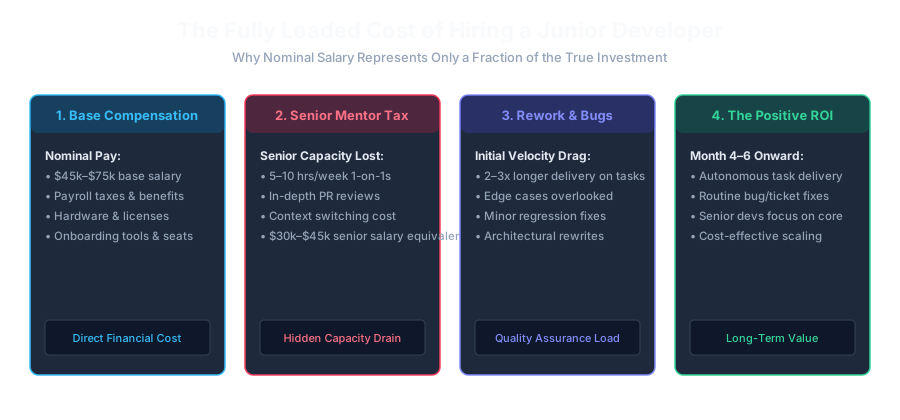
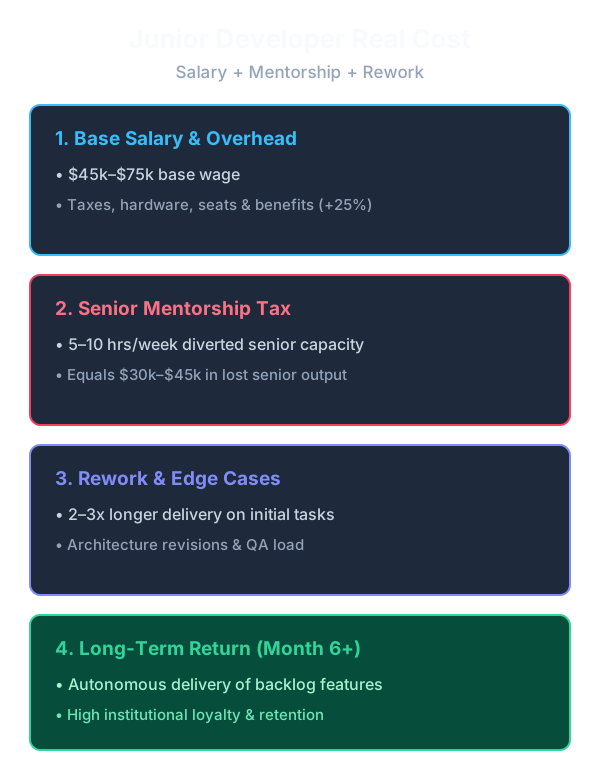
When founders ask whether hiring a junior developer is worth it, they usually evaluate direct financial outlays while ignoring operational drag. To understand the real economics of beginner engineering talent, a company must calculate the fully loaded engineering cost. This equation incorporates four distinct financial variables:
- Direct Compensation: Base wage, health insurance, payroll taxes, hardware procurement, and cloud software seat licenses (GitHub, Jira, IDEs, CI/CD runners).
- The Mentorship Tax: The monetary value of senior developer hours diverted away from shipping strategic features to answer questions, guide environment setups, and review commits.
- Rework and Regression Overhead: The engineering hours required to refactor fragile implementations, fix logic bugs discovered in staging, and resolve production support escalations.
- Opportunity Cost of Velocity: The business revenue lost when a core customer milestone or product launch is delayed due to unexpected technical bottlenecks.
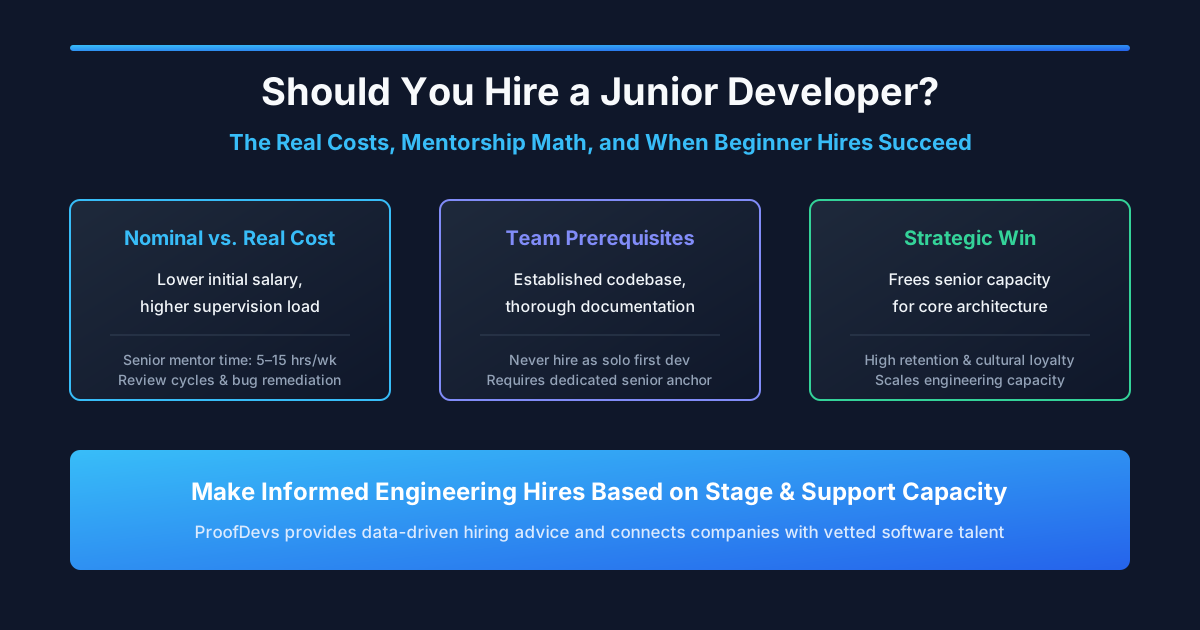
If a senior engineer earning $85 per hour spends ten hours each week mentoring a junior colleague, reviewing their code, and pairing on complex logic, that junior hire incurs an additional $3,400 per month in diverted senior payroll. Add the time spent fixing unintended edge cases or broken database migrations, and the monthly cost differential between a beginner and an autonomous mid-level engineer narrows dramatically.
The Fatal Startup Mistake: The Solo Junior Developer
The single most catastrophic hiring error in early-stage tech ventures is hiring a junior developer as the sole or foundational technical hire. A non-technical founder conceives a product concept, raises a modest angel round or commits personal savings, and hires a recent coding bootcamp graduate or university alumnus because that is what their current cash reserves accommodate.
This dynamic invariably fails for predictable reasons:
- Inability to Evaluate Quality: A non-technical founder cannot judge code cleanliness, database normalization, or security configurations. When the junior developer declares that an authentication workflow or payment integration is "finished," the founder has no way to verify whether the implementation handles token expiry, race conditions, or webhook replay attacks.
- Absence of Architectural Guardrails: Junior developers lack the pattern recognition that comes from witnessing systems fail under real user traffic. They tend to solve problems by installing arbitrary third-party npm packages, creating tangled dependencies that slow down rendering and introduce unpatched security vulnerabilities.
- The Inevitable Rewrite: When user volume increases or an investor conducts technical due diligence, the foundational architecture collapses. The startup is forced to halt marketing, discard six months of work, and pay an experienced team to rebuild the platform from scratch.
If your startup is building its initial minimum viable product and lacks an in-house technical leader, do not assign the core architecture to a beginner. Review our structured roadmap on how to build an MVP for a startup to understand how clean scoping and senior engineering execution preserve long-term capital.
When Hiring a Junior Developer Delivers Exceptional ROI
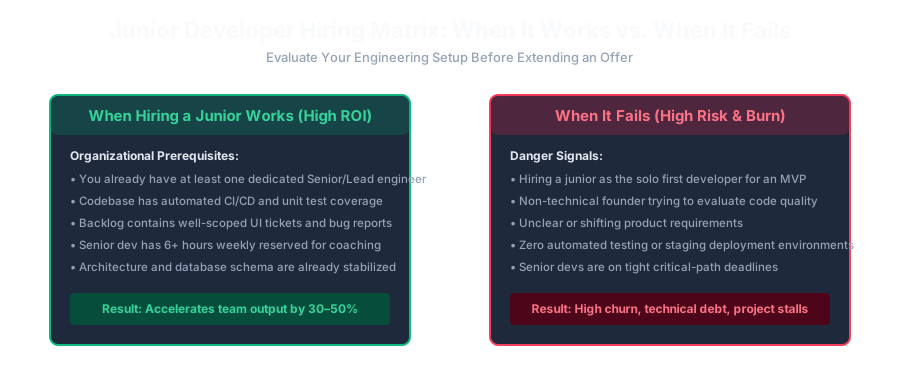
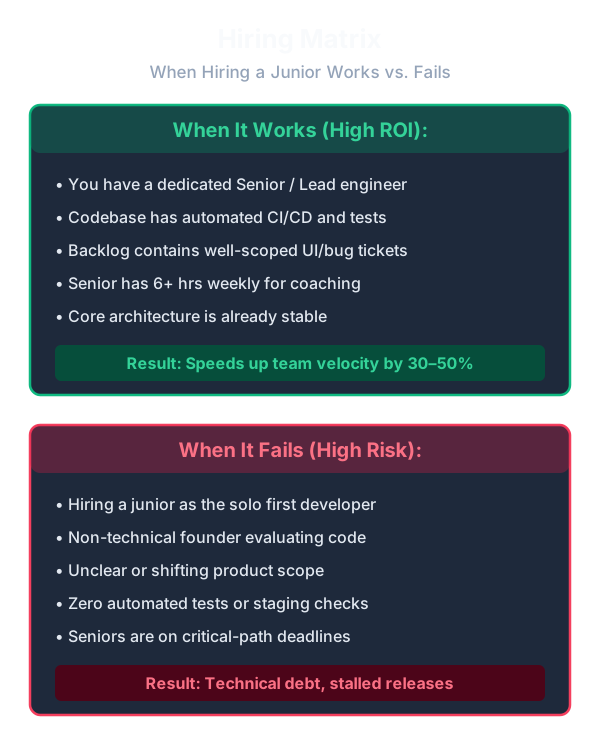
While hiring a beginner as a solo builder is dangerous, integrating a junior engineer into an established, mature engineering team is one of the most effective scaling strategies available. When the right environmental conditions exist, beginner hires generate substantial commercial returns.
1. You Possess an Anchored Senior Engineer
A junior developer can thrive only when there is an experienced staff engineer, technical lead, or senior full-stack developer who actively embraces the mentorship role. The senior engineer provides the system architecture, defines the database models, establishes coding conventions, and decomposes large initiatives into well-bounded, bite-sized tasks.
2. The Codebase Has Automated Guardrails
In modern software engineering, junior developers should be protected by automated infrastructure rather than manual oversight alone. A healthy environment features automated linting, strict TypeScript compilation checks, comprehensive unit test suites, and preview staging deployments on Vercel or AWS. When the continuous integration pipeline automatically blocks broken commits, beginners can experiment and learn without risking production outages.
3. You Have a Steady Stream of Well-Scoped Tasks
Every engineering team has a backlog of essential, non-critical tasks that consume valuable senior focus: internal administration panels, responsive styling adjustments, email notification templates, secondary API integrations, and bug fixes with reproducible test cases. Offloading these tasks to a motivated junior developer frees your senior engineers to concentrate on low-latency data pipelines, security hardening, and core platform scalability.
4. Cultural Loyalty and Retention
Senior engineers are aggressively recruited by global tech companies and frequently change jobs every two to three years. In contrast, a junior developer who is given their first professional break, treated respectfully, and mentored systematically often develops immense institutional loyalty. Within twelve to eighteen months, a talented junior can evolve into a productive mid-level engineer who understands your proprietary business logic better than any external hire.
Junior vs. Mid-Level vs. Senior Developer Comparison
Choosing the right seniority level requires aligning your project's technical ambiguity with the candidate's autonomous execution ability. The table below outlines how responsibilities, supervision needs, and commercial economics distribute across experience tiers:
| Evaluation Factor | Junior Developer (0–2 yrs) | Mid-Level Developer (2–5 yrs) | Senior Developer (5+ yrs) |
|---|---|---|---|
| Supervision Needed | Continuous (requires daily task breakdowns & reviews) | Moderate (requires weekly goals & architectural check-ins) | Minimal (operates autonomously from business requirements) |
| Task Complexity | Defined bug fixes, UI components, repetitive CRUD logic | Feature modules, third-party API wiring, schema updates | System architecture, data security, performance & scaling |
| Architectural Judgment | Follows existing patterns; struggles with unmapped trade-offs | Applies established design patterns reliably across features | Anticipates failure modes, cost spikes, and technical debt |
| Typical US Annual Base | $50,000 – $75,000 | $85,000 – $120,000 | $135,000 – $185,000+ |
| Net Team Velocity | Negative initially (-20% senior drag for first 60 days) | Neutral to immediately additive (+100% capacity) | Force multiplier (accelerates entire engineering output) |
| Primary Value Driver | Cost-effective execution of defined backlog items | Reliable independent delivery of planned milestones | Strategic risk prevention, speed, and technical leadership |
For founders comparing international versus domestic contractor compensation bands, examine our comprehensive research on software engineer salary benchmarks to align your budget with regional talent markets.
How to Evaluate a Junior Developer: Separating Builders from Tutorial Repeaters
The widespread availability of coding bootcamps and AI coding assistants has resulted in an influx of entry-level applicants with identical resumes. Nearly every applicant presents a portfolio containing a generic clone of Netflix, Spotify, or Twitter built by following an online video tutorial. These projects demonstrate that a candidate can copy code from a screen, but reveal nothing about whether they can solve unfamiliar business problems.
1. Demand Shipped, Interactive Projects
Look for candidates who have deployed live, responsive web applications accessible via a public URL. In our analysis of entry level front end developer jobs, we emphasize that hiring managers prioritize candidates who have navigated the friction of production deployment: configuring custom domains, managing environment variables, handling CORS errors, and connecting live databases over those who merely possess local GitHub repositories.
2. Inspect Git Commit Discipline
Examine the candidate's GitHub commit history. Look for granular, descriptive commit messages that document iterative problem solving (e.g., fix: resolve race condition in token refresh loop) rather than massive single commits containing 50,000 lines of uninspected code labeled initial commit or finished app. A candidate who understands git branching, pull requests, and atomic commits can integrate into your workflow on day one.
3. Conduct a Small, Paid Practical Trial
Never rely on whiteboard algorithmic puzzles or trivia questions about JavaScript closures. Instead, offer promising candidates a compensated 4-to-6 hour practical trial task that mirrors actual team work:
- Provide a simplified slice of your real codebase or a small starter repository.
- Ask them to implement a specific UI component, connect a public REST API endpoint, or fix a known, reproducible bug.
- Evaluate their communication: Did they ask clarifying questions when requirements were ambiguous? Did they document their setup assumptions? How did they respond when given constructive feedback during the code review?
A junior candidate who communicates transparently, acknowledges what they do not know, and demonstrates rapid coachability will outperform an arrogant candidate with marginally higher technical knowledge every time.
Structuring the First 90 Days for Maximum Velocity
If you extend an offer to a junior developer, your onboarding structure determines whether they become a productive asset or an ongoing drain on engineering bandwidth. Structure their initial quarter into three distinct operational phases:
Days 1 to 30: The Supervised Sandbox
The beginner should focus on absorbing the codebase architecture, setting up local development containers, and shipping small, low-risk bug fixes. Every pull request must be reviewed thoroughly by a senior engineer before merging into staging. The goal of month one is mastering the deployment workflow and learning team conventions, not shipping major features.
Days 31 to 60: Bounded Feature Ownership
Assign the junior developer ownership of self-contained, well-scoped feature tickets: a new user profile settings page, an export-to-CSV utility, or an integration with an email service provider like Postmark. Provide clear inputs, expected outputs, and interface mockups. Encourage them to write automated unit tests covering their logic before requesting review.
Days 61 to 90: Autonomous Contribution
By the third month, the junior engineer should resolve routine backlog items with minimal senior intervention. Senior engineers should spend no more than two to three hours weekly reviewing their pull requests. If an engineer still requires hands-on hand-holding for routine tasks after 90 days, the onboarding process was flawed or the hiring bar was set incorrectly.
Alternative Strategies: When to Engage Part-Time Senior Talent Instead
If your organization lacks the senior capacity to mentor a junior engineer, attempting to hire one is counterproductive. Fortunately, early-stage companies have access to flexible talent models that were unavailable a decade ago:
- Fractional Technical Leadership: If your team lacks architectural direction, engaging an experienced fractional CTO for five to ten hours monthly provides high-level system design, vendor vetting, and security oversight without executive salary burn.
- Part-Time Senior Engineers: Rather than paying a junior developer $5,000 monthly for slow, supervised output, many startups engage a verified senior engineer on a flexible 10-to-15 hour weekly retainer. The senior specialist delivers production-ready features, clean database models, and bug-free releases in a fraction of the time, requiring zero supervision.
- Milestone-Based Contracting: For discrete product deliverables, hiring specialized independent contractors for focused two-week sprints allows companies to preserve cash while guaranteeing production results.
Frequently Asked Questions
Is it a good idea for a startup to hire a junior developer?
Only if the startup already employs at least one experienced senior software engineer who can provide daily architectural mentorship. If the startup has no technical leadership, hiring a junior developer as the solo builder almost always leads to severe technical debt and costly rewrites.
How much does a junior developer really cost a company?
Beyond their base salary ($50,000 to $75,000), a junior developer consumes 5 to 10 hours per week of senior engineering time for reviews and mentoring. When accounting for payroll taxes, software licenses, and diverted senior capacity, the true annual investment typically ranges from $80,000 to $115,000.
How long does it take for a junior developer to become productive?
In a well-documented codebase with active mentorship, a junior developer begins shipping small bug fixes within two to three weeks. They generally achieve independent, net-positive productivity on moderate features within three to six months.
Can junior developers write production code with AI tools?
AI assistants like GitHub Copilot and ChatGPT help junior developers generate syntax faster, but they do not provide architectural judgment. Without senior oversight, beginners using AI tools often paste unvalidated code that introduces subtle security vulnerabilities and performance bottlenecks.
What is the biggest risk of hiring a junior developer?
The primary risk is unmonitored architectural drift. Without experienced review, junior developers may implement fragile database relationships, bypass security practices, or introduce performance regressions that remain undetected until production scaling fails.
Should I hire one senior developer or two junior developers?
Always hire one senior developer first. One senior engineer will architect a maintainable platform, establish testing infrastructure, and ship reliable software. Two junior developers without senior guidance will build technical debt twice as fast.
What qualities should I look for when interviewing a junior developer?
Prioritize curiosity, coachability, and proof of finished work over theoretical computer science knowledge. Look for candidates who have deployed live applications, maintain clear git commit histories, and communicate openly about what they do not know.
How many hours a week does a senior developer spend mentoring a junior?
During the first 60 days, expect a senior engineer to dedicate 6 to 10 hours weekly to code reviews, pair programming, and architectural explanations. By month three, this typically stabilizes at 2 to 4 hours per week.
Can a junior developer work fully remotely?
Remote junior onboarding is challenging and requires disciplined asynchronous documentation, recorded walkthroughs, daily standups, and dedicated pair-programming sessions. Teams with poor documentation or chaotic communication struggle to support remote beginners.
When should a company promote a junior developer to mid-level?
Promote a developer to mid-level when they consistently take ambiguous feature requirements, break them down independently, write automated tests, and deliver clean, production-ready code with minimal architectural revisions during code review.
Make the Right Engineering Hire for Your Business Stage
Deciding whether to hire a junior developer comes down to institutional capacity. If your engineering team has established architectural patterns, robust automated testing, and senior developers eager to mentor, bringing in entry-level talent is an exceptional investment that builds cost-effective, loyal engineering capacity for years to come.
However, if your business is racing to launch an MVP, validate product-market fit, or resolve complex technical bottlenecks without experienced leadership, do not expect a beginner to navigate those challenges alone. Submit your technical scope on ProofDevs to connect directly with vetted senior software developers who have proven track records shipping dependable, scalable applications.
Written by Michael Melnyk
Senior IT Technical Writer & Technology Analyst
Senior Technical Writer and IT Industry Analyst with over 7 years of experience analyzing software engineering ecosystems, tech leadership models, and developer procurement frameworks.