Small Business Startup Ideas: Practical Software & Tech Concepts (2026)
The best small business startup ideas solve one expensive, repetitive problem for an underserved niche. Here are 7 high-probability tech concepts, realistic MVP budgets, and how to build them with an independent developer.

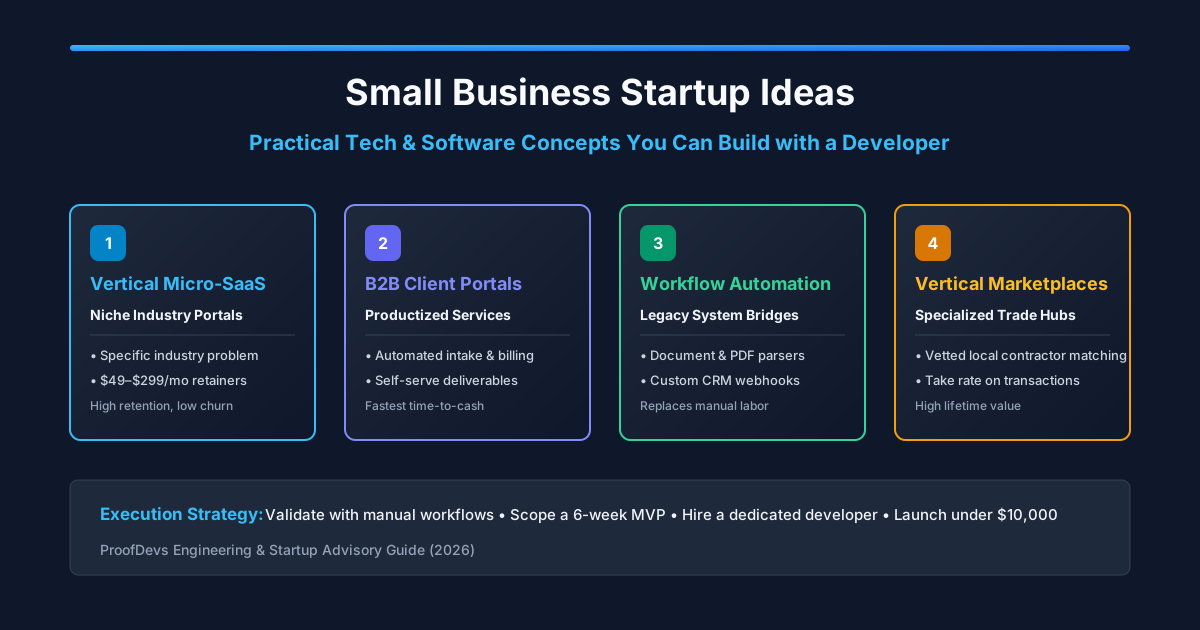
The conventional wisdom around startup ideas is fundamentally broken. Popular business media continues to celebrate venture-backed "moonshots"—consumer social networks, speculative cryptocurrency platforms, and hyper-generalized AI wrappers competing directly against trillion-dollar tech conglomerates. For an independent founder or small business entrepreneur, chasing these concepts is an almost guaranteed recipe for burning capital without acquiring a single paying customer.
The most resilient, profitable small business startup ideas in 2026 are not flashy consumer apps; they are focused, unglamorous B2B software tools that eliminate tedious, manual operations for specific business verticals. Instead of trying to reinvent the internet, successful modern founders look for fragmented industries—such as specialty trade contractors, local healthcare clinics, logistics brokers, and boutique professional services—where companies still run critical business workflows on chaotic email threads, paper clipboards, and brittle Google Sheets. By transforming one costly manual headache into a streamlined web application, a small business startup can establish a profitable, high-retention software product within months.
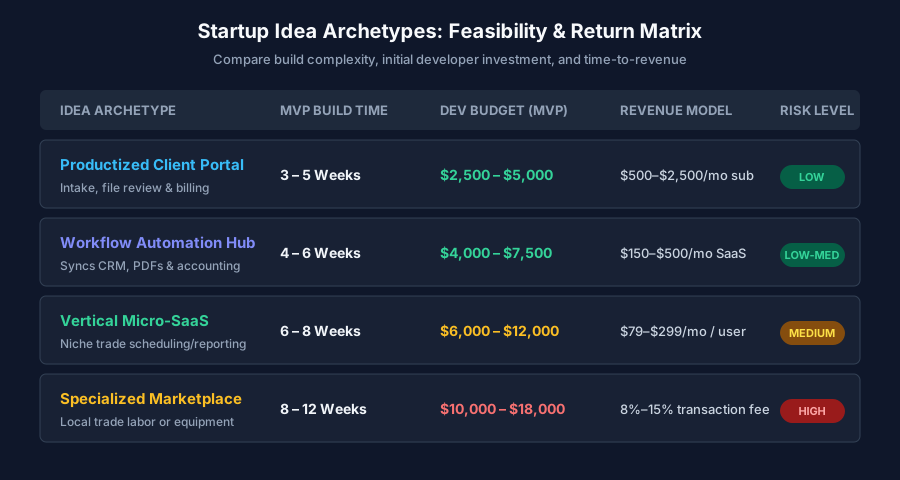
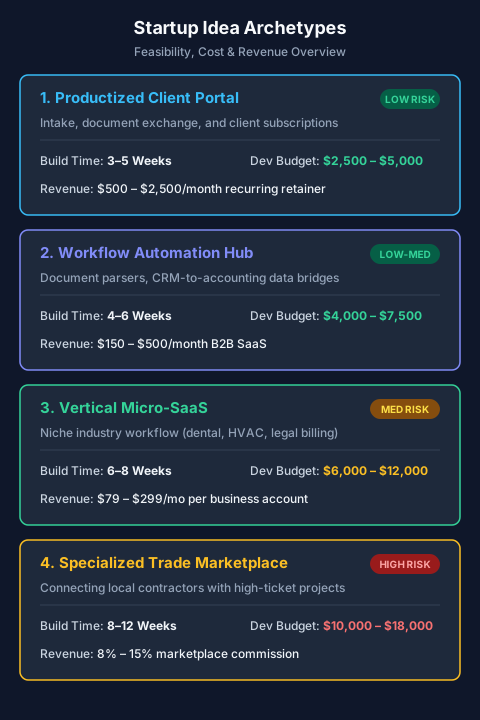
The 4-Filter Evaluation Framework: Scoring Startup Ideas Before Writing Code
Before investing a single dollar in software development or hiring an engineer, an entrepreneur must validate that a startup idea possesses strong commercial fundamentals. Every viable software concept should pass through four stringent filters:
1. High Frequency and Measurable Financial Pain
Does the target customer experience this problem on a daily or weekly cadence? If an issue arises only once per year (such as filing annual corporate tax returns), convincing a business owner to maintain a recurring software subscription is an uphill battle. Look for problems that consume at least five to ten hours of manual staff time every week or directly lead to missed customer revenue (such as delayed sales quotes or lost customer inquiries).
2. The "Spreadsheet Workaround" Litmus Test
The best proof of market demand is not verbal enthusiasm during an informal conversation; it is observing an existing, painful workaround. If a business has already built an elaborate 15-tab spreadsheet with custom formulas, Zapier connections, and manual copy-pasting to manage an internal workflow, they have already validated the commercial need. Your startup simply packages that ad-hoc workflow into an automated, multi-user web application with validation rules and error handling.
3. High Willingness to Pay (B2B over B2C)
Consumer software is notoriously brutal for bootstrapped startups: consumers demand consumer-grade design, expect free tiers, submit endless customer support tickets, and churn the moment a $9 monthly subscription renews. Conversely, small-to-medium businesses (SMBs) will gladly pay $99 to $499 per month without hesitation if the software saves two hours of administrative labor or recovers one lost customer contract. Small business B2B software delivers predictable monthly recurring revenue (MRR), lower customer churn, and much higher customer lifetime value (LTV).
4. Manageable Technical Complexity for a Solo Developer
A fatal mistake made by non-technical founders is selecting ideas that require massive infrastructure, real-time computer vision, complex machine learning training pipelines, or two-sided marketplace dynamics. For a small business startup, the optimal technical architecture is a clean CRUD (Create, Read, Update, Delete) application with role-based access control, relational database storage, third-party API integrations, and Stripe billing. A single senior full-stack developer can take this architecture from wireframes to production in four to eight weeks.
7 High-Probability Small Business Startup Ideas for 2026
The following seven startup archetypes represent proven, high-demand software categories where independent entrepreneurs and small business operators can build defensible, recurring-revenue products:
Idea 1: Niche Vertical Client Intake & Proposal Estimator
The Core Problem: Specialty contractors (roofing, commercial HVAC, solar installers, landscaping architects) spend hours visiting job sites and manually drafting quotes in Word or Excel. Customer inquiries routinely fall through the cracks because estimators fail to follow up within 24 hours.
The Software Solution: A customized, mobile-first intake and dynamic proposal generator tailored to a single industry. A contractor inputs room dimensions, material tiers, and customer details, and the platform instantly generates an itemized, branded PDF proposal with embedded electronic signature capture and a 50% deposit payment gateway via Stripe.
- Target Buyer: Independent trade contractors with 3 to 15 employees.
- Monetization Model: $129 to $249 / month per company, with an optional 1% platform transaction fee on collected deposits.
- Estimated MVP Build Time: 4 to 6 weeks.
- Realistic Developer Budget: $4,000 – $7,500.
Idea 2: B2B Productized Service Client Portal
The Core Problem: Agencies, independent consultancies, bookkeeping firms, and boutique marketing providers manage client deliverables over fragmented email threads, Slack messages, and Google Drive folders. Clients constantly ask "What is the status of my project?" and invoice tracking is separated from project approvals.
The Software Solution: A dedicated, white-label client portal built for specific service niches (such as fractional CFOs, immigration document preparers, or architectural rendering studios). It provides a secure login where clients submit structured request briefs, upload required source files, review work-in-progress revisions, approve final assets, and manage recurring retainer invoices.
- Target Buyer: Boutique agencies and solo professional service providers.
- Monetization Model: $79 to $199 / month per agency seat.
- Estimated MVP Build Time: 3 to 5 weeks.
- Realistic Developer Budget: $3,000 – $6,000.
Idea 3: Supplier Inventory & Catalog Sync Bridge
The Core Problem: Independent eCommerce retailers selling specialized products (auto parts, medical supplies, boutique apparel) source inventory from wholesale distributors that provide daily catalog updates via outdated CSV files, SFTP drops, or fragmented legacy databases. Store owners waste hours manually adjusting stock counts, resulting in out-of-stock orders and angry customers.
The Software Solution: A lightweight synchronization engine that connects supplier FTP/CSV feeds directly to Shopify or WooCommerce APIs. It automatically remaps product SKUs, adjusts real-time stock quantities every 30 minutes, applies markup pricing rules, and flags discontinued items.
- Target Buyer: Mid-sized eCommerce merchants and drop-ship retailers ($300k–$2M annual revenue).
- Monetization Model: $149 to $399 / month tiered by SKU count and sync frequency.
- Estimated MVP Build Time: 4 to 6 weeks.
- Realistic Developer Budget: $4,500 – $8,000.
Idea 4: Local Equipment & Trade Fleet Sub-Rental Exchange
The Core Problem: Heavy machinery, specialized survey equipment, commercial generators, and utility trailers sit idle in local contractor yards for weeks at a time. Concurrently, neighboring subcontractors are forced to pay exorbitant daily rates to national rental chains for short-term project spikes.
The Software Solution: A localized, verified peer-to-peer equipment sharing portal for a single metropolitan trade ecosystem. Contractors list verified equipment with availability calendars, insurance certificates, and security deposit holds. The platform handles digital rental contracts, telematics check-in, and automated payments.
- Target Buyer: Regional commercial subcontractors and specialty trade businesses.
- Monetization Model: 10% to 15% marketplace take rate on completed rental transactions.
- Estimated MVP Build Time: 8 to 10 weeks.
- Realistic Developer Budget: $8,000 – $14,000.
Idea 5: Document Compliance & Permit Processing Hub
The Core Problem: General contractors, logistics trucking operators, and food service franchises must maintain dozens of municipal permits, safety certifications, and insurance policies for subcontractors. An expired certificate of insurance (COI) can shut down an entire $500,000 construction site during an OSHA inspection.
The Software Solution: An automated compliance vault that uses optical character recognition (OCR) and structured parsing to extract expiration dates, coverage limits, and policyholder names from uploaded PDF documents. The system automatically alerts vendors 60, 30, and 7 days before expiration and provides subcontractors with a magic-link upload portal to submit renewed policies without logging into an account.
- Target Buyer: General contractors, property management companies, and logistics dispatchers.
- Monetization Model: $199 to $499 / month based on active monitored subcontractors.
- Estimated MVP Build Time: 5 to 7 weeks.
- Realistic Developer Budget: $5,500 – $9,500.
Idea 6: Automated Lead Re-Activation & SMS Dispatch Engine
The Core Problem: Local service businesses (dentists, auto repair shops, HVAC maintenance, veterinary clinics) have customer databases containing thousands of dormant past clients who haven't booked a service in 6 to 18 months. Staff members are too busy answering front-desk phones to execute outbound follow-ups.
The Software Solution: A software bridge that integrates with the business's appointment scheduling system (via API or webhook). It identifies clients overdue for seasonal maintenance or annual checkups and sends personalized, conversational two-way SMS reminders with instant calendar booking links.
- Target Buyer: Local service practices and multi-chair healthcare/wellness clinics.
- Monetization Model: $199 / month base + $0.05 per SMS message sent, or performance-based per booked appointment.
- Estimated MVP Build Time: 4 to 6 weeks.
- Realistic Developer Budget: $4,000 – $7,000.
Idea 7: Niche B2B Vendor Vetting & Review Directory
The Core Problem: Enterprise software review sites like G2 or Capterra are heavily saturated and biased toward multi-million-dollar software suites. Niche service buyers (such as clinical trial researchers looking for specialized contract research organizations, or Shopify brands seeking vetted 3PL warehouses) have no trusted, verticalized authority site to compare providers based on real operational criteria.
The Software Solution: A curated, authoritative directory that benchmarks 50 to 100 specialized service providers in a single industry. It features standardized performance metrics, verified customer case studies, and a direct request-for-proposal (RFP) matching form.
- Target Buyer: B2B service providers seeking high-intent inbound sales leads.
- Monetization Model: $500 to $1,500 / month featured placement sponsorships and qualified cost-per-lead (CPL) payouts ($100–$250 per RFP submission).
- Estimated MVP Build Time: 3 to 5 weeks.
- Realistic Developer Budget: $3,000 – $5,500.
Startup Ideas Feasibility and Economics: Summary Comparison
The table below summarizes the technical requirements, time investment, and commercial potential across these startup models:
| Idea Model | Primary Tech Stack | MVP Build Timeline | Initial Dev Budget | Target Pricing Model | Initial Break-Even Customers |
|---|---|---|---|---|---|
| Intake & Proposal Estimator | Next.js, Tailwind, Supabase, Stripe | 4 – 6 Weeks | $4,000 – $7,500 | $149 / month | 25 to 35 businesses |
| Productized Client Portal | React, Node.js, PostgreSQL, AWS S3 | 3 – 5 Weeks | $3,000 – $6,000 | $99 / month | 30 to 45 agencies |
| Inventory Sync Bridge | Node.js, Redis, Shopify API, Postgres | 4 – 6 Weeks | $4,500 – $8,000 | $199 / month | 20 to 30 merchants |
| Local Equipment Exchange | Next.js, Supabase, Stripe Connect | 8 – 10 Weeks | $8,000 – $14,000 | 12% transaction fee | $70k monthly GMV |
| Compliance & COI Vault | Next.js, Python/FastAPI, OCR API | 5 – 7 Weeks | $5,500 – $9,500 | $299 / month | 15 to 25 contractors |
| Lead Re-Activation Engine | Node.js, Twilio API, Webhooks | 4 – 6 Weeks | $4,000 – $7,000 | $199 / month | 20 to 30 clinics |
| Niche B2B Directory | Next.js, Tailwind, Postgres, Search | 3 – 5 Weeks | $3,000 – $5,500 | $500 / mo sponsor | 6 to 10 sponsors |

How to Build Your Startup Idea With an Independent Developer
Having a validated startup concept is only half the battle. Non-technical founders often freeze at the execution stage, believing they must either hire an expensive $150,000/year in-house CTO or hand their entire budget over to a traditional digital agency that charges $40,000 for a preliminary prototype. Neither approach is necessary or advisable for early-stage validation.
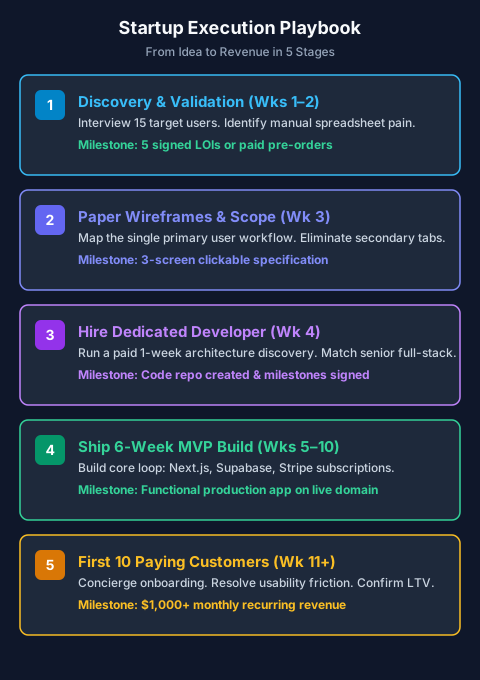
The most capital-efficient path to market is partnering directly with a vetted, independent senior software developer. To ensure a smooth, on-budget launch, follow this structured hiring and execution methodology:
Step 1: Define the Smallest Functional Scope
Do not hand a developer a 50-page specification detailing every feature your software might have three years from now. Strip the product down to its absolute core workflow—the single action that solves the customer's primary pain point. If building an intake and proposal generator, your MVP needs only three views: a lead intake form, a dynamic proposal generator, and a client signature/payment page. Eliminate secondary bells and whistles like custom theme editors, team activity logs, or multi-currency conversions. For a deep dive into disciplined scoping frameworks, read our guide on how to build an MVP for a startup.
Step 2: Match the Developer to Your Precise Architecture
Different software startup ideas require different engineering specialties. A client portal requires strong frontend UX and secure authentication; an inventory sync bridge requires deep backend experience with background queue workers, rate-limiting, and REST/GraphQL APIs. Once you have selected a concept, consult our guide on how to hire a developer for a small business or startup to determine whether you need a full-stack engineer, a website developer, or a backend specialist, and how to structure milestones that protect your project budget.
Step 3: Run a Paid Architecture Discovery First
Never sign a multi-month contract or transfer a large upfront deposit to a developer you have never worked with. Before committing to the full MVP build, commission a paid one-week discovery sprint ($500 to $1,500). During this initial engagement, the developer reviews your wireframes, drafts the database schema, recommends the hosting stack (such as Supabase, Vercel, and Stripe), and produces a line-item technical roadmap with agreed-upon delivery milestones. If the communication, code quality, or speed is lacking during discovery, you can cut ties before wasting thousands of dollars. Non-technical entrepreneurs should also review our advice on how to hire a developer as a non-technical founder.
Step 4: Insist on Continuous Deployment and Code Ownership
From day one of the project, all software must be developed in a private Git repository (GitHub or GitLab) owned by your company, with deployment pipelines pushing directly to your cloud hosting account. Require weekly live staging demos rather than waiting for a "big reveal" at the end of two months. If a previous vendor has left you with stalled or unfinished code, our codebase rescue team can audit the repository and establish clean deployment workflows before you resume development.
Step 5: Budget for Ongoing Maintenance Post-Launch
Software is not a physical product that stays finished once assembled; it requires ongoing infrastructure monitoring, security dependency patches, and error tracking. Review our analysis of website management services and monthly maintenance costs to understand realistic post-launch operating retainers ($100–$400/month) so your application remains secure and performant as users register.
5 Costly Mistakes That Kill Startup Ideas Early
Every year, thousands of promising startup concepts fail before generating any meaningful revenue. In almost every case, failure is driven by predictable, avoidable strategic blunders:
- Launching a Two-Sided Marketplace Without Pre-Seeded Supply: Marketplaces (like an equipment exchange or freelance platform) require balancing both buyers and sellers simultaneously. If a contractor logs in and finds zero machinery listed in their zip code, they will never return. If you build a marketplace, manually secure and onboard 30 to 50 active suppliers before opening the platform to buyers.
- Targeting Low-Budget Consumers With Micro-Pricing: A $5/month B2C product requires 2,000 active paying users just to generate $10,000 in monthly revenue. At typical consumer churn rates (5–10% per month), you must acquire hundreds of new customers every month just to avoid shrinkage. A $199/month B2B product requires only 50 customers to reach the exact same milestone.
- Over-Engineering Before the First Sale: Founders frequently spend months configuring microservice architectures, Kubernetes clusters, and complex caching layers for traffic they do not yet have. Build your MVP on monolithic, managed platforms (Next.js, Vercel, Supabase, PostgreSQL) that can comfortably handle 50,000 monthly visitors for under $50 in total hosting costs.
- Outsourcing to Opaque Agencies Without Code Access: Traditional web agencies frequently charge $30,000 to $60,000 for simple web apps, retain exclusive ownership of the underlying server accounts, and build on proprietary frameworks that cannot be maintained by external engineers. Review our guide on outsourcing vs hiring developers to avoid vendor lock-in.
- Failing to Verify Production Bug Fixes: When early users encounter payment bugs, login errors, or broken form submissions, they will rarely submit a polite support ticket; they will simply leave and never return. Ensure your developer sets up real-time error telemetry (such as Sentry) and an established emergency bug triage protocol during the initial release.
Frequently Asked Questions (FAQs)
What is the easiest small business startup idea to launch with a developer?
The simplest and fastest model to launch is a B2B Productized Client Portal or an Industry Intake & Proposal Estimator. These applications follow standard, proven web patterns: user authentication, document upload/storage, a form with calculation logic, PDF generation, and Stripe checkout. An experienced full-stack developer can deploy a production-grade MVP within three to five weeks for under $5,000.
How much does it cost to build a software MVP for a small business?
For a focused, well-scoped B2B web application, realistic initial development costs range between $3,000 and $10,000 when working directly with an independent senior developer on a milestone basis. High-complexity platforms featuring two-sided marketplaces or custom OCR integrations typically range from $8,000 to $16,000. Beware of agencies quoting $50,000+ for early-stage MVPs, as well as bargain developers quoting $500 who deliver unmaintainable, broken templates.
Do I need a technical co-founder to build a software startup?
No. You do not need a technical co-founder to build and validate a successful software business. What you do need is deep domain expertise in the problem you are solving, a clear functional specification, and a trusted contract developer who writes clean, documented, standard code. Once your software reaches $10,000 to $20,000 in monthly recurring revenue, you can choose to hire a full-time lead engineer or bring on a technical partner using proven revenue rather than speculative equity.
How can I validate my startup idea before spending money on code?
Execute the core service manually first. If you want to build an automated proposal generator for landscaping contractors, draft five proposals manually for local landscapers using Google Docs and spreadsheets. If they find your manual output valuable enough to pay you a fee or sign a Letter of Intent (LOI) promising to adopt the software upon launch, you have confirmed genuine demand.
What tech stack should a small business startup choose in 2026?
Stick to modern, widely adopted, open-source technologies with vast developer talent pools: Next.js (React) for the frontend and API routes, Tailwind CSS for responsive styling, Supabase (PostgreSQL) for authentication and relational database storage, and Stripe for subscriptions and invoicing. This stack provides instant serverless scalability, excellent documentation, low running costs, and makes it effortless for any new developer to take over the codebase in the future.
How long does it take from idea to the first paying customer?
With disciplined scoping, a startup should take 8 to 12 weeks from initial customer discovery to onboarding paying users: two weeks for discovery interviews, one week for wireframing and scoping, one week for developer hiring and architecture discovery, four to six weeks for software development, and two weeks for pilot onboarding and sales outreach.
How do I protect my startup idea from being stolen by a developer?
In software entrepreneurship, ideas have zero intrinsic value—value is generated through execution, distribution, and domain-specific customer relationships. However, to protect your legal interests, execute a standard Mutual Non-Disclosure Agreement (NDA) and an Independent Contractor Agreement that clearly stipulates all intellectual property, source code, and assets created belong exclusively to your company.
What if my developer abandons the project halfway through?
If you maintain administrative ownership of your Git repository and deploy weekly to your own cloud infrastructure, an abandoned project can be picked up by another developer with minimal friction. If you find yourself in this situation, our guide on what to do when a developer abandons your project outlines the immediate 48-hour recovery steps to secure your credentials and resume progress.
Should I build a mobile app (iOS/Android) or a web app first?
Always build a responsive web application first unless your core value proposition fundamentally depends on native hardware sensors (such as Bluetooth hardware pairing or background GPS logging). Web applications are significantly cheaper to build, run on all desktop and mobile browsers, bypass Apple and Google's 30% App Store fees, and allow you to deploy instant updates without waiting days for app store review approval.
How do I know if my startup idea is too small or too niche?
In the small business software space, there is almost no such thing as "too niche." A software product that serves only 400 specialty elevator repair companies paying $150/month generates $60,000 in high-margin monthly recurring revenue ($720,000 ARR). Hyper-focused vertical software enjoys higher conversion rates, virtually zero churn, and can be dominated with minimal marketing expenditure compared to broad, generic tools.
Ready to Turn Your Startup Idea Into Production Software?
Every successful software startup begins with a single, well-executed workflow. Do not let your concept languish in a notebook or get bogged down in endless agency sales pitches. Define your customer's core pain point, map out your primary wireframe, and partner with a vetted developer who can ship your MVP on time and within budget.
Whether you need to match with a verified full-stack developer for your initial MVP build, need an independent code and proposal review before signing a development contract, or require ongoing maintenance and support for an existing platform, ProofDevs connects non-technical founders with the top 5% of technical talent.
Written by Michael Melnyk
Senior IT Technical Writer & Technology Analyst
Senior Technical Writer and IT Industry Analyst with over 7 years of experience analyzing software engineering ecosystems, tech leadership models, and developer procurement frameworks.